高等教育

Search documents
2.37亿元!北京中医药大学巨资采购大批仪器
仪器信息网· 2025-08-06 03:58
Core Viewpoint - Beijing University of Chinese Medicine has announced multiple government procurement intentions for laboratory instruments, with a total budget of 237 million yuan, indicating significant investment in research and development capabilities [2][3]. Summary by Sections Procurement Overview - The procurement includes nine types of laboratory instruments, with a total budget of 237 million yuan. The expected procurement period is from April to August 2025 [3][8]. Instrument Descriptions - **Nano Structure Scanning Transmission Electron Microscope**: An advanced tool for observing and analyzing material structures at the nanoscale [4]. - **Differential Scanning Calorimeter**: A thermal analysis instrument that measures heat flow differences to analyze material properties [5]. - **Electric Turbidity Meter**: An automated instrument for measuring the concentration of particles in liquids based on light scattering principles [6]. Detailed Procurement List - The procurement list includes various instruments such as: - Multi-functional enzyme labeler - Rapid component analysis system for traditional Chinese medicine - Nano structure scanning transmission electron microscope - Differential scanning calorimeter - Molecular interaction and active component fishing system for traditional Chinese medicine - Active ingredient purification system for traditional Chinese medicine - Kjeldahl nitrogen analyzer - Mass spectrometry imaging system - Drug analysis system - Sample processing system [3][10][12]. Specific Projects - **High-fidelity Human Engineering Platform**: Plans to procure office furniture and laboratory equipment to support educational and research tasks [7]. - **Traditional Chinese Medicine Constitution and Chronic Disease Prevention Innovation Service Platform**: Aimed at enhancing research capabilities, with a focus on essential equipment for life sciences [10][11]. - **Clinical Research Equipment for Traditional Chinese Medicine**: Includes a wide range of advanced medical and research instruments to support clinical studies and training [13]. Additional Equipment - The procurement also includes various small instruments for educational purposes, such as automatic titrators, UV spectrophotometers, and various training models for medical education [12][13].

预算9303万元!东北大学近期大批仪器采购意向
仪器信息网· 2025-08-06 03:58
Core Viewpoint - Northeast University has announced multiple government procurement intentions related to large scientific instruments, with a total budget of 93.03 million yuan for 23 items, expected to be procured between June and September 2025 [1][2]. Summary by Relevant Sections Procurement Overview - The procurement includes various advanced instruments such as deep well low heat early high-strength filling body forming modules, non-oxidizing environment construction devices for casting and rolling processes, chemical adsorption and mass spectrometry instruments, and electron backscatter diffraction instruments [2][4]. - The total budget for these instruments is 93.03 million yuan, with procurement expected to occur from June to September 2025 [1][2]. Instrument Details - **Electron Backscatter Diffraction (EBSD) Instrument**: A precision analysis tool used in materials science for microstructural analysis, detecting electron beam interactions with crystal samples to analyze features like phase distribution and grain orientation [2][5]. - **High Concentration Tailings Slurry Preparation Module**: Budgeted at 1.85 million yuan, this module focuses on efficient stabilization of tailings [4]. - **Deep Well Low Heat Early High-Strength Filling Body Forming Module**: Budgeted at 3.4 million yuan, it monitors the solidification process of filling bodies [4]. - **Aluminum Alloy Casting Process Equipment**: Includes several key devices for the industrialization of thin strip casting, addressing domestic equipment gaps [5][6]. Additional Instrument Specifications - **Chemical Adsorption and Mass Spectrometry Instrument**: Budgeted at 1.95 million yuan, it combines dynamic analysis techniques to reveal material surface characteristics [5][6]. - **Standardized Aseptic Operation System**: Aimed at providing a sterile environment for biological engineering labs, with a budget of 1 million yuan [5][6]. - **Artificial Intelligence and Smart Manufacturing Training Platform**: A comprehensive platform for training in smart manufacturing, budgeted at 1.555 million yuan [6]. Procurement Timeline - The expected procurement timeline for these instruments is set between June and September 2025, indicating a strategic planning phase for the university's research capabilities [1][2].

大连理工大学:“AI评委”重塑学生素质评价体系
Ke Ji Ri Bao· 2025-08-05 23:45
"在峰岚杯文艺大赛中,我作为主演,用话剧展现科研人员探索真理的过程……"近日,在大连理工大学 计算机教室,未来技术学院2024级学生苑景琪对着屏幕中的数字人评委,讲述自己一年来的成长经历。 她所使用的是学院学生创业团队自主研发的AI人机问答评价系统,用于学生综合素质评价答辩环节。 在答辩过程中,系统先对学生上传材料的内容逻辑与表达结构进行分析,再通过语音识别技术迅速捕捉 陈述信息,随后基于学院育人理念和教师形象训练而成的高度仿真数字人评委,针对陈述的关键点发起 追问。 (文章来源:科技日报) 支撑该系统底层运行逻辑的,是学院研制的学生综合评价指标体系。该体系以学生成长为中心,将培养 目标细化为"八大核心维度",涵盖政治素养、科技创新、文体素养、领军能力等400余项指标。学院党 委副书记孙智妍表示:"学生综合素质评价改革的核心在于'以评促长',聚焦创新思维、领导力、社会 责任感等关键能力,引导学生在学习和实践中不断突破。" 该体系采用"客观+主观"双维评价模式。客观评价涵盖基础能力、创新能力和多元素质三大模块;主观 评价依托AI人机问答系统进行成长答辩。系统通过智能分析生成指标分析报告、能力雷达图和个人发 展画 ...
洋名校“搬”进印度,能留住学生的心吗?
Huan Qiu Shi Bao· 2025-08-05 22:42
印度教育部长达尔门德拉·普拉丹近日向4所外国高校颁发了在印设校的意向书,分别是澳大利亚的西悉 尼大学、维多利亚大学和拉筹伯大学,以及英国布里斯托大学。就在几天前,普拉丹刚刚为英国南安普 顿大学设在新德里郊外古尔冈的印度校区揭幕,这是印度首个正式运营的外国大学校区。他表示,预计 在当前学年内,最多将有15所海外高校在印度设立分校。这一举措基于印度2022年宣布的政策转变,首 次允许全球排名靠前的高校在印度设立独立校区。这与以往仅限于合作办学或"双联课程"的政策相比, 是重大突破。 不过,外籍大学的布局目前主要集中在班加罗尔、德里首都圈和孟买等大城市,乔杜里认为这将限制其 影响范围,"现实更有可能发生的情况是,有抱负的学生会离开家乡"。 乔杜里表示,设立外国高校并不一定能阻止学生出国留学。"很多印度学生选择出国,主要是为了移 民。"因此,未来可能出现一些学生在印度境内分校完成部分学业,之后再转至国外完成学位的趋势。 乔杜里还建议,关于外国大学入驻印度的讨论应更多聚焦于它们如何为印度经济和社会发展做出贡献。 (作者比曼·穆克吉,朱迪译) 教育格局的变化预计将降低学生的留学成本,再加上海外签证不确定性上升、就业机会减 ...
教育高质量发展扎实推进
Jing Ji Ri Bao· 2025-08-05 22:11
Group 1: Education System Development - Since the 18th National Congress, China has built the world's largest education system, achieving a historic leap in education popularization, with a higher education gross enrollment rate exceeding 60% [1] - In 2024, the nine-year compulsory education consolidation rate is projected to be 95.9%, and the gross enrollment rate for high school is expected to reach 92.0%, placing China's basic education level in the upper-middle tier globally [2] Group 2: Quality Education and Technology Integration - The establishment of quality high schools in rural areas has stabilized student sources and improved the quality of education in townships, with Nantong having 20 township high schools, 16 of which are four-star rated [2] - The integration of technology in education is evident with over 1,200 digital twin schools established in Ningxia, connecting rural schools with urban quality schools through online platforms [3] Group 3: Vocational Education and Workforce Development - Over 70% of new frontline workers in modern manufacturing and strategic emerging industries come from vocational schools, highlighting the importance of vocational education in building a skilled workforce [4] - As of 2023, China has 11,133 vocational schools with nearly 35 million students, forming the world's largest vocational education system, producing approximately 10 million skilled workers annually [4] Group 4: Higher Education and Innovation - In 2024, the total enrollment in various forms of higher education in China is 48.46 million, with 20.86 million in undergraduate programs and 4.10 million in graduate programs, indicating a robust higher education landscape [6] - Top universities are innovating in talent cultivation and research, with initiatives like Tsinghua University's interdisciplinary laboratories and Fudan University's project-based talent training model [7]
北京拟新增4所推免资格高校,北京电子科技学院等在列
Xin Jing Bao· 2025-08-05 10:00
新京报讯(记者杨菲菲)8月4日,北京市教委官网发布了北京市2025年新增推免资格高校拟推荐名单, 包括北京电子科技学院、北京联合大学、北京物资学院、北京第二外国语学院4所高校。北京市教委表 示,公示期为8月4日至8月8日,公示期内,如对公示结果有异议,可向北京市教育委员会高等教育处书 面提出。以单位名义反映的应加盖公章,以个人名义反映的应签署真实姓名、身份证号和联系电话。 北京第二外国语学院是由文化和旅游部与北京市人民政府共建的高水平特色大学,是一所以外语为主 体、旅游为特色,多学科协同发展的著名高校,是中国外语、翻译、旅游、经贸等人才培养与研究的重 要基地。现设英语学院、日语学院、亚洲学院等16个教学单位,本科专业48个(其中有31个语种专 业)、硕士学位一级学科授权点6个、硕士学位二级学科授权点30个、专业硕士学位授权点7个、联合培 养博士点1个(与"丝绸之路"国际旅游与文化遗产大学联合培养博士)、博士后科研工作站2个(分别与 社会科学文献出版社、首都经济贸易大学联合共建)。 据统计,截至目前,全国已有66所高校获得各省公示拟新增推免资格。这也是自2017年以来教育部时隔 八年再次启动推免资格高校增选工作 ...
气候变化导致亚南极赫德岛近四分之一冰川融化
Xin Hua She· 2025-08-04 09:55
赫德岛是澳大利亚海外领地赫德岛和麦克唐纳群岛的组成部分,位于珀斯西南约4100公里处。该岛面积 368平方公里,岛上无人居住。赫德岛和麦克唐纳群岛于1997年被列入联合国教科文组织世界遗产名 录。作为亚南极地区唯一的活火山群岛,这里具有特殊的冰川地貌。(完) 莫纳什大学研究人员日前在欧洲学术期刊《冰冻圈》上发表论文说,他们使用1947年以来的地形图以及 当前卫星图像等数据,分析了赫德岛29处冰川在1947年、1988年和2019年的轮廓、面积等特征。结果发 现,自1947年以来,赫德岛有大约64平方公里冰川已经融化消失,约占该岛原本冰川总量的23.1%。 研究人员计划今年晚些时候访问赫德岛,进一步研究冰川退缩会如何威胁当地生物多样性。莫纳什大学 地球、大气与环境学院院长安德鲁·麦金托什说,目前的测绘显示冰川正在显著退缩,未来冰川会否消 失,取决于人们如何排放温室气体。 新华社悉尼8月4日电(记者梁有昶 章建华)澳大利亚莫纳什大学4日发布新闻公报说,该校研究人员 发现,自1947年以来位于亚南极地区的赫德岛已有近四分之一冰川融化,表明该岛受到气候变化的深刻 影响。 ...
饮水思源,爱国荣校!上海交大这样回答“钱学森之问”
Ren Min Ri Bao· 2025-08-04 05:48
Group 1 - Shanghai Jiao Tong University (SJTU) collaborates with Huawei to address "bottleneck" technology issues through joint training programs and high-level mentorship [1] - The partnership aims to enhance talent cultivation and contribute to national and industry needs [1] - SJTU emphasizes the importance of moral education and innovative talent training models to nurture responsible individuals for national rejuvenation [1] Group 2 - The Qian Xuesen Library at SJTU serves as a venue for promoting patriotism and scientific spirit among students [2] - The library hosts various educational activities, including lectures and practical courses, to inspire students with the legacy of Qian Xuesen [2] - SJTU integrates ideological education with practical experiences to instill a sense of mission and value in students [2] Group 3 - SJTU's Innovation Center provides a comprehensive environment for students to develop innovative skills through hands-on projects and industry collaboration [4] - The center offers courses that emphasize the integration of education and industry, updating 15% of its curriculum annually to align with technological advancements [5] - The focus is on cultivating talents with both deep academic knowledge and practical industry insights [4][5] Group 4 - SJTU is implementing a new talent cultivation plan aimed at fostering innovative leaders through interdisciplinary approaches [5] - The university is enhancing its educational framework to support lifelong learning and adaptability in students [5] - A closed-loop system is being developed to ensure a continuous growth path for students from undergraduate to postgraduate levels [5] Group 5 - SJTU's leadership emphasizes the need for education to support China's modernization and strategic positioning in global competition [6] - The university is committed to optimizing its academic structure to meet national demands for high-level talent [6] - A focus on personalized education is being adopted to ensure that each student receives suitable guidance [6] Group 6 - SJTU is enhancing its faculty development by integrating teaching excellence with research achievements [7] - The university is prioritizing undergraduate education in faculty evaluations and recruitment processes [9] - This approach aims to boost teaching quality and foster a more engaging learning environment for students [9]
1.21亿元!北京航空航天大学采购大批仪器
仪器信息网· 2025-08-04 03:58
Core Viewpoint - Beijing University of Aeronautics and Astronautics has announced procurement intentions for 10 types of instruments and equipment, with a total budget of 121 million yuan, expected to be procured between July and August 2025 [2][3]. Summary by Relevant Sections Procurement Overview - The procurement includes advanced instruments such as the Micro X-ray Phase Contrast CT 3D Imaging Analyzer, which is crucial for high-resolution imaging of internal structures, particularly for low atomic number materials [2][5]. - The total budget for the procurement is 121 million yuan, indicating significant investment in advanced technology [2]. Instrument Details - The Micro X-ray Phase Contrast CT 3D Imaging Analyzer is highlighted as a cutting-edge device that enhances imaging capabilities for materials like biological tissues and polymers, which are essential in aerospace applications [2][5]. - Other items in the procurement list include components for large planar wave synthetic aperture power distribution networks, with specific quantities and delivery deadlines outlined [5][6]. Urgency and Market Need - There is an urgent need for these technologies domestically, as similar equipment is not currently available in China, necessitating imports to meet the demands of the aerospace sector [3][6].

今年,东莞经济何以挑大梁?高技术产业增长显著|东莞一周
Nan Fang Du Shi Bao· 2025-08-03 14:13
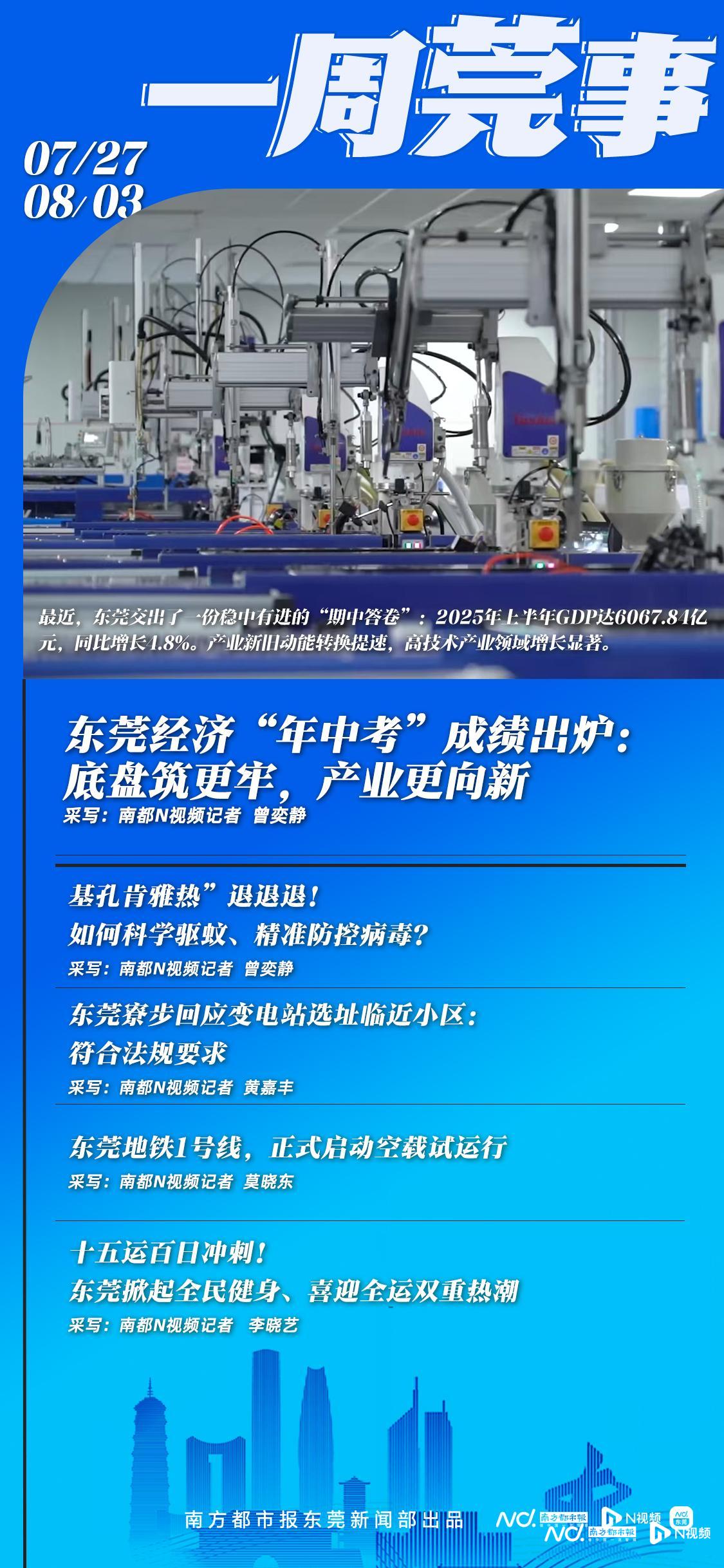
Economic Performance - Dongguan's GDP for the first half of 2025 reached 606.78 billion yuan, with a year-on-year growth of 4.8% [5] - The total import and export value in the first half of the year was 749.28 billion yuan, marking a year-on-year increase of 16.5%, leading among major foreign trade cities in Guangdong [5] - The acceleration of the transformation of old and new economic drivers is evident, particularly in high-tech industries [5] Public Health - Guangdong reported 2,940 new local cases of Chikungunya fever, with 3 cases in Dongguan [6] - Public health measures include wearing long sleeves and pants, and following the "three prevention" principles: eliminate standing water, kill mosquitoes, and prevent bites [6] Sports and Community Engagement - Dongguan launched a series of events to welcome the 15th National Games, emphasizing community fitness and engagement [3][7] - The event aims to integrate sports with consumption, culture, tourism, and intelligent manufacturing [7] Transportation Infrastructure - The Dongguan Metro Line 1 has officially started its empty test run, with plans for high-quality opening within the year [9] - The line will facilitate transfers with Line 2 and intercity lines, enhancing public transportation convenience [9] Environmental Management - The Dongguan Ecological Environment Bureau released environmental reports indicating that total phosphorus and ammonia nitrogen levels in the Songmushan Reservoir exceeded standards [18] - Air quality in the high-tech zone showed an improvement, with a good rate of 91.9%, up 0.3% from the previous year [18]