氢能

Search documents
北京就可再生能源开发利用进行意见征集,聚焦光伏、氢能和京津冀协同
Zheng Quan Shi Bao Wang· 2025-08-18 09:36
Core Viewpoint - Beijing is implementing a comprehensive plan to promote renewable energy development and utilization, aiming for a green and low-carbon economic transformation in the city [1][2][3] Group 1: Renewable Energy Development - The plan includes integrating renewable energy development into national economic and social development planning, establishing a target assessment mechanism, and promoting collaboration across various sectors [1] - There is a focus on increasing the installed capacity of renewable energy generation, particularly in solar and wind energy, and utilizing abandoned mining sites for concentrated photovoltaic and wind power applications [1] Group 2: Hydrogen Energy Support - The plan emphasizes the development of hydrogen energy infrastructure and applications, aiming to create a comprehensive hydrogen infrastructure network covering Beijing and the surrounding regions [1][2] - It includes initiatives for local hydrogen production, construction of hydrogen refueling stations, and exploration of hydrogen pipeline feasibility within the Beijing-Tianjin-Hebei region [2] Group 3: Green Power and Sustainability - The plan aims to ensure that new and expanded data centers achieve over 80% green power usage by 2025, with a target of 100% by 2030 [2] - It encourages leading enterprises and foreign companies to develop green supply chains and promote green charging stations for electric vehicles [2] Group 4: Financial and Policy Support - The Beijing Development and Reform Commission plans to enhance financial support policies to guide financial institutions in backing renewable energy projects and companies [3] - There will be improvements in renewable energy statistical systems to strengthen the foundational data for renewable energy development [3]
氢能商用车领域惊现350辆大单!
第一商用车网· 2025-08-18 06:58
Core Viewpoint - The strategic cooperation between Yihuatong and Pengfei Group aims to advance hydrogen fuel cell technology and its large-scale application, marking a significant step towards commercializing the hydrogen energy industry in Lvliang [1][3]. Group 1: Strategic Cooperation - Yihuatong and Pengfei Group signed a strategic cooperation agreement on August 8, focusing on hydrogen fuel cell technology development and large-scale application [1]. - The partnership is expected to promote resource sharing and complementary advantages, driving high-quality development of the hydrogen energy industry in Lvliang [1][4]. Group 2: Resource and Infrastructure - Lvliang has a unique advantage with its "resource + scenario" dual engine, including an annual coking capacity of 18.67 million tons in Xiaoyi City, which can produce 4.4 billion cubic meters of coke oven gas, yielding 200,000 tons of low-cost hydrogen [3]. - Pengfei Group has established a complete "hydrogen production-storage-transportation-application" chain, with a logistics network of 70,000 heavy trucks to support the large-scale deployment of hydrogen vehicles [3]. Group 3: Initial Procurement and Application - The initial phase of the cooperation includes the procurement of 100 hydrogen fuel cell heavy trucks and 250 hydrogen fuel cell logistics vehicles, with heavy trucks designated for coking raw material transportation and light trucks for urban cold chain logistics [3][4]. - Yihuatong will provide core technology for the fuel cell systems, while Pengfei Group will build a cluster of hydrogen refueling stations and a digital operation platform to validate the economic viability and reliability of hydrogen vehicles [3][4]. Group 4: Future Development Plans - Yihuatong aims to integrate the three key elements of "coking hydrogen source - heavy truck manufacturing - logistics finance" to create a replicable "Lvliang model" for hydrogen energy development across the country [4].


北京:拟推进氢能基础设施建设及多领域应用 加力推进市域内氢燃料汽车扩容增量
Mei Ri Jing Ji Xin Wen· 2025-08-18 06:53
Core Viewpoint - The draft implementation plan for the "Beijing Renewable Energy Development and Utilization Regulations" emphasizes the promotion of hydrogen energy infrastructure and its applications across multiple sectors [1] Group 1: Hydrogen Infrastructure Development - The plan aims to establish a hydrogen energy infrastructure network covering the entire city and extending to the Beijing-Tianjin-Hebei region [1] - It proposes diversified local hydrogen production pilot projects and the construction of integrated hydrogen production and refueling stations [1] - The effective utilization of the local industrial by-product hydrogen purification project from Yanshan Petrochemical is highlighted [1] Group 2: Green Hydrogen Initiatives - The plan includes the active planning of green hydrogen transportation pipelines and the construction of transportation channels for the green hydrogen project in Ulanqab, Inner Mongolia [1] - It explores the feasibility of hydrogen pipeline construction within the Beijing-Tianjin-Hebei region [1] Group 3: Hydrogen Fuel Applications - The plan focuses on the development needs of vehicles and application scenarios, aiming to optimize hydrogen refueling facilities within the city [1] - It emphasizes the expansion of hydrogen fuel vehicles, improving vehicle utilization rates and operational mileage [1] - Pilot projects for hydrogen bicycles and the exploration of hydrogen drone applications are included, along with the promotion of hydrogen technology and equipment research in the aviation sector [1] Group 4: Regional Hydrogen Transport Corridors - The plan accelerates the creation of hydrogen transport corridors across the Beijing-Tianjin-Hebei region and surrounding areas [1] - It aims to layout hydrogen refueling stations along these transport corridors [1] Group 5: Integrated Energy Systems - The plan advocates for the localized layout of hydrogen-based combined heat and power systems [1] - It promotes demonstration projects for comprehensive energy utilization centered around hydrogen and zero-carbon heating [1]
重庆:拟适度超前规划加氢站 积极拓展可再生能源制氢
Zheng Quan Shi Bao Wang· 2025-08-18 06:49
Core Viewpoint - The Chongqing Municipal Hydrogen Station Industry Development Plan (2025-2035) draft emphasizes the need for a systematic approach to hydrogen station planning and construction, focusing on regional coordination and resource optimization [1] Group 1: Planning and Infrastructure - The plan suggests a proactive approach to hydrogen station planning, ensuring alignment with urbanization and regional needs [1] - It advocates for the construction of hydrogen storage and transportation facilities, utilizing industrial by-product hydrogen and expanding renewable energy hydrogen production [1] - The overall layout of hydrogen stations should be adapted to demand distribution, road station conditions, and urbanization patterns [1] Group 2: Technology and Development - The plan highlights the importance of overcoming key technological challenges, particularly in integrated hydrogen production and high-pressure storage and transportation [1] - It supports the renovation and expansion of existing gas stations and comprehensive energy service stations to accommodate hydrogen stations [1]
国富氢能涨超5% 近日与BPHB达成合作签约 聚焦东南亚首座10吨/天液氢示范项目落地
Zhi Tong Cai Jing· 2025-08-18 06:34
Core Viewpoint - Guofu Hydrogen Energy (02582) has seen a stock increase of over 5%, currently trading at 67.2 HKD with a transaction volume of 47.5869 million HKD, following its participation in a significant energy transition event in Sarawak [1] Group 1: Company Developments - Guofu Hydrogen Energy is the only Chinese company among three international firms to sign a cooperation memorandum with BPHB during the Sarawak Energy Transition Policy launch event [1] - The collaboration focuses on an integrated "Port + Hydrogen" model, with an initial project aimed at establishing Southeast Asia's first 10 tons/day liquid hydrogen demonstration project [1] - The project will leverage BPHB's deep-water port and logistics hub to plan for integrated facilities for liquid hydrogen production, storage, and export, prioritizing local hydrogen demand in Sarawak [1] Group 2: Industry Context - The initiative aims to create a regional hub for green energy and sustainable fuels in Sarawak, aligning with global trends towards renewable energy solutions [1] - The project emphasizes the integration of Sarawak's abundant hydropower and solar resources to provide a low-carbon hydrogen solution through a "green electricity to green hydrogen" closed-loop system [1]
港股异动 | 国富氢能(02582)涨超5% 近日与BPHB达成合作签约 聚焦东南亚首座10吨/天液氢示范项目落地
智通财经网· 2025-08-18 06:33
Core Viewpoint - Guofu Hydrogen Energy (02582) has seen a stock price increase of over 5%, currently trading at 67.2 HKD, with a transaction volume of 47.5869 million HKD, following its participation in a significant energy transition event in Sarawak [1] Group 1: Company Developments - Guofu Hydrogen Energy is the only Chinese company among three international firms to sign a cooperation memorandum with BPHB during the Sarawak Energy Transition Policy launch event [1] - The collaboration focuses on an integrated "Port + Hydrogen" model, with the first phase targeting the establishment of a 10 tons/day liquid hydrogen demonstration project in Southeast Asia [1] Group 2: Project Details - The project will leverage BPHB's deep-water port and logistics hub to plan for integrated facilities for liquid hydrogen production, storage, and export, prioritizing local transportation and industrial high-purity hydrogen needs [1] - The initiative aims to explore export opportunities for surplus production while integrating Sarawak's abundant hydropower and solar resources to provide a low-carbon hydrogen solution through a "green electricity to green hydrogen" closed-loop system [1]
CINNO Research:2025上半年中国新能源项目投资总额约1.4万亿元 智能电网等领域保持较高热度
智通财经网· 2025-08-18 05:45
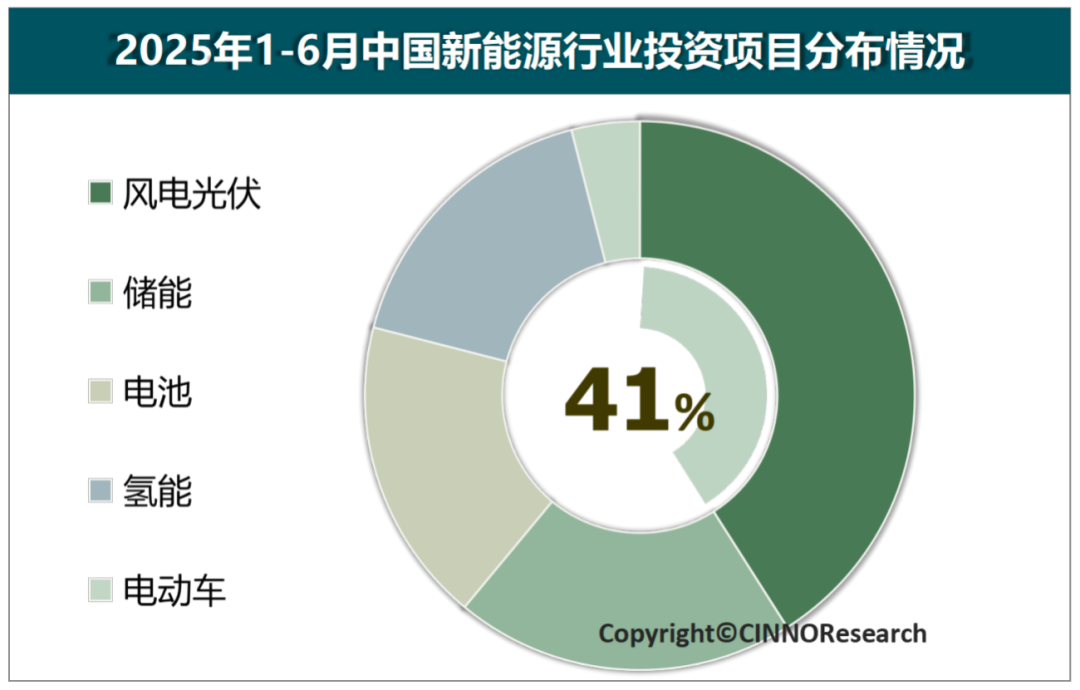
Core Insights - The Chinese renewable energy sector is expected to maintain strong investment momentum in the first half of 2025, with total investment projected at approximately 1.4 trillion RMB, despite a year-on-year decline of 32.2% [1] Investment Trends - The investment landscape in the renewable energy sector shows a mixed trend, with significant growth in energy storage while traditional wind and solar investments are declining [2] - Wind and solar energy investments totaled 560.4 billion RMB, accounting for 40.8% of the sector, but experienced a year-on-year decrease of 44.4% [2] - Energy storage emerged as a highlight with an investment of 279.9 billion RMB, reflecting a 10.5% year-on-year increase and a share of 20.3% [2] - Investments in the battery sector and hydrogen energy saw declines of 25.8% and 40.2%, respectively, indicating a shift of capital towards more promising growth areas [2] Sector-Specific Insights - In the wind and solar sectors, solar investments reached 195 billion RMB, with 91.8 billion RMB directed towards solar power station projects, representing 47.1% of total solar investment [3] - Wind energy investments were highly concentrated, with 352.4 billion RMB in operational projects making up 96.4% of total wind investment [3] - In the battery sector, 124.2 billion RMB was invested in cell manufacturing, accounting for 51.1% of total battery investment [3] Energy Storage Dynamics - Within the energy storage sector, pumped storage dominated with an investment of 148.2 billion RMB, representing 52.9% of total energy storage investment [4] - Investment in new energy storage technologies is steadily increasing, reflecting a focus on innovation [4] Overall Industry Transition - The investment pattern indicates a transition from rapid expansion to high-quality development in the renewable energy sector, with capital increasingly focused on core areas with technological barriers and scale advantages [5]

安徽首张,明天氢能船用燃电系统获中国船级社型式认可
势银能链· 2025-08-18 04:03
Core Viewpoint - The hydrogen energy shipping industry is gaining momentum as a solution to reduce carbon emissions from vessels, with significant advancements in fuel cell technology and government support for green development initiatives [3][4][6]. Group 1: Industry Overview - The annual carbon emissions from various types of vessels reach 1.12 billion tons, accounting for 4.5% of global CO2 emissions. In China, over 110,000 inland cargo and passenger ships predominantly use diesel, leading to severe pollution and a pressing need for clean energy alternatives [3]. - Hydrogen-powered vessels are recognized for their zero carbon emissions, high energy conversion efficiency, modular design, low operational noise, and reduced maintenance costs, making them a primary focus for research and industrialization in the new energy shipping sector [3]. Group 2: Government Initiatives - The "Hydrogen Industry Development Medium- and Long-Term Plan (2021-2035)" encourages the exploration of fuel cell applications in shipping and aviation. In 2023, a joint action plan for the green development of the shipbuilding industry was issued, promoting the development of new power ship types, including fuel cells, to create standardized and series-produced green vessels [3]. Group 3: Technological Advancements - The MTSYS-120 fuel cell system and MTMOD-150 fuel cell stack, developed by Tomorrow Hydrogen Company, have received type approval from the China Classification Society (CCS), allowing their use in domestic maritime and inland vessels. This marks the first CCS type approval certificate for hydrogen fuel cells in Anhui Province [3][6]. - The fuel cell system features a power output greater than 150 kW, a power density of 6.5 kW/L, and a lifespan exceeding 22,000 hours. It is modular, allowing for flexible integration into vessels with varying power requirements, and can be expanded to megawatt-level outputs [6].

绿氢五大奖项首批入围名单 | 2025势银绿氢产业大会(GHIC 2025)
势银能链· 2025-08-18 04:03
Core Viewpoint - The article highlights the upcoming 2025 TrendBank Green Hydrogen Industry Conference scheduled for August 27-28 in Wuxi, Jiangsu, focusing on the development and future outlook of the green hydrogen market in the first half of the year [2][3]. Group 1: Conference Details - The conference will take place at the New Lake Pullman Hotel in Wuxi, Jiangsu Province [2]. - TrendBank will summarize the green hydrogen market's development in H1 and discuss strategies for scaling up the industry [2]. - Attendees must register using their personal mobile numbers to access the event and related materials [3]. Group 2: Awards and Nominees - TrendBank will present awards to companies that have significantly contributed to the advancement of China's green hydrogen industry [3]. - The first batch of nominees for the 2025 Green Hydrogen Market Leadership Award includes companies such as Hubei Yingte Electric Co., Ltd. and Jiangsu Hydrogen Guide Intelligent Equipment Co., Ltd. [5]. - Nominees for the 2025 Green Hydrogen Industry Pioneer Award feature companies like Wuxi Tianrong New Energy Technology Co., Ltd. and Jiangsu Shuangliang Hydrogen Energy Technology Co., Ltd. [6]. - The 2025 Green Hydrogen Technology Breakthrough Award nominees include companies such as Anhui Masu Water New Energy Technology Co., Ltd. and Shenzhen Furu Electric Co., Ltd. [7]. - The 2025 Green Hydrogen Application Demonstration Award nominees include companies like State Power Investment Corporation Hydrogen Energy Technology Development Co., Ltd. and Shanghai Hydrogen Era Technology Co., Ltd. [9].
2025年上半年中国新能源产业投资金额1.4万亿元,同比下降32.2%
CINNO Research· 2025-08-18 03:55
Core Viewpoint - The investment in China's new energy projects in the first half of 2025 is approximately 1.4 trillion RMB, reflecting a year-on-year decrease of 32.2%, yet it remains one of the most dynamic investment directions in the technology sector, particularly in next-generation battery technology and smart grid areas [1][2]. Investment Trends - The investment landscape in the new energy sector shows a trend of "one rise and multiple declines" in the first half of 2025. Wind and solar power, traditional strongholds, accounted for 5,604 billion RMB, representing 40.8% of the industry share, but saw a year-on-year decline of 44.4%. Wind power investment reached 3,654 billion RMB, while solar power investment was 1,950 billion RMB, indicating a saturation in the market [4]. - The energy storage sector emerged as a highlight with an investment of 2,799 billion RMB, achieving a year-on-year growth of 10.5%, increasing its share to 20.3%. This growth is attributed to breakthroughs in new energy storage technologies and a surge in demand for grid-side storage [4]. - Investments in the battery sector totaled 2,430 billion RMB (17.7% share) and hydrogen energy investments were 2,304 billion RMB (16.8% share), both experiencing declines of 25.8% and 40.2% respectively, indicating a shift of capital towards areas with greater growth potential [4]. Sector Characteristics - In the wind and solar sectors, solar power investment totaled 1,950 billion RMB, with solar power station projects receiving 918 billion RMB, accounting for 47.1%, highlighting the focus on large-scale centralized power stations. Wind power investment was highly concentrated, with 3,524 billion RMB in operational projects making up 96.4% of total wind investment [5]. - In the battery sector, 2,430 billion RMB was invested, with the cell manufacturing segment receiving 1,242 billion RMB, representing 51.1%, indicating continued capital interest in core manufacturing as new battery technologies advance [5]. - In the energy storage sector, 2,799 billion RMB was invested, with pumped storage accounting for 1,482 billion RMB (52.9%), maintaining its dominant position, while investments in new energy storage technologies are steadily increasing [5]. Regional Distribution - The investment in new energy in the first half of 2025 exhibited significant regional concentration, with Inner Mongolia and Xinjiang leading at 15.1% and 11.7% respectively, contributing to a total of 42.9% of the industry’s total investment when combined with provinces like Sichuan, Jiangsu, and Fujian [8]. - This distribution pattern is closely related to local resource endowments and policy support, with Inner Mongolia leveraging its abundant wind and solar resources, and Xinjiang attracting substantial investment due to its energy transition demonstration zone [8]. Future Outlook - The new energy industry in China is expected to enter a new phase of high-quality development in 2025, driven by policy support and technological innovation. The installed capacity for wind and solar power has surpassed 1.4 billion kilowatts, and the penetration rate of the new energy vehicle market is projected to exceed 60% [9]. - The development of new power systems is accelerating, with large-scale integration projects for source, grid, load, and storage being promoted, significantly enhancing the capacity for renewable energy consumption [9].