
制鞋

Search documents
瑞银:裕元集团次季盈利胜预期 升目标价至16港元
Zhi Tong Cai Jing· 2025-08-12 09:37
Core Viewpoint - UBS reports that Yue Yuen Industrial Holdings Limited (00551) experienced a 1% year-on-year increase in revenue and a 13% increase in net profit for the second quarter, with revenue meeting expectations and net profit exceeding expectations by 19% due to a lower tax rate and gains from financial instruments [1] Financial Performance - Revenue for the second quarter grew by 1% year-on-year, aligning with market expectations [1] - Net profit increased by 13% year-on-year, surpassing expectations by 19% due to favorable tax rates and financial instrument gains [1] Product Pricing - Average selling prices rose by 2.5% in the first quarter and 3.9% in the second quarter year-on-year [1] - UBS forecasts a low single-digit percentage increase in average selling prices for the entire year, accounting for the impact of tariff policies [1] Target Price Adjustment - UBS raised the target price for Yue Yuen from HKD 14 to HKD 16, reflecting higher order growth expectations for the next year [1] - The rating for Yue Yuen is maintained at "Buy" [1]
青岛市市场监督管理局公布老人鞋产品抽查结果
Zhong Guo Zhi Liang Xin Wen Wang· 2025-08-12 08:16
Summary of Key Points - The Qingdao Municipal Market Supervision Administration recently announced the results of a special quality supervision inspection for online sales of elderly shoes in 2025, revealing that all four batches tested were compliant with quality standards [2][3] - The inspection covered various products, including breathable and lightweight shoes designed for elderly individuals, confirming their adherence to quality requirements [3] - The inspection results indicate a positive trend in the quality of elderly footwear products available in the market, reflecting the effectiveness of regulatory oversight [2][3]

裕元集团半年报:制造业务增长8.3%,零售板块承压,股东溢利下降7.2%至1.71亿美元
Jin Rong Jie· 2025-08-12 06:13
Core Insights - The article highlights the mixed performance of Yue Yuen Industrial Holdings Limited, with manufacturing business showing resilience while retail business faces significant challenges [1][4]. Group 1: Manufacturing Business Performance - The manufacturing segment recorded a revenue increase of 1.1% year-on-year, reaching $4.06 billion, despite a 7.2% decline in shareholder profit to $171 million [1]. - Footwear shipment volume rose by 5.0% to 126.7 million pairs, with average selling price increasing by 3.2% to $20.61 per pair [3]. - Manufacturing revenue from footwear activities increased by 8.3% to $2.611 billion, with sports and outdoor footwear accounting for 83.4% of this revenue [3]. - However, the cost structure worsened, with direct labor costs and manufacturing expenses rising to $1.307 billion from $1.207 billion year-on-year, and material costs increasing from $925 million to $995 million [3]. - The manufacturing gross margin declined by 1.4 percentage points to 17.7% due to uneven capacity utilization and increased labor costs [3]. Group 2: Retail Business Challenges - The retail subsidiary, Pou Sheng, faced severe challenges, with revenue declining by 8.3% year-on-year to RMB 9.159 billion and profit attributable to shareholders dropping by 44.1% to RMB 187.6 million [4]. - The decline in consumer confidence in the Chinese sports goods market led to weak foot traffic and intense price competition, significantly impacting sales performance [4]. - Pou Sheng closed 40 stores in Greater China, reducing the total to 3,408 stores compared to the end of 2024 [4]. - Despite these challenges, Pou Sheng achieved a 16% year-on-year growth in omni-channel sales, with live-streaming sales more than doubling [4]. Group 3: Financial Performance and Future Outlook - Overall gross profit decreased by 5.8% to $919 million, with gross margin declining by 1.7 percentage points to 22.6% [6]. - Basic earnings per share fell to 10.67 cents from 11.44 cents year-on-year [6]. - Cash and cash equivalents decreased to $832 million from $881 million reported in 2024 [6]. - The company anticipates ongoing challenges from tariff-related issues, inflation, macroeconomic uncertainties, and regional conflicts affecting logistics stability [6]. - Yue Yuen plans to diversify manufacturing capacity in Indonesia and India and implement a comprehensive plan focused on rapid response to enhance production efficiency [6].

现在的鞋子,正悄悄变宽
3 6 Ke· 2025-08-10 07:02
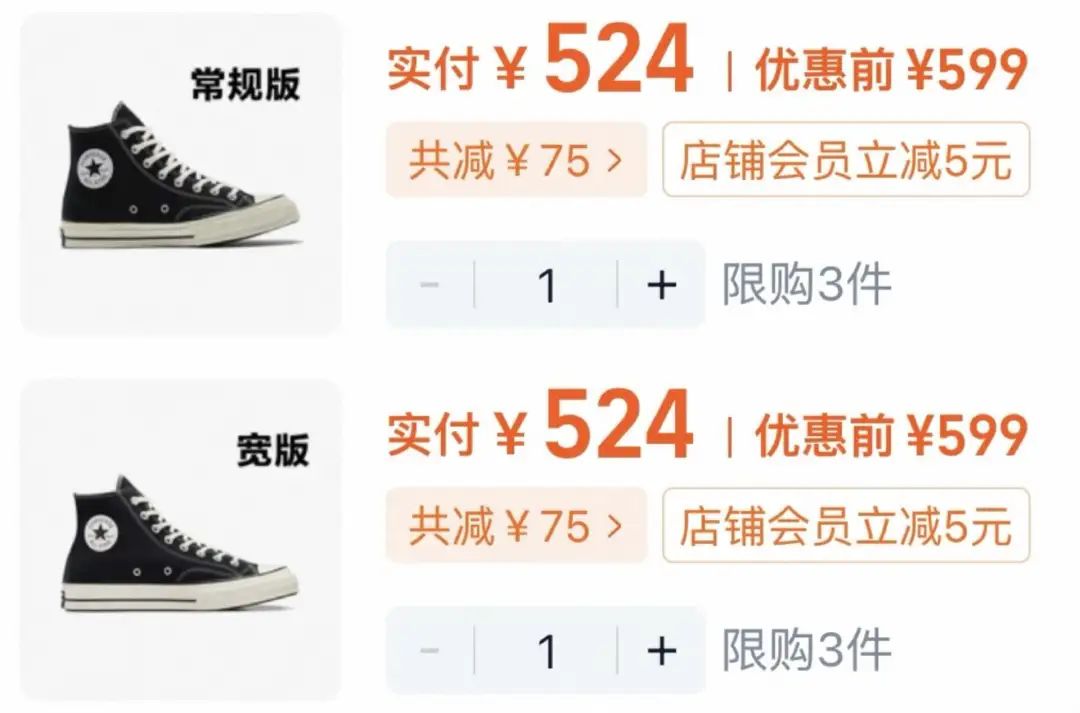
Group 1 - Converse has launched a new CHUCK 70 wide version shoe, with overall dimensions increased by approximately 15mm and sole width increased by 7mm [1] - The CHUCK 70 is available in both regular and wide versions, with no price difference between the two [1] - Other brands like New Balance and HOKA ONE ONE also offer wide versions of their shoes, indicating a trend towards wider footwear [3][5] Group 2 - The trend of wider shoes is not new, as many brands have already introduced wide versions alongside standard ones [3][5] - New Balance's 1080 v14 series offers both standard and wide shoes, with the wide version approximately 2cm wider and priced 100 yuan higher [3] - Brooks offers three versions of their "Ghost 17" running shoes: regular, wide (2E), and extra wide (4E), with the wide version approximately 5mm wider and the extra wide version 1cm wider [7] Group 3 - The shift towards wider shoes is driven by consumer preference for comfort, with 78.2% prioritizing comfort when purchasing footwear [28] - Research indicates that Asian individuals generally have wider feet compared to those from North America and Europe, making wider shoes more suitable for this demographic [29][30] - The design of shoes is evolving from "making shoes fit the foot" to "making shoes accommodate the natural shape of the foot" [41]
华利集团:控股股东提议2025年半年度利润分配预案 拟10派10元
Zheng Quan Shi Bao Wang· 2025-08-08 10:06
人民财讯8月8日电,华利集团(300979)8月8日晚间公告,控股股东香港俊耀提议公司2025年半年度利 润分配预案如下:以截至2025年6月30日公司总股本11.67亿股为基数,向全体股东每10股派发现金红利 10元(含税)。 ...
跑鞋大火抢占球鞋市场,运动品牌怎么办?
3 6 Ke· 2025-08-08 01:28
Core Insights - The basketball shoe market is experiencing a decline, with sales dropping by 5% in 2024 and projected to fall by 8% by May 2025, posing challenges for major sports brands that heavily invest in this category [1][2] - The rise of running shoes, which are favored for their comfort and broader audience appeal, is a significant factor contributing to the decline in basketball shoe sales [2][3] - The influence of basketball stars, particularly Michael Jordan, has waned over time, leading to a decrease in the cultural relevance of basketball shoes compared to their past prominence [6][8] Group 1: Market Dynamics - The basketball shoe market was once a popular choice for consumers, but the shift towards running shoes has disrupted this trend, as brands struggle to compete with the technological advancements and pricing strategies of running shoes [2][3] - New brands like Hoka and On are capitalizing on the running trend by associating their products with an ideal lifestyle, attracting a diverse consumer base [3][5] Group 2: Brand Strategy - To revitalize basketball shoe sales, brands must focus on technological innovation and performance enhancement, as these are critical competitive advantages in the market [9][10] - The development of new materials and supply chain advancements are essential for creating high-performance basketball shoes that can attract consumers [12] Group 3: Role of Designers - Designers are increasingly stepping into the spotlight, engaging directly with consumers to share design philosophies and brand stories, which can positively impact sales [13][17] - The emergence of platforms for designers to share knowledge and experiences is fostering a collaborative environment that can lead to innovative design breakthroughs [16][17]

芜湖唯欣鞋业有限公司成立 注册资本100万人民币
Sou Hu Cai Jing· 2025-08-07 23:12
Core Viewpoint - Wuhu Weixin Footwear Co., Ltd. has been established with a registered capital of 1 million RMB, indicating a new player in the footwear industry [1] Company Summary - The legal representative of Wuhu Weixin Footwear Co., Ltd. is Tao Miaomiao [1] - The company’s business scope includes retail and wholesale of shoes and hats, sales of raw and auxiliary materials for shoemaking, and sales of special labor protection products [1] - Additional services offered by the company include shoe and leather repair, rental services (excluding licensed rental services), and internet sales [1] Industry Summary - The company is positioned to engage in various retail sectors, including daily necessities, clothing and accessories, and sports equipment [1] - It also provides technical services, consulting, and information technology services, which may enhance its operational capabilities [1] - The establishment of Wuhu Weixin Footwear Co., Ltd. reflects ongoing growth and diversification within the footwear and retail industry [1]
卡骆驰Q2调整后EPS超预期 预计Q3营收将下降约9%至11%
Ge Long Hui A P P· 2025-08-07 13:07
Core Insights - Crocs reported Q2 revenue of $1.15 billion, a year-over-year increase of 3.6%, surpassing analyst expectations of $1.14 billion [1] - Adjusted earnings per share were $4.23, up from $4.01 in the same period last year, exceeding analyst expectations of $4.00 [1] - The company anticipates a revenue decline of approximately 9% to 11% for Q3, while analysts expected a growth of 0.3% [1] - Adjusted operating margin is projected to be around 18% to 19%, which includes an expected negative impact of approximately 170 basis points from announced and pending tariffs [1]

芜湖苏禾鞋业有限公司成立 注册资本100万人民币
Sou Hu Cai Jing· 2025-08-06 23:11
Core Insights - Wuhu Suhe Footwear Co., Ltd. has been established with a registered capital of 1 million RMB, indicating a new player in the footwear industry [1] Company Overview - The legal representative of the company is Liu Xinyu, suggesting a potential leadership structure [1] - The company’s business scope includes a wide range of activities such as retail and wholesale of footwear and hats, sales of raw materials for shoe manufacturing, and various technical services [1] Business Activities - The company is involved in the retail and wholesale of shoes and hats, indicating a focus on both direct consumer sales and bulk distribution [1] - Additional activities include the sale of personal protective equipment, shoe and leather repair services, and rental services, which diversify its business model [1] - The company also engages in internet sales and live streaming services, reflecting a modern approach to retail [1] Additional Services - The company offers a variety of services including technical consulting, information technology consulting, and office equipment sales and leasing, showcasing its multifaceted business capabilities [1] - The inclusion of sales for outdoor products, baby products, and home goods indicates a broad market reach beyond just footwear [1]
刘宁到民权县睢县调研时强调 做强主导产业 加快绿色转型 因地制宜推动县域经济高质量发展
He Nan Ri Bao· 2025-08-04 12:38
8月4日,省委书记刘宁到商丘市民权县、睢县,调研县域经济发展、产业转型、生态保护等工作。 近年来,我省牢固树立和践行"绿水青山就是金山银山"理念,全省生态文明建设取得显著成效。刘宁来 到河南"塞罕坝"民权申甘林带、黄河故道,实地察看林场保护管理、美丽河湖建设等情况。"习近平总 书记在我省考察时指出,要着力加强生态环境保护,持之以恒加强重点流域生态保护治理,深化污染防 治攻坚,筑牢生态安全屏障。"刘宁强调,要深入践行"两山"理念,坚持生态优先、保护第一,因地因 时制宜、分区分类施策,大力发展绿色产业和生态经济,加快现代水网和水运网建设,在推动绿色发展 上迈出新步伐。 调研中,刘宁听取民权县、睢县经济社会发展情况汇报,强调要深入贯彻习近平总书记在河南考察时重 要讲话精神,落实省委十一届九次全会部署,聚焦"1+2+4+N"目标任务体系,立足殷商文化起源地、四 省交界协同区、豫东开放桥头堡定位,坚持以科技创新引领新质生产力发展,做强"一县一特色产业", 大力发展枢纽经济,构建具有县域特点的现代化产业体系。当前要做好抗旱保秋粮丰收,高度重视旱涝 急转风险,做好防汛备汛各项准备工作,全力保障人民生命财产安全。要广泛深入察 ...