
消费金融

Search documents
中信消金开年“吃下”百万罚单!总经理去年出任副市长引关注
Nan Fang Du Shi Bao· 2026-01-13 10:03
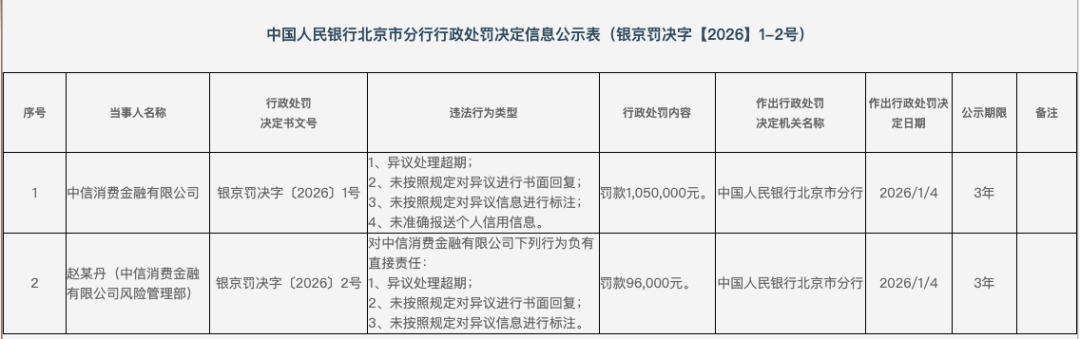
近期,中信消费金融有限公司(以下简称"中信消金")因信用信息管理违规方面的四项违规行为收到中 国人民银行北京分行开出的"双罚"罚单,该公司被罚105万元,其风险管理部责任人赵某丹同步被罚9.6 万元。值得注意的是,这是不到两年内该公司第二次触碰监管红线。 中信消金再收百万罚单 据中国人民银行北京分行发布行政处罚决定信息公示表(银京罚决字〔2026〕1-2号)显示,中信消金 本次涉及的违法行为为以下四项:异议处理超期、未按规定对异议进行书面回复、未按规定对异议信息 进行标注、未准确报送个人信用信息,罚款105万元。 据悉,中信消费金融2019年开业之初注册资本为3亿元。股东有三家分别为:中信有限持股比例为 35.1%;中信信托有持股比例为34.9%;金蝶软件持股比例为30%。 2025年2月27日,中信消金增资获监管批复,注册资本从7亿元增至10亿元,达标2024年4月国家金融监 督管理总局发布的《消费金融公司管理办法》中"注册资本最低限额10亿元人民币"的刚性要求。 此次增资完成后,公司股权结构保持不变,中信金控仍维持绝对控股地位。中信消金当时回应称,本次 增资体现了股东单位对消费金融行业前景的看好及公司发展 ...


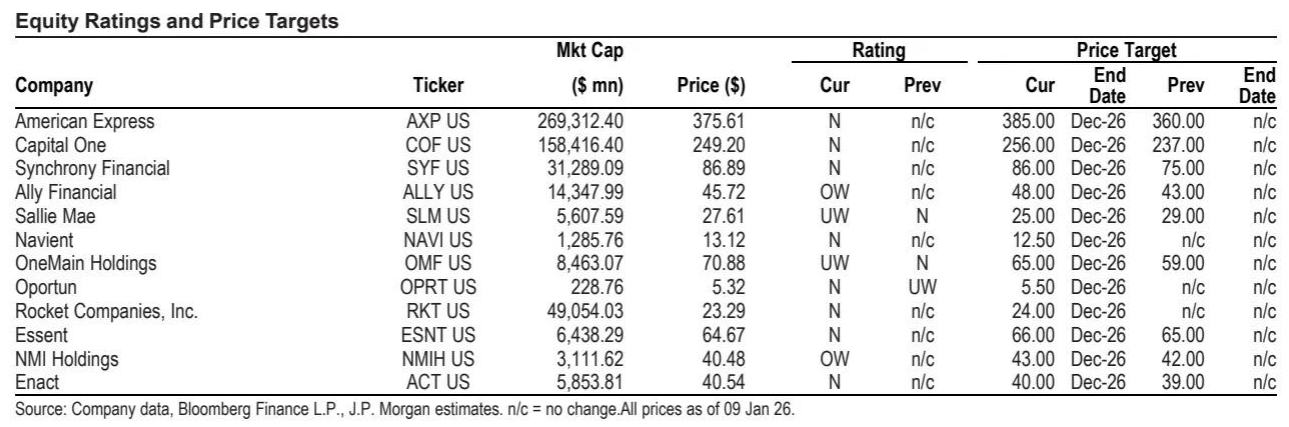
大摩展望美国消费金融财报季:防御仍是主线,特朗普信用卡限息提议增添不确定性
智通财经网· 2026-01-13 09:33
Group 1 - The core viewpoint of the reports indicates that the financial sector is advised to maintain a defensive posture due to anticipated impacts from inflation and labor market dynamics on credit performance and consumer confidence [1] - Morgan Stanley acknowledges that while target stock prices have been steadily raised since the beginning of the year, earnings expectations have largely remained unchanged, reflecting a conservative outlook [1] - The report highlights a significant proposal from Trump to limit credit card interest rates to 10% for one year, which could fundamentally reshape the credit card industry and significantly reduce profitability for issuers [1] Group 2 - In December, U.S. consumer spending growth showed signs of slowing, with a year-over-year increase of 2.4%, down from 3.7% in November, indicating a divergence in spending patterns between high-income and low-income households [2] - The labor market is characterized by low hiring and low layoffs, with non-farm payrolls increasing by only 50,000 in December, which is below expectations, while the unemployment rate decreased from 4.6% to 4.4% [2] - Despite geopolitical news, the direct impact on consumer finance remains limited, with Morgan Stanley expecting inflation and labor market conditions to continue being focal points for investors and operators [3] Group 3 - Morgan Stanley maintains a selective and rigorous approach in evaluating the financial sector, considering factors such as adequate valuations, uneven credit trends, and execution risks within the rating spectrum [3] - The report includes specific ratings and target price adjustments for various financial stocks, reflecting a balanced and differentiated outlook based on current market dynamics [3]
新年消费“开门红”:消费金融发力场景深耕
Zhong Guo Jing Ying Bao· 2026-01-13 04:11
Group 1 - The consumer market experienced a strong start to the new year, with 142 million domestic trips and total spending of 84.789 billion yuan during the three-day New Year holiday [1] - Consumer finance institutions are shifting their strategies from blind growth to refined scenario management, aiming to balance benefits for consumers and customer acquisition [1] Group 2 - Financial institutions are implementing various discount measures to stimulate consumer demand, with Ningyin Consumer Finance issuing over 50,000 electronic discount coupons covering more than 150,000 consumers by the end of December 2025 [2] - Zhongyuan Consumer Finance upgraded its "28 days interest-free borrowing" benefit during the New Year, providing interest-free periods for 1.52 million people and reducing interest fees by 15.5 million yuan [2] - Zhongyuan Consumer Finance has served 3.46 million people and provided over 52.46 million yuan in benefits through measures like interest rate reductions and consumer subsidies by the end of December 2025 [2] Group 3 - Mashang Consumer Finance has provided benefits to over 12 million users through various types of coupons since 2025, focusing on precision and collaboration in its promotional strategies [3] - The company organized over 30 live broadcasts on rural revitalization and consumption promotion themes in 2025, achieving over 110 million transactions in goods and services [3] Group 4 - The consumer finance market's promotional strategies for the New Year are increasingly focused on specific consumption scenarios rather than cash incentives [4] - Several licensed consumer finance institutions are intensifying their focus on key areas such as home appliances, education, and healthcare, with Inner Mongolia Mengshang Consumer Finance issuing over 100 billion yuan in consumer loans and serving over 9 million customers [4] - Zhongyuan Consumer Finance reported a cumulative loan amount exceeding 510 billion yuan and a customer base surpassing 28 million by the end of December 2025, with 67% of loans concentrated in key consumption areas [4] Group 5 - The recovery of consumer spending during the New Year has raised expectations for consumer finance institutions, emphasizing the need for responsible lending practices [5] - Financial support for consumption should not lead to excessive credit, and institutions are encouraged to embed services in real scenarios while maintaining transparency in pricing [5]
消金机构去年扎堆甩不良包袱:兴业消金狂甩四百亿或成清仓王
Nan Fang Du Shi Bao· 2026-01-13 03:50
2025年,消费金融行业个人不良贷款转让规模显著放量。南都湾财社记者不完全统计发现,随着个贷不 良批量转让试点持续扩容,多家消费金融公司在银行业信贷资产登记流转中心(以下简称"银登中心") 发布个人不良贷款转让业务相关公告,密集"甩卖"不良资产包。其中,兴业消金以401.06亿元的转让规 模领跑行业,创下2025年单笔208.13亿元的行业纪录;招联消金、中银消金、南银法巴消金、湖北消金 等机构也纷纷加大处置力度。 在政策红利持续释放、存量风险集中暴露、监管压力等多重因素共同推动下,消费金融不良资产转让 从"试水探索"走向"深水区",正从阶段性行为转向常态化、制度化的风险处置路径。 兴业消金狂甩401亿 2025年,消费金融行业迎来个人不良贷款转让的集中释放期。南都湾财社记者不完全统计发现,随着个 贷不良批转试点持续扩容,多家消费金融公司密集在银登中心挂牌不良资产包,行业不良处置节奏明显 加快。其中,兴业消金以超400亿元的不良资产规模,或成为业内的不良处置"清仓王"。 | 交易基准日 | 20251031 | 未偿本金总额(元) | 9,839,771,543.82 | | --- | --- | --- ...

引导金融机构加力支持扩大内需
Sou Hu Cai Jing· 2026-01-12 23:16
Core Viewpoint - Expanding domestic demand is a strategic foundation for constructing a new development pattern, with a focus on enhancing the domestic market and supporting key areas such as consumption, technological innovation, and small and micro enterprises [1][2]. Financial Support for Domestic Demand - Financial services play a crucial role in supporting the real economy, and the effectiveness of these services directly impacts the success of expanding domestic demand [1]. - The transition from scale-driven financial support to quality and efficiency-driven support is necessary as the economy shifts from high-speed growth to high-quality development [2][3]. Structural Issues in Financial Support - There are structural issues in financial support for expanding domestic demand, including inadequate mechanisms to promote consumer confidence and willingness to spend [4]. - For enterprises, there is a gap in the supply of medium- and long-term funds necessary for effective investment, leading to mismatches in financing needs [5]. - Financial institutions face challenges in lending and risk management, which affects their ability to support consumer and small business loans effectively [6]. Systemic Reforms Needed - Systemic reforms are required to enhance the quality and efficiency of financial services, focusing on long-term support for manufacturing upgrades and innovative consumption scenarios [7]. - Strengthening the collaboration between fiscal and monetary policies is essential to improve the effectiveness of financial support for expanding domestic demand [8]. Enhancing Financial Institutions' Capabilities - Financial institutions need to shift from collateral-based lending to credit-driven models, utilizing comprehensive data systems to create digital credit profiles [9]. - There is a need for innovative financial support mechanisms that integrate with rural revitalization and local economic development [10].
消费金融行业信用风险展望(2026年1月)
Lian He Zi Xin· 2026-01-12 11:30
Investment Rating - The report indicates a stable outlook for the consumer finance industry, with expectations of steady growth in market size but potential challenges in growth rates due to various economic factors [9][48]. Core Insights - The consumer finance industry is experiencing a slowdown in credit growth due to factors such as slow income growth, weak consumer confidence, and a shift in deposits towards investments and wealth management [9][10]. - The asset quality of consumer finance companies remains relatively stable, but there are signs of pressure due to increased bad debt transfers and retail credit risk exposure [9][10]. - The industry is facing a narrowing interest margin and compressed profit space, with a significant focus on self-operated business transformation and risk control capabilities as core competitive advantages [48][50]. Industry Policy and Regulatory Environment - In 2024, policies aimed at boosting consumption were implemented, but consumer performance did not meet expectations. The contribution of final consumption expenditure to economic growth decreased [10][11]. - Regulatory policies are pushing the consumer finance industry towards lower interest rates and stronger compliance, which may lead to increased competition and a focus on customer acquisition and risk management capabilities [15][17]. Industry Competition Landscape - The competition in the consumer finance market is intensifying, with commercial banks holding a significant position. The proportion of credit cards in consumer loans is declining, while self-operated consumer loans and internet finance platforms are gaining traction [18][19]. - The industry is characterized by a clear differentiation between leading companies and others, with top firms benefiting from lower funding costs and stronger risk control capabilities [50][51]. Business Operations and Financial Status - Consumer finance companies are expanding their service offerings, particularly in scenario-based loans, but the product structure remains heavily weighted towards cash loans [22][23]. - The average non-performing loan (NPL) rate for consumer finance companies decreased to 1.97% by the end of 2024, reflecting improved asset quality management [25][26]. - Financing costs for consumer finance companies have decreased, with many institutions reporting costs below 4% [30][31]. Capital Adequacy Level - The capital adequacy ratio for consumer finance companies was 13.04% at the end of 2024, indicating a decline but still within a sufficient range [39][40]. - The industry is facing challenges in capital replenishment, with limited new capital injections and a slowdown in the pace of capital increases [35][36]. Industry Bond Market Performance - The bond issuance activity among consumer finance companies increased in 2024, with a total of 33 bonds issued, reflecting a strong market recognition [40][41]. - The average coupon rate for bonds issued by consumer finance companies has been on a downward trend, indicating improved credit quality and market acceptance [42][43]. Future Outlook - The consumer finance industry is expected to continue expanding, driven by policies promoting consumption and increasing penetration in lower-tier markets, although growth rates may stabilize in the short term [48][49]. - The importance of self-operated business transformation and risk control capabilities is expected to rise, as companies adapt to regulatory pressures and market conditions [48][50].
【Fintech 周报】去年理财产品平均收益率2.28%;银行短期大额存单利率进入“0字头”
Sou Hu Cai Jing· 2026-01-12 04:27
Regulatory Dynamics - The Financial Regulatory Bureau has issued a notice to unify the execution standards for non-auto insurance "reporting and issuing" practices, addressing issues of irrational competition and high costs in the non-auto insurance market [1] - Guangzhou Huilibao Payment Technology Co., Ltd. has been fined over 74 million yuan for multiple violations, including breaches of clearing management regulations and merchant management rules [1] Industry Dynamics - Major state-owned banks are raising the threshold for gold accumulation business, requiring personal clients to have a risk tolerance level of C3- or above to purchase gold accumulation products starting January 12, 2026 [2] - The interest rates for short-term large-denomination time deposits have dropped to "0" for several major state-owned banks, with rates for 1-month and 3-month deposits at 0.9% [2] - The average annualized yield of wealth management products has decreased to 2.2809% as of the end of 2025, with a total market size of 31.63 trillion yuan [3] - A significant wave of deposits maturing, estimated at 50 trillion yuan, is expected this year, with the majority concentrated in 2-year and 3-year deposits [5] - Several joint-stock banks' financial asset investment companies have begun investing in emerging industries, focusing on high-growth sectors such as new energy and materials [5] Corporate Dynamics - Everbright Bank's "Lehui Jin" credit card has been reported to show ghost debts, affecting users' credit scores and loan applications despite no actual defaults [6] - Yunnan's first trillion-yuan bank is set to be established through the merger of local rural credit cooperatives, creating the largest financial institution in the province [7] - Ping An Life has increased its holdings in Agricultural Bank of China and China Merchants Bank, triggering regulatory filings for both [8] - China Dadi Insurance and Sunshine Property Insurance have ceased new financing insurance business applications as of the end of 2025 [8] - Beijing's North Silver Consumer Finance has received approval to increase its registered capital by 150 million yuan, raising it to 1 billion yuan [9] - Jinshan Consumer Finance has become an executed party in a court case, with a claim amount of 20,000 yuan [9] - Zhonggang Yintong's payment license has been revoked by the central bank, marking the 12th payment license cancellation in 2025 [10] - ELong has fully acquired Firefly Microloan, enhancing its position in the financial services sector [11] Overseas Dynamics - JPMorgan Chase is set to take over Goldman Sachs' Apple credit card business, acquiring over $20 billion in credit card loans as Goldman Sachs shifts away from consumer finance [12] - Global fintech venture capital funding has rebounded significantly in 2025, reaching $55.94 billion, a 25% increase from 2024 [13]






人事调整 资本“补血” 释放什么信号?
Jin Rong Shi Bao· 2026-01-12 01:44
岁末年初,消费金融领域动态频频。政策端,新一轮"国补"开启,商务部、中国人民银行、金融监 管总局联合印发的《关于加强商务和金融协同 更大力度提振消费的通知》指引新一年金融促消费发展 方向;机构端,增资、人事、合规多线并行,行业转型加速推进。 金融监管总局黑龙江监管局、辽宁监管局分别发布公告,已批复同意孙升学的哈尔滨哈银消费金融 有限责任公司董事、董事长以及周峙的盛银消费金融有限公司董事长任职资格。 董事长更迭折射出2025年消费金融行业人事调整加速进行。 据《金融时报》记者不完全统计,在31家消费金融公司中,建信消金、中原消金、海尔消金、京东 消金、锦程消金、晋商消金、哈银消金、蒙商消金、盛银消金等公司2025年更换了董事长、总经理或总 裁,另有十余家公司的董事、总经理助理、首席风险官等关键岗位出现人事调整。整体来看,超半数消 费金融公司2025年密集进行了核心高管团队人员的变动。 《金融时报》记者注意到,金融监管总局北京、天津、宁波、重庆、上海、黑龙江、江苏等地监管 局集中公开了一批涉及多家消费金融公司的章程修改、高管任命、股权结构调整、注册资本增加、行政 处罚等批复事项。 根据批复信息,建信消费金融有限公 ...
被曝四项违法行为,中信消金再吃百万罚单!
Shen Zhen Shang Bao· 2026-01-12 01:28
Core Viewpoint - Citic Consumer Finance Co., Ltd. has been fined for multiple regulatory violations, indicating ongoing compliance issues within the company [1][2][3] Group 1: Regulatory Penalties - Citic Consumer Finance was fined 1.05 million yuan for failing to respond to disputes in writing, not accurately reporting personal credit information, and other violations [1][2] - Zhao, a member of the risk management department, was fined 96,000 yuan for direct responsibility in three of the violations [1][2] - This penalty follows a previous fine of 1.2 million yuan in June 2024 for issues related to cooperation mechanisms, product information disclosure, credit approval, and post-loan management [3] Group 2: Company Background and Financial Performance - Citic Consumer Finance was established as the 24th licensed consumer finance institution in China, officially commencing operations in June 2019 [3] - The company increased its registered capital from 700 million yuan to 1 billion yuan in February 2025 [3] - In 2024, Citic Consumer Finance reported revenue of 921 million yuan, a 30.07% increase from the previous year, with total assets of 11.414 billion yuan and total liabilities of 10.48 billion yuan [3] - The company issued a total of 4.605 million loans, amounting to 124.5 billion yuan, with a loan balance of 10.688 billion yuan by the end of 2024 [3] - Citic Consumer Finance has served approximately 13.5165 million customers through its "Youqi Loan" product [3]
招联消费金融取得静默图像翻拍检测方法及装置专利
Sou Hu Cai Jing· 2026-01-11 12:27
国家知识产权局信息显示,招联消费金融股份有限公司取得一项名为"一种静默图像翻拍检测方法及装 置"的专利,授权公告号CN116229109B,申请日期为2023年1月。 天眼查资料显示,招联消费金融股份有限公司,成立于2015年,位于深圳市,是一家以从事货币金融服 务为主的企业。企业注册资本1000000万人民币。通过天眼查大数据分析,招联消费金融股份有限公司 参与招投标项目222次,财产线索方面有商标信息141条,专利信息327条,此外企业还拥有行政许可80 个。 来源:市场资讯 声明:市场有风险,投资需谨慎。本文为AI基于第三方数据生成,仅供参考,不构成个人投资建议。 ...