
铁路运输

Search documents
春运客流或创新高, 国际航线冷暖分极
Guan Cha Zhe Wang· 2026-01-23 05:16
Core Viewpoint - The 2026 Spring Festival travel season in China is expected to see record-high passenger flow and transportation volume across railways and civil aviation, with significant increases in both sectors compared to previous years [1][4]. Railway Sector - The China National Railway Group anticipates sending 539 million passengers during the Spring Festival travel period from February 2 to March 13, 2026, representing a 5% year-on-year increase [1]. - On peak travel days, over 14,000 passenger trains are expected to operate, with a 5.3% increase in seating capacity compared to the previous year [1]. - The railway ticketing service will enhance support for key passenger groups, including additional discounts for college graduates and continued services for students and workers [1][3]. Civil Aviation Sector - The civil aviation sector is projected to transport 95 million passengers during the Spring Festival, with a daily average of 2.375 million passengers, marking a 5.3% increase [4]. - Major airlines are expected to operate 657,000 flights, also reflecting a 5% increase year-on-year [4]. - The top three airlines (China Eastern, Air China, and China Southern) will account for 43% of the flights, while the top 20 airlines will represent 90% of the total operations [4]. Ticket Pricing and Trends - As of January 15, 2026, the average pre-sale price for domestic economy class tickets during the Spring Festival is 1,064 yuan (including tax), which is 20% higher than the actual transaction price from the previous year [5]. - The peak ticket prices are expected around the Spring Festival, with significant price drops possible for travelers who adjust their travel dates [5]. - Popular domestic travel destinations are dominated by southern cities, with Shantou leading in booking growth at 186% year-on-year [5]. International Travel - During the Spring Festival, outbound travel is primarily focused on Southeast Asia, with Thailand being the most popular destination [6]. - There has been a significant reduction in flights to Japan, with a cancellation rate of 36% for flights during the travel period [6]. - The demand for customized outbound travel packages has increased, with an 18% rise in pre-orders for long-haul trips [6].





CSX运输Q4营收及每股收益逊于预期,工业需求疲软
Ge Long Hui A P P· 2026-01-23 02:33
Core Viewpoint - CSX Transportation reported Q4 2025 earnings with revenue of $3.5 billion, a 1% year-over-year decline, falling short of analysts' average expectations of $3.54 billion [1] - Earnings per share were $0.39, also below the expected $0.41, primarily due to weak industrial demand and reduced coal export volumes offsetting pricing gains and intermodal transportation growth [1] - CEO Steve Angel stated that CSX has a strong operational foundation and aims to improve financial performance in 2026 by focusing on productivity, cost control, and capital discipline while continuing to provide safe and reliable services [1] Financial Performance - Revenue for Q4 2025 was $3.5 billion, down 1% year-over-year [1] - Earnings per share were reported at $0.39, lower than the anticipated $0.41 [1] Operational Insights - The decline in revenue and earnings was attributed to weak industrial demand and a decrease in coal export volumes [1] - Despite the challenges, CSX is focusing on enhancing productivity and controlling costs [1] Future Outlook - The company aims for better financial performance in 2026 by maintaining a strong operational foundation and prioritizing safety and reliability in services [1]

加钱就可抢票?平台卖“加速包”被罚50万!
Xin Hua Wang· 2026-01-23 02:01
Core Viewpoint - The article highlights the deceptive practices of third-party ticket purchasing platforms during the Spring Festival travel season, emphasizing that these platforms mislead consumers into paying for services that do not provide any real advantage in securing train tickets [1][15]. Group 1: Deceptive Practices - The so-called "ticket grabbing" services are essentially just "official waiting lists," misleading consumers into believing they are purchasing tickets when they are actually just entering a queue for tickets that may not be available [3][15]. - Third-party platforms claim to offer "speed-up packages" for a fee, suggesting that these packages will enhance the chances of securing tickets, but in reality, no tickets are available once they are sold out, rendering these services ineffective [5][6]. - The "real-time monitoring" feature advertised by these platforms is unreliable, as it merely refreshes the official ticketing website for publicly available information without any actual ticket reservation capabilities [9][15]. Group 2: Financial Implications - Consumers are charged fees ranging from 10 to 58 yuan for various ticket grabbing services, which are essentially just repackaged free services offered by the official ticketing platform [11][15]. - The Beijing Market Supervision Administration has penalized one platform 500,000 yuan for misleading advertising related to its ticket grabbing services, highlighting the financial repercussions of such deceptive practices [13][15]. Group 3: Consumer Guidance - The official ticketing platform, China Railway 12306, is the only legitimate channel for purchasing tickets, and consumers are advised to avoid third-party platforms that promise priority access [17][21]. - Travelers are encouraged to apply for waiting lists immediately if they cannot secure desired tickets, as submitting multiple combinations of dates and train numbers increases the likelihood of obtaining tickets [18][21]. - Any claims of paid services that promise to speed up the ticket purchasing process are marketing traps, and consumers should refrain from paying additional fees to avoid financial loss and delays in the ticket purchasing process [21].

【人民日报】京哈高铁 连接双城,带动发展
Ren Min Ri Bao· 2026-01-23 00:45
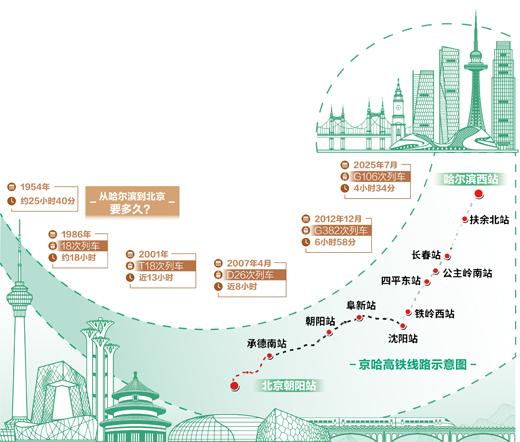
Core Insights - The Beijing-Harbin High-Speed Railway (京哈高铁) has been operational for five years, serving 210 million passengers, significantly enhancing connectivity between major cities in Northeast China and Beijing [1] - The railway is a crucial part of China's high-speed rail network, facilitating economic integration and development in the Northeast region [1][7] Group 1: Operational Achievements - Over the past five years, the railway has transported over 210 million passengers, with more than 63 million traveling from Beijing to Northeast China and approximately 39.36 million from Harbin to Beijing [1] - The railway spans 1,198 kilometers and connects Beijing, Hebei, Liaoning, Jilin, and Heilongjiang, forming an essential segment of the "Eight Vertical and Eight Horizontal" high-speed rail network [1] Group 2: Economic Impact - The high-speed railway has stimulated local economies, particularly in cities like Chengde, which has seen a surge in tourism due to its proximity to Beijing [6] - In Northeast China, the railway has become a key player in the "ice and snow economy," with significant tourist traffic during peak seasons, such as 140,500 visitors on New Year's Day 2026 [6] Group 3: Future Developments - Starting July 1, 2025, the railway will operate at a maximum speed of 350 km/h, reducing travel times between Beijing and Harbin to approximately 4 hours and 33 minutes [5] - The railway's expansion is expected to further enhance connectivity, allowing for same-day round trips between major cities along the route [5] Group 4: Technological Innovations - The high-speed trains are equipped with advanced cold-resistant technology, ensuring safe operation in extreme winter conditions [12] - Innovations such as the "ice melting and snow removal" system have improved operational efficiency, addressing challenges posed by winter weather [13][14]
京哈高铁 连接双城,带动发展
Ren Min Ri Bao· 2026-01-22 23:55
Core Viewpoint - The Beijing-Harbin High-Speed Railway (京哈高铁) has been operational for five years, serving 210 million passengers and significantly enhancing connectivity in Northeast China, contributing to regional economic development and tourism [1][5]. Group 1: Operational Achievements - The Beijing-Harbin High-Speed Railway has transported a total of 210 million passengers over five years, with over 63 million passengers traveling from Beijing to Northeast China and approximately 39.36 million from Harbin to Beijing [1]. - The railway spans 1,198 kilometers and is a crucial part of China's high-speed rail network, connecting major cities in Beijing, Hebei, Liaoning, Jilin, and Heilongjiang [1][4]. - The railway's full operation began on January 22, 2021, with the opening of the Beijing to Chengde section [1]. Group 2: Economic and Social Impact - The high-speed railway has stimulated the development of cities along its route, such as Chengde, which has seen a surge in tourism due to its proximity to Beijing [7]. - In Northeast China, the railway has become a key transportation method for the "ice and snow economy," with significant tourist traffic to Harbin during peak seasons [7]. - Cities like Qiqihar have experienced a dramatic increase in passenger flow, with daily traffic rising from 10,000 in 2020 to 17,000 by 2025, contributing to local economic growth [7]. Group 3: Future Developments - Starting July 1, 2025, the Beijing-Harbin High-Speed Railway will operate at a maximum speed of 350 km/h, further reducing travel times between major cities [4]. - The fastest travel times will be reduced to 2 hours and 29 minutes to Shenyang and 4 hours and 33 minutes to Harbin, enabling same-day round trips between key cities [4]. Group 4: Technological Innovations - The high-speed railway employs advanced technologies to ensure safe operation in extreme winter conditions, including special materials for train construction and innovative snow removal systems [12][13][15]. - The railway's infrastructure has been enhanced to withstand cold weather, with features like heated switches and real-time monitoring systems to maintain operational safety [15].
革命圣地延安与遵义即将实现动车直达
Shan Xi Ri Bao· 2026-01-22 23:10
西安铁路局相关负责人表示,动车直达的实现,既是全国铁路路网优化的重要成果,也是红色文旅 与区域经济协同发展的新契机。两座城市将依托高铁通道,深化红色旅游资源联动,推出跨省红色旅游 精品线路,让游客能够更便捷地重温革命历史。同时,快速的铁路交通将加速两地人员、物资流动,推 动陕北革命老区与黔北地区在产业发展、乡村振兴等领域的深度合作,为革命老区高质量发展注入新动 能。 此次调图后,延安还将实现与北京、上海、广州等13座全国主要城市的高铁直达,遵义的高铁辐射 范围也进一步向北延伸,南北红色革命老区的联动发展将为两地带来全新机遇。(记者:杨光) 1月26日0时起,全国铁路将实行2026年一季度列车运行图,革命圣地延安与遵义将实现动车直达。 两座红色城市的时空距离大幅拉近,陕北与黔北地区的互联互通将迈入新阶段。 此次调图依托西延高铁开通运营的资源优势,中国铁路成都局集团新增成都东、贵阳北等车站至延 安动车6对,首次实现遵义与延安动车直达互连,填补了川黔渝"两省一市"至延安的动车空白。据铁路 12306平台信息,1月26日,延安至遵义将开行G3351次高铁,9时35分发车、17时42分抵达,全程8小时 7分钟;遵义至延 ...
CSX(CSX) - 2025 Q4 - Earnings Call Transcript
2026-01-22 22:32
Financial Data and Key Metrics Changes - The company reported a 1% increase in volume, but revenue decreased by 1% due to business mix headwinds and coal pricing [9][14] - Operating income and earnings per share fell by 9% and 7% year-over-year, respectively, with results impacted by approximately $50 million in charges for workforce optimization and technology impairments [4][10] - Fourth quarter expenses increased by $73 million, or 3%, excluding goodwill impairment charges [10] Business Line Data and Key Metrics Changes - Merchandise volume and revenue both declined by 2%, with softness in chemicals and forest products, where volume decreased by 6% and 11%, respectively [15] - The intermodal franchise saw a revenue increase of 7% year-over-year, driven by a 5% increase in volume [16] - Coal business volume increased by 1% year-over-year, with domestic tonnage up by 6% due to higher utility demand [16][17] Market Data and Key Metrics Changes - The company anticipates modest declines in housing starts and challenges in the automotive market, affecting many commodity markets [18] - The consensus forecasts suggest low single-digit revenue growth for 2026, with flat industrial production and modest GDP growth expected [22] - The company is positioned to benefit from infrastructure project activity driving demand for materials like cement and aggregates [17] Company Strategy and Development Direction - The company is focused on driving greater profitability and cash flow while preparing for future demand increases [6] - Capital expenditures for 2026 are planned to be below $2.4 billion, emphasizing investments in safety, reliability, and growth projects [23] - The company is committed to optimizing its workforce and managing discretionary expenses to improve operating margins [22][24] Management's Comments on Operating Environment and Future Outlook - Management noted that the near-term outlook remains soft across many key markets, with no significant improvement in macroeconomic conditions anticipated [22] - The company is focused on executing core fundamentals of service, cost discipline, and operating efficiency to create long-term shareholder value [24] - Management expressed confidence in the ability to improve operating margins through productivity initiatives and effective price management [38][68] Other Important Information - The company has identified over 100 diverse savings initiatives to drive efficiency across various business areas [11][52] - The leadership team has been renewed to enhance value creation and fiscal responsibility [5] - The company is preparing for potential impacts from severe weather, with improved network conditions compared to previous years [42][43] Q&A Session All Questions and Answers Question: Inquiry on Operating Ratio Improvement - The base operating ratio for 2025 is adjusted for goodwill charges, and pricing initiatives are expected to yield higher price yields in 2026 compared to 2025 [27][28] Question: Clarification on Guidance for Improvement - The guidance for 200-300 basis points improvement includes unique charges from 2025, with a focus on productivity initiatives to drive further improvements [32][33] Question: Revenue Growth Composition - The company anticipates low single-digit revenue growth, with modest volume growth expected and a focus on pricing management [36][37] Question: Preparation for Severe Weather - The network is in better condition than last year, with precautions in place to mitigate impacts from upcoming storms [42][43] Question: Positioning Amid Industry Merger - The company is focused on running its business effectively while preparing for potential opportunities arising from industry changes [55][56] Question: Coal Revenue Per Unit Clarification - Revenue per unit for coal is influenced by market mix, with expectations for stabilization in the coming year [60][63]
CSX(CSX) - 2025 Q4 - Earnings Call Transcript
2026-01-22 22:32
Financial Data and Key Metrics Changes - The company reported a 1% increase in volume but a 1% decrease in revenue due to business mix headwinds and coal pricing [9][14] - Operating income fell by 9% and earnings per share decreased by 7% year-over-year [9][10] - Fourth quarter expenses increased by $73 million, or 3%, excluding goodwill impairment charges [10][11] Business Line Data and Key Metrics Changes - Merchandise volume and revenue both decreased by 2%, with softness in chemicals and forest products [14][16] - Automotive volume was down 5% year-over-year, while fertilizer volume increased by 7% [15][16] - Intermodal revenue grew by 7% year-over-year on a 5% increase in volume, driven by new business wins [16] Market Data and Key Metrics Changes - The industrial chemicals market remains weak, affecting freight spending [14] - The housing market is expected to see a modest decline in starts, impacting commodity markets [18] - Domestic utility coal demand increased due to higher power demand and natural gas prices [16][19] Company Strategy and Development Direction - The company aims for low single-digit revenue growth in 2026, focusing on operational efficiency and cost discipline [21][22] - Capital expenditures are planned to be below $2.4 billion, emphasizing safety, reliability, and growth projects [22] - The company is preparing for potential opportunities arising from industry mergers while maintaining operational excellence [54][55] Management's Comments on Operating Environment and Future Outlook - Management acknowledges a challenging year with subdued demand and limited growth opportunities [4][20] - There is no expectation of significant macroeconomic improvement in the near term, but the company is focused on internal initiatives to drive profitability [21][22] - Management is optimistic about the potential for growth in 2026, particularly in intermodal and domestic utility coal [19][20] Other Important Information - The company has identified over 100 cost-saving initiatives across various areas, including labor and non-labor spending [11][50] - The leadership team has been renewed to enhance operational effectiveness and drive value [5] Q&A Session All Questions and Answers Question: Inquiry about operating ratio improvement and pricing initiatives - Management indicated that the starting point for 2025's operating ratio excludes goodwill charges and emphasized ongoing pricing initiatives to improve yield in 2026 [28][29] Question: Clarification on guidance for operating margin improvement - Management noted that unique charges from 2025 would not recur in 2026, and they expect productivity improvements to drive margin expansion [32] Question: Discussion on revenue growth profile and mix effects - Management acknowledged that mix effects would impact revenue growth, with stronger growth expected in lower RPU segments [78][79] Question: Inquiry about coal revenue per unit and market conditions - Management clarified that coal RPU would be influenced by market mix and expected stabilization in the coming year [58][61] Question: Discussion on operational readiness for upcoming storms - Management assured that the network is in better condition compared to previous years and outlined preparedness measures for adverse weather [40][42] Question: Inquiry about the impact of industry mergers - Management emphasized the importance of operational excellence regardless of merger outcomes and expressed confidence in managing potential risks [54][55]
CSX(CSX) - 2025 Q4 - Earnings Call Transcript
2026-01-22 22:30
Financial Data and Key Metrics Changes - CSX reported a modest total volume growth of 1% in the fourth quarter, but revenue decreased by 1% due to business mix headwinds and coal pricing [7][12] - Operating income fell by 9% and earnings per share decreased by 7% year-over-year, with results impacted by approximately $50 million in expenses related to workforce optimization and technology impairments [3][8] - Fourth quarter expenses increased by $73 million, or 3%, excluding goodwill impairment charges, with a focus on driving efficiency in labor costs [9][10] Business Line Data and Key Metrics Changes - Merchandise volume and revenue both declined by 2%, with significant softness in chemicals and forest products, where volumes dropped by 6% and 11% respectively [13] - The intermodal franchise saw revenue growth of 7% year-over-year, driven by a 5% increase in volume, indicating strong performance in this segment [14] - Coal business volume increased by 1% year-over-year, with domestic tonnage up by 6% due to rising power demand and higher natural gas prices, while export tonnage declined by 3% [14][15] Market Data and Key Metrics Changes - The industrial chemicals market remains weak, and many customers are controlling freight spending due to inflation and tariff pressures [13] - The housing market is expected to see a modest decline in starts, impacting the automotive market and overall commodity demand [16] - Infrastructure project activity is driving demand for materials such as cement and aggregates, which is a positive for CSX's merchandise volumes [16] Company Strategy and Development Direction - CSX is focused on delivering stronger performance through cost structure adjustments and operational efficiencies, aiming for year-over-year operating margin expansion of 200-300 basis points in 2026 [20][21] - The company plans to maintain capital expenditures below $2.4 billion, prioritizing investments in safety, reliability, and growth projects [21] - CSX is preparing for potential opportunities arising from industry mergers while emphasizing the importance of running the business effectively in the interim [50][51] Management's Comments on Operating Environment and Future Outlook - Management acknowledges a challenging year with subdued demand and limited growth opportunities, but remains committed to improving service levels and operational efficiency [3][4] - The near-term outlook for key markets remains soft, with expectations of low single-digit revenue growth based on flat industrial production and modest GDP growth [20] - Management is optimistic about the potential for growth in 2026, particularly in intermodal and domestic utility segments, despite ongoing market uncertainties [18][19] Other Important Information - The company has identified over 100 diverse savings initiatives aimed at reducing non-labor spending and improving operational efficiency [10][46] - CSX is focused on enhancing its pricing strategies to ensure pricing growth exceeds cost inflation in 2026 [25][26] Q&A Session Summary Question: What is the base operating ratio for 2025 and how does pricing compare to cost inflation? - The base operating ratio for 2025 excludes goodwill charges, and management is optimistic about achieving pricing above cost inflation in 2026 through new pricing structures [25][26] Question: Can you provide details on the 200-300 basis point guidance for improvement? - The guidance includes unique charges from 2025, and management expects significant productivity improvements driven by cost optimization initiatives [29][30] Question: What are the expectations for revenue growth in 2026? - Revenue growth is expected to be low single-digit, with modest volume growth anticipated, influenced by market conditions and pricing strategies [33][34] Question: How is CSX preparing for upcoming storms and operational challenges? - CSX is better prepared for storms this year, with improved network conditions and proactive measures in place to mitigate disruptions [38][39] Question: How is the company positioning itself amid industry mergers? - CSX is focused on running the business effectively while preparing for potential opportunities arising from industry consolidation [50][51] Question: What is the outlook for coal revenue per unit (RPU)? - Coal RPU is expected to stabilize, with a mix of lower RPU segments impacting overall revenue growth [54][57]
从北京到哈尔滨,最快只要4小时33分钟 京哈高铁 连接双城,带动发展
Ren Min Ri Bao· 2026-01-22 22:01
Core Viewpoint - The Beijing-Harbin High-Speed Railway (京哈高铁) has been operational for five years, serving 210 million passengers and significantly enhancing connectivity in Northeast China and the Beijing-Tianjin-Hebei region [1][6]. Group 1: Operational Achievements - The Beijing-Harbin High-Speed Railway has transported a total of 210 million passengers over five years, with over 63 million passengers traveling from Beijing to Northeast China and 39.36 million from Harbin to Beijing [1]. - The railway spans 1,198 kilometers and is a crucial part of China's "eight vertical and eight horizontal" high-speed rail network, connecting Beijing, Hebei, Liaoning, Jilin, and Heilongjiang [1][5]. Group 2: Future Developments - Starting July 1, 2025, the Beijing-Shenyang section of the high-speed railway will operate at a speed of 350 km/h, reducing travel times to 2 hours and 29 minutes to Shenyang and 4 hours and 33 minutes to Harbin [5]. - The high-speed railway is expected to create a "2-3 hour" transportation circle, facilitating same-day round trips between major cities along the route [5]. Group 3: Economic Impact - The high-speed railway is driving development in cities along its route, with cities like Chengde experiencing a surge in tourism due to the "half-hour tourism circle" [6][7]. - The railway has become a key player in the "ice and snow economy" of Northeast China, with significant passenger traffic during peak tourist seasons, such as 140,500 visitors on New Year's Day 2026 [6][7]. Group 4: Technological Innovations - The high-speed railway is equipped with advanced technologies to withstand harsh winter conditions, including special materials for train bodies and systems for snow and ice removal [11][12][13]. - Innovations such as real-time monitoring systems and snow-melting devices at stations enhance operational safety and efficiency during winter [13].