
高等教育

Search documents
预算1.99亿元!武汉大学近期大批仪器采购意向
仪器信息网· 2025-06-18 07:01
Core Viewpoint - Wuhan University has announced two procurement intentions for laboratory instruments and equipment, with a total budget of 199 million yuan, scheduled for procurement in May to June 2025 [1][2]. Group 1: Procurement Details - The procurement includes various advanced instruments such as vacuum interconnect atomic etching product detection instruments, vacuum interconnect photoresist fluorescence detection instruments, and multi-functional X-ray testing devices [2][4]. - The total number of procurement items is 39 sets, focusing on enhancing semiconductor manufacturing and testing capabilities [5]. Group 2: Specific Equipment and Functions - The first procurement item is a domestic autonomous vacuum interconnect semiconductor material growth and testing platform, aimed at optimizing and upgrading research hardware facilities to improve equipment utilization efficiency [4][5]. - The second procurement item is a high-performance computing GPU cluster, designed to provide computational support for scientific and artificial intelligence calculations, with a focus on flexible scheduling of computing power [5].


近期国内多所知名高校官宣扩招本科生
Hang Zhou Ri Bao· 2025-06-18 02:30
Group 1 - Zhejiang University announced an expansion of its undergraduate enrollment for 2025, particularly in the artificial intelligence field, and introduced a series of innovative talent training programs [1] - Several prestigious universities in China, including Tsinghua University, Peking University, and China Agricultural University, have also announced plans to increase their undergraduate enrollment, with a total increase of approximately 20,000 students aimed for this year [1][2] - The expansion of quality undergraduate education is emphasized in the "Education Strong Country Construction Plan Outline (2024-2035)" and the government work report, indicating a strategic push towards enhancing higher education quality [1][2] Group 2 - The focus of the enrollment expansion is on cultivating interdisciplinary talents in high-demand fields such as artificial intelligence, integrated circuits, biomedicine, healthcare, and renewable energy [2] - Tsinghua University is establishing a new general education college aimed at nurturing talents with AI thinking and interdisciplinary knowledge, while Renmin University is focusing on AI and smart governance in its enrollment plans [2] - Other universities, such as China Agricultural University and University of Electronic Science and Technology, are aligning their expansion with national strategic needs, particularly in areas like food security and electronic information technology [2] Group 3 - Basic disciplines and interdisciplinary studies are also receiving attention, with universities like Sichuan University and Hunan University increasing enrollment in these areas [3] - Many institutions are introducing integrated master's and bachelor's programs and dual degree options to foster innovative and interdisciplinary talents [3]
“定向西藏就业计划”纳入普通本科批招生
Zheng Zhou Ri Bao· 2025-06-18 00:53
政策明确,定向西藏就业计划纳入普通本科批招生,实行平行志愿投档,按照教育部有关政策规 定,录取分数线不得低于我省普通本科批有关高校提档分数线以下40分。报考定向西藏就业计划的考生 应同时具备以下条件:符合我省2025年普通高校招生报名条件,并参加我省2025年普通高校招生统一考 试;须为我省非西藏自治区户籍的应届高中毕业生。报考定向西藏就业计划的考生被录取后,师范类专 业考生须与西藏自治区教育厅及招生高校签订定向就业协议;其他专业考生须与西藏自治区人力资源和 社会保障厅及招生高校签订定向就业协议。录取考生毕业后,须按照签订的定向就业协议到西藏自治区 县以下基层单位工作,服务期限不少于5年。其中,所学专业及教师资格符合高中阶段任教条件的师范 类考生,毕业后可安排至西藏自治区高中阶段学校任教。 根据安排,拟报考定向西藏就业计划的考生,须自行打印河南省2025年普通高校招生定向西藏就业 计划报考申请书,经本人签字确认以及家长或监护人签署意见后,于6月29日12时前携带本人有效身份 证、准考证、户口簿、报考申请书等证件材料,提交至报名所在地县(市)区招生考试机构,进行资格 审核。对通过提供虚假个人信息材料等手段获得报 ...
哈尔滨工业大学:院士给本科生当导师
Ke Ji Ri Bao· 2025-06-18 00:42
Core Points - Harbin Institute of Technology (HIT) is establishing a new elite program called "尖班" (Top Class) aimed at nurturing innovative talents with the involvement of academicians as mentors [1][4] - The program allows students to enter based on their college entrance examination scores, expanding access beyond the previous "dual selection" method [2] - HIT has introduced a new "Autonomous Intelligent Systems Academician Class," focusing on cutting-edge research in artificial intelligence and related fields [4] Group 1 - The "尖班" program is designed to cultivate top innovative talents and is supported by a team of over ten academicians, including the university president [1] - The curriculum breaks traditional structures, emphasizing a talent cultivation system that integrates mathematical and physical foundations with interdisciplinary approaches [1] - Students in the program can choose their academic paths from undergraduate to doctoral levels, promoting personalized development [2] Group 2 - HIT encourages undergraduate students to engage in research related to their doctoral theses, allowing them to complete their undergraduate projects early and join academic teams [2] - The "哈工大—港大优学班" (HIT-HKU Elite Class) is also being launched, enabling students to complete their undergraduate studies in three years and pursue advanced degrees at the University of Hong Kong [4] - Over the past five years, HIT graduates have shown a high employment rate in key sectors, with nearly 40% securing jobs in central enterprises and Fortune 500 companies [4]
南京大学:组建新工科“至诚班”
Ke Ji Ri Bao· 2025-06-18 00:42
Group 1 - Nanjing University aims to provide the best undergraduate education in China, launching initiatives to cultivate top innovative talents [1] - The university has established a new Robotics and Automation College at its Suzhou campus, introducing a major in Automation (Robotics Direction) focused on smart manufacturing and robotics technology [1] - The "Zhicheng Class" is introduced to strengthen practical training and industry-education integration, featuring a talent cultivation system driven by industry needs and deep involvement from central enterprises [1] Group 2 - In 2025, Nanjing University will add "Intelligent Science" and "Electronic Science" directions to its Mathematics and Physics programs, respectively [2] - The Kuang Yaming College will continue to reform its outstanding talent cultivation model, allowing students to freely choose their academic paths and mentors, with over 80% of graduates pursuing further studies at prestigious institutions [2] - New dual-degree programs in Software Engineering combined with Business Management and Economics will be introduced to foster interdisciplinary talents [3] Group 3 - The university will continue to offer various dual-degree programs, including Computer Finance, German Law, Intelligent System Integration, and Big Data Communication, to provide students with ample choices and development opportunities [3]

中国科学技术大学:科技英才班全面升级
Ke Ji Ri Bao· 2025-06-18 00:42
Group 1 - The core viewpoint of the news is that the University of Science and Technology of China (USTC) is expanding its undergraduate enrollment in 2025, focusing on fundamental disciplines, new engineering, and new medical fields that are urgently needed by the country [1] - USTC is implementing the "Science and Education Integration 3.0" program, aiming to cultivate internationally renowned scientists and top innovative talents with innovative spirit and practical abilities [1][2] - The university has established a unique talent cultivation path through various stages of "Science and Education Integration," collaborating with the Chinese Academy of Sciences [1] Group 2 - USTC plans to build a world-class mentor team and a high-quality curriculum system, creating a systematic training model from undergraduate to doctoral levels [2] - In 2025, USTC will separately recruit students for the Quantum Information Science major, leveraging national research platforms to enhance talent training in this field [2][4] - The university will optimize and expand its enrollment in intelligent technology-related undergraduate programs, establishing a training system that meets societal needs and national demands for innovative talents [4]

入学尝鲜果毕业携硕果 第十届“畅享园艺”甜蜜送别毕业生
Zhong Guo Xin Wen Wang· 2025-06-17 18:49
Core Insights - The event "Enjoy Horticulture" organized by Northwest A&F University celebrates the achievements of graduating students in horticulture, showcasing various research成果 in fruits like watermelon, cherry, and tomato [1][2] - The event aims to instill a sense of responsibility and mission among students regarding agricultural modernization and rural revitalization [2] Group 1: Event Overview - The "Enjoy Horticulture" event is a unique farewell activity for the 2025 graduating class, featuring a variety of fruits and research成果 [1] - Students actively participated in educational activities, including quizzes and games related to horticultural research, fostering a sense of community and nostalgia [1] Group 2: Institutional Support - The university's leadership emphasizes the importance of understanding the challenges behind scientific research and encourages students to embody the spirit of innovation and perseverance [2] - The event has been held for ten years, symbolizing the university's ongoing commitment to its students and their development in the field of horticulture [2] Group 3: Student Reflections - Graduating students express their gratitude and connection to their agricultural studies, viewing the event as a reminder of their mission and passion for agriculture [3]
预算1200万元,河南大学发布机器人自动合成系统等采购意向
news flash· 2025-06-17 10:04
6月16日,河南大学发布了2025年6至7月的政府采购意向,预算金额为1200万元。项目名称为"河南大学 机器人自动合成系统及高通量快速评价系统(一期)项目"。采购需求主要满足AI合成研发平台及催化剂 性能评价需求,包括自动合成系统和高通量快速评价系统两部分。自动合成系统包含固体分配器、全自 动移液工作站、自主移动协作机器人等;高通量快速评价系统主要包括多通道电化学工作站、催化剂微 反评价装置等。设备需满足材料制备及评价过程中各项参数指标,预计采购时间为2025年7月。(大河财 立方) ...

一觉醒来,专业没了
Hu Xiu· 2025-06-17 05:28
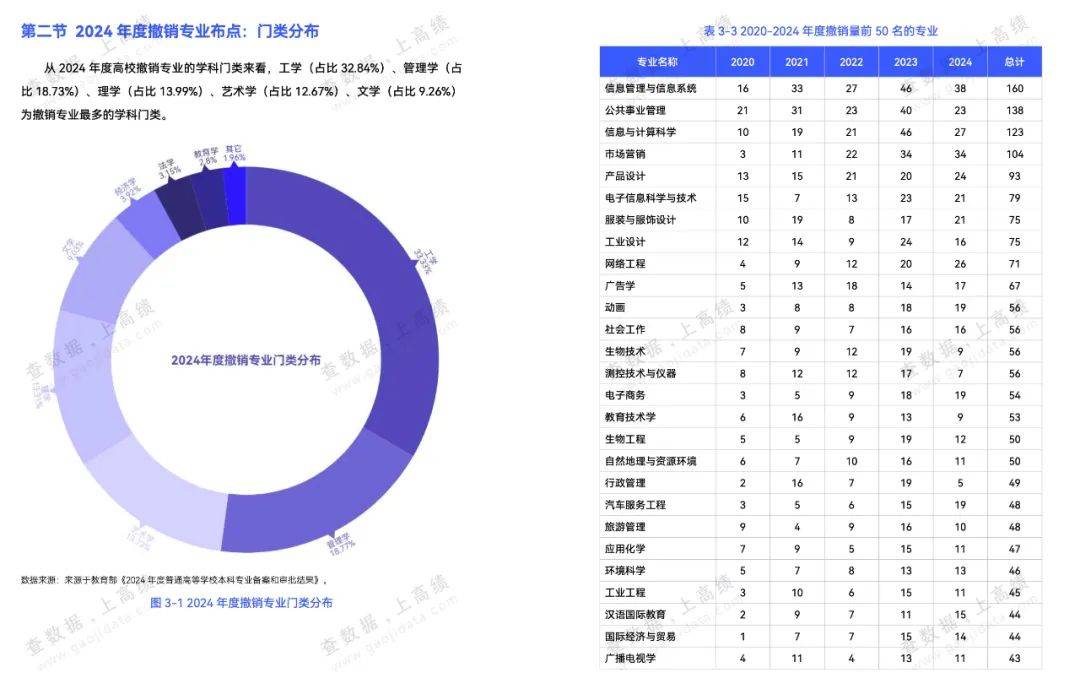
ChatGPT,特别是DeepSeek国产AI大模型的问世后,"哪些工作会被AI取代"持续刺痛和冲击着打工人。而在这场AI革命重塑就业市场的同时,高等教育领 域也正在经历一场专业变革——人工智能、大数据等新兴专业成为增设热门,部分传统专业陆续在高校消失。 今年4月,教育部发布的《2024年度普通高等学校本科专业备案和审批结果》显示,全国高校共撤销专业点1428个,停招专业2220个,调整规模远超新增 专业数量。这样的变化不仅关乎千万高考考生的专业选择,也直接影响着在校大学生的职业规划。 而在这样的变革之下,有几个问题值得深入思考:推动这场专业调整的深层因素是什么?被撤销的专业是否意味着相关领域人才需求的消失?还是说,这 仅仅是人才培养模式的一次转型升级? 淘汰的专业和尴尬的在校生 高绩数据发布的《中国高校本科专业新增与撤销分析报告》显示,2024年度撤销的学科门类中,工学占比32.84%,管理学占比18.73%,理学、艺术学、 文学分别占比13.99%、12.67和9.26%。 | | | | 3-3 2020-2024 年度撤销量前 50 名的专业 | | | | | --- | --- | --- | - ...
2025央视网名校之约|中国医科大学:红医精神育栋梁,九秩征程启新篇——2025招生亮点全解析
Yang Shi Wang· 2025-06-17 03:23
Core Viewpoint - China Medical University is committed to nurturing high-level medical talents and adapting its educational offerings to meet national needs, with a focus on its unique "Red Medical Spirit" and innovative training models [2][5][10]. Group 1: University Background and Achievements - China Medical University is the earliest established institution by the Communist Party of China and has a history of over 90 years, having trained more than 300,000 medical professionals [2]. - The university has two campuses and offers degrees in six disciplines, with 72 doctoral and 78 master's degree programs [2]. - The university's admission scores are relatively stable, with the minimum score for its flagship Clinical Medicine program being 667 in 2024 [2]. Group 2: 2025 Admission Plans - The specific admission plan for 2025 is yet to be released, but it will follow the framework of the 2024 plan, focusing on national needs and social demands [3]. - The university will continue to recruit students from all 31 provinces, with no reserved plans and no gender restrictions on admissions [3]. Group 3: Specialized Programs and Training Models - The university offers 28 undergraduate programs, with a focus on national-level first-class programs, including the "Red Medical Class" for Clinical Medicine [4]. - The "Red Medical Class" integrates undergraduate and doctoral education, allowing students to continue their studies seamlessly if they meet the criteria [5]. - The Clinical Medicine (Laboratory Physician Training Experimental Class) is recognized for its excellence and is led by a national-level teaching team [6]. Group 4: Admission Requirements and Support - Medical programs have specific health requirements, including color vision limitations, while left-handed students are advised to consider practical challenges in certain fields [7][8]. - The university has a comprehensive support system for students, including a 15% opportunity for major transfers and various financial aid options for economically disadvantaged students [8][9]. Group 5: Employment and Career Support - The university boasts a 55% graduate school admission rate and an 85% employment rate, with extensive career support services in place [11]. - The university integrates career planning into its curriculum and provides personalized assistance for students facing employment challenges [11]. Group 6: International Collaboration and Innovation - The university has established a global network for medical education, partnering with 116 institutions across 20 countries and launching various international programs [10]. - It offers two international cooperative programs in Drug Preparation and Biotechnology, which are designed to provide high-quality education [10]. Group 7: Tuition and Campus Life - Tuition fees range from 5,200 to 6,050 yuan, with accommodation fees at 1,200 yuan per year, providing an affordable education [13]. - The campus offers a vibrant cultural life with various facilities, including a swimming pool, gym, and dining options, enhancing the student experience [13].