资产管理

Search documents
三大股指期货齐跌 时隔7年美国政府再次“关门” 今晚ADP成焦点
Zhi Tong Cai Jing· 2025-10-01 12:12
Market Overview - US stock index futures are all down, with Dow futures down 0.26%, S&P 500 futures down 0.38%, and Nasdaq futures down 0.42% [1] - European indices show positive performance, with Germany's DAX up 0.52%, UK's FTSE 100 up 0.68%, France's CAC40 up 0.48%, and the Euro Stoxx 50 up 0.41% [2][3] Commodity Prices - WTI crude oil is down 0.55%, trading at $62.03 per barrel, while Brent crude oil is down 0.53%, trading at $65.68 per barrel [3][4] Economic Events - The US government has shut down for the first time in seven years due to Congress's failure to agree on a spending plan, affecting federal workers and public services [5] - The ADP employment report is expected to show an increase of approximately 60,000 jobs, becoming the focus of labor market data for the month [5] Gold Market - Gold prices have reached a new historical high of $3,890 per ounce, driven by increased demand for safe-haven assets amid the government shutdown [6] Federal Reserve Insights - The market is pricing in a high probability of interest rate cuts this month, with a 76% chance of another cut in December [6] Corporate News - Samsung and SK Hynix have signed a letter of intent to supply memory chips for OpenAI's data center, supporting the Stargate project [9] - Berkshire Hathaway is reportedly close to acquiring Occidental Petroleum's chemical division for approximately $10 billion, marking its largest acquisition since 2022 [9] - BHP is investing $554 million to expand its Olympic Dam copper mine in South Australia, anticipating a 70% increase in global copper demand by 2050 [10] - Tesla has raised leasing prices for all models in the US following the expiration of a $7,500 federal tax credit [10] - Nike's Q1 revenue was $11.7 billion, slightly down but better than expected, indicating early success in its business transformation [11]



惠誉:沙特资管行业资管规模将超4000亿美元
Ge Long Hui A P P· 2025-10-01 09:12
Core Insights - Fitch Ratings projects that the asset management industry in Saudi Arabia will exceed $400 billion, making it the largest in the Gulf Cooperation Council (GCC) region [1] Group 1 - The asset management scale in Saudi Arabia is expected to surpass $400 billion [1] - This growth positions Saudi Arabia at the forefront of the asset management sector within the GCC [1]
2025上海全球资产管理论坛即将举办
Di Yi Cai Jing Zi Xun· 2025-09-30 16:16
Core Insights - The global economy has entered a "low growth, high risk" new normal since 2025, prompting the Central Financial Committee to issue guidelines to enhance Shanghai's role as an international financial center while ensuring financial security [2] - The 2025 Shanghai Global Asset Management Forum aims to promote high-quality development in the asset management industry and build an ecosystem that serves the real economy, featuring participation from regulatory bodies, economists, and leading asset management institutions [2][3] Group 1 - The forum is a high-profile event held annually in October, serving as the kickoff for the "Global Asset Management Center · Shanghai International Activity Week," focusing on the release of significant industry reports and guidelines [3] - This year's forum features a more diverse range of projects and richer information, emphasizing cross-industry collaboration and technological advancements in asset management [3][4] Group 2 - The forum will host a closed-door dialogue between global exchanges and asset managers, discussing investment strategies and opportunities amid global market fluctuations [4] - An international session will focus on promoting high-level bilateral openness in asset management between China and Europe, addressing the current geopolitical landscape [4] Group 3 - The forum will include various discussions and presentations, such as a roundtable on enhancing institutional investors and a dialogue with top investors regarding investment opportunities in the context of the "14th Five-Year Plan" [11][12][14] - A memorandum of cooperation will be signed between the Shanghai Asset Management Association and the German Investment Fund Association, highlighting the commitment to enhancing financial cooperation between China and Europe [16]

2025上海全球资产管理论坛即将举办
第一财经· 2025-09-30 16:09
Core Viewpoint - Since 2025, the global economy has entered a "low growth, high risk" new normal, with Shanghai emerging as a global asset management "stabilizer" and "innovation source" due to its policy advantages, open ecosystem, and innovative vitality [2] Group 1: Forum Overview - The "2025 Shanghai Global Asset Management Forum" is co-hosted by Yicai Media and Bank of China, aiming to promote high-quality development in the asset management industry and build an ecosystem that serves the real economy [2][4] - This year's forum features a more diverse range of projects and richer information, highlighting cross-industry collaboration and technological advancements [3] Group 2: Key Events and Discussions - The forum will include a closed-door dialogue between global exchanges and asset managers, focusing on investment strategies and opportunities amid global market fluctuations [3][4] - A special session on promoting high-level bilateral openness in asset management between China and Europe will gather leading institutions to discuss cross-border investment cooperation [4][11] Group 3: Agenda Highlights - The main forum will take place on October 16, 2025, in Shanghai, featuring opening remarks, keynote speeches, and a series of important report releases [5] - Roundtable discussions will address topics such as enhancing institutional investors and building first-class investment institutions [8]
外资REITs上市首日,机构早已布局三月!
Sou Hu Cai Jing· 2025-09-30 14:33
Core Viewpoint - The listing of Huaxia Kaide Commercial REIT on the Shanghai Stock Exchange marks a significant milestone as the first consumer REIT initiated by an international asset management company in China, reflecting ongoing financial innovation in the capital market [1] Group 1: Market Behavior and Data Analysis - Historical data analysis reveals that financial innovations often leave traces in market behavior prior to their official announcement, as seen with the recent Kaide REITs and its underlying assets in Guangzhou and Changsha [3] - The observation of institutional fund activity prior to the listing of the first public REIT in 2015 indicates that similar patterns may be present in the current Kaide case, suggesting that market participants exhibit unique behavioral fingerprints in data [3][5] - The case of Hongye Futures illustrates that unusual data characteristics can signal potential concept explosions, contrasting with other financial concepts that lack sustained institutional support [5] Group 2: Quantitative Insights and Strategies - Kaide Investment, as a major Singaporean asset management firm, employs strategies that involve both high-profile asset management claims and discreet positioning in derivative markets, which can be detected through specific data patterns [7] - Quantitative analysis focuses on the flow of funds and spatial distribution characteristics, which can predict operational turning points in commercial real estate 3-6 months in advance, as demonstrated by a hedge fund's successful prediction using GPS data from shopping carts [8] - A three-layer filtering mechanism is recommended to differentiate between genuine innovations and superficial concepts, enhancing the ability to identify true market opportunities [8][10] Group 3: Broader Implications for the Market - The listing of Kaide REITs is not just about a single financial product but represents a broader narrative of the opening process of China's capital market, highlighting the limitations of traditional analysis in the face of quantitative models employed by international capital [8] - The democratization of data processing technology is transforming tools previously exclusive to institutions into accessible resources for the general public, akin to how the telescope revolutionized astronomical discoveries [8]
上交所落地首单持有型不动产ABS扩募 实现多方面机制创新
Zhong Guo Jing Ying Bao· 2025-09-30 13:29
Core Viewpoint - The successful expansion of the "Jianxin Long-term Rental ABS" marks a significant milestone in the market, establishing a pathway for the expansion of holding-type real estate ABS and enhancing the product's capacity for continuous growth [1][2]. Group 1: Expansion Details - The "Jianxin Long-term Rental ABS" completed its first expansion on September 30, with a total fundraising scale of 4.53 billion yuan, bringing the cumulative subscription amount to 27.28 billion yuan and achieving a subscription multiple of 7.8 times [1]. - The underlying assets for this expansion are two rental housing projects in Nanjing, and the initial product scale was set at 1.17 billion yuan [1]. Group 2: Mechanism Innovation - Unlike traditional ABS products, this expansion utilized a market-oriented pricing mechanism for book-building, allowing the market to determine pricing and achieving a premium issuance [2]. - The expansion attracted participation from 33 diverse investors, including banks, securities firms, insurance companies, and asset management institutions, further enriching the types of investors involved [2]. Group 3: Market Development - The holding-type real estate ABS is positioned as an equity-type listed product, playing a crucial role in building a multi-tiered REITs market and serving as an innovative tool for activating existing assets and expanding effective investments [2]. - The Shanghai Stock Exchange is committed to promoting the construction of the holding-type real estate ABS market, aiming to cultivate more investable projects and provide comprehensive support mechanisms for both investment and financing parties [3].
永赢基金选择彭博AIM优化QDII投资流程
彭博Bloomberg· 2025-09-30 02:07
Core Viewpoint - Bloomberg has announced that Yongying Fund Management Co., Ltd. has adopted its leading order and investment management technology solution, AIM, to optimize the entire process of overseas investments, enhance operational efficiency, strengthen compliance management, and deepen insights into investment portfolios [1] Group 1: Yongying Fund Management Co., Ltd. - Yongying Fund is a leading asset management company in China, supported by strong shareholders such as Ningbo Bank and Oversea-Chinese Banking Corporation Limited, which provide robust capital, technology, and brand support for diversified business development [3] - As of the end of Q2 2025, Yongying Fund's non-monetary asset management scale reached 358.6 billion yuan, ranking 18th among 162 fund companies according to data from Galaxy Securities [4] Group 2: Bloomberg's AIM Solution - Bloomberg's AIM solution covers the entire investment lifecycle and possesses multi-asset management capabilities, including research management, order and execution management, portfolio and risk analysis, trading compliance, and operational support [2] - The AIM solution is used by over 900 institutional clients and nearly 15,000 professionals globally, managing a total of over 22 trillion dollars in assets [1]

Pimco首席执行官:关税不确定性导致美国股市面临风险
Ge Long Hui A P P· 2025-09-29 15:56
Core Viewpoint - The full impact of U.S. President Trump's tariff policy has yet to be realized, and its trajectory may weigh on the outlook for the U.S. stock market [1] Group 1: Economic Conditions - Despite some bright spots in the economy, such as the booming data center sector, many U.S. businesses are struggling outside of the major cloud providers [1] - Revenue growth is stagnant for many companies, raising concerns about the effects of tariffs and how U.S. businesses will respond to price pass-through or declining profit margins [1]
2万亿全球资管巨头CEO“泼冷水”:关税影响未知或拖累美股
Jin Shi Shu Ju· 2025-09-29 13:52
Group 1 - PIMCO's CEO Emmanuel Roman indicated that the effects of Trump's tariff policies have yet to materialize, potentially dragging down the outlook for the U.S. stock market [2] - Despite highlights in the U.S. economy, such as the AI data center boom, the industrial sector is facing challenges, with corporate revenues showing no growth [2] - PIMCO forecasts a return of approximately 6% for the U.S. stock market over the next three years [2] Group 2 - PIMCO is optimistic about opportunities in the asset-backed financing sector, recently leading a $26 billion debt transaction to support Meta Platforms' data center construction in Louisiana [3] - The data center market is characterized by significant demand for capital and equity, with expectations of numerous financing transactions and construction projects globally [3] - PIMCO is also bullish on natural gas due to the energy-intensive nature of data center operations, highlighting substantial investment opportunities in the fixed income market [3][4]
首单外资消费REITs项目上市,国际化迈出关键一步
Sou Hu Cai Jing· 2025-09-29 12:09
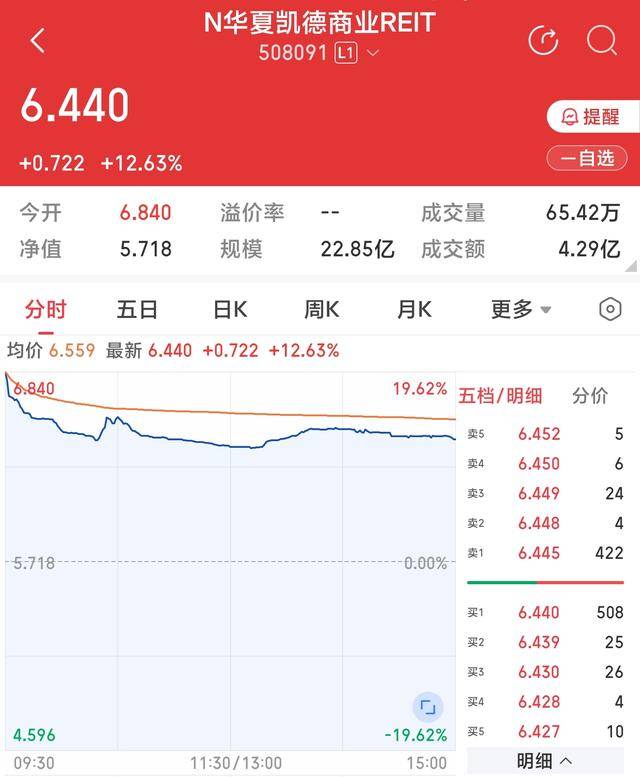
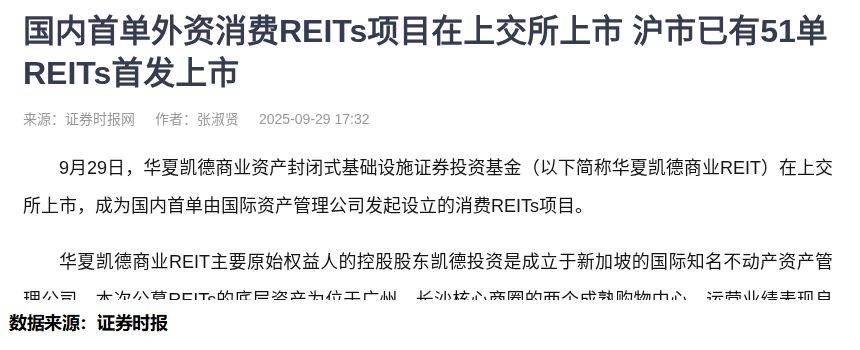
Core Insights - The listing of Huaxia Kaide Commercial REIT on the Shanghai Stock Exchange marks the first consumer REIT project initiated by an international asset management company in China, indicating a significant step towards the internationalization and diversification of China's public REITs market [1][3] Group 1: Market Performance - On its first trading day, Huaxia Kaide Commercial REIT saw a price increase of 12.63%, closing at 6.440 yuan per share [1][2] - The fund's total issuance was 400 million shares at a price of 5.718 yuan per share, raising a total of 22.872 billion yuan [3] Group 2: Fund Management and Assets - The controlling shareholder of Huaxia Kaide Commercial REIT, CapitaLand, is a well-known international real estate asset management company based in Singapore, with fund management handled by Huaxia Fund Management Co., Ltd. and special plan management by CITIC Securities Co., Ltd. [2][3] - The underlying assets of the REIT consist of two mature shopping centers located in the core business districts of Guangzhou and Changsha, with a total construction area of approximately 168,400 square meters and projected combined revenue of 251.9624 million yuan for 2024 [2][3] Group 3: Industry Context - As of now, there are 51 REITs listed on the Shanghai Stock Exchange, with a total financing scale of 134.39 billion yuan, showcasing an expanding range of asset types and a more diverse set of participants and investors [3]