纺织服饰

Search documents
中观高频景气图谱(2025.10):上游企稳回升,中游分化修复
Guoxin Securities· 2025-11-06 11:27
Group 1 - The overall performance of upstream resource products remains low, with internal structural differentiation continuing. The coal industry maintains stable conditions, with a slight month-on-month increase in thermal coal prices. The oil and petrochemical sector continues to show weakness, with a widening year-on-year decline in gasoline and natural gas prices. Basic chemicals are under pressure, with prices of PVC and methanol continuing to decline. Non-ferrous metals remain relatively stable, with slight increases in copper and aluminum prices. Demand for construction materials is weak, with cement and glass prices still in negative territory year-on-year [3][4][5] - In the midstream manufacturing sector, the new energy chain performs well, with improvements in power equipment and a rebound in prices of polysilicon and components. The machinery equipment industry continues its recovery, with marginal improvements in demand for transportation and engineering equipment. The automotive sector shows short-term recovery but remains weak overall, with operating rates and sales improving month-on-month but still below last year's levels. The textile and apparel sector shows significant differentiation, with stable raw material prices but slow recovery in downstream orders [3][4][5] - The downstream consumer sector continues to show a differentiated pattern, with the home appliance sector remaining robust, and sales of small household appliances and kitchen appliances performing well. The food and beverage sector shows a month-on-month rebound, with overall mild increases in agricultural product prices. The pharmaceutical and biotechnology sector experiences increased differentiation, with prices of traditional Chinese medicinal materials continuing to decline. The social services sector continues to recover, with hotel and tourism-related indicators improving month-on-month and increased consumer activity [3][4][5] Group 2 - Supportive services and finance show a continued recovery trend, with the banking system's performance improving month-on-month, and liquidity rebounding, leading to a marginal easing of the funding environment. Non-bank financial services remain highly active but with slowing growth. Transportation shows differentiation, with shipping and container freight rates rebounding while overall freight rates face slight pressure. The environmental protection sector continues to warm up, with improvements in air quality and related investment indicators [3][4][5]
南山智尚(300918):财报点评:业绩符合预期,机器人新品+合作落地
East Money Securities· 2025-11-06 09:11
Investment Rating - The report maintains a "Buy" rating for the company [2][6] Core Insights - The company reported a revenue of 1.226 billion yuan for the first three quarters of 2025, representing a year-on-year growth of 5.39%. However, the net profit attributable to shareholders decreased by 5.81% to 117 million yuan [5] - In Q3 2025, the company achieved a revenue of 494 million yuan, a year-on-year increase of 27.86% and a quarter-on-quarter increase of 33.81% [5] - The company has successfully developed tendon products and secured small batch orders, becoming the first domestic company to achieve this milestone [5] - A new tactile glove product was launched, integrating multiple innovative technologies, enhancing the tactile perception capabilities of humanoid robots [5] - The company has established strategic partnerships for joint research and production in the humanoid robot field, focusing on key materials for robot components [5] Financial Summary - The total market capitalization of the company is approximately 9.78 billion yuan, with a circulating market value of about 8.40 billion yuan [4] - The company’s revenue projections for 2025-2027 are 1.85 billion yuan, 2.54 billion yuan, and 2.84 billion yuan respectively, with net profits of 192 million yuan, 262 million yuan, and 307 million yuan [6][7] - The earnings per share (EPS) are projected to be 0.38 yuan, 0.52 yuan, and 0.61 yuan for the years 2025, 2026, and 2027 respectively [6][7] - The company’s price-to-earnings (P/E) ratios are expected to be 52, 38, and 34 for the years 2025, 2026, and 2027 respectively [6][7]
246股今日获机构买入评级 56股上涨空间超20%
Zheng Quan Shi Bao Wang· 2025-11-05 09:25
Summary of Key Points Core Viewpoint - Today, 246 stocks received buy ratings from institutions, with 4 stocks having their ratings upgraded and 6 stocks receiving initial coverage from institutions [1]. Institutional Ratings - A total of 292 buy rating records were published today, covering 246 stocks. The stocks with the highest attention include Chao Hong Ji and China Pacific Insurance, each receiving 4 buy ratings [1]. - Among the stocks rated today, 81 records provided future target prices, with 56 stocks showing an upside potential of over 20%. The highest upside potential is for Zhong Ding Co., with a target price of 37.33 yuan, indicating a potential increase of 70.53% [1]. - Other stocks with significant upside potential include China Merchants Shekou and Xingyu Co., with expected increases of 60.45% and 52.84%, respectively [1]. - There were 6 stocks that received initial coverage from institutions, including Chao Hong Ji and Da Yang Biological [1]. - Four stocks had their ratings upgraded, including Ai Xu Co. and Er Liu San [1]. Market Performance - Stocks with buy ratings from institutions averaged a rise of 0.17% today, underperforming the Shanghai Composite Index. A total of 116 stocks increased in price, with China Film hitting the daily limit [2]. - The top gainers included Ke Xin New Energy, Chuan Jin Nuo, and Zhong Mi Control, with increases of 8.81%, 6.82%, and 6.42%, respectively [2]. - The largest declines were seen in Fu Shi Da, Rong Tai Health, and Ding Jie Smart, with decreases of 7.68%, 5.92%, and 5.11%, respectively [2]. Industry Focus - The electronics sector was the most favored, with 35 stocks, including Bei Fang Hua Chuang and BOE Technology Group, listed among the buy-rated stocks [2]. - The pharmaceutical and automotive sectors also received significant attention, with 30 and 19 stocks, respectively, appearing on the buy rating list [2].
10只创业板股最新股东户数降逾一成
Zheng Quan Shi Bao Wang· 2025-11-05 02:54
Summary of Key Points Core Viewpoint - The number of shareholders in 263 ChiNext stocks has decreased as of October 31, with 110 stocks experiencing a decline of over 10% in shareholder numbers compared to the previous period [1]. Group 1: Shareholder Changes - 110 out of 263 ChiNext stocks reported a decrease in shareholder numbers, with 10 stocks seeing a decline of more than 10% [1]. - The stock with the largest decrease in shareholder numbers is Shouhua Gas (300483), which saw a 22.18% drop to 21,736 shareholders, and has declined 11.65% since the concentration of shares began [1]. - Xianying Technology (301067) reported a 20.80% decrease in shareholders, totaling 9,985, while its stock price increased by 10.66% during the same period [1]. - Huali Group (300979) had 10,800 shareholders, down 16.28%, with a stock price increase of 17.08% since the concentration began [1]. Group 2: Continuous Decrease in Shareholders - 33 ChiNext stocks have shown a continuous decrease in shareholder numbers for more than three consecutive periods, with some stocks experiencing a decline for up to seven periods [1]. - Yihua New Materials (301176) has seen a 32.29% cumulative decrease in shareholders over seven periods, totaling 15,712 [2]. - Shuangfei Group (300817) also reported a 16.94% decrease over seven periods, with 19,651 shareholders [2]. - Other notable stocks with significant cumulative decreases include Naipu Mining (300818) and Taihe Technology (300801), with declines of 36.97% and 35.23%, respectively [2]. Group 3: Market Performance and Industry Trends - The average increase for concentrated stocks since October 21 is 2.33%, with Taihe Technology, Huali Group, and Hengbo Co. (301225) leading with increases of 19.02%, 17.08%, and 14.72%, respectively [2]. - The industries with the most concentrated stocks include machinery, electronics, and computers, with 16, 14, and 10 stocks, respectively [2]. - As of November 4, 29 concentrated stocks have attracted leveraged funds, with Hengshuai Co. (300969) and Xianying Technology seeing financing balances increase by 95.48% and 55.05%, respectively [2].


A股全天缩量调整,创业板指跌近2%
Dongguan Securities· 2025-11-04 23:33
Market Overview - The A-share market experienced a volume contraction with the ChiNext index dropping nearly 2% [3] - Major indices closed as follows: Shanghai Composite Index at 3960.19 (-0.41%), Shenzhen Component Index at 13175.22 (-1.71%), and ChiNext at 3134.09 (-1.96%) [1][3] Sector Performance - The top-performing sectors included Banking (+2.03%), Utilities (+0.24%), and Environmental Protection (+0.15%) [2] - The worst-performing sectors were Non-ferrous Metals (-3.04%), Medical Biology (-1.97%), and Basic Chemicals (-1.57%) [2] Market Sentiment and Trends - The market showed mixed sentiment with various sectors experiencing volatility; while the Fujian sector rose, the innovative drug concept faced adjustments [3] - The total trading volume in the Shanghai and Shenzhen markets was 1.91 trillion yuan, a decrease of 191.4 billion yuan from the previous trading day [5] Future Outlook - The report suggests that investors should be cautious and flexible in managing their positions, especially in light of the recent market fluctuations [5] - Defensive sectors such as Financials and Coal, as well as low-positioned sectors like Food and Beverage, are recommended for attention [5] Policy Developments - The National Health Commission released guidelines to promote AI applications in healthcare, aiming to establish high-quality data sets and intelligent applications by 2027 [4]
主力资金丨尾盘主力资金大幅抢筹2股
Zheng Quan Shi Bao Wang· 2025-11-04 10:49
Market Overview - The main funds in the Shanghai and Shenzhen markets experienced a net outflow of 575.34 billion yuan on November 4, with the ChiNext board seeing a net outflow of 258.43 billion yuan and the CSI 300 index stocks a net outflow of 200.36 billion yuan [1] Industry Performance - Among the 5 major industries tracked by Shenwan, only 2 saw net inflows of main funds. The light industry manufacturing sector led with a net inflow of 1.05 billion yuan, followed by the comprehensive sector with a net inflow of 47.99 million yuan [1] - The banking sector had the highest increase at 2.03%, while the power equipment sector saw the largest decline at 3.04% [1] Individual Stock Movements - 51 stocks had net inflows exceeding 100 million yuan, with 14 stocks seeing inflows over 200 million yuan. The top stock, Xue Ren Group, had a net inflow of 4.95 billion yuan [2] - Dongshan Precision, a PCB stock, had a net inflow of 4.62 billion yuan following its announcement of acquiring 100% of the French GMD Group for approximately 1 billion euros (about 8.14 billion yuan) [2][3] - Wanlima, a textile and apparel stock, also saw significant inflows, with a net inflow of 4.09 billion yuan [3] Notable Outflows - Over 160 stocks experienced net outflows exceeding 100 million yuan, with 19 stocks seeing outflows over 500 million yuan. The top outflow was from Sunshine Power, which had a net outflow of 1.608 billion yuan [5] - Other notable outflows included Sanhua Intelligent Control, Changshan Pharmaceutical, and Yiwei Lithium Energy, each with outflows exceeding 1.1 billion yuan [5] End-of-Day Trading - At the end of the trading day, the main funds had a net outflow of 41.65 billion yuan, with the ChiNext board seeing a net outflow of 9.39 billion yuan [6] - BlueFocus and Wanlima led the end-of-day net inflows, each exceeding 2.5 billion yuan [7]

富春染织涨8.53%,股价创历史新高
Zheng Quan Shi Bao Wang· 2025-11-03 06:43
Group 1 - The stock price of Fuchun Dyeing and Weaving reached a historical high, increasing by 8.53% to 20.35 yuan, with a trading volume of 6.9414 million shares and a transaction value of 136 million yuan, resulting in a turnover rate of 3.58% [1] - The latest total market capitalization of the company in A-shares is 3.949 billion yuan, with the same amount for the circulating market capitalization [1] - The textile and apparel industry, to which the company belongs, has an overall increase of 0.14%, with 72 stocks rising and 31 stocks declining [1] Group 2 - For the first three quarters, the company reported an operating income of 2.408 billion yuan, representing a year-on-year growth of 9.87%, while the net profit was 23.3476 million yuan, showing a year-on-year decline of 77.49% [1] - The basic earnings per share for the company is 0.1100 yuan, and the weighted average return on net assets is 1.24% [1]

千亿险资系私募基金,最新动向曝光
Zhong Guo Zheng Quan Bao· 2025-11-02 04:10
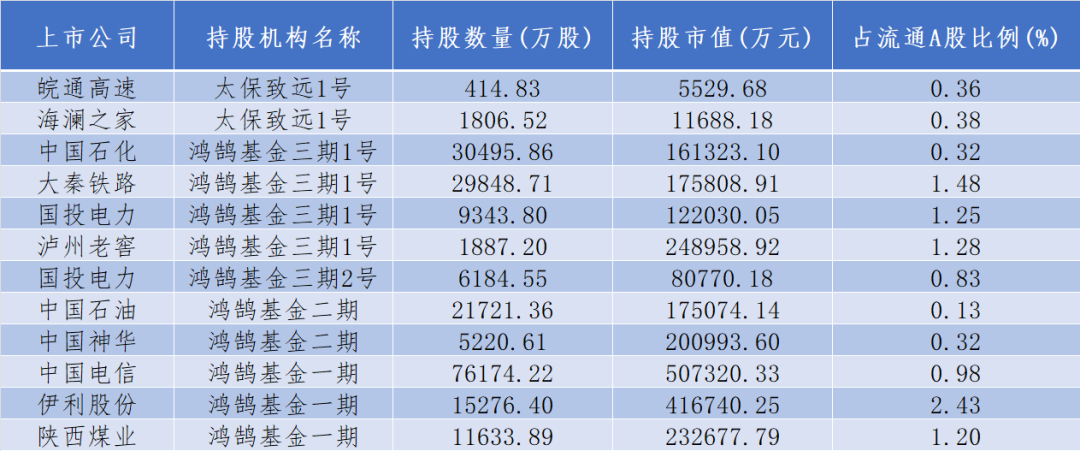
Core Insights - The trial reform for long-term investment of insurance funds has accelerated this year, with the latest holdings of insurance-related private equity funds revealed following the disclosure of listed companies' Q3 reports [1][9] - Five insurance-related private equity funds have disclosed their latest holdings, with significant investments in companies such as Sinopec, Daqin Railway, Guotou Power, Luzhou Laojiao, Anhui Expressway, and HLA [1][4] Holdings Summary - As of the end of Q3, Taibao Zhiyuan No. 1 Private Securities Investment Fund has appeared in the top ten circulating shareholders of Anhui Expressway and HLA, holding 4.1483 million shares and 18.0652 million shares respectively [3][6] - The holdings of five insurance-related private equity funds are detailed in a table, showing the number of shares, market value, and percentage of circulating A-shares for each listed company [5] - The Honghu Fund Phase III No. 1 has emerged as a major shareholder in Sinopec, Daqin Railway, Guotou Power, and Luzhou Laojiao, with holdings of 304.9586 million shares, 298.4871 million shares, 93.438 million shares, and 18.872 million shares respectively [6][7] Investment Focus - The insurance-related private equity funds are primarily concentrated in sectors such as petrochemicals, transportation, coal, public utilities, food and beverage, telecommunications, and textiles, with many holdings being industry leaders characterized by high dividends and low volatility [7][10] - The ongoing trial reform has seen the number of operational insurance-related private equity funds increase to seven, with a total approved scale of 222 billion yuan [9][10]



【中国银河固收】转债策略更新 | 权益市场震荡冲高,风格切回稳健低波
Xin Lang Cai Jing· 2025-10-31 11:37
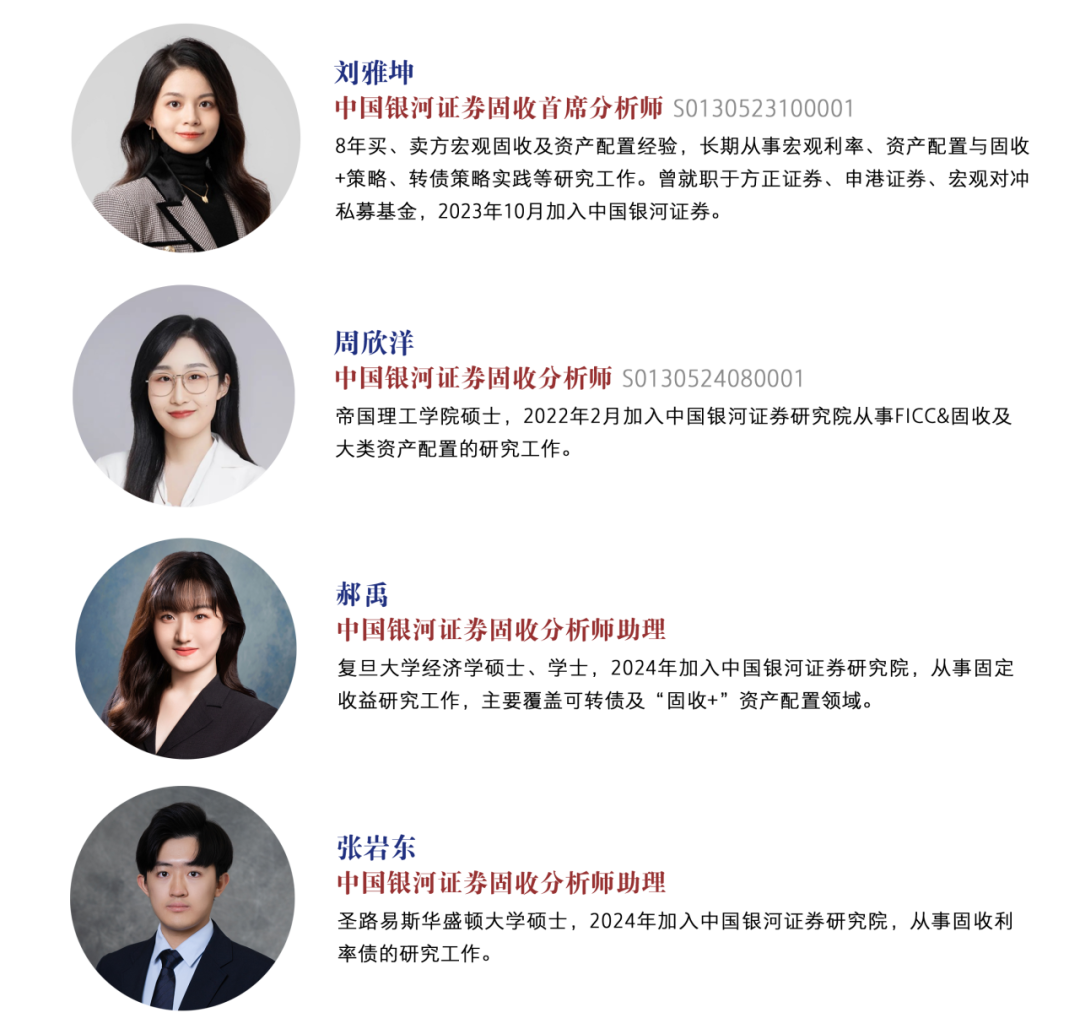
Core Insights - The report highlights the performance of three investment strategies: Low Price Enhancement, Improved Dual Low, and High Price High Elasticity, which recorded returns of 1.3%, 0.5%, and 0.7% respectively during the last period, outperforming the benchmark return of 0.3% [1] - Year-to-date, these strategies have achieved returns of 17.4%, 28.2%, and 52.2%, with cumulative excess returns of 0.3%, 11.2%, and 35.2% compared to the benchmark return of 17.0% [1] - The equity market experienced fluctuations, with the Wind All A and CSI Convertible Bonds rising by 1.5% and 0.3% respectively, indicating a resurgence of low volatility strategies [1] Low Price Enhancement Strategy - The latest holdings include new entries such as Jinggong Convertible Bond (Construction Decoration), Shangyin Convertible Bond (Bank), and Yangfeng Convertible Bond (Basic Chemicals) among others [2] - The adjustment rationale is based on the strong performance of the low price index (1.4%) and the resurgence of low volatility strategies, with a focus on stable or improving performance and reasonable premium rates [3] Improved Dual Low Strategy - The latest holdings feature new entries like Shangyin Convertible Bond (Bank) and Zhonghuan Convertible Bond (Environmental Protection) [4] - Adjustments were made due to the upward movement of the dual low index (0.4%), with a focus on stocks with improved performance or stable operations while avoiding those with high redemption progress [5] High Price High Elasticity Strategy - The latest holdings include new entries such as Wankai Convertible Bond (Basic Chemicals) and Shuiyang Convertible Bond (Beauty Care) [6] - The strategy's adjustments were influenced by the decline in high price index returns (-1.5%) and the need to manage redemption risks while maintaining a balanced industry allocation [7]

邓晓峰、冯柳、夏俊杰、董承非等百亿私募大佬2025年三季度重仓股出炉!
私募排排网· 2025-10-31 03:33
Core Insights - The article provides an overview of the A-share holdings of seven prominent private equity fund managers as of the end of Q3 2025, highlighting their investment strategies and stock performance [2][3]. Group 1: Fund Managers' Holdings - As of the end of Q3 2025, the seven fund managers collectively held shares in 43 A-share companies, with a total market value of approximately 270.87 billion yuan, and an average increase of 30.85% in stock prices for the year [3]. - Among the fund managers, only Feng Liu had a holding value exceeding 100 billion yuan, with a total of 140.2 billion yuan across 12 companies [3]. - The fund managers with more than five holdings include Deng Xiaofeng, Feng Liu, Xia Junjie, and Dong Chengfei [3]. Group 2: Individual Fund Manager Insights - Deng Xiaofeng, managing approximately 94.08 billion yuan across five companies, reduced his stake in Zijin Mining, which saw a significant price increase this year [7][8]. - Feng Liu, with a total holding of 140.2 billion yuan, reduced his position in Hikvision for four consecutive quarters, currently holding 288 million shares valued at 88.26 billion yuan [10]. - Zhuo Liwei increased his stake in Chao Hong Ji, benefiting from a nearly 150% price increase this year, with a total holding value of 1.46 billion yuan [11]. - Xia Junjie managed 11.9 billion yuan across 14 companies, with new investments in four companies, including Huayu Automotive [12]. - Dong Chengfei focused on semiconductor companies, holding 20.63 billion yuan across seven companies, with an average price increase of 65.16% this year [14]. - Jiang Tong reduced her stake in a computer company, with a current holding value of approximately 1.39 billion yuan, reflecting a nearly 50% price increase this year [16]. - Wu Weizhi managed 1.21 billion yuan across three basic chemical companies, with a new investment in Hunan Haili [16][17].