皮革

Search documents
鄂尔多斯(600295)7月31日主力资金净流出1238.84万元
Sou Hu Cai Jing· 2025-07-31 10:57
Group 1 - The stock price of Ordos (600295) closed at 10.15 yuan on July 31, 2025, down 1.55% with a turnover rate of 1.17% and a trading volume of 231,500 lots, amounting to 234 million yuan [1] - The latest financial report for Ordos shows total operating revenue of 5.603 billion yuan, a year-on-year decrease of 16.39%, while net profit attributable to shareholders was 459 million yuan, an increase of 32.44% [1] - The company has a current ratio of 0.718, a quick ratio of 0.514, and a debt-to-asset ratio of 46.07% [1] Group 2 - Ordos Resources Co., Ltd. was established in 1995 and is primarily engaged in the leather, fur, feather products, and footwear industries [1] - The company has made investments in 56 enterprises and participated in 215 bidding projects [2] - Ordos holds 643 trademark registrations and 802 patents, along with 40 administrative licenses [2]

遥望科技(002291)7月30日主力资金净流入7167.41万元
Sou Hu Cai Jing· 2025-07-30 07:45
Group 1 - The stock price of Yaowang Technology (002291) closed at 6.68 yuan on July 30, 2025, with an increase of 2.45% and a turnover rate of 8.43% [1] - The company reported a total revenue of 972 million yuan for Q1 2025, a year-on-year decrease of 38.52%, while the net profit attributable to shareholders was 91.19 million yuan, a year-on-year increase of 3.23% [1] - The company has a current ratio of 1.178, a quick ratio of 0.967, and a debt-to-asset ratio of 39.66% [1] Group 2 - Yaowang Technology has made investments in 25 companies and participated in 4 bidding projects [2] - The company holds 31 trademark registrations and 27 patents, along with 29 administrative licenses [2]

破发股明新旭腾近1年半均亏 2020上市2募资共16.35亿
Zhong Guo Jing Ji Wang· 2025-07-30 03:12
明新旭腾募集资金总额为9.62亿元,扣除发行费用后,募集资金净额为8.72亿元,用于"年产110万张牛皮汽车革清洁化智能化提升改 造项目"、"年产50万张高档无铬鞣牛皮汽车革工业4.0建设项目"、"明新旭腾新材料股份有限公司研发中心建设项目"和"补充流动资 金"。 明新旭腾发行费用为8955.50万元,其中,保荐机构第一创业证券承销保荐有限责任公司获得保荐及承销费用5805.40万元。 据中国证监会批复(证监许可〔2022〕327号),公司由主承销商第一创业证券承销保荐有限责任公司采用余额包销方式,向社会公众 公开发行6,730,000张可转换公司债券,发行价为每张面值100元,共计募集资金67,300.00万元,坐扣承销费用606.00万元后的募集资 金为66,694.00万元,已由主承销商第一创业证券承销保荐有限责任公司于2022年4月7日汇入公司募集资金监管账户。另减除上网发 行费、招股说明书印刷费、申报会计师费、律师费、评估费等与发行权益性证券直接相关的新增外部费用和募集资金到位前预付的 保荐费329.77万元后,公司本次募集资金净额为66,364.23万元。上述募集资金到位情况业经天健会计师事务所( ...



华特达因(000915)7月29日主力资金净流入3940.57万元
Sou Hu Cai Jing· 2025-07-29 10:48
Group 1 - The core viewpoint of the news is that Huate Dain (000915) has shown a slight decline in stock price while maintaining positive revenue and profit growth in its latest financial report [1][3] - As of July 29, 2025, Huate Dain's stock closed at 33.09 yuan, down 0.06%, with a turnover rate of 5.06% and a trading volume of 118,500 hands, amounting to 397 million yuan [1] - The company reported total revenue of 616 million yuan for Q1 2025, representing a year-on-year growth of 7.78%, and a net profit attributable to shareholders of 182 million yuan, up 8.13% year-on-year [1] Group 2 - Huate Dain has a current liquidity ratio of 4.668 and a quick ratio of 4.574, indicating strong short-term financial health [1] - The company's debt-to-asset ratio stands at 17.51%, reflecting a low level of financial leverage [1] - Huate Dain has made investments in 13 companies and participated in 810 bidding projects, showcasing its active engagement in business expansion [2]

兴业科技: 第六届董事会2025年第二次独立董事专门会议审核意见
Zheng Quan Zhi Xing· 2025-07-28 16:14
Core Viewpoint - The independent directors of Xingye Leather Technology Co., Ltd. have reviewed and approved a proposal for the company to apply for bank credit with guarantees provided by related parties, affirming that this does not harm the company's interests or independence [2]. Group 1 - The independent directors convened a special meeting on July 21, 2025, to discuss the proposal regarding bank credit and related party guarantees [2]. - The company requires bank credit for operational needs, with guarantees provided by related parties Wu Huachun and Sun Wanyu, which supports the company's development [2]. - The independent directors concluded that the company will not incur any costs or provide counter-guarantees for this transaction, and it does not negatively impact the company's independence [2].

兴业科技: 关于公司向银行申请授信并由关联方提供担保的公告
Zheng Quan Zhi Xing· 2025-07-28 16:14
Group 1 - The company has applied for a total of 58 million yuan in comprehensive credit from two banks, with a two-year credit period [1][3] - The chairman, Wu Huachun, will provide personal joint liability guarantees for the credit applications, along with his spouse, Sun Wanyu, for one of the applications [1][3] - The independent directors have reviewed and approved the related party transactions, confirming that there are no conflicts of interest or negative impacts on the company's operations [2][4] Group 2 - The company will not incur any costs or provide counter-guarantees for the guarantees provided by the related parties, which supports the company's development [3][4] - The total amount of related party transactions with Wu Huachun and Sun Wanyu from the beginning of 2025 to the disclosure date is zero [4]
辛集:全产业链赋能 千年皮都焕新颜
Sou Hu Cai Jing· 2025-07-25 02:13
Core Insights - The city of Xinji, known as the "Leather Capital of China," is transforming its leather industry by integrating traditional craftsmanship with modern innovation, aiming for a complete industrial chain that includes tanning, garment production, research, design, and sales [1] Group 1: Industry Transformation - Xinji's leather apparel industry is transitioning from winter clothing production to a full range of seasonal, green, fashionable, and personalized products, collaborating with well-known domestic and international brands to expand product variety [2] - The city is actively developing spring and autumn clothing categories, introducing diverse product lines such as national style and outdoor series, while establishing an industrial design innovation center in partnership with prestigious universities [2] Group 2: Brand Development - Xinji is enhancing its influence through a dual-brand strategy of "regional brand + enterprise brand," successfully hosting international leather fashion weeks to create platforms for exchange and cooperation [3] - The upcoming 2025 Xinji International Leather and Fur Fashion Week will showcase high-quality products and host brand launch events, while promoting collective participation in major exhibitions to attract renowned brands [3] Group 3: Green Economy - The tanning industry in Xinji is focusing on green, branded, high-end, and international development, achieving a shift from traditional processing to high-value-added industries through technological innovation [4] - The city has made significant advancements in eco-friendly tanning technologies, such as chromium-free tanning, and has established partnerships with major automotive companies for sustainable leather supply [4] Group 4: Industrial Cluster Development - In the first half of 2025, Xinji will initiate nine key projects with a total investment of 3.117 billion yuan, promoting the "China Leather Capital · Collagen New City" strategy and enhancing the local collagen protein industry [5] Group 5: Technological Innovation - Xinji is building a comprehensive innovation system across the entire leather industry chain through collaboration with universities and the establishment of high-end platforms [7] - The city has developed a leading domestic tanning technology platform and is leveraging e-commerce and live streaming to expand market reach, with online sales projected to exceed 180 million yuan in 2024 [7] Group 6: International Collaboration - Xinji is accelerating technological advancements through international cooperation, engaging with design institutions from Italy and Russia, and participating in global exhibitions to gain overseas orders and introduce advanced techniques [8] - The city is nurturing design talent through competitions and collaborations with universities, resulting in innovative projects that merge traditional techniques with modern materials [8] Group 7: Future Vision - Xinji aims to become a "China Autumn and Winter Apparel Manufacturing Base" and an "International Leather Fashion Center," with the 2025 International Leather and Fur Fashion Week serving as a showcase for its industrial capabilities [8][9]
Coach母公司投资Gen Phoenix;蜜雪冰城云南新设两家子公司
Sou Hu Cai Jing· 2025-07-20 12:39
Investment Dynamics - Tapestry Group, the parent company of Coach, is increasing its investment in Gen Phoenix, a company that produces regenerated leather fiber materials, with a recent funding round of $15 million led by Material Impact [3] - The investment aims to innovate and meet customer demands, particularly among younger consumers focused on sustainability, while also helping Tapestry achieve carbon reduction goals [3] Food and Beverage Sector - Little Sesame, a brand specializing in hummus, successfully completed an $8.5 million Series A funding round led by InvestEco Capital, with participation from other CPG investors [5] - The funding will enhance Little Sesame's production capacity, product development, and talent recruitment to better compete in the market [5] Retail and Consumer Experience - Aveda, a high-end hair care brand under Estée Lauder, opened its first flagship store in Shanghai, showcasing over 50 products in a new experiential space [8] - Skechers unveiled a new Youth concept store designed specifically for teenagers, creating a unique shopping and social space that emphasizes street culture [11][12] - Onitsuka Tiger opened its global flagship store on the Champs-Élysées in Paris, featuring a blend of Japanese aesthetics and modern design, along with exclusive product offerings [14] Corporate Developments - DaKa International Food and DaKa International Agriculture, both established by Mixue Ice City, have been registered in Yunnan, with a focus on food production and sales [17] - Swire Coca-Cola, a joint venture between Coca-Cola and Swire Group, inaugurated a $136 million beverage production plant in Vietnam, which is the largest and first LEED Gold certified facility for Coca-Cola in the country [20][21] - Mango appointed former H&M CEO Helena Helmersson to its board, aiming to enhance innovation and sustainability as part of its 4E strategic plan [30][31] Financial Performance - Richemont reported a 6% increase in sales for the first fiscal quarter, reaching €5.4 billion, driven by strong demand for jewelry in Europe, the Americas, and the Middle East [25][27]

皮革、制鞋业标准化建设迈入系统集成、协同联动新阶段
Xiao Fei Ri Bao Wang· 2025-07-17 02:42
Core Viewpoint - The meeting held by the China Light Industry Federation aims to enhance the standardization work in the light industry, focusing on high-quality development and the establishment of a new quality standard system, while summarizing the achievements and challenges faced during the 14th Five-Year Plan period [1][2]. Group 1: Achievements in Standardization - The leather and footwear industry standardization committees (皮标委 and 鞋标委) have made significant progress by establishing a comprehensive management system and enhancing the professional capabilities of their members through training and collaboration [2][3]. - A full-process verification mechanism has been developed, integrating various testing laboratories to support the implementation of new standards, ensuring their scientific validity and applicability [3][4]. Group 2: Project Management and Standard Development - The committees focus on industry dynamics and technical bottlenecks, ensuring that standard projects are relevant and feasible through various feedback mechanisms [3][4]. - A dual-review mechanism has been implemented for standard assessments, enhancing the quality and authority of the standards developed [3][4]. Group 3: Standardization and Sustainability - The committees have actively promoted group standards that respond to green and intelligent industry trends, filling technical gaps and providing clear pathways for carbon accounting and product sustainability [4][5]. - International cooperation has been strengthened, with efforts to align domestic standards with international ones, enhancing China's influence in global standardization [4][5]. Group 4: Future Directions - The committees plan to enhance the management of standards throughout their lifecycle, focusing on high-end manufacturing, digital transformation, and green development [6]. - A more open, scientific, and internationally influential standard system is being established, which will empower the high-quality development of the leather and footwear industry [6].
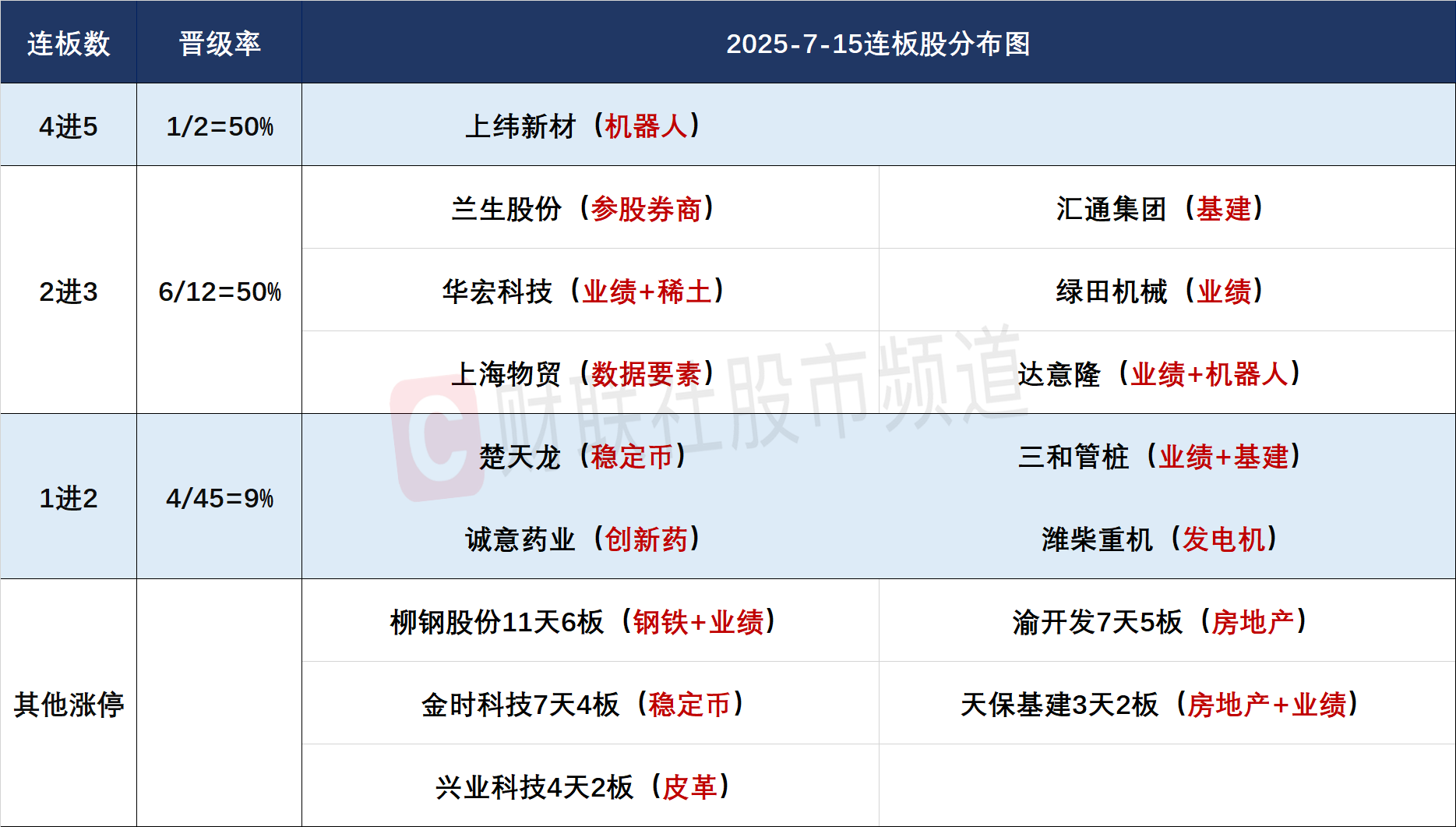
7月15日连板股分析:高位股持续低迷 算力硬件端权重大幅走强
news flash· 2025-07-15 07:57
Group 1 - The core viewpoint of the articles indicates a significant divergence in stock performance, with high-position stocks continuing to underperform while the computing hardware sector shows substantial strength driven by strong earnings from key players like Xinyi Technology [1] - A total of 42 stocks hit the daily limit up, with 11 stocks in a continuous rise, and 7 of them achieving three consecutive limit ups, reflecting a晋级率 of 38.89% excluding ST and delisted stocks [1] - The overall market saw over 4000 stocks decline, with 16 stocks hitting the daily limit down, indicating a notable increase in downward pressure [1] Group 2 - In the computing hardware sector, major stocks with strong fundamentals performed exceptionally well, with Xinyi Technology hitting the limit up at 20%, and other stocks like Zhongji Xuchuang and Shenghong Technology rising over 10% [1] - Small-cap stocks showed relatively weaker performance, with the micro-cap stock index dropping over 2% during the trading session [1] - Specific stocks such as Liu Steel and Jinshi Technology have shown notable performance, with Liu Steel achieving 6 limit ups in 11 days and Jinshi Technology achieving 4 limit ups in 7 days, indicating strong market interest in these companies [2]