种植业

Search documents
“粮食安全这根弦必须始终绷紧”——中央财办、中央农办有关负责人解读中央一号文件
Ren Min Ri Bao· 2026-02-05 00:27
Core Insights - The central document emphasizes the importance of agricultural modernization and outlines actionable policies to enhance food security and farmer income, while addressing both immediate and long-term agricultural challenges [1][2][10]. Group 1: Food Security - The overall food security situation in China is stable, with grain production expected to reach 1.43 trillion jin by 2025, maintaining a historical high [2]. - The document stresses the need to maintain a tight grip on food security, ensuring that production capacity, ecological sustainability, and income growth are all prioritized [2]. - Measures include stabilizing grain production areas, enhancing yield through improved agricultural practices, and implementing a new round of food production capacity enhancement actions [2][3]. Group 2: Farmer Income - Increasing farmer income is a central task, with a focus on stabilizing agricultural earnings through minimum purchase prices and subsidies [4]. - The document proposes a comprehensive set of measures to promote income growth, including support for local industries and the development of unique county economies [4][5]. - It emphasizes the importance of stable employment for migrant workers and the need for vocational training to match job demands [5]. Group 3: Agricultural Innovation - The document outlines a commitment to agricultural modernization through technological innovation, focusing on integrated innovation and application of new technologies [6][7]. - It highlights the importance of enhancing the agricultural technology innovation system and promoting the use of drones, AI, and IoT in agriculture [6][7]. - The goal is to transform agricultural practices from traditional methods to data-driven and algorithm-based approaches, thereby increasing efficiency [6]. Group 4: Poverty Alleviation and Support - The transition to normalized assistance for poverty alleviation is emphasized, with a focus on dynamic management of support targets to prevent poverty recurrence [8][9]. - The document outlines the need for precise and efficient support methods, including organized labor output and the use of public employment channels [8][9]. - It stresses the importance of maintaining stable financial and resource support for targeted poverty alleviation areas [9]. Group 5: Modern Agricultural Industry - The vision for agriculture is to evolve into a modernized large industry, emphasizing the need for a richer agricultural connotation and a complete industrial system [10][11]. - The document advocates for a diversified food supply system that includes ecological and cultural functions, alongside traditional agricultural production [11]. - It encourages the development of new industries such as rural tourism and leisure agriculture to meet changing consumer demands and promote rural economic prosperity [11].
推动农耕文明和现代文明有机融合交相辉映
Xin Lang Cai Jing· 2026-02-04 22:38
Core Viewpoint - The integration of traditional agricultural civilization and modern urban culture in Chengdu Plain is highlighted, showcasing the region's rich agricultural heritage and its evolution into a modern economic hub [1][10]. Agricultural Development - Chengdu Plain's agricultural practices are characterized by a highly developed irrigation system and a focus on rice cultivation, with the Dujiangyan irrigation system being a key historical achievement [2][4]. - The agricultural landscape has evolved over centuries, with significant changes during the Ming and Qing dynasties, including the introduction of high-yield crops and a two-crop system that enhanced land productivity [3]. Cultural Heritage - The "Linpan" settlement pattern, a unique agricultural community structure, reflects the integration of natural conditions and agricultural needs, forming a semi-natural, semi-artificial ecosystem [6][8]. - Linpan culture has historical roots dating back to the Qing Dynasty, evolving through the influence of immigration and local agricultural practices [7][8]. Modernization and Challenges - Since the establishment of the People's Republic of China, agricultural modernization has progressed, with mechanization and the introduction of high-yield varieties contributing to increased food production [4][10]. - The rapid urbanization and industrialization in Chengdu pose challenges to traditional agricultural landscapes, leading to the disappearance of some Linpan settlements [10]. Cultural Preservation Efforts - Recent initiatives by the Sichuan provincial and Chengdu municipal governments focus on the preservation and promotion of agricultural cultural heritage as part of rural revitalization and cultural confidence [11][12]. - Educational programs incorporating agricultural culture into school curricula aim to foster respect for land and agricultural labor among students [13]. Economic Significance - Chengdu Plain is a vital economic area, contributing significantly to the province's GDP and housing a majority of its population and high-tech industries [10].
金观平:提升农业产能和质量效益
Xin Lang Cai Jing· 2026-02-04 22:38
Core Viewpoint - The central government prioritizes enhancing agricultural comprehensive production capacity and quality efficiency, aiming to ensure food security while transitioning agricultural production from a quantity-focused approach to a quality-focused one [1] Group 1: Food Security and Production Goals - Food security is a critical national priority, with a target of achieving a grain output of 1.43 trillion jin by 2025, setting historical highs in total output and yield per unit area, while maintaining a per capita grain availability of 1000 jin [1] - The long-term balance between grain supply and demand remains tight, with structural shortages still prominent, necessitating continuous vigilance in food security [1] Group 2: Agricultural Production Strategies - The strategy emphasizes stabilizing grain and oil production through area maintenance and yield improvement, ensuring grain output remains above 1.4 trillion jin [2] - There is a focus on optimizing planting structures and regional layouts, enhancing soybean production, and expanding the cultivation of oilseeds like rapeseed and peanuts [2] - The approach advocates for a diversified food supply system, integrating agriculture, forestry, animal husbandry, and fishery [2] Group 3: Enhancing Agricultural Capacity - Significant improvements in agricultural infrastructure, machinery, and technology have been achieved, with a new initiative to enhance grain production capacity by 100 billion jin [2] - The strategy includes strict land use regulations, promoting high-standard farmland construction, and leveraging technology, including AI, to boost agricultural productivity [2] Group 4: Quality and Efficiency Improvement - The focus is on transitioning from quantity to quality in agricultural production, ensuring products are of high quality, well-marketed, and yield high returns [3] - There is an emphasis on enhancing the quality and safety of agricultural products through improved traceability and regulatory systems [3] - The development of rural industries and agricultural processing is encouraged to maximize the value chain from production to consumption [3] Group 5: Trade and Global Positioning - As a major agricultural product importer, the coordination between trade and production is crucial, with efforts to boost domestic production while promoting exports of competitive agricultural products [3] - The strategy includes managing imports of essential agricultural products to stabilize domestic markets and enhance the global competitiveness of agricultural enterprises [3]
提升农业产能和质量效益
Jing Ji Ri Bao· 2026-02-04 22:17
Core Viewpoint - The central government emphasizes enhancing agricultural comprehensive production capacity and quality efficiency as a priority, aiming to ensure food security while promoting a shift from quantity to quality in agricultural production [1] Group 1: Food Security - Food security is a critical national priority, with a target of achieving a grain output of 1.43 trillion jin by 2025, setting historical highs in total output and yield per unit [1] - The balance between grain supply and demand remains tight, with structural shortages still prominent, necessitating continuous vigilance in food security [1] Group 2: Agricultural Production Strategy - The strategy focuses on stabilizing grain and oil production by maintaining acreage and increasing yield, ensuring grain output remains above 1.4 trillion jin [2] - There is an emphasis on optimizing planting structures and expanding the production of diverse oilseeds, while also promoting a multi-faceted food supply system that includes agriculture, forestry, animal husbandry, and fishery [2] - The government plans to implement a new round of actions to enhance grain production capacity, leveraging improved infrastructure, technology, and strict land use regulations [2] Group 3: Quality and Efficiency Enhancement - The shift towards quality enhancement in agriculture aims to ensure superior production, better sales, and higher profits, adapting to consumer trends [3] - There is a focus on improving product quality, brand development, and establishing a comprehensive quality safety traceability system from farm to table [3] - The strategy includes promoting the processing of agricultural products and enhancing the value chain, ensuring farmers benefit more from industry value addition [3] Group 4: Trade and Global Positioning - As a major agricultural product importer, the coordination between trade and production is crucial, with efforts to stabilize domestic production while promoting exports of competitive agricultural products [3] - The government aims to enhance the international competitiveness of agricultural enterprises and actively participate in global food governance to establish a fairer global food security system [3]
新华全媒头条|人勤春早 不负春光——立春时节农耕一线见闻
Xin Hua She· 2026-02-04 12:38
Core Viewpoint - The article highlights the agricultural activities and advancements in China as spring begins, emphasizing the integration of traditional farming practices with modern technology to enhance crop yields and sustainability [1][4][12]. Group 1: Agricultural Innovations - The National South Breeding Research Institute in Hainan is showcasing new pepper varieties, with over 800 organizations and 8,000 researchers collaborating on breeding materials for more than 40 crop species [2]. - Advanced breeding technologies, such as molecular markers and functional gene integration, are significantly reducing breeding cycles and improving precision in crop development [3]. - In Shandong, local vegetable seed production has reached 2 billion seedlings annually, with 305 new vegetable varieties developed, some outperforming foreign seeds [3]. Group 2: Soil and Crop Management - The central government aims to stabilize grain production at approximately 1.4 trillion jin (about 700 million tons) as part of its agricultural strategy [4]. - In Jilin Province, protective farming practices are being implemented, with plans to reach 3 million acres of protective tillage by 2025, improving soil quality and increasing corn yields to 3,000 jin per hectare [6]. - In Yunnan, traditional practices are being maintained to ensure the sustainability of terraced farming, with farmers preparing for spring plowing and irrigation [7]. Group 3: Technological Integration - The use of drones for spraying growth regulators and fertilizers is becoming common, enhancing efficiency in large-scale wheat farming [8]. - The government plans to establish 135 million acres of high-standard farmland by 2030, with significant investments in irrigation and mechanization to reduce labor costs [8]. - The integration of ancient agricultural wisdom with modern technology is creating a robust framework for food security and rural revitalization [12]. Group 4: Industry Development - In Yunnan, coffee production is thriving, with over 13,600 acres dedicated to coffee cultivation, yielding more than 4,000 tons annually and generating an agricultural output value of 250 million yuan by 2025 [10]. - The development of a full-chain coffee industry, including value-added products, is significantly increasing the economic benefits for local farmers [10]. - The Ministry of Agriculture is supporting the establishment of numerous agricultural industry clusters and modern agricultural parks to drive rural revitalization [12].
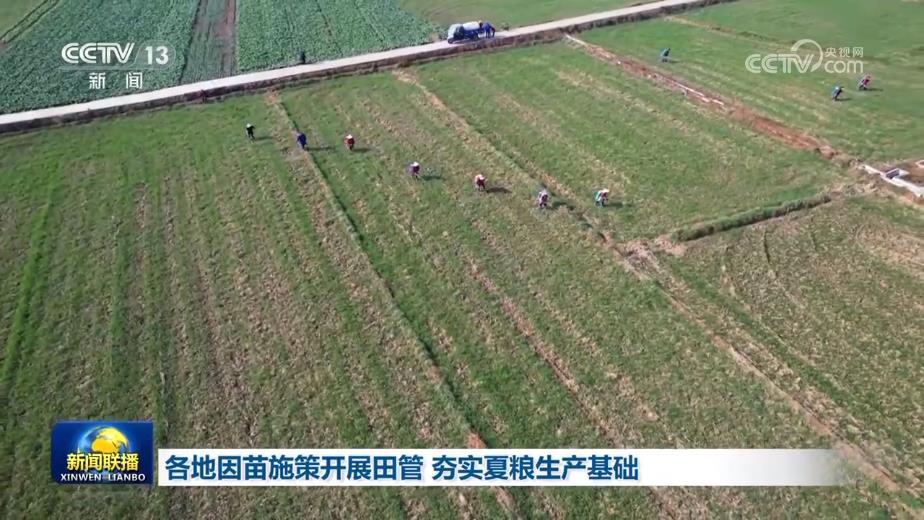
各地因苗施策开展田管 夯实夏粮生产基础
Yang Shi Wang· 2026-02-04 12:28
Group 1 - The beginning of spring, marked by the Lichun solar term on February 4, signifies the start of busy agricultural activities, particularly in winter wheat production areas [1] - The Ministry of Agriculture and Rural Affairs reports that northern winter wheat is about to green up, but the growth is generally weak due to late sowing caused by last year's unprecedented autumn floods [1] - In Anhui province, a major grain-producing area, over 1.6 million acres of winter wheat were sown late, with half of the area affected; local authorities are mobilizing service teams to apply water-soluble fertilizers to strengthen weak seedlings [1] Group 2 - In the southwestern wheat region, winter wheat is entering the jointing stage, with over 9 million acres under management; farmers are conducting aerial pest control based on temperature trends and pest occurrence patterns [3] - The national winter wheat planting area is expected to remain stable compared to last year, with the Ministry of Agriculture and Rural Affairs advising early preparation for spring field management and targeted strategies to enhance seedling growth [3]

当AI成“新农具”:从靠天吃饭到“数据掌舵”
Xin Lang Cai Jing· 2026-02-04 12:20
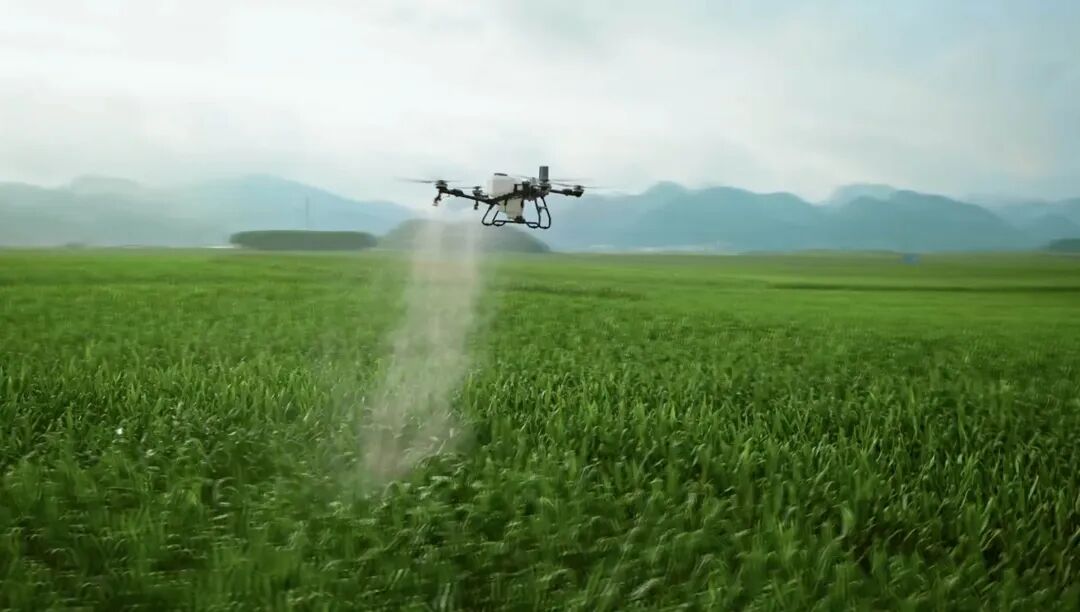
(来源:大象新闻) 锄禾日当午,汗滴禾下土。 在传统观念,农业总是和辛苦联系在一起。 2026年2月3日,中央一号文件《中共中央 国务院关于锚定农业农村现代化 扎实推进乡村全面振兴的意见》发布,这是党的十八大以来第14个指导"三 农"工作的中央一号文件,也是"十五五"首个中央一号文件。文件明确提出,因地制宜发展农业新质生产力,促进人工智能与农业深度融合。 一号文件高屋建瓴。走进中原大地,你会发现,这早已不是纸面蓝图,而是农民手机里跳动的数据、泵站里自动启停的阀门、天空中巡航的无人机。 在新乡获嘉县弘晟合作社,种粮大户们早就不用看天吃饭了,浇水也不用再扛铁锹,只需要在手机上点几下。2022年开始,获嘉县投资9.3亿元,建设30 万亩高标准农田,覆盖全县11个乡镇163个村。农民们只需在手机操作,就可以指挥田地里的任意一个喷灌器进行作业,"深埋滴灌"系统便将水肥精准送 达小麦根部。 不仅如此,农民们手机里的"智慧农业"软件,连接着当地高标准农田数智中心,墒情、虫情、苗情、灾害预警等一目了然。比着普通耕地,种高标准农 田,就像年轻人玩游戏,啥时候该浇地、施肥,还有病虫害防治,系统都会及时预警提醒。 这些不是个案,而 ...
@所有人,中央一号文件这些提法与你有关→
Jin Rong Shi Bao· 2026-02-04 11:33
Core Viewpoint - The "Opinions" issued by the Central Committee and State Council emphasize the importance of modernizing agriculture and rural areas, focusing on stable grain production, targeted assistance, and promoting farmers' income growth as key strategies for rural revitalization [1][2]. Group 1: Agricultural Production Capacity and Quality - The document highlights the necessity of ensuring national food security, with a target grain output of approximately 1.4 trillion jin [2]. - It stresses the integration of production capacity, ecological sustainability, and income growth, aiming to enhance agricultural productivity and quality [2]. - The focus is on optimizing agricultural production structures and improving grain quality to meet market demands [2]. Group 2: Implementation of Targeted Assistance - By 2025, over 7 million individuals will be identified for assistance to prevent poverty, with a focus on improving education, healthcare, housing, and water safety [3]. - The concept of "normalized precise assistance" is introduced to ensure the sustainability of poverty alleviation efforts, integrating support into the broader rural revitalization strategy [3][4]. - The approach emphasizes continuous and stable policy implementation to address the needs of vulnerable populations [3][4]. Group 3: Agricultural Technology Innovation - The document outlines plans to enhance agricultural modernization, with a goal of establishing over 75.68 million mu of high-standard farmland by 2025 [5]. - It aims for a mechanization rate of 76.7% in crop farming, with significant advancements in smart agriculture technologies [5]. - The focus is on developing high-end agricultural machinery and integrating AI and other technologies into agricultural practices [6]. Group 4: Promoting Farmers' Income Stability - The "Opinions" prioritize measures to ensure stable income growth for farmers, with a target of 24,456 yuan in per capita disposable income by 2025, reflecting a 6% increase from the previous year [7]. - The document outlines a comprehensive set of policies to address challenges such as low agricultural product prices and employment pressures for migrant workers [7][8]. - It emphasizes the importance of integrating various agricultural sectors to enhance income opportunities for farmers [8]. Group 5: Expanding Rural Consumption - The document encourages the expansion of rural consumption through various initiatives, including supporting new consumption models and enhancing service levels [8]. - It highlights the potential of integrating rural consumption with technology, culture, and tourism to create immersive experiences [9]. - The focus is on fostering new business models and enhancing the overall quality of rural services to stimulate economic growth [9].
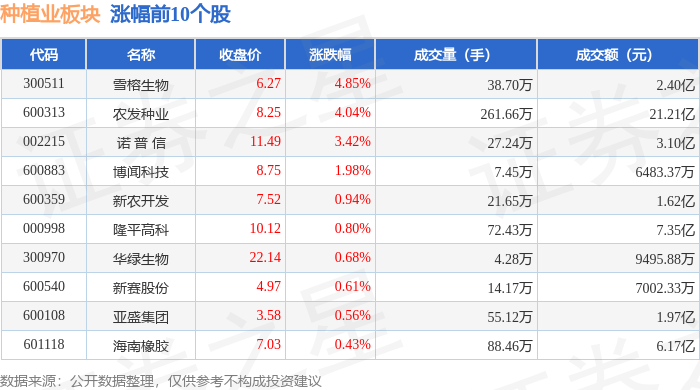
种植业板块2月4日涨0.28%,雪榕生物领涨,主力资金净流出7.09亿元
Zheng Xing Xing Ye Ri Bao· 2026-02-04 08:49
Market Overview - The planting industry sector increased by 0.28% compared to the previous trading day, with Xue Rong Biological leading the gains [1] - The Shanghai Composite Index closed at 4102.2, up by 0.85%, while the Shenzhen Component Index closed at 14156.27, up by 0.21% [1] Top Gainers in Planting Sector - Xue Rong Biological (300511) closed at 6.27, up by 4.85% with a trading volume of 387,000 shares and a transaction value of 240 million [1] - Nongfa Seed Industry (600313) closed at 8.25, up by 4.04% with a trading volume of 2.6166 million shares and a transaction value of 2.121 billion [1] - Nuo Puxin (002215) closed at 11.49, up by 3.42% with a trading volume of 272,400 shares and a transaction value of 310 million [1] Top Losers in Planting Sector - Dunhuang He V (600354) closed at 7.15, down by 2.59% with a trading volume of 1.1124 million shares and a transaction value of 799 million [2] - Qiu Le Seed Industry (920087) closed at 19.82, down by 2.36% with a trading volume of 256,800 shares and a transaction value of 530 million [2] - Wanxiang Denong (600371) closed at 9.45, down by 1.97% with a trading volume of 346,300 shares and a transaction value of 329 million [2] Capital Flow Analysis - The planting industry sector experienced a net outflow of 709 million from main funds, while retail funds saw a net inflow of 504 million [2] - The main funds showed a net inflow in Xue Rong Biological of 36.2962 million, while retail funds had a net outflow of 14.1443 million [3] - Nuo Puxin had a net inflow from main funds of 29.0745 million, with retail funds also experiencing a net outflow of 789,280 [3]