3D打印

Search documents
铂力特龙虎榜:营业部净卖出1.00亿元
Zheng Quan Shi Bao Wang· 2026-01-12 15:08
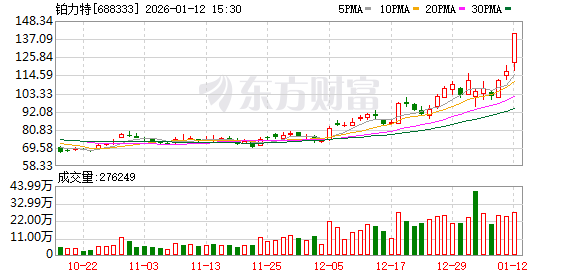
Group 1 - The closing price of Plutotech (688333) on January 12 was 140.27 yuan, reaching the daily limit with a trading volume of 36.30 billion yuan and a turnover rate of 10.07% [2] - The stock was listed on the daily trading list due to a price increase of 15% at the close [2] - The top five trading departments accounted for a total transaction of 10.24 billion yuan, with a net sell of 1.00 billion yuan [2] Group 2 - The main funds saw a net outflow of 93.96 million yuan throughout the day [3] - The top buying department was the Shanghai-Hong Kong Stock Connect, with a purchase amount of 176.32 million yuan [3] - The top selling department was also the Shanghai-Hong Kong Stock Connect, with a selling amount of 188.60 million yuan [3]


铂力特:截止2025年9月30日,公司商业航天营业收入占当期公司总收入比例约为3%
Ge Long Hui· 2026-01-12 12:00
Group 1 - The core viewpoint of the article is that the development stage of commercial aerospace is still early, and its contribution to the company's total revenue will be limited in the coming years [1] - By September 30, 2025, the revenue from commercial aerospace is expected to account for approximately 3% of the company's total revenue [1]
消费级3D打印行业专题:创意点亮生活,3D打印入万家
Guoxin Securities· 2026-01-12 11:14
Investment Rating - The report maintains an "Outperform" rating for the consumer-grade 3D printing industry [1] Core Insights - Technological advancements are driving the growth of the consumer-grade 3D printing industry, which is entering a period of widespread adoption. The global market is expected to exceed $4 billion by 2024, with a compound annual growth rate (CAGR) of 28% from 2020 to 2024. The sales of 3D printers alone are projected to reach $2.1 billion, growing at a CAGR of 21% during the same period [3][15] - The consumer-grade 3D printing market is characterized by intense competition, with Chinese companies dominating the landscape. By 2024, China is expected to account for 45% of global 3D printer exports, with major markets in the US and Europe [3][24] - The report highlights the growth potential of 3D printing consumables, which are expected to reach $1 billion by 2024, with a CAGR of 36% from 2024 to 2029. Chinese companies are gradually capturing market share in this segment [3][45] Summary by Sections 1. Technological Advancements Driving Growth - Continuous improvements in hardware and software are lowering the operational barriers for consumer-grade 3D printing, leading to increased market penetration. The global consumer-grade 3D printing market is projected to reach $4 billion by 2024, with a CAGR of 28% from 2020 to 2024 [3][15] - The number of consumer-grade 3D printers is expected to reach approximately 15.8 million units globally by 2024, indicating a penetration rate of only 1.8% among the 860 million households in the US, Europe, and China, suggesting significant growth potential [3][15] 2. Competitive Landscape - The report identifies a competitive landscape where Chinese companies, such as Chuangxiang Sanwei and Tuozhu, are leading the market. Chuangxiang Sanwei holds a market share of 28% in cumulative shipments from 2020 to 2024, while Tuozhu is expected to lead in 2024 with a 29% market share [3][27] - The competition is primarily driven by product capabilities, with a focus on technological research and development, as well as supply chain efficiency [3][28] 3. Company Profiles - Chuangxiang Sanwei offers a diverse range of products, including 3D printers, consumables, and services, with projected revenues of 2.3 billion yuan in 2024 and a stable gross margin of around 30% [3][35] - Tuozhu Technology focuses on integrating advanced technologies into their 3D printers, enhancing user experience and product performance, which has propelled them to the top of the industry [3][44] 4. Growth of 3D Printing Consumables - The consumables segment is expected to grow significantly, with the market projected to reach $1 billion by 2024, driven by the increasing number of 3D printers in use. The CAGR for this segment is anticipated to be 36% from 2024 to 2029 [3][45] - Chinese companies are gradually increasing their market share in the consumables sector, particularly in upstream resin production and modified plastics [3][45]

铂力特:商业航天的发展阶段较为前期,未来几年对公司的总营业收入贡献有限
Mei Ri Jing Ji Xin Wen· 2026-01-12 10:48
Group 1 - The company announced that it has not found any undisclosed significant information that may have a substantial impact on its stock trading price, following a self-examination [1] - The development stage of the commercial aerospace sector is still in its early phases, which will contribute limited revenue to the company in the coming years [1] - As of September 30, 2025, the revenue from commercial aerospace is expected to account for approximately 3% of the company's total revenue for that period [1]
两企融资,一企破产;鞍钢设新公司入局增材制造;全球消费级3D打印机九成中国造|库周报
Sou Hu Cai Jing· 2026-01-12 07:24
Major Events - China dominates the consumer-grade 3D printing market, producing approximately 90% of the global supply, with Shenzhen accounting for 90% of that production, establishing itself as the manufacturing hub for consumer-grade 3D printers [3] - The United States and Europe together hold over 70% of the global market share, while China's domestic market share is around 10%, indicating a strong export-oriented characteristic of the industry [3] Industry Dynamics - Ansteel Group has established a new company, Anshidi Materials Technology, with a registered capital of 20 million yuan, focusing on additive manufacturing and new materials research and development [4] - Black Buffalo 3D, a US-based construction 3D printing company, has filed for bankruptcy protection, highlighting challenges in its commercialization path [5] - The seventh batch of group standards for additive manufacturing medical devices has been released, covering areas such as oral, orthopedic, biomaterials, and advanced manufacturing processes [6][7] Fun Manufacturing - Cobra has launched two new 3D printed golf clubs, the 3DP MB and 3DP X, which combine the feel of forged irons with larger clubhead forgiveness, enhancing shot distance [8] - JD's Jingzhao has introduced 3D printed slippers priced at 299 yuan, with a promotional price of 255.55 yuan after government subsidies, indicating a growing acceptance of consumer-grade 3D printed footwear [9] - Tim, a well-known tech influencer, showcased the ability to turn photos into 3D printed models at CES 2026, emphasizing the appeal of 3D printing technology [10] Financing/Mergers and Acquisitions - Beijing Yuding Additive Manufacturing Research Institute has completed a Pre-A round financing of several hundred million yuan, aimed at the R&D and industrialization of key technologies for large metal components in additive manufacturing [11] - Suzhou Xianyi Technology has secured seed round financing of 10 million yuan, which will be used for new product development, market expansion, and capacity building [12] New Products - Creality has launched the SPARKX i7, a multi-color 3D printer that supports AI and photo modeling, featuring a quick setup time and improved material efficiency [13] - Shenzhen BIQU has released a food-grade 3D printing accessory called "Panda Treat," which allows for the printing of edible designs on food [14] - Shumei Wanhua has introduced the Hitem3D 2.0, a high-definition model generation tool that enhances the realism and structural integrity of 3D printed models [15] - China Aerospace Science and Industry Corporation has developed a 36-beam laser metal 3D printer, achieving a 300% increase in forming efficiency and a 40% reduction in equipment costs [16] Cutting-edge Technology - A research team led by Academician Lü Jian has published findings in Nature Communications, proposing a new design paradigm for additive manufacturing that enhances the strengthening efficiency of titanium alloys [17]

AI浪潮下造物权革命-3D打印飞入寻常百姓家
2026-01-12 01:41
Summary of 3D Printing Industry Conference Call Industry Overview - The global 3D printing market is approximately $25 billion, equivalent to about 170 billion RMB, with a projected annual growth rate of nearly 20% from 2024 to 2034 [2][10] - The consumer-grade 3D printing market is valued at around $4 billion, representing 16% of the total 3D printing industry, and is expected to grow at a faster rate than the overall industry [2][10] Key Insights and Arguments - The consumer-grade 3D printing market is driven by improvements in product capabilities (e.g., automatic leveling, laser monitoring, AI modeling), decreasing prices (basic models below smartphone prices), and enhanced brand effects, significantly optimizing user experience and expanding the market [1][6] - The 3D printing industry value chain consists of upstream materials (20%), midstream equipment (28%), and downstream services (52%), with midstream equipment being the technological source and value center crucial for upgrading upstream and downstream [1][7] - China holds a significant position in global consumer-grade 3D printing equipment exports, with North America accounting for about 35%, Europe for about 30%, and the Asia-Pacific region for about 26% [8] Future Growth Potential - The consumer-grade 3D printing market is expected to see high growth rates, particularly in 2025, with ongoing acceleration thereafter [2][10] - By 2030, the industry is projected to reach sales levels exceeding 10 million units, similar to the 2D printer market [10] - The introduction of multi-head, multi-color 3D printing technology in 2026 is anticipated to significantly reduce waste and printing time, driving broader applications of mixed-color products [15] Notable Companies and Investment Opportunities - Companies to watch include upstream material provider Jialin Technology, midstream company Chuang 3D (expected to go public), and various emerging service providers [9][14] - The 3D printing materials market is diverse, with a strong focus on PLA, which constitutes over 50% of consumer-grade applications [11] Additional Considerations - The service sector around 3D printing technology is crucial, providing manufacturing and design solutions, with significant potential in both domestic and overseas markets [12][13] - The trend of brand materials being tied to equipment is expected to enhance user experience and product quality [11]
股市必读:南风股份(300004)1月9日董秘有最新回复
Sou Hu Cai Jing· 2026-01-11 17:22
Core Viewpoint - The stock of Nanfeng Co., Ltd. (300004) closed at 13.4 yuan on January 9, 2026, reflecting a 2.52% increase, indicating positive market sentiment towards the company [1] Group 1: Company Performance - On January 9, 2026, Nanfeng Co., Ltd. experienced a trading volume of 628,000 shares and a transaction value of 850 million yuan [1] - The net inflow of main funds was 24.71 million yuan, suggesting strong interest from institutional investors [1] Group 2: Business Development - The company is actively advancing its 3D printing business through its wholly-owned subsidiary, Nanfang Additive, focusing on sectors such as shoe molds, military, commercial aerospace, and microchannel cooling [1] - The company is in the process of sample delivery and business negotiations, with ongoing discussions on technical solutions with potential clients [1]

增材龙头冲刺IPO,抢占商业航天千亿赛道
Shang Hai Zheng Quan Bao· 2026-01-11 15:16
Core Insights - The commercial aerospace index has seen a continuous rise, with a total market value exceeding 8.9 trillion yuan, indicating a strong focus from both capital markets and the industry on this sector [1] - Hangzhou E-Additive Manufacturing Technology Co., Ltd. (E-Additive) is positioned as a key supplier in the commercial aerospace manufacturing equipment sector, leveraging its advanced large-scale metal 3D printing technology [1][3] - The company is preparing for an IPO on the Sci-Tech Innovation Board, aiming to raise 1.205 billion yuan to enhance its core business [2][3] Company Performance - E-Additive's revenue is projected to grow from 247 million yuan in 2022 to 471 million yuan in 2024, reflecting a compound annual growth rate of 38.06% [3] - The net profit attributable to the parent company is expected to increase from 28.93 million yuan to 98.81 million yuan during the same period, showcasing the company's improving profitability [3] Technological Advancements - E-Additive has developed significant technological capabilities, including over 130 authorized patents and participation in national standards formulation, establishing itself as a key player in the industry [3] - The company has addressed critical manufacturing challenges in aerospace, such as reducing the weight of rocket engines by over 50% and shortening delivery times from months to weeks through its 3D printing technology [5] Market Demand - The demand for E-Additive's solutions is evident as it serves leading commercial aerospace companies, contributing to the production of critical components for various rocket engines [6] - The company is also expanding its international presence, having established subsidiaries in Germany and the USA, and forming strategic partnerships to enhance its global service network [6] Industry Outlook - The commercial aerospace sector is entering a new phase of large-scale development, supported by national policies and funding, with a focus on satellite deployment and deep space exploration [8] - E-Additive is expected to leverage its technological and market advantages through capital market support, positioning itself as a leading player in the burgeoning trillion-yuan commercial aerospace market [8]
全体上刺刀——A股一周走势研判及事件提醒
Datayes· 2026-01-11 14:14
Group 1: Aerospace Industry - China plans to apply for frequency resources for over 200,000 satellites by December 2025, indicating a strategic national focus on satellite technology [1] - The U.S. FCC has approved SpaceX to deploy an additional 7,500 Starlink satellites, increasing the total to approximately 15,000, enhancing global broadband coverage and competitive edge in satellite communications [1] Group 2: Renewable Energy and Battery Industry - From April 1, 2026, China will cancel VAT export rebates for photovoltaic products and reduce the rebate rate for battery products from 9% to 6%, leading to a potential surge in exports before the policy takes effect [4][5] - The solar energy sector accounts for about 10% of China's aluminum demand, and the upcoming policy changes are expected to positively impact aluminum demand in Q1 [4] Group 3: Market Trends and Investment Strategies - Analysts suggest that the current market sentiment is driven by emotions and liquidity, with expectations of continued upward movement in A-shares, particularly in technology and robotics sectors [12] - The spring market rally is anticipated to continue, with a focus on sectors that show strong performance and potential for growth, despite short-term volatility [12][13] Group 4: Robotics Industry - Hangzhou Xinjian Electromechanical Transmission Co., Ltd. has initiated listing guidance, recognized as a primary supplier for humanoid robots [17] - At CES 2026, AAC Technologies showcased a comprehensive humanoid robot solution, indicating advancements in robotics technology [18] Group 5: AI and Computing - DeepSeek is set to launch a new AI model with enhanced code generation capabilities, reflecting ongoing advancements in AI technology [20] - Tencent's new chief scientist highlighted that the productivity gains from current AI models are just beginning to be realized, with significant commercial opportunities ahead [20] Group 6: Rare Earth Industry - Chinese state-owned enterprises have notified some Japanese companies of the termination of new sales contracts for rare earths, marking a significant shift in trade relations [23] - The price index for rare earths has been launched, with recent data showing a slight increase in prices for praseodymium and neodymium [25]

95后海归博士在苏州创业,获千万元种子轮投资
Sou Hu Cai Jing· 2026-01-09 09:34
Group 1 - Xianyi Technology, a high-tech company focused on 3D printing technology, has completed a seed round financing of 10 million RMB, led exclusively by Tailun Capital [2] - The funding will be used for technology research and development as well as team expansion to further promote industrialization [2] - Founded in October 2025 by post-95 returnee PhD Xue Bo, the core team consists of several returnee PhDs and experienced market directors, all with strong backgrounds in materials science [2] Group 2 - Continuous fiber 3D printing technology enhances mechanical properties by synchronously extruding continuous fiber-reinforced materials with thermoplastic resin matrices, enabling lightweight and high-strength combinations [4] - Xianyi Technology has developed the first domestic large-size multi-axis continuous fiber 3D printer, achieving breakthroughs in speed, strength, and intelligence [4] - The F1 series high-temperature continuous fiber printer operates at 2-4 times the forming speed of similar products and supports aerospace-grade materials like PEEK and PEKK [4] Group 3 - The company aims to bring aerospace-grade composite material performance to large-scale industrial applications at faster speeds and lower costs [5] - Tailun Capital's representative expressed confidence in Xianyi Technology's innovative technology in the 3D printing field, aligning with future manufacturing trends [5]