Energy

Search documents
How to Play Defense as Oil Spikes and Markets Slide
Barrons· 2026-03-03 19:32
Core Viewpoint - Oil prices are rising due to concerns over a prolonged conflict in Iran, prompting investors to seek protection through gold, energy stocks, dividend payers, and alternative investments [1] Group 1: Oil Market - The increase in oil prices is attributed to fears surrounding the potential escalation of conflict in Iran [1] Group 2: Investment Strategies - Investors are turning to gold as a safe-haven asset amid rising oil prices [1] - Energy stocks are being favored as a potential hedge against inflation and geopolitical risks [1] - Dividend-paying stocks are attracting attention for their ability to provide steady income during volatile market conditions [1] - Alternative investments are also being considered as a means of diversification and risk management [1]


Enbridge: Gulf Instability's Quiet Beneficiary (NYSE:ENB)
Seeking Alpha· 2026-03-03 14:14
Core Insights - The article emphasizes the importance of a strong foundation in finance and strategy, particularly in sectors like banking, mining, and energy [1] - It highlights the significance of a balanced investment approach, focusing on both value stocks and growth opportunities [1] - The investment philosophy is centered around thorough research and a long-term perspective, which aids in navigating market cycles [1] Company Insights - The company operates in the retail real estate sector, overseeing complex financial operations and strategy [1] - The role of the Head of Finance is crucial in managing financial operations effectively within the company [1] Investment Strategy - The investment strategy involves uncovering promising under-the-radar stocks that may not be widely recognized in the market [1] - A balanced portfolio approach is maintained, with a growing emphasis on value stocks while still capturing growth opportunities [1]

Flotek Industries Awarded Its First Contract to Deliver Power Services for Utilities Infrastructure Support
Prnewswire· 2026-03-03 11:55
Core Insights - Flotek Industries, Inc. has secured its first contract in the utilities infrastructure sector, focusing on delivering power services to support federal disaster recovery initiatives [1] - The contract involves the installation of up to 50 megawatts (MW) of advanced power generation equipment, utilizing Flotek's proprietary PWRtek platform for enhanced efficiency and resilience [1] Contract Details - The initial term of the contract is six months, starting in the second quarter of 2026, with an option for the customer to extend for an additional four years at the same rental rate [1] - Revenue during the initial term will depend on the customer's final power requirements, potentially totaling approximately $1 million per MW if the full 50 MW is deployed [1] - Equipment deployment will occur in phases over several weeks following the contract start date, allowing for operational integration [1] Technology and Services - Flotek will provide up to 50 MW of scalable power integrated with advanced gas distribution and smart conditioning systems [1] - The smart conditioning skids are designed to optimize fuel delivery and ensure continuous performance, while the gas distribution skid allows independent fuel control for each generator set [1] - The deployment aims to energize a newly constructed residential location and support local critical infrastructure [1] Strategic Importance - This contract represents a significant milestone for Flotek, showcasing its capabilities in delivering high-reliability utilities infrastructure support under challenging conditions [1] - The opportunity highlights the strong demand for Flotek's advanced power technologies in emergency and infrastructure markets, aligning with the company's corporate strategy [1]


Global shares are mostly lower as investors focus on the Iran war's impact on energy supplies
ABC News· 2026-03-03 09:30
Market Overview - Global shares mostly declined due to concerns over energy supply threats from the Iran war [1] - U.S. futures also fell, with the S&P 500 down 1.5% and the Dow Jones Industrial Average down 1.6% [2] Regional Market Performance - In early European trading, France's CAC 40 dropped 2.2% to 8,207.10, Germany's DAX sank 2.9% to 23,935.62, and Britain's FTSE 100 declined 2.2% to 10,546.30 [2] - South Korea's Kospi plunged 7.2% to 5,791.91 as markets reopened after a holiday [2] - Japan's Nikkei 225 sank 3.1% to finish at 56,279.05, with concerns over oil supply impacting resource-poor countries [3] Oil Prices - Benchmark U.S. crude rose by $3.24 to $74.47 per barrel, while Brent crude increased by $3.56 to $81.30 per barrel [3] - Analysts noted that Japan has a sizable stockpile of oil lasting more than 200 days, mitigating immediate threats [4] Airline Industry Impact - Airline stocks, including American Airlines, United, and Delta, were among the biggest losers due to rising fuel costs and airport closures [5] - In Asia, ANA stock fell 3.3%, Japan Airlines dropped 6.4%, Korean Air declined 10.3%, and Qantas Airways lost 1.8% [6] Historical Context - Past military conflicts in the Middle East have not led to long-term declines in U.S. stocks, with significant oil price increases needed to cause sustained market impacts [7] - Historical data shows that energy shocks do not automatically derail equities unless they are severe and sustained [8]

World’s hottest stock market suddenly blows cold with a 7% tumble
Yahoo Finance· 2026-03-03 09:19
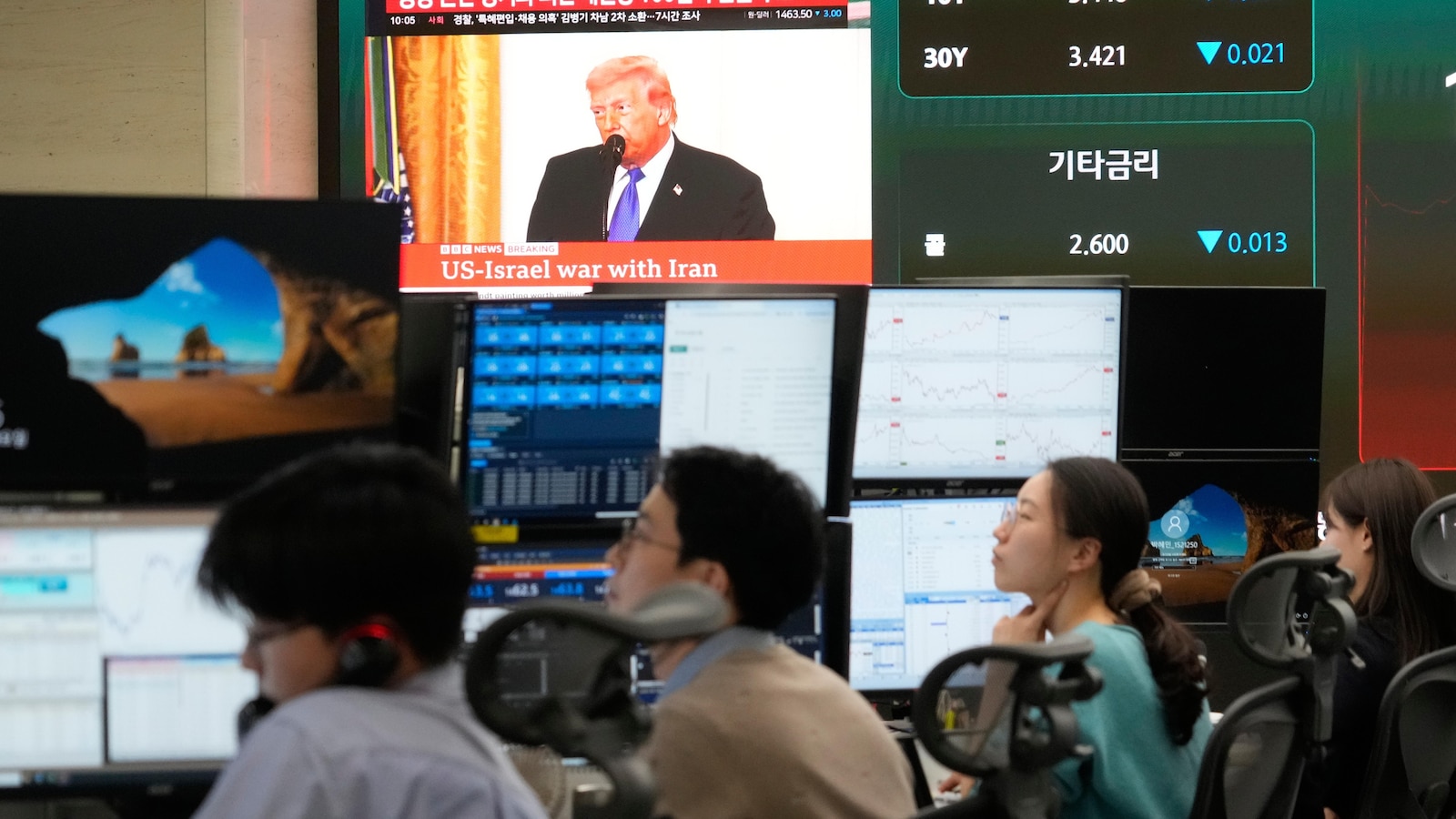
Market Overview - Foreign investors have sold more than $7 billion in Korean shares over the last two trading sessions, leading to significant losses in the South Korean stock market [2] - The Kospi Composite index experienced a 7% correction, prompting market regulators to implement a short-term suspension of program trading due to triggered circuit breakers [3] Currency and Commodities - The Korean won depreciated by 1.34% against the U.S. dollar amid a risk-off sentiment towards emerging-market currencies, influenced by rising crude oil prices following U.S.-Israeli strikes on Iran [4] - South Korea, as one of the largest importers of crude oil, requires approximately 2.7 million barrels daily, with around 70% of its supplies sourced from the Middle East [4] Major Companies Impacted - Samsung Electronics and SK Hynix, the world's largest memory-chip manufacturers, saw their shares decline by 9.88% and 11.5%, respectively [5] - Despite these declines, the Korean market has shown healthy returns of 37% year-to-date in 2026 and 128% over the last 12 months, although recent trading activity indicated speculative behavior among retail traders [5] Investor Behavior - Data from the Korean exchange indicated that international investors began reducing their exposure, with a net outflow of 7 trillion won ($4.7 billion) on the last trading day of February, followed by another net selling of 5.4 trillion won [6] - The recent drop in the benchmark index marked the largest one-day decline since the volatility caused by the yen carry trade unwind in August 2024 [6] Sector Performance - Certain sectors, including shipping companies like Korea Line Corp. and STX Green Logis, defense stocks such as Hanwha Systems and Lig Nex1 Co, and energy companies like Daesung Energy, experienced upward movement amid the broader market decline [7]
X @Bloomberg
Bloomberg· 2026-03-03 08:04
Syzygy Plasmonics makes a series of deals aimed at a massive increase in the supply of sustainable jet fuel https://t.co/GY40bmC0EQ ...
As Missiles Fly, is it Time to Buy?
ZACKS· 2026-03-03 00:30
Geopolitical Impact on Markets - The U.S. and Israel launched a coordinated air attack against Iran, ending Ayatollah Ali Khamenei's 36-year rule, which was anticipated by the markets [1] - Despite the attack, stocks rose on Monday, indicating that markets often discount future events [2] - Defense stocks and drone manufacturers, such as Red Cat Holdings, experienced strong rallies due to the military buildup in the Middle East [3] Military Operation Success - The military operation against Iran has been largely successful, with significant leadership losses for Iran and minimal U.S. casualties [4] - The operation's efficiency has exceeded expectations, contributing to positive market sentiment [12] Investment Opportunities - Geopolitical conflicts can create buying opportunities for investors, as seen in the current market reaction [5] - AI infrastructure investments remain robust, with NVIDIA investing $2 billion in Lumentum and Coherent, highlighting the importance of optics in AI development [9] - Beaten-down sectors like software and Bitcoin are showing signs of recovery, with the iShares Software ETF approaching its 200-week moving average [10] Market Resilience - The market's reaction to geopolitical events demonstrates its predictive nature, with investors having already positioned themselves in energy and defense sectors prior to the strikes [12] - The ongoing investment in AI infrastructure continues to support a bullish outlook for the broader market [12]

ETF Edge on positioning in international markets amid the war in the Middle East
Youtube· 2026-03-03 00:17
Core Viewpoint - The recent geopolitical tensions, particularly the conflict involving the US, Israel, and Iran, have raised questions about the landscape for global investing, especially in emerging markets [3][4][5]. Geopolitical Impact - The Middle East represents only about 5% of emerging markets, and while there may be short-term tactical changes due to higher oil prices, the long-term outlook suggests a weaker dollar and stronger emerging market equities [4][5]. - If the conflict persists, it could lead to higher oil prices, inflation, and interest rates in the US, potentially strengthening the dollar, which would be a headwind for emerging markets [7]. Investor Sentiment - Despite heightened geopolitical risks, investor sentiment appears resilient, with many investors accustomed to geopolitical noise and maintaining a risk-on approach [10][11]. - A survey indicated that over 75% of advisors still favor equity risk for investments in 2026, suggesting a strong appetite for risk [13]. Emerging Market Strategies - Emerging markets are seeing a shift towards more discerning investment strategies, with a focus on smaller pockets and active strategies to mitigate concentration risk, particularly in Asia [17][18]. - Countries like Argentina, Brazil, and Colombia are highlighted for their value opportunities, with low price-to-earnings multiples and exposure to commodities [19][23]. Political and Economic Factors - Political reforms in Latin America, such as those in Argentina and Brazil, are expected to drive fiscal reform and reduce risk premiums, attracting more investment [22]. - Brazil's high real interest rates and favorable inflation rates create a stable environment for investment, particularly in financials [23][42]. ETF Market Trends - International equities, especially emerging markets, have seen significant inflows, with over 40% of ETF flows directed towards international ETFs, marking a trend not seen in many years [30]. - The popularity of actively managed ETFs is increasing as investors seek targeted exposure to specific countries and sectors within emerging markets [35][38]. Sector Focus - The focus is shifting towards value and cyclicals, particularly in commodities like copper, energy, and gold, with financials expected to benefit from improving asset quality as interest rates decline [42]. - The technology sector, particularly in Asia, remains attractive due to strong tailwinds from the AI ecosystem, but there is a cautious approach towards momentum trades [26][41].

Kharg Island is a 'choke point' for Iran's oil exports, says VanEck Funds CEO
CNBC Television· 2026-03-02 20:31
Here for more on how investors should position and think about these escalating geopolitical risks is Yan Vanek. He is the CEO of Vanek Funds. It's great to see you.Um Hel Lima just was talking there about China and the kind of knock-on effect this could have and whether they've been as Doug Bergam said stockpiling to maybe be ready for a scenario like this and what would you be kind of following there. >> Yeah, I mean there's there's one concept or one dimension of this that no one seemingly has mentioned ...
Berkshire Hathaway shares slide after earnings, CEO letter
Reuters· 2026-03-02 19:16
Core Viewpoint - Berkshire Hathaway's shares experienced their largest decline since the announcement of Warren Buffett's succession plan, following disappointing financial results and cautious investment outlook from the company [1]. Financial Performance - In the fourth quarter, Berkshire Hathaway reported an operating profit of $10.2 billion, marking a 30% decrease compared to the previous year, with Geico and other insurance businesses seeing a 38% decline [2]. - Analyst Meyer Shields noted that the results broadly missed forecasts, reflecting weaknesses in various sectors including BNSF railroad, energy, manufacturing, and retail, leading to a 5% reduction in his 2026 earnings forecast for the company [4]. Strategic Outlook - Greg Abel, in his first annual letter to shareholders, indicated that Geico may continue to face challenges in retaining customers due to competitive pricing pressures, while other insurance operations are also experiencing pricing pressures from increased capital in the market [3]. - Despite holding a significant cash stake of $373 billion, Abel emphasized a careful assessment of value and a long-term investment strategy, without indicating plans for stock buybacks or dividends [3].