垃圾处理

Search documents
事关水电气热等领域,公用事业领域反垄断指南出台
证券时报· 2026-02-11 12:14
Core Viewpoint - The article discusses the issuance of the "Antitrust Guidelines for the Public Utilities Sector" by the State Council, aimed at preventing and curbing monopolistic behaviors in public utilities, ensuring fair market competition, and protecting consumer and public interests [1][4]. Group 1: Background and Purpose - The public utilities sector, which includes water supply, electricity, gas, heating, sewage treatment, waste disposal, and public transportation, often exhibits natural monopolistic characteristics [7]. - Recent years have seen a rise in monopolistic behaviors within this sector, where operators extend their monopolistic advantages to upstream and downstream competitive segments, limiting market competition [2][8]. - The guidelines consist of seven chapters and 50 articles, summarizing enforcement experiences and providing clear rules for identifying monopolistic behaviors in public utilities [2][9]. Group 2: Key Contents of the Guidelines - The guidelines outline the overall principles for antitrust enforcement in the public utilities sector, emphasizing the need for operators and industry associations to establish compliance management systems to prevent risks [12][14]. - Specific provisions include the clarification of the rights and procedures for whistleblowers, and the prohibition of monopolistic behaviors through data algorithms [15][16]. - The guidelines detail the forms of monopolistic agreements and the conditions under which certain agreements may be exempt from prohibition [18][21]. Group 3: Market Dominance and Abuse - The guidelines provide a framework for analyzing the abuse of market dominance, including factors for determining whether a public utility operator holds a dominant market position [22][24]. - They specify considerations for identifying unfair pricing, refusal to deal, and other abusive practices, along with common justifications that may not be accepted as valid [26][27]. - The guidelines also address the review of operator concentrations, particularly in natural monopoly segments, and the potential requirement for operators to report concentrations that may restrict competition [27][28]. Group 4: Legal Responsibilities and Enforcement - The guidelines clarify the legal responsibilities of public utility operators and industry associations in cases of antitrust law violations, including the consequences of aiding in monopolistic agreements [32][34]. - They emphasize the importance of compliance with antitrust regulations and the potential for penalties to be recorded in credit histories, highlighting the collaborative enforcement approach among regulatory bodies [34].

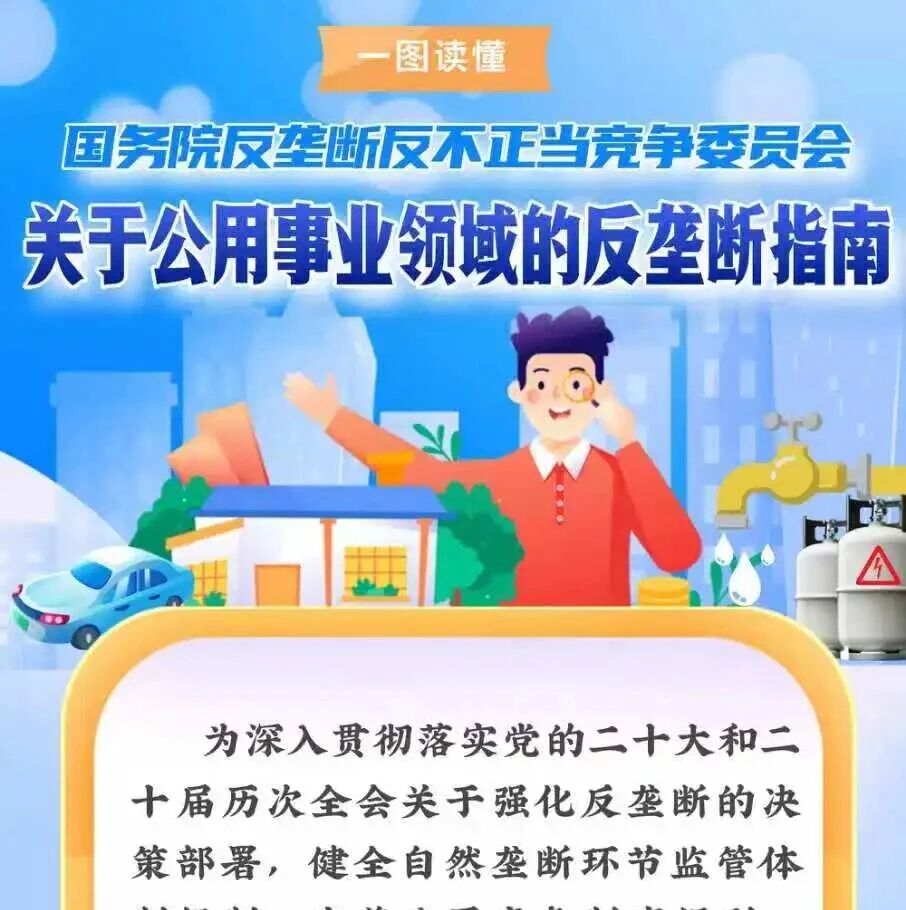
事关水电气热等领域,公用事业领域反垄断指南出台
中国能源报· 2026-02-11 10:52
Core Viewpoint - The article discusses the release of the "Antitrust Guidelines for Public Utilities" by the State Council Antitrust Committee, aimed at preventing monopolistic behaviors in public utility sectors such as water, electricity, gas, heating, sewage treatment, waste management, and public transportation [1][3]. Group 1: General Principles - The purpose of the guidelines is to prevent and stop monopolistic behaviors in public utilities, guide operators in antitrust compliance, strengthen regulation of natural monopoly sectors, and protect fair market competition and consumer interests [3]. - The guidelines emphasize maintaining fair competition, scientifically regulating the sector, enhancing public welfare, and supporting high-quality development [4][5]. Group 2: Antitrust Compliance - Public utility operators are encouraged to strengthen antitrust compliance management and identify potential legal risks [5]. - Industry associations in the public utility sector should enhance antitrust compliance management and self-discipline to avoid violations of antitrust laws [5]. Group 3: Reporting and New Monopolistic Behaviors - Any individual or organization can report suspected monopolistic behaviors in the public utility sector to antitrust enforcement agencies, which must keep the whistleblower's identity confidential [6]. - Public utility operators are prohibited from using data, algorithms, technological, capital advantages, or platform rules to engage in monopolistic behaviors [6]. Group 4: Market Definition - The guidelines provide a framework for defining relevant markets in the public utility sector, considering factors such as product characteristics, usage costs, and consumer dependency [8][9]. - The geographic market is defined based on the physical network or infrastructure coverage of the public utility operator [7]. Group 5: Monopolistic Agreements - The guidelines outline the criteria for identifying monopolistic agreements, including horizontal and vertical agreements that restrict competition [9][10]. - Public utility operators must not engage in practices that could be deemed as price-fixing, market division, or limiting production [10][11]. Group 6: Abuse of Market Dominance - The guidelines specify the framework for identifying abuse of market dominance, including unfair pricing and refusal to deal [12][13]. - Factors such as market share, dependency of consumers, and barriers to market entry are considered in determining market dominance [14][15]. Group 7: Operator Concentration - Public utility operators can legally concentrate through fair competition and voluntary cooperation, but must report to antitrust authorities if they meet certain thresholds [19][20]. - The guidelines emphasize the need for scrutiny of concentrations that may harm competition, especially in natural monopoly sectors [25][26]. Group 8: Fair Competition Review - Administrative bodies must conduct fair competition reviews for policies affecting public utility operators to ensure equal access to resources and fair market participation [28][29]. - The guidelines prohibit the abuse of administrative power to limit competition in the public utility sector [30][31]. Group 9: Legal Responsibilities - Violations of antitrust laws by public utility operators, industry associations, and administrative bodies will be subject to legal consequences as outlined in the guidelines [39][40]. - The guidelines encourage cooperation with investigations and provide for leniency in penalties for those who actively assist in compliance [45][46].
圣元环保:目前主营业务为垃圾焚烧发电和城市生活污水处理
Zheng Quan Ri Bao Wang· 2026-02-10 05:48
Core Viewpoint - Shengyuan Environmental Protection (300867) is focusing on its main businesses of waste incineration power generation and urban sewage treatment while actively developing a new health industry centered around taurine raw materials and their derivatives [1] Group 1: Business Focus - The company currently operates in waste incineration power generation and urban sewage treatment [1] - The company is also developing a new health industry focused on taurine raw materials and their derivatives [1] Group 2: Future Plans - For the year 2026, the company aims to enhance the refined operational management of existing projects and expedite the production and efficiency of new projects under construction [1] - Specific development goals and work plans for 2026 will be detailed in the company's 2025 annual report [1]

中科环保(301175):以“绿能综合利用”为方向 积极探索多元应用领域
Xin Lang Cai Jing· 2026-02-09 12:47
控股公司绵阳中科与星际荣耀达成合作意向,开辟商业航天应用领域。2025 年上半年,中科环保控股 公司绵阳中科与四川星际荣耀航天动力有限责任公司达成合作意向,并签署了《合作框架协议》。双方 将围绕绿色低碳能源应用、尖端科技融合等领域展开深度合作。中科绵投通过餐厨垃圾与污泥处理,制 备绿色生物天然气,加注液氧甲烷火箭,实现低碳燃料替代,并提供绿色电能、绿色热能、中水及除盐 水等清洁能源支持,为星际荣耀航天动力生产提供全链条低碳化支持,实现了"环保+航天"的跨界协同 创新。根据绵阳发布引用星际荣耀相关负责人介绍,通过此次合作,成本将节约20%。 垃圾焚烧技术始于中科院,技术装备获市场高度认可。公司垃圾焚烧技术始于1995 年中国科学院工程 热物理所开发的循环流化床生活垃圾焚烧技术,后消化吸收丹麦伟伦炉排炉技术且不断改进。在先进焚 烧技术与装备、污染物超低排放控制技术与装备、智能技术工程化应用等领域具有显著的技术优势。 2025 年11 月,公司再获改造项目设备供货新订单,助力东北地区某固废处理专业公司由循环流化床焚 烧工艺改建为炉排炉工艺,技术装备实力再获市场高度认可。在环保技术不断革新的背景下,公司较早 实现了循 ...
高原城市十年蝶变 五大提升绘就新卷
Xin Lang Cai Jing· 2026-02-06 17:53
Core Insights - Qinghai has achieved significant urban development since the 2015 Central Urban Work Conference, with improvements in new urbanization, planning, governance, ecological environment, and cultural heritage [1][2] Group 1: Urbanization and Economic Growth - The urbanization rate in Qinghai increased by 13.56 percentage points over the past decade, narrowing the gap with the national urbanization rate to 3.14 percentage points [1] - The urban economy contributes 82% to the regional GDP, which has nearly doubled since 2015 [1] - The integration of the Lanzhi urban agglomeration and the Xining-Haidong metropolitan area is accelerating, with regional center cities growing and urbanization in county towns being addressed [1] Group 2: Infrastructure and Environmental Improvements - The total area of urban and county built-up areas reached 451.1 square kilometers, a 20.2% increase since 2015 [1] - The urban sewage treatment rate is at 96.09%, and major cities have eliminated black and odorous water bodies [2] - The green coverage rate in urban areas is 36.71%, promoting a lifestyle where citizens frequently encounter greenery [2] Group 3: Cultural Heritage and Community Development - Qinghai has established a comprehensive system for the protection and transmission of urban and rural historical culture, including various national and provincial historical cultural cities and villages [2] - Significant improvements in living conditions have been made for nearly 500,000 residents through the renovation of old urban communities and shantytowns [2]
军信股份:签订吉尔吉斯共和国奥什市垃圾科技处置项目投资协议和特许经营协议
Xin Lang Cai Jing· 2026-02-06 10:32
军信股份公告,下属公司军信环保(吉尔吉斯)投资有限公司与吉尔吉斯共和国内阁和奥什市市政府签 署了《吉尔吉斯共和国内阁与外国企业军信环保(吉尔吉斯)投资有限公司关于在奥什市建设基于垃圾 科技处置发电综合体投资项目的投资协议》和《吉尔吉斯共和国奥什市垃圾科技处置项目特许经营协 议》。项目规划垃圾处理规模为2000吨/日,初期建设一个处理规模为850吨/日的垃圾科技处置发电 站,总投资金额约9500万美元。 ...
变废为宝 向“绿”而兴
Xin Lang Cai Jing· 2026-02-05 18:10
●新华社记者 孙铁翔 朱涵 张璇 近日,浙江杭州入选联合国"20个迈向零废物的城市"。这是继"无废亚运"实践后,杭州在数字化赋能循 环经济、探索可持续发展方面再次得到国际性认可。 作为中国具有代表性的超大城市,杭州在经济总量突破2万亿元、常住人口超过1260万的形势下,系统 推进固体废物综合治理与资源化利用,为全球城市践行循环经济与可持续发展贡献了具有借鉴意义的中 国样本。 从"人海战术"到"智慧治理" 清晨8点,晨光透过树梢洒在杭州市蒋村街道的小区里。市民王爱芬将一袋垃圾投入智能分类 箱,"嘀"的一声,她的手机同时弹出消息:"您已成功参与投递。" 这袋垃圾的"数字生命"就此激活。装载了定位系统的清运车将它送往九峰垃圾焚烧发电项目。 更深远的变化发生在监管层面。焚烧烟气数据会经由环保专线接入属地生态环境局,上传至浙江省及国 家相关监管平台。 "垃圾治理正在经历从'人海战术'到'数智融合'的范式变革。"杭州市城管局相关负责人指着"生活垃圾数 智治理平台"上跳动的光点说道,全市10806个集置点、1785辆清运车、10座焚烧厂和14座易腐处理设施 的运行状态尽收眼底。 与此同时,一场更深刻的垃圾价值革命在市井街巷 ...
从“垃圾围城”到“化废为宝”:北京垃圾处理蝶变记
Xin Hua Wang· 2026-02-05 09:41
Core Viewpoint - The transformation of waste management in Beijing reflects a significant shift from traditional landfill practices to innovative waste-to-energy solutions, contributing to the city's goal of becoming a "zero waste city" by the end of 2024 [9] Group 1: Historical Context - In the 1980s, Beijing faced severe environmental challenges due to increasing urban waste, primarily managed through open dumping, which hindered urban development [4] - Prior to the construction of the Beijing Garden Expo Park, the area was filled with construction debris and sand pits, contributing to dust storms in the region [4] Group 2: Waste Management Innovations - The Beijing Garden Expo Park underwent a transformation where millions of tons of construction waste were repurposed for landscaping, creating a stable ecosystem through the planting of aquatic and near-natural vegetation [4] - The Beishenshu Sanitary Landfill has processed over 7 million tons of waste, transitioning from a landfill to an ecological green space through stabilization and landscaping projects [6] Group 3: Advanced Waste-to-Energy Solutions - The Daxing District's Anding Circular Economy Park is the largest waste incineration power project in Beijing, capable of processing 5,100 tons of waste daily and generating 659 million kWh of electricity annually [7] - The facility employs advanced technologies to ensure emissions meet or exceed national and EU standards, while also enabling the recovery of valuable metals and materials from incineration residues [7] Group 4: Future Goals and Vision - By the end of 2024, Beijing aims to achieve zero landfill of municipal waste, shifting the role of landfills to a backup function while enhancing waste incineration and resource utilization [9] - The ongoing changes in waste management reflect a broader commitment to harmonizing urban development with environmental sustainability in Beijing [9]

南宁市关于第二轮中央生态环境保护督察反馈意见(问题编号三十六)整改工作验收公示
Xin Lang Cai Jing· 2026-02-04 23:41
Core Viewpoint - The report highlights significant environmental issues in Guangxi, particularly regarding waste management, with a focus on the inadequate disposal of municipal solid waste and the need for urgent improvements in waste treatment facilities [1][2]. Group 1: Current Situation - In 2020, Guangxi generated 29,000 tons of municipal solid waste daily, but only 20,900 tons were disposed of safely, indicating a shortfall in waste management capacity [1]. - Approximately one-third of the planned 45 waste treatment facilities under the "13th Five-Year Plan" were not completed by the end of 2020, leading to environmental risks [1]. - 24 out of 51 operational landfills exceeded their designed capacity, with actual disposal reaching 180% of their capacity, resulting in a significant accumulation of leachate [1]. Group 2: Remedial Actions - The local government plans to implement comprehensive renovations of existing landfills to enhance leachate treatment capabilities and address leakage issues [2][3]. - Measures to reduce leachate volume include leasing emergency treatment facilities and constructing permanent ones, aiming to keep leachate levels below one-third of the total pool capacity [2]. - The construction of seven unfinished waste treatment projects, including a waste-to-energy plant, is prioritized for completion by the end of 2022 [3][6]. Group 3: Financial and Regulatory Measures - Increased financial investment is planned for waste treatment facility upgrades, with efforts to secure central government funding [3][6]. - Legal actions are being taken against environmental violations, particularly concerning the improper discharge of leachate from the second landfill in Hengzhou [3][6]. - A new integrated waste management model is being developed to ensure 100% coverage of rural waste collection and disposal systems by the end of 2024 [7]. Group 4: Verification and Compliance - Initial self-assessments and on-site inspections have confirmed that remedial measures have been implemented effectively, leading to preliminary acceptance of the corrective actions [8]. - The local government has submitted a request for formal verification and closure of the environmental issues identified in the central ecological environment protection inspection [8].
中国垃圾真不够烧了
投资界· 2026-02-04 08:16
以下文章来源于正解局 ,作者正解局 正解局 . 从"垃圾围城"到"垃圾不够烧",这不只是一个环保逆袭的故事。 答案也没那么简单。 "垃圾山"消失了 最近很多媒体,不约而同关注到了深圳罗湖区的这座垃圾山,沉睡了二十多年的玉龙垃 圾填埋场。 11 . 6 9万平方米的超大绿色天幕下,多台挖掘机有序工作着,对这座沉睡近3 0年、海拔 11 0米、高差达4 6米的垃圾山,进行精准"解剖"。 这也是目前全国体量最大、全量开挖的垃圾环境修复治理工程。 这座填埋场建于1 9 8 3年,1 9 9 7年停用,2 0 0 5年底实施封场,曾是深圳市最早、最大的 生 活 垃 圾 填 埋 场 之 一 , 累 计 填 埋 垃 圾 超 过 4 1 0 万 吨 , 大 约 有 2 5 0 万 立 方 米 , 差 不 多 2 . 5 个"鸟巢"那么大。 解读产业,发现价值。产业/城市/企业。 废物不是"负担",而是"资源"。 作者 / 正解局 来源 / 正解局 (ID:zhengjieclub) 有个事,可能超出很多人的认知: 现在,全国的垃圾焚烧厂竟然发愁:垃圾不够烧的! 臭气、蚊蝇、渗滤液污染…… 在当年,在城市快速扩张的年代,焚烧技 ...