
矿产加工

Search documents
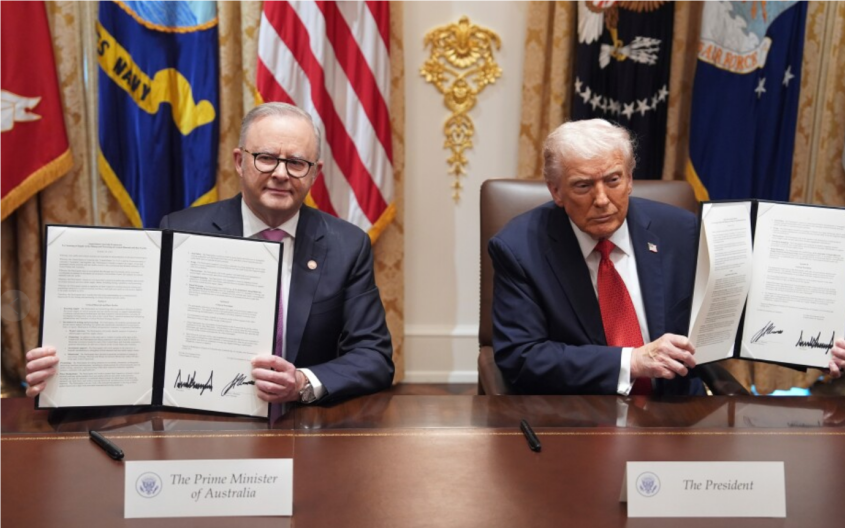
澳总理赴美推销,美澳达成85亿美元关键矿产合作协议
Huan Qiu Wang· 2025-10-21 02:38
Core Points - The United States and Australia signed a key mineral agreement aimed at enhancing mining and processing capabilities, with a total project value of $8.5 billion [1][3] - The agreement is expected to accelerate investments in three types of projects, including U.S. investments in Australian processing facilities [3] - The U.S. plans to invest in a gallium refining plant in Western Australia with an annual capacity of 100 tons, supported by approximately $2.2 billion in financing from the Export-Import Bank of the United States [3] Industry Context - The agreement marks a significant step in U.S.-Australia relations, aiming to counter China's dominance in the critical minerals market [3] - Australia, despite being a major source of critical minerals, relies heavily on China for processing, with over 90% of its lithium being sent to Chinese refineries [3] - The partnership seeks to address the weaknesses in Australia's domestic processing capabilities, which are relatively underdeveloped compared to its mining strengths [3]

澳总理向美推销关键矿产,外媒:澳本土加工能力相对薄弱,需借中国大型精炼厂加工
Huan Qiu Shi Bao· 2025-10-20 22:50
Core Points - Australian Prime Minister Albanese is visiting the White House to seek greater U.S. support for Australia's critical minerals amid China's tightening export controls [1] - Discussions will include nuclear submarines and trade, with a focus on promoting Australia's capabilities in supplying critical minerals for U.S. high-tech manufacturing [1] - Albanese is expected to announce an agreement to strengthen Australia's supply of critical minerals to the U.S. during his two-day visit [1] Group 1 - Australian Treasury Minister Jim Chalmers has been preparing for Albanese's visit, emphasizing Australia's potential as a reliable supplier of critical minerals [2] - Chalmers expressed the desire to maintain stable economic relations with China while increasing cooperation with the U.S. [2] - Australian Ambassador to the U.S. Kevin Rudd highlighted Australia's ability to address the critical mineral supply threats faced by Western economies [2] Group 2 - Rudd noted that Australia could meet 30 to 40 of the 50 designated critical minerals and rare earths needs of the U.S. through investment, particularly in rare earth processing [2] - Despite Australia's strong mining capabilities, there is a relative weakness in domestic processing capacity, with over 90% of Australian lithium being sent to China for processing [2]
恒鑫硫铁矿烧渣除杂提质项目启动
Zhong Guo Hua Gong Bao· 2025-10-13 03:14
Core Viewpoint - The project initiated by Chizhou Hengxin Metal Materials Co., Ltd. under Copper Chemical Group focuses on enhancing the quality of sulfur iron ore slag and recovering precious metals, with a total investment of approximately 60 million yuan for the first phase [1] Group 1: Project Details - The project is located in the Xiqu area of Chizhou High-tech Industrial Development Zone, Anhui Province, and is divided into two phases [1] - The first phase has a production capacity of 250,000 tons per year and is expected to be completed and put into operation by December of this year [1] Group 2: Technology and Process - The project utilizes a carbon pulp method for gold extraction, improving the 200 mesh pass rate from approximately 70% to 95% [1] - The process reduces harmful metal content such as copper, zinc, and lead while recovering gold from the sulfur iron ore slag [1] - The recovered sulfur iron ore slag can still be used as raw material for producing pellets after gold recovery [1]
特朗普执政下的“232调查”版图一览——关税大棒下,哪些行业在风口浪尖?
Xin Lang Cai Jing· 2025-09-25 06:14
Core Viewpoint - The article discusses the imposition of tariffs on various products, highlighting the specific rates and categories affected, as well as ongoing investigations into additional tariffs on other goods scheduled for 2025 [1] Tariffs Already Imposed - Tariffs of 25% have been imposed on automobiles and parts, covering passenger cars, SUVs, light trucks, and numerous components [1] - Tariffs of 50% have been applied to copper and its derivatives, although raw materials like copper ore, concentrates, and electrolytic copper are exempt [1] - A 50% tariff has also been levied on steel, aluminum, and their derivatives, with the scope of these tariffs expanding to include components for wind turbines, furniture, and compressors [1] Ongoing Investigations - Investigations into medium and heavy trucks and their parts will commence in April 2025, with details yet to be disclosed [1] - A similar investigation for commercial aircraft and engines and their parts will start in May 2025, with no details provided [1] - Drones, drone systems, and their components will be investigated starting in July 2025, with specifics not yet available [1] - An investigation into polysilicon and its derivatives, crucial for semiconductors and solar panels, will also begin in July 2025 [1] - Medical devices and supplies, including masks, syringes, catheters, pacemakers, and ventilators, will be investigated starting in September 2025 [1] - Robotics and industrial machinery, including CNC machines, industrial stamping machines, and laser cutting equipment, will be under investigation starting in September 2025 [1] - An investigation into logs, wood products, and derivatives will start in March 2025, covering items like furniture, cabinets, and wooden decorative pieces [1] - Pharmaceuticals and active pharmaceutical ingredients will be investigated starting in April 2025, including finished drugs, active ingredients, and key starting materials [1] - Critical minerals, processed minerals, and derivatives will be investigated starting in April 2025, focusing on processed ores and downstream products using these ores [1] - An investigation into semiconductors and semiconductor manufacturing equipment will also begin in April 2025, covering semiconductor substrates, bare wafers, legacy chips, advanced chips, and downstream electronic products containing semiconductors [1]
普华永道:2025年全球矿业报告着眼未来
Sou Hu Cai Jing· 2025-08-19 07:04
Industry Overview - The mining industry is a cornerstone of the global economy, increasingly intertwined with human activities. In 2024, the top 40 non-gold mining companies experienced a 3% year-on-year decline in revenue and a 10% drop in EBITDA due to rising costs, leading to a decrease in EBITDA margins. Conversely, gold mining companies saw a 15% increase in revenue and a 32% rise in EBITDA, somewhat masking the performance decline of non-gold mining firms [1][8][11]. Multi-Sector Support and Cross-Industry Opportunities - Mining provides essential mineral support for six core sectors: energy and power, transportation, food, healthcare, construction, and manufacturing. Cross-sector development presents opportunities, such as mining companies investing in zero-emission power production and participating in cross-regional railway projects, enhancing operational efficiency and promoting social welfare [1][21][16]. Concentration Risk and Response Measures - There is a mismatch in the geographical distribution of mineral reserves and production, leading to concentration risks that are susceptible to regional issues. Countries are responding by formulating critical mineral strategies, increasing investments, and ensuring supply security. Companies are investing in processing stages, exploring alternative materials, and innovating technologies, while end-users stabilize supply chains through agreements and investments. For instance, Indonesia has enhanced its position in the global nickel market through export restrictions on nickel ore, promoting processing capacity growth [1][34][25]. Market Dynamics - In 2024, the number and scale of mining transactions declined, with energy transition minerals accounting for a lower proportion of transactions compared to previous years. The industry is witnessing trends such as consolidation (especially in gold and silver), divestment of non-core assets, vertical integration, diversification, technology-driven mergers and acquisitions, and increased government involvement [2][40][43]. 2035 Outlook - The report analyzes seven driving factors impacting the mining industry, including population growth, urbanization, energy transition, and environmental impacts. It is anticipated that population growth and urbanization will increase mineral demand over the next decade, while energy transition will drive demand for critical minerals. Technological advancements will enhance efficiency, and changes in human capital and funding support will reshape the landscape, with government regulation and policy collaboration being crucial [2][51][55]. Conclusion and Appendix - Collaboration across sectors is essential, with mining companies encouraged to cooperate in downstream research and development, infrastructure construction, and talent cultivation. The appendix provides geographical distribution data for reserves and production of various minerals, including copper and lithium, along with information about the report's authors and contact details [2][4][11].

印尼经济部:印尼拥有丰富的镍、铜、钴等储备,我们可以与美国在这些关键矿物的加工方面优化合作。
news flash· 2025-07-10 03:08
Core Viewpoint - Indonesia's Ministry of Economic Affairs highlights the country's abundant reserves of nickel, copper, and cobalt, suggesting potential optimization of cooperation with the United States in the processing of these critical minerals [1] Group 1 - Indonesia possesses rich reserves of key minerals such as nickel, copper, and cobalt [1] - The country is looking to enhance collaboration with the United States in the processing of these minerals [1]
加蓬总统:我们希望我们的矿产在本地加工。
news flash· 2025-07-09 17:15
Group 1 - The President of Gabon expressed a desire for local processing of the country's mineral resources [1]
不到24小时,特朗普又改口了:中美如果谈不拢,美国将制定新规则
Sou Hu Cai Jing· 2025-04-19 18:30
Group 1 - Trump's recent shift in tone suggests a willingness to negotiate with China regarding tariffs, indicating a potential easing of tensions [8][9][12] - The volatility in Trump's stance has led to significant market reactions, with over $4 trillion evaporating from the stock market, representing 14% of the U.S. GDP [4][6] - The new tariff policies have adversely affected American citizens, with over 30% of their funds tied to the stock market, leading to concerns over pension funds [6][8] Group 2 - Trump's negotiations with Japan are seen as a strategy to pressure other countries into accepting stringent U.S. conditions, although Japan is cautious and not in a hurry to finalize agreements [19][21] - The Federal Reserve, led by Powell, has faced criticism from Trump for not aligning with his economic policies, particularly regarding interest rates and inflation concerns stemming from the tariff policies [23][25] - The ongoing trade tensions have prompted countries like Mexico and Canada to adopt ambiguous stances, while China is strengthening trade ties with other regions, potentially undermining U.S. leverage [33][35]
