茶叶加工

Search documents
2025年广东省茶叶加工工职业技能竞赛暨“英德红茶工匠”技能竞赛颁奖典礼在穗举办
Nan Fang Nong Cun Bao· 2025-11-23 11:33
Core Points - The 2025 Guangdong Province Tea Processing Vocational Skills Competition and "Yingde Black Tea Craftsman" Skills Competition was held in Guangzhou, emphasizing the importance of skill development in the tea industry [2][3][20] - The competition was approved by the Guangdong Provincial Human Resources and Social Security Department and organized by various local associations and companies, highlighting collaboration within the industry [5][6][7] Group 1 - The competition took place from October 10 to 12, with 136 participants from various regions competing in theoretical knowledge and practical skills [11][12][10] - The assessment was based on the National Occupational Standards for Tea Processing, ensuring a standardized evaluation process [12][13] - A total of 35 outstanding participants received awards, including 2 gold, 4 silver, 8 bronze, and 21 merit awards, showcasing the competitive nature of the event [17][18] Group 2 - Officials emphasized the positive impact of the competition on the development of the tea industry in Guangdong, noting its role in motivating tea craftsmen and practitioners [20][21][22] - The event was recognized for its professionalism, authority, and fairness, contributing to the overall growth and recognition of the tea processing sector [22][21]


茶山深处的“土地生金”密码
Ren Min Ri Bao Hai Wai Ban· 2025-11-20 00:41
Core Viewpoint - The article highlights the successful implementation of a collective land share model in Guangxi's Cangwu County, which has enabled local tea producers to access land and financing, thereby enhancing their production capabilities and economic sustainability [1][4]. Group 1: Collective Land Share Model - The collective land share model allows local farmers to invest their land into tea production, providing them with a stable income through a "minimum return + fixed dividend" system without needing to manage daily operations [2][4]. - The model has been officially recognized, with the first collective land use rights certificate issued in Guangxi, facilitating land value activation and enabling financing through property rights [4][5]. Group 2: Economic Impact on Local Tea Industry - The Yaojia Xuelan Liubao Tea Cooperative is projected to purchase over 20 million yuan worth of fresh tea leaves annually from local farmers, demonstrating the economic benefits of the model [4]. - The success of the model has prompted interest from other local tea enterprises, with 18 additional companies expressing land needs, indicating a broader industry trend towards this cooperative approach [5]. Group 3: Government Support and Policy - The Cangwu County has been designated as a pilot area for natural resource policy to promote rural revitalization, showcasing government support for innovative agricultural financing solutions [1][4]. - Local authorities are prioritizing the promotion of the land share model for key industries, aiming to enhance community benefits and create a successful paradigm for land cooperation [5].

建德三都“医农”合作项目“四时青柑”养生茶上市
Mei Ri Shang Bao· 2025-11-11 22:14
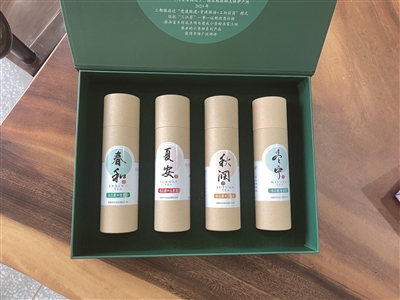
Core Insights - The collaboration between traditional Chinese medicine and local citrus industry has led to the creation of the "Four Seasons Qinggan" tea series, which integrates seasonal flowers and traditional health practices into daily tea consumption, providing a new path for the revitalization of the local citrus industry [2][3][4] Group 1: Industry Background - San Duo Town's citrus is a "National Geographical Indication Protected Product," with annual production ranking high in the Hangzhou citrus region. However, increasing market competition has made the single fresh fruit sales model increasingly unsustainable, creating a bottleneck for farmers' income [3] - To break the single-industry dilemma and enhance the added value of citrus, the local government began exploring deep processing paths for citrus products [3][4] Group 2: Product Development - The "Four Seasons Qinggan" project was initiated by the San Duo Town government, the Health Bureau of Jian De City, Jian De City Maternal and Child Health Hospital, and the "Qinggan" Co-Prosperity Workshop, focusing on traditional Qinggan tea while incorporating seasonal health concepts [4] - The product line includes four seasonal teas: Spring He, Summer An, Autumn Run, and Winter Ning, promoting a health lifestyle that aligns with seasonal changes [4][5] Group 3: Product Features - The tea series is designed based on traditional Chinese medicine principles, with specific ingredients for each season: rose for spring, dendrobium for summer, white chrysanthemum for autumn, and osmanthus for winter, addressing common seasonal health issues [5][6] - The production process involves strict standards set by the Chinese medicine team, including sourcing, precise ratios, and aging for at least six months to ensure flavor and efficacy [5][6] Group 4: Market Strategy - The products are available in both simple and gift packaging, with prices set at 68 yuan per can for the simple version and 198 yuan for the gift box, with promotional discounts available [6] - The series aims to leverage positive market feedback from existing seasonal health teas to enhance the visibility and market reach of the "Four Seasons Qinggan" project [6]
陕西农业产业发展亮点纷呈
Shan Xi Ri Bao· 2025-10-04 23:32
Group 1: Apple Industry - The 18th China Shaanxi (Luochuan) International Apple Expo was held with the theme "Driving Innovation through Technology and Integrated Development" [1] - The expo showcased the entire apple industry chain, including modern fruit equipment, seedlings, fresh fruit, and deep processing [1] - A report on the quality characteristics of Luochuan apples was released, aiding in brand building and market promotion [1] Group 2: Kiwi Industry - The 3rd China Kiwi Fruit Expo was held in Meixian, featuring over 200 booths and various themed exhibitions [2] - A total of 1.56 million tons of kiwi purchase agreements were signed, amounting to 196 million yuan [2] - Meixian, known as the "Hometown of Kiwi," has a geographical indication brand value of 16.137 billion yuan [2] Group 3: Tea Industry - 29 tea products from Shaanxi won awards at the 15th International Tea Competition, showcasing the quality and innovation of Shaanxi tea [3] - The competition evaluated 463 tea samples from China, Japan, and South Korea, awarding 8 Grand Prizes, 197 Gold Awards, and 120 Silver Awards [3] - Various Shaanxi tea companies received accolades across different categories, highlighting the region's tea quality [3] Group 4: Agricultural Cooperation - A cooperation event between China (Shaanxi) and Tajikistan focused on investment and collaboration in areas like water-saving agriculture and deep processing of agricultural products [4] - The event aimed to enhance agricultural trade channels and establish a long-term cooperation mechanism [4] - Officials and experts from both regions participated, promoting investment and trade needs [4] Group 5: Rural Tourism - An event for building the rural tourism industry chain was held in Liuba, focusing on the development of cultural and tourism industries [5] - The provincial government emphasizes rural tourism as a key driver for industrial transformation and rural revitalization [6] - The event aimed to strengthen partnerships with leading accommodation operators to enhance rural tourism offerings [6]
犍为韵茶兴茶叶加工厂(个体工商户)成立 注册资本50万人民币
Sou Hu Cai Jing· 2025-09-20 09:16
Group 1 - A new tea processing factory named Qianwei Yunchai has been established, with a registered capital of 500,000 RMB [1] - The legal representative of the factory is Lin Zhilong [1] - The business scope includes primary processing of edible agricultural products, tea planting, sales of agricultural and sideline products, and internet sales among others [1] Group 2 - The factory is authorized to produce tea products and engage in food sales and production, subject to relevant approvals [1] - The operations will be conducted in accordance with the business license and relevant departmental approvals [1]
凤庆县润福茶叶加工服务厂(个体工商户)成立 注册资本20万人民币
Sou Hu Cai Jing· 2025-09-13 10:45
Core Insights - A new individual business named Fengqing County Runfu Tea Processing Service Factory has been established, with a registered capital of 200,000 RMB [1] Company Overview - The legal representative of the company is Chang Dexian [1] - The business scope includes general projects such as initial processing of edible agricultural products, wholesale of edible agricultural products, primary agricultural product acquisition, retail of edible agricultural products, sales of agricultural and sideline products, and internet sales (excluding items requiring permits) [1] - The company is also involved in the sale of unprocessed nuts and dried fruits, with operations subject to relevant approvals [1] Licensing and Regulatory Compliance - The company has licensed projects that include food sales and food internet sales, which require approval from relevant authorities before operations can commence [1] - Specific business activities will be conducted in accordance with the approvals or permits obtained from relevant departments [1]
云县成华茶叶加工服务坊(个体工商户)成立 注册资本10万人民币
Sou Hu Cai Jing· 2025-08-29 09:25
Core Viewpoint - The establishment of Yunxian Chenghua Tea Processing Service Workshop indicates a growing interest in the tea industry, with a focus on tea product production and related services [1] Company Summary - The newly established entity is registered with a capital of 100,000 RMB [1] - The legal representative of the company is Luo Chenghua [1] Industry Summary - The business scope includes licensed projects such as tea product production, which requires approval from relevant authorities before operations can commence [1] - General projects include tea planting, sale of agricultural products, retail of edible agricultural products, internet sales of food (limited to pre-packaged food), sale of health food (pre-packaged), and food sales (limited to pre-packaged food) [1]
川南抹茶加工基地落地宜宾珙县 协议投资1亿元
Xin Hua Cai Jing· 2025-08-14 13:53
Core Viewpoint - The signing of the investment agreement for the matcha processing project in Gongxian County, Yibin City, marks the establishment of a 100 million yuan matcha processing base, which aims to enhance the local tea industry and promote high-quality development in Sichuan's matcha sector [1][2]. Group 1: Project Overview - The project involves the construction of a 10,000 square meter standardized matcha processing plant in Gongxian, equipped with 10 automated matcha production lines, to meet large-scale and standardized production needs [1]. - The first phase of the project is expected to be completed by the first quarter of 2026, with production commencing by April of the same year, and full operational capacity anticipated by 2027 [1]. Group 2: Economic Impact - The project aims to improve the quality and efficiency of 5,000 acres of tea gardens and train 200 professional tea farmers within three years [2]. - By 2027, the initiative is expected to benefit over 2,000 tea farmers through a model of order-based procurement, enhancing their income [2]. Group 3: Industry Collaboration - A collaborative agreement was signed to establish the "Sichuan Matcha Industry Technology Research Institute," focusing on high-quality development of Sichuan's matcha industry through joint research and technology transfer [1]. - The project will leverage a "government-led + enterprise-driven + research support" ecosystem to foster the matcha industry in the region [1].
武汉企业首次发布产品碳足迹报告
Chang Jiang Ri Bao· 2025-07-23 00:53
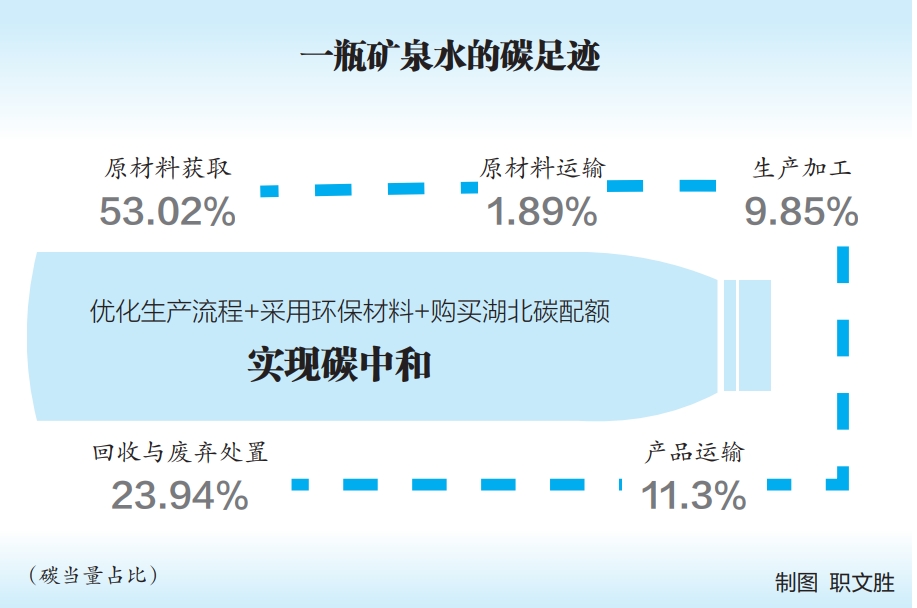
Core Insights - Hubei Shennong (Hubei) Beverage Co., Ltd. has launched a carbon footprint report for its Shennongxi mineral water, marking the first such initiative in Hubei province [1][3] - The carbon footprint for producing a 550ml bottle of mineral water is 232.4 grams of CO2 equivalent, with raw material acquisition accounting for approximately 50% of the total emissions [3] - The Hubei Provincial Product Carbon Footprint Public Service Platform serves as a centralized data hub for carbon footprint management, allowing companies to generate reports and obtain carbon labels easily [3] Company Initiatives - Hubei Shennong is collaborating with the Badong County Ecological Environment Bureau to optimize production processes and use eco-friendly materials to reduce carbon footprints [3] - The company has achieved carbon neutrality for the first batch of 10,000 bottles of Shennongxi mineral water by purchasing Hubei carbon credits [3] Industry Trends - Several companies in Hubei are actively engaging in "carbon exploration," with Xiangyang Tea Co., Ltd. calculating a carbon footprint of 19.39 kg per kilogram of tea [4] - The carbon footprint assessments and carbon neutrality practices by Hubei enterprises provide reference models for low-carbon development in related industries and offer consumers clear choices for low-carbon products [4]
“九山半水”通江海:浙江丽水三大“法宝” 的破圈之道
Zhong Guo Xin Wen Wang· 2025-07-21 11:45
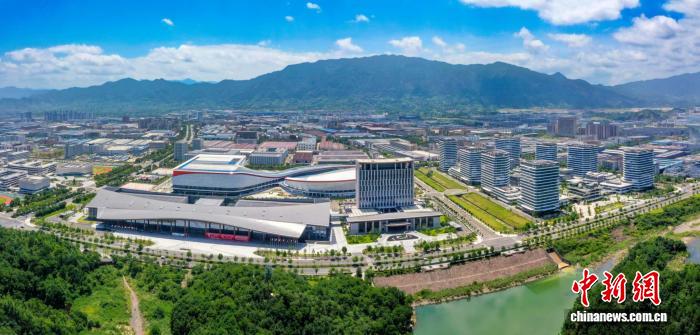
Core Viewpoint - Lishui City is leveraging its rich ecological resources and innovative strategies to achieve high-quality economic development, particularly through the establishment of the Lishui Airport and the promotion of green economy initiatives [1][14]. Group 1: Economic Development Strategies - Lishui has established a development strategy focused on green economy, industrial strength, and ecological city construction since its inception in 2000, emphasizing the importance of ecological benchmarks in economic growth [4]. - The city has successfully integrated traditional ecological resources with modern economic practices, exemplified by the sale of ecological product rights, which marks a breakthrough in the marketization of ecological products [2]. - Lishui's production value is projected to reach 218.12 billion yuan in 2024, with a year-on-year growth of 6.6%, surpassing national and provincial averages [8]. Group 2: Industry and Innovation - The city is focusing on five key industries: agriculture, culture, tourism, forestry, and green manufacturing, to enhance its economic structure and promote sustainable growth [5]. - Lishui is advancing towards a modern industrial system by transitioning from traditional manufacturing to intelligent manufacturing, with companies reporting over 10% improvements in production efficiency [5][7]. - The semiconductor industry in Lishui has seen significant growth, with 96 projects introduced and a continuous growth rate of over 25% for four consecutive years [8]. Group 3: External Collaboration and Investment - Lishui is actively engaging in open economic strategies, attracting significant investments from the Yangtze River Delta region, with 550 projects and a total investment of 238.7 billion yuan from 2021 to May 2025 [10]. - The city is implementing the "Double Recruitment and Double Introduction" strategy to enhance its economic vitality and connect with major economic regions [10]. - Lishui is also leveraging its overseas Chinese community to facilitate global trade and investment, enhancing its economic network through cross-border e-commerce and international partnerships [13].