
证券资管

Search documents
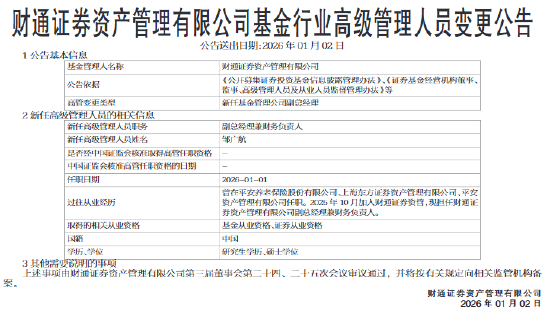
财通资管新任任邹广航为副总经理兼财务负责人
Xin Lang Cai Jing· 2026-01-06 04:07
Core Viewpoint - The appointment of Zou Guanghang as the new Deputy General Manager and Chief Financial Officer of Caitong Securities Asset Management is a strategic move aimed at enhancing the company's management capabilities and aligning with recent leadership changes within the organization [1][3]. Group 1: Management Changes - Zou Guanghang will officially assume his role on January 1, 2026, and brings extensive experience from previous positions at major financial institutions, including Ping An Pension Insurance and Shanghai Dongfang Securities Asset Management [2][6]. - The recent management adjustment also includes the appointment of Lu Zhen as Assistant General Manager, who has a strong background in channel management from his tenure at Industrial and Commercial Bank of China [3][6]. Group 2: Company Overview - Caitong Securities Asset Management, established in December 2014, is a wholly-owned subsidiary of Caitong Securities, the only provincial-level securities firm in Zhejiang [3][6]. - As of December 2025, the company reported an asset scale of 107.78 billion yuan, with non-monetary assets amounting to 94.248 billion yuan, ranking 49th out of 164 in the industry [3][6]. Group 3: Business Strategy - The company has developed a "one main, two wings" business model, focusing on active management in equity investment, fixed income, and multi-asset investment, while also engaging in asset securitization and capital market services [5][8]. - In March 2025, Caitong Securities Asset Management became the first securities firm to obtain QDII business qualifications, marking a significant step in its international business expansion [5][8]. Group 4: Industry Context - The asset management industry is experiencing a wave of executive changes, with many firms undergoing leadership transitions as they adapt to regulatory changes and increased competition [5][8]. - The shift from traditional channel business to active management is a critical trend in the industry, highlighting the importance of Zou Guanghang's dual background in insurance and securities for the company's future development [5][8].


中广核电力(01816.HK)获中信证券资管增持3049.4万股
Ge Long Hui A P P· 2026-01-05 23:14
Core Viewpoint - China General Nuclear Power (01816.HK) has seen an increase in shareholding by CITIC Securities Asset Management Co., which raised its stake from 17.97% to 18.24% by purchasing 30.494 million shares at an average price of HKD 2.9394 per share, totaling approximately HKD 89.6341 million [1]. Summary by Category - **Shareholding Increase** - CITIC Securities Asset Management Co. acquired 30,494,000 shares of China General Nuclear Power at an average price of HKD 2.9394 per share [1]. - Following this transaction, CITIC's total shareholding in the company increased to 2,036,073,000 shares, representing 18.24% of the total issued shares [1]. - **Financial Implications** - The total investment made by CITIC Securities in this transaction amounts to approximately HKD 89.6341 million [1].


券商资管2026年展望:权益掘金牛市后半程 多元配置凸显价值
Zhong Guo Ji Jin Bao· 2026-01-04 14:49
Group 1: Core Viewpoints - The brokerage asset management sector is focusing on equities, bonds, and FOF (Fund of Funds) for investment strategies in 2026, indicating a clear direction for the year [1] - The equity market is perceived to be in the "second half of a bull market," driven by ample liquidity, a recovering profit cycle, ongoing policy support, and a shift in resident asset allocation [2][3] Group 2: Equity Market Insights - Multiple brokerage firms maintain a positive outlook on the A-share market for 2026, citing factors such as a supportive liquidity environment and structural opportunities in certain industries [2] - Key sectors for investment include photovoltaic, brokerage, semiconductors, consumer electronics, and basic chemicals, with a focus on TMT (Technology, Media, and Telecommunications) and small-cap stocks [3] Group 3: Bond Market Outlook - The bond market is expected to experience a wide range of fluctuations, with limited space for both upward and downward movements, emphasizing the need for focus on wave trading and structural opportunities [4][5] - Credit bonds and convertible bonds are highlighted for their respective value propositions, with a continued emphasis on the "asset shortage" phenomenon [4] Group 4: FOF Market Strategy - The trend towards multi-asset strategies is expected to gain momentum in 2026, with confidence in both quantitative strategies and active funds contributing to excess returns [6][7] - The brokerage asset management sector anticipates that the evolving macroeconomic landscape will favor multi-asset FOF strategies, with a focus on low correlation among various asset classes [7]
财通资管新任一副总 来自平安资管
Xin Lang Cai Jing· 2025-12-31 10:12
Core Viewpoint - The appointment of Zou Guanghang as the new Deputy General Manager and Financial Officer of Caitong Asset Management marks a significant leadership change, reflecting the ongoing transformation and reform within the securities asset management industry in China [1][4][5]. Group 1: Company Overview - Zou Guanghang has 18 years of experience in human resources management within the financial sector, having previously worked at Ping An Asset Management and Oriental Red Asset Management [3][8]. - Caitong Asset Management, established in 2014, is a wholly-owned subsidiary of Caitong Securities and has seen its entrusted asset management scale exceed 300 billion yuan, ranking third among securities asset management institutions in China [4][9]. Group 2: Industry Context - The securities asset management sector is undergoing a significant leadership reshuffle, with several high-profile changes among management teams, indicating a critical period of transformation and reform [4][9]. - As of November 2025, only 14 securities firms and asset management subsidiaries hold public offering qualifications, and many companies have withdrawn their applications for public offering licenses, reflecting a pause in the expansion of public fund management [5][9]. - The industry is experiencing a shift towards high-quality development characterized by stable total assets, optimized structures, and highlighted features, with expectations for continued focus on active management strategies in 2026 [5][10].

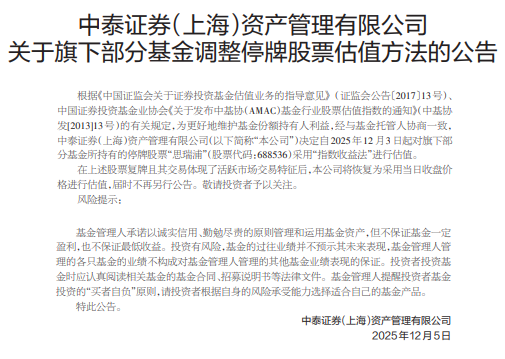
中泰证券资管调整旗下持有思瑞浦相关基金估值
Zhong Guo Jing Ji Wang· 2025-12-05 08:04
Core Viewpoint - Zhongtai Securities (Shanghai) Asset Management Co., Ltd. announced adjustments to the valuation method for certain funds' suspended stocks, specifically adopting the "index yield method" for the stock "Siyirpu" (stock code: 688536) starting from December 3, 2025 [1] Group 1 - The decision was made in accordance with the guidelines from the China Securities Regulatory Commission and the Asset Management Association of China [1] - The adjustment aims to better protect the interests of fund shareholders [1] - The valuation method will revert to using the closing price on the day of resumption of trading once the stock exhibits active market trading characteristics [1]


券商资管系第3只浮动费率基金正在发行
Zheng Quan Ri Bao Wang· 2025-12-03 04:17
Group 1 - The core point of the news is the launch of the first floating fee rate fund by Caitong Asset Management, which will be open for subscription from December 3 to December 23, and it is the third floating fee rate fund issued by a brokerage asset management firm in the market [1] - The fund's management fee will be linked to the holding period and performance, ranging from 0.6% to 1.5%, with specific rates based on the annualized excess return relative to the benchmark [1] - If investors hold shares for less than one year, a management fee of 1.2% per year will be charged; for one year or more, the fee will vary based on performance, with a maximum of 1.5% for excess returns over 6% [1] Group 2 - The floating management fee model raises the requirements for fund managers' research and investment capabilities, incentivizing them to pursue more certain excess returns and share risks with investors during poor market performance [2] - The proposed fund manager, Li Xiang, has 17 years of experience in the securities industry and will focus on four key areas: technology, industrial metals, optimizing competitive landscapes, and consumer sectors at historical valuation lows [2] - Caitong Asset Management emphasizes a research-driven, value investment approach, with a comprehensive range of equity funds covering various investment strategies and themes [3]
券商资管“公募热”退潮:年内三家撤回 仅剩国金等批文
Guo Ji Jin Rong Bao· 2025-11-27 15:12
Core Viewpoint - The once-booming competition among brokerage asset management firms for public fund licenses is clearly retreating, with several firms withdrawing their applications, indicating a shift in strategy and market conditions [1][2][5]. Group 1: Withdrawal of Applications - The recent trend shows a significant number of brokerage asset management firms, including Guotai Junan Asset Management, Guangfa Asset Management, and Guosen Asset Management, have suspended their applications for public fund licenses, leaving only Guojin Asset Management in the queue [1][2]. - Guosen Asset Management submitted its application in October 2023 but has not received any feedback, highlighting the uncertainty in the approval process [3]. Group 2: Market Environment and Strategic Choices - The collective withdrawal from public fund license applications reflects a more cautious strategic choice by brokerage asset management firms in the current market environment, rather than a fundamental devaluation of public fund licenses [5]. - The tightening of regulations and intense competition in the public fund industry has led some asset management firms to reassess their cost-benefit ratios, opting to withdraw if they lack sufficient resources or competitive advantages [5][6]. Group 3: Regulatory Context and Future Implications - The approval process for public fund licenses has slowed significantly since the initial surge in applications in 2023, with only a few firms receiving approvals, indicating a potential "zero release" situation in 2024 [3][4]. - The impending deadline for brokerage firms to complete the transformation of their collective asset management products by the end of 2025 adds pressure, prompting some firms to seek alternative solutions to alleviate transformation stress [6][7].
券商资管“公募热”退潮:年内三家撤回,仅剩国金等批文
Guo Ji Jin Rong Bao· 2025-11-27 15:05
Group 1 - The trend of brokerage asset management firms withdrawing applications for public fund licenses is evident, with several firms like Guotai Junan Asset Management and Guangfa Asset Management halting their applications, leaving only Guojin Asset Management in the queue [1][2][4] - The approval process for public fund licenses has significantly slowed down after a surge in applications in 2023, with only a few firms receiving approvals, indicating a stark contrast to the previous year's enthusiasm [4][5] - The collective withdrawal from public fund license applications reflects a more cautious strategic choice by brokerage asset management firms in the current market environment, rather than a fundamental devaluation of public fund licenses [6][7] Group 2 - The tightening of regulations and intense competition in the public fund industry have led some asset management firms to reassess their cost-benefit ratios, resulting in a more rational decision to withdraw from applications [6][7] - The impending deadline for the transformation of brokerage collective asset management products into public offerings by the end of 2025 adds pressure on firms, prompting them to seek alternative solutions to alleviate transformation stress [7][8] - Some firms have begun transferring their collective asset management products to affiliated fund management companies as a strategy to comply with regulatory requirements while awaiting public fund license approvals [8]
撤回!券商资管申请公募牌照,退潮!
券商中国· 2025-11-26 10:58
Core Viewpoint - The application for public fund licenses by securities asset management companies has significantly cooled down after a two-year policy relaxation, shifting from a rush to apply to a more rational withdrawal of applications [1][2]. Group 1: License Application Trends - Initially, four securities asset management subsidiaries, including GF Asset Management, Guangfa Asset Management, and Guozheng Asset Management, applied for public fund licenses, but by November, three of them had withdrawn their applications, leaving only Guojin Asset Management still in the queue [1][2]. - In 2023, six securities asset management companies submitted applications for public fund licenses, but only two, China Merchants Asset Management and Xingsheng Asset Management, were granted licenses. The approval of new licenses has nearly stagnated in 2024 [2][4]. Group 2: Regulatory Environment - The "One Participation, One Control" policy, which relaxed the restrictions on the number of public fund licenses, was implemented in May 2022, prompting many securities firms to seek additional licenses [2]. - Recent regulatory signals indicate that no new public fund licenses will be issued to securities asset management companies, leading to speculation that Guojin Asset Management may also withdraw its application [4]. Group 3: Transition to Public Fund Management - According to the asset management regulations established in 2018, securities firms must complete the public transformation of their "participating public collective" products by the end of 2025. Firms without public fund licenses must choose to liquidate, extend, or change management for their related products upon expiration [5][6]. - As the deadline approaches, the industry is entering a critical transition phase, with many firms opting to transfer management of their public collective products to affiliated public fund companies or to shift towards private asset management [6][7].

山证资管总经理李宏宇:券商资管迎来重要发展机遇
Zheng Quan Shi Bao Wang· 2025-11-19 11:07
Core Insights - The 19th Shenzhen International Financial Expo opened on November 19, highlighting significant opportunities for securities asset management within China's 160 trillion yuan asset management ecosystem [1] Group 1: Securities Asset Management - Securities asset management is expected to focus more on high-net-worth clients and non-bank institutions, offering a diverse range of products including ABS, REITs, derivatives, private FOF/MOM, and quantitative tools [1] - The core competitiveness of securities asset management lies not only in direct investment capabilities but also in asset allocation abilities, distinguishing it from public funds [1] Group 2: Public Funds vs. Securities Asset Management - Public funds are anticipated to concentrate on individual investors and transparent, tool-based products, while securities asset management will leverage its strengths in multi-asset and multi-strategy offerings [1] - The competitive edge of public funds is primarily in their direct investment capabilities, contrasting with the broader strategy of securities asset management [1] Group 3: Banking Wealth Management - Current challenges in banking wealth management include a strategic shift towards multi-asset and multi-strategy approaches, aligning closely with securities asset management [1] - There is potential for collaboration between securities asset management and banking wealth management, especially as smaller banks without wealth management licenses face transformation pressures [1]