
保险资管

Search documents
陈征宇履新中信保诚资产总经理!银行跨界经验能否激活中游险资?
Sou Hu Cai Jing· 2025-08-21 06:29
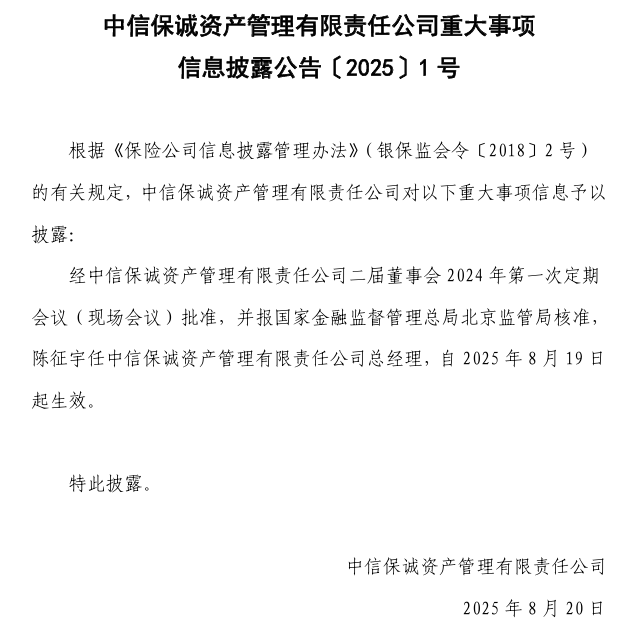
Core Viewpoint - The appointment of Chen Zhengyu as the new General Manager of CITIC Prudential Asset Management marks a significant leadership change following a turbulent period characterized by the previous manager's investigation and dismissal [4][5]. Group 1: Leadership Changes - Chen Zhengyu has been appointed as the General Manager of CITIC Prudential Asset Management, effective from August 19, 2025, after receiving approval from the board and regulatory authorities [1][4]. - The previous General Manager, Zhao Xiaofan, was investigated for serious violations and was dismissed in May 2025, leading to a series of interim leadership changes [4][5]. - The management structure now consists of five members, with Chen Zhengyu serving as the General Manager, Executive Director, and Party Branch Secretary [7]. Group 2: Company Performance - CITIC Prudential Asset Management reported a revenue of 444 million yuan and a net profit of 188 million yuan for 2024, both showing over 30% year-on-year growth, outperforming the industry average [8]. - The company's revenue structure remains heavily reliant on its parent company, CITIC Prudential Life, which contributed 281 million yuan to the asset management fees, accounting for nearly 80% of total income [9]. - The asset management scale reached 336.5 billion yuan by January 2025, reflecting over 160% growth in less than five years, although it still lags behind leading firms in the industry [12].

保险业“洗尽铅华”系列一:中国保险资管研究:发展历程、海外镜鉴与未来趋势
Western Securities· 2025-08-19 04:21
Investment Rating - The industry rating is "Overweight" and has been maintained from the previous rating [5]. Core Insights - The report emphasizes the transformation and evolution of China's insurance asset management (IAM) industry, highlighting its historical development, current status, and future trends [1][3]. - The IAM industry has experienced significant growth, with total assets under management (AUM) reaching approximately 8.5 trillion yuan by the end of 2023, reflecting a year-on-year increase of 32.3% [30]. - The report identifies key competitive advantages of IAM, including long-term capital management experience, strong fixed-income investment capabilities, and strict compliance and risk control [2][71]. Summary by Sections 1. Evolution of China's IAM Industry - The IAM industry has gone through three phases: initiation in 2003 with the establishment of the first IAM company, diversification from 2012 to 2017, and accelerated market reforms since 2018 [14][15]. - By the end of 2023, there were 34 IAM companies in China, with a significant increase in the number of private equity fund managers [15]. 2. Current Status of IAM Industry - The industry has seen continuous expansion, with a total revenue of 29.66 billion yuan in 2023, representing an 8.2% year-on-year growth [18]. - The funding sources are predominantly from insurance capital, accounting for approximately 74% of total funding [23]. - The investment preference is heavily weighted towards fixed-income assets, with investment returns concentrated between 2.25% and 4.5% [24][27]. 3. Competitive Analysis in the IAM Landscape - The total scale of China's asset management industry exceeds 131 trillion yuan, with significant product differentiation [2][62]. - IAM is positioned in the middle tier in terms of scale and yield compared to other asset management products [66]. - The primary sales channel for IAM products is direct sales, with the "Yinbao Tong" platform playing a crucial role in connecting banks and securities firms [70]. 4. Overseas Benchmarking of Leading IAM Firms - Allianz Asset Management, a global leader, has an AUM of 2.45 trillion euros, with over 70% of its business coming from third-party sources [2][79]. - The report highlights the importance of global expansion and professional division of labor as common experiences among leading overseas IAM firms [2][3]. 5. Future Trends in China's IAM Industry - The report suggests that the IAM industry will focus on enhancing equity research capabilities and diversifying investment strategies, particularly in high-dividend and alternative investments [3]. - There is an emphasis on leveraging overseas experiences for mergers and acquisitions, enhancing digitalization, and pursuing globalization [3].
再获殊荣!永诚保险资产“永盈货币”产品入围金贝“2025卓越货币类保险资管产品”
2 1 Shi Ji Jing Ji Bao Dao· 2025-08-16 13:29
Core Viewpoint - The "Yongcheng Asset Yongying Monetary Asset Management Product" has been recognized as one of the "2025 Excellent Monetary Insurance Asset Management Products" at the 2025 Golden Shell Asset Management Annual Conference, marking the fourth consecutive year that Yongcheng Asset has been included in this prestigious recognition [1][3]. Group 1: Company Performance and Recognition - The "Golden Shell" case collection for asset management in China began in 2008 and is one of the most influential and authoritative awards in the industry, highlighting Yongcheng Asset's product innovation capabilities [3]. - The "Yongying Monetary" product, established on August 9, 2022, has successfully navigated its initial phase and features a stable underlying asset structure, focusing on providing steady returns for small and medium-sized financial institutions [3][4]. - Yongcheng Asset reported a revenue of 241 million yuan in 2024, with a year-on-year growth rate of 10.64% [4]. Group 2: Risk Management and Development Strategy - Yongcheng Asset's risk management strategy emphasizes safety, liquidity, and profitability, balancing risk and return while adhering to regulatory compliance and maintaining a substantial risk baseline [3][4]. - The company has adopted a development path characterized by "specialization, productization, and marketization," aiming to establish itself as a "boutique insurance asset management company" [4]. - Yongcheng Asset continuously collects and analyzes internal and external information to identify risks and implement control measures, ensuring the continuity of business processes [4]. Group 3: Future Outlook - As the asset management industry enters a new phase of high-quality development, Yongcheng Asset is poised to embrace new opportunities, with the Golden Shell award serving as a milestone in its journey [5]. - The company's successful experience provides a differentiated development model for small and medium-sized asset management institutions, demonstrating that specialization and digitalization can create significant opportunities in a competitive market [5].

险资ABS规模增长显著 盘活存量基础资产加速
Zhong Guo Zheng Quan Bao· 2025-08-14 22:23
Core Insights - The article highlights the significant growth of insurance asset-backed securities (ABS) in China, with a total registration scale of 130 billion yuan for four new asset-backed plans, contributing to a total of over 2000 billion yuan for the year, marking a substantial increase compared to the same period last year [1][2]. Group 1: Growth of Insurance ABS - The number of asset-backed plans registered by Zhongbao Dengdeng has reached 50 this year, with a cumulative scale exceeding 2000 billion yuan, indicating a notable year-on-year increase [1][2]. - Insurance ABS, characterized by its flexible structure and clear cash flow, has become an important tool for asset allocation among insurance and bank wealth management funds in a low-interest-rate environment [1][2]. Group 2: Types of Underlying Assets - The types of underlying assets for ABS have diversified, including consumer finance, micro-loans, supply chain assets, financing leases, fund shares, and restructured debts, reflecting a trend towards innovation in asset types [3]. - The growth of asset-backed plans is driven by regulatory reforms and market changes, with a focus on revitalizing existing assets and aligning with the risk preferences of insurance and wealth management funds [3]. Group 3: Future Development Trends - Future developments in insurance ABS are expected to expand into new areas such as carbon credit rights, data assets, and the silver economy, while also deepening involvement in green finance and rural revitalization [4]. Group 4: Exchange-Traded ABS - The recent guidance from the China Securities Regulatory Commission supports insurance asset management institutions in participating in ABS and REITs, with five institutions being the first to pilot these initiatives [5]. - By the end of 2024, these pilot insurance asset management institutions successfully issued their first ABS on the exchange, covering various asset types such as financing leases and receivables [6].
险资ABS规模增长显著盘活存量基础资产加速
Zhong Guo Zheng Quan Bao· 2025-08-14 20:16
Core Insights - The recent registration of four asset-backed plans by China Insurance Asset Registration and Custody Corporation (中保登) indicates a total scale of 13 billion yuan, contributing to a significant year-on-year growth in the asset-backed securities (ABS) market for insurance asset management institutions [1][2] - The growth of insurance ABS is attributed to its flexible structure, clear cash flow, and the increasing variety of underlying assets, making it an important tool for investment by insurance and bank wealth management funds in a low-interest-rate environment [1][2] Group 1: Growth of Insurance ABS - A total of 50 asset-backed plans have been registered this year, with a cumulative scale exceeding 200 billion yuan, marking a substantial increase compared to the same period last year [2] - The majority of funds for insurance ABS subscriptions come from within the insurance industry, with some interest from wealth management funds [2][3] Group 2: Diversification of Underlying Assets - The types of underlying assets for ABS have diversified, including consumer finance, micro-loans, supply chain assets, financing leases, fund shares, and restructured debts [3] - New asset types and business models are emerging, with products covering leasing debts, infrastructure revenue rights, consumer finance debts, supply chain receivables, commercial real estate mortgages, and small loans [3] Group 3: Development of Exchange-Traded ABS - The China Securities Regulatory Commission has guided stock exchanges to support insurance asset management institutions in conducting ABS and REITs business, with five institutions being the first to pilot this initiative [4] - These institutions have successfully issued their first ABS on the exchange, covering various underlying asset types such as financing leases, receivables, and policy pledge loans [4]
加快保险资管产品发展 业界期待统一政策出台
Xin Hua Wang· 2025-08-12 06:19
Core Viewpoint - Insurance asset management institutions should actively embrace the wealth management market by leveraging their advantages to cultivate high-net-worth clients, expand funding sources and sales channels, enrich product categories, develop tool-based products, and provide corresponding asset allocation consulting services [1] Group 1: Development of Insurance Asset Management Products - The scale of combination insurance asset management products has grown rapidly, increasing from 12.5 trillion yuan at the end of 2019 to 34.5 trillion yuan by the end of March 2022, with an annual growth rate of 57.02% [2] - The main funding sources for these products are bank self-operated and wealth management, accounting for approximately 51% and 40% respectively [2] - In terms of investment performance, stock and mixed insurance asset management products have shown high average returns over the past three years, while fixed-income products have demonstrated stable performance, with pure bond insurance asset management products outperforming public funds [2] Group 2: Advantages and Disadvantages Compared to Public Funds - Combination insurance asset management products have advantages over public funds, including stable funding sources and longer funding durations, which provide relative advantages in risk control, long-term fund management, and asset allocation [2] - However, they face disadvantages such as a relatively single funding source and weaker distribution channels, primarily due to past regulatory restrictions on insurance asset management sales [3] Group 3: Future Outlook and Recommendations - The insurance asset management industry is expected to respond to the evolving wealth management market by expanding funding sources through pensions and high-net-worth clients, and by developing distribution capabilities [3] - The article highlights several challenges, including tax burden discrepancies and lower allocation ratios for stock subscriptions compared to public funds, which reduce the attractiveness of insurance asset management products [4] - It is recommended that regulatory bodies review the financial and tax policies applicable to the asset management industry to ensure fair competition among all market participants [5]
保险资管市场化提速 组合类产品成抓手
Xin Hua Wang· 2025-08-12 06:19
Core Viewpoint - The implementation of the "Regulations on the Management of Insurance Asset Management Companies" starting September 1 is expected to accelerate the market-oriented and professional development of insurance asset management institutions, particularly through the growth of portfolio insurance asset management products [1][2]. Group 1: Market Growth and Trends - The scale of portfolio insurance asset management products has surged from 1.35 trillion yuan at the end of 2019 to over 3 trillion yuan by the end of 2021, indicating rapid development [2]. - As of the end of 2021, the total asset management market in China reached 134 trillion yuan, with insurance asset management becoming increasingly competitive alongside other financial products [2]. - In the first half of the current year, over 380 new portfolio insurance asset management products were registered, reflecting a growing trend in this sector [2]. Group 2: Product Composition and Performance - As of August 11, there were over 810 publicly disclosed portfolio insurance asset management products, with fixed income products dominating the market at 528, followed by equity products at 148 and mixed products at 132 [4]. - The highest annualized return for fixed income products this year was 17.95%, while the median return was 2.09%. For equity products, the highest return was 18.23%, with a median of -19.46% [4]. - Over the past three years, the median return for mixed bond secondary insurance asset management products was 21.13%, outperforming other fixed income types [4]. Group 3: Third-Party Business Development - There is a consensus among insurance asset management companies to enhance the proportion of third-party asset management business, which is seen as a key strategy for competing in the broader asset management landscape [6][7]. - Companies like Taiping Asset and Ping An Asset are focusing on expanding their third-party business, with strategies that include developing a comprehensive product system and collaborating with other financial institutions [7]. - Domestic insurance asset management institutions are encouraged to leverage their strengths in asset allocation and investment management to meet the needs of high-net-worth and pension clients, thereby expanding their third-party business [7].
险资版ABS数量和规模均创新高 持续增长趋势有望延续
Xin Hua Wang· 2025-08-12 05:47
数据显示,2019年,中保登上线资产支持计划注册系统。2019年至2022年,在中保登注册/登记的保险 资产支持计划数量分别为8只、24只、37只、65只,注册/登记规模分别为115亿元、713亿元、1562亿 元、3045亿元。 从需求层面看,光大永明资产表示,目前流动性较为充裕,包括银行资金特别是理财资金在内的资金方 对资产的需求较大。同时,行业普遍认为,以底层资产分散作为重要特征的ABS在风险收益的匹配上更 具性价比,且作为非标产品,险资版ABS与标品ABS相比,具有一定的收益率溢价。 人保资本保险资产管理有限公司(简称"人保资本")党委书记、总裁万谊青近日在署名文章中提到,宏 观环境为险资版ABS业务发展提供了广阔空间。例如,稳经济专项政策在充实资产供给的同时,亦刺激 盘活存量资产的需求,市场对优质资产的需求强劲。同时,我国在基础设施等领域积累了大量优质存量 资产,亟待通过资产证券化的方式进行盘活,形成存量资产和新增投资的良性循环。 业内人士认为,当前,优质资产较为稀缺,险资版ABS市场具有增长快、空间大的特点,在供需双方的 共同推动下,市场规模还将持续快速增长。 11月30日,中保保险资产登记交易系 ...

连破关口!险资这一业务,收益率跌破3%
券商中国· 2025-08-12 04:57
Core Viewpoint - The yield of debt investment plans has significantly declined in recent years, with new products averaging expected yields of "3%+" and high-quality asset projects dropping below 3% [2][3]. Summary by Sections Yield Trends - The average yield of newly registered debt investment plans has fallen to a range of 3.6% to 3.9% this year, with yields above 4% becoming rare [3][4]. - Historical data shows a clear downward trend in yields over the past decade, with infrastructure debt plans averaging 6.61% in 2015 and real estate debt plans at 7.25% [4][5]. Market Dynamics - The decline in yields is attributed to reduced financing demand from traditional sectors like real estate and infrastructure, which are currently in an adjustment phase [6]. - The competition among financing methods, including trust plans and bank loans, has intensified, making it challenging for debt investment plans to maintain competitive yields [7][8]. New Investment Opportunities - There is a slight yield advantage for debt plans targeting new infrastructure projects, with yields approximately 40 basis points higher than traditional sectors [6]. - The focus is shifting towards new economic sectors, such as 5G, IoT, and data centers, which are seen as potential growth areas for long-term investment [6]. Perpetual Debt Plans - Perpetual debt plans are gaining traction due to their favorable characteristics for both issuers and investors, offering a more "friendly" financing method for asset-liability ratios [7][8]. - Several perpetual debt plans have been registered recently, indicating a growing interest in this financing structure [7].

前7个月“保险版”ABS登记规模超2200亿元 同比增长50.4%
Zheng Quan Ri Bao· 2025-08-10 16:50
Core Viewpoint - The insurance asset management sector is experiencing significant growth in asset-backed securities (ABS) registration, driven by favorable market conditions and regulatory support [1][2][3]. Group 1: Asset-Backed Securities Growth - Zhongbao Insurance Asset Registration and Trading System Co., Ltd. reported that four asset-backed plans registered by insurance asset management institutions totaled 13 billion yuan [1]. - In the first seven months of this year, 50 asset-backed plans were registered, with a total scale of 221.877 billion yuan, marking a year-on-year increase of 50.4% [1][2]. - In July alone, 12 asset-backed plans were registered, up from 6 in the same month last year, with a total registration scale of 41.781 billion yuan, reflecting a year-on-year growth of 71.7% [2]. Group 2: Market Drivers - The growth in asset-backed plans is attributed to their risk characteristics aligning with insurance capital preferences and the ongoing decline in interest rates, prompting insurers to seek quality assets [2][4]. - The flexibility of product structure, clear repayment cash flows, and low correlation with equities and bonds make asset-backed plans attractive to insurers [2][3]. Group 3: Regulatory Support and Innovation - In April, the National Financial Supervision Administration and other departments issued a plan to support banks and insurance institutions in increasing investments in technology-driven bonds and asset-backed plans [3]. - Asset-backed plans are expanding into new segments, including steam charging rights, data asset charging rights, and new energy electricity revenue rights, indicating ongoing product innovation [3]. Group 4: Future Outlook - The insurance sector is expected to continue increasing the scale of registered asset-backed plans, with a broader variety of underlying assets [5]. - As investment scales grow, insurers will enhance their asset judgment capabilities and accumulate more experience in risk management and disposal related to asset-backed plans [5].