
医疗保险

Search documents
Alignment Healthcare (NasdaqGS:ALHC) 2025 Conference Transcript
2025-09-10 17:17
Summary of Alignment Healthcare Conference Call Company Overview - **Company**: Alignment Healthcare (NasdaqGS:ALHC) - **Industry**: Medicare Advantage (MA) managed care Key Points and Arguments Star Ratings and Performance - Alignment Healthcare has maintained 100% of its members in four-star or higher plans, indicating strong execution and performance [1][2][3] - The company has improved its raw star scores through conservative cut points and initiatives to enhance CAHPS scores, focusing on access to care and care coordination [3][4] - There is confidence in maintaining a four-star rating, with discussions ongoing with CMS regarding data reconciliation [4][5][6] Cut Points and Risk Adjustment - The new cut points are seen as aggressive but necessary to ensure that four-star plans genuinely reflect high quality [8][9][10] - The administration is supportive of Medicare Advantage, and the company expects to remain bullish on the MA market [9][10] - The company aims to normalize the playing field in risk adjustment to ensure quality at lower costs [9] Care Management and CAP Scores - The company has implemented a multi-phase strategy to improve CAP scores, focusing on holding IPAs to high standards and taking control of medical management [12][14][15] - A reduction in admissions per thousand has been achieved, indicating better medical management [15][20] - The company is transitioning care to high-quality facilities to further reduce readmission rates [23][24] Financial Guidance and Growth - For 2025, the company feels optimistic about its position, but specific guidance for 2026 will be provided later [26][27] - The company is focused on margin expansion and maintaining a disciplined approach to growth, with a long-term growth target of 20% [31][32] - The company aims to reach $5 billion to $6 billion in revenue within three years, with a long-term goal of $10 billion [35][37] RADV Audits and Compliance - Alignment Healthcare is prioritizing preparation for expanded RADV audits, which will cover multiple years [46][48] - The company is close to 100% validation of HCC codes, minimizing exposure during audits [51][52] - The Care Anywhere model is designed to support documentation and compliance, enhancing the company's readiness for audits [51] Market Position and Competitive Landscape - The company is cautious about aggressive pricing strategies from smaller plans, which may not be sustainable [30][31] - There is a focus on maintaining a balance between growth and quality, ensuring that the company does not compromise on its care model [30][31] Additional Important Insights - The company has a strong infrastructure in place to manage growth effectively, which has been a key factor in its recent performance [32][35] - The management emphasizes a culture of continuous improvement and automation to enhance operational efficiency [39][42] - Future growth strategies may involve leveraging free cash flow to expand into new markets [39] This summary encapsulates the critical insights from the conference call, highlighting the company's strategic focus, performance metrics, and outlook for the future.

实现近亲属之间职工医保个人账户共济使用 四川已开通医保钱包11.8万个
Si Chuan Ri Bao· 2025-09-10 06:25
Core Insights - The article discusses the implementation and impact of the medical insurance wallet in Sichuan Province, which allows for the transfer of personal medical insurance funds between family members across provinces [1] Group 1: Implementation Details - As of July this year, Sichuan Province has opened 118,000 medical insurance wallets, with 34,200 designated medical institutions supporting the wallet service [1] - The cumulative number of mutual transfers conducted through the medical insurance wallet is 31,845, involving a total amount of 22.4753 million yuan [1] - The medical insurance wallet service was first launched in November 2024, with a full rollout across 22 coordinated areas in the province in January this year [1] Group 2: Functionality and Benefits - The medical insurance wallet allows insured employees to transfer funds from their personal medical accounts to the wallets of close relatives for medical expenses, facilitating cross-province usage of personal medical accounts [1] - The service has successfully activated previously dormant funds in personal medical accounts, breaking the traditional limitations of local and personal use of medical funds [1] - The initiative aims to alleviate the financial burden of medical expenses for families by enabling mutual assistance across regions [1] Group 3: Transfer Statistics - There have been 6,814 cross-province transfers into Sichuan's medical insurance wallets, totaling 5.9072 million yuan, while Sichuan has conducted 6,412 transfers out to other provinces, amounting to 4.9333 million yuan [1]
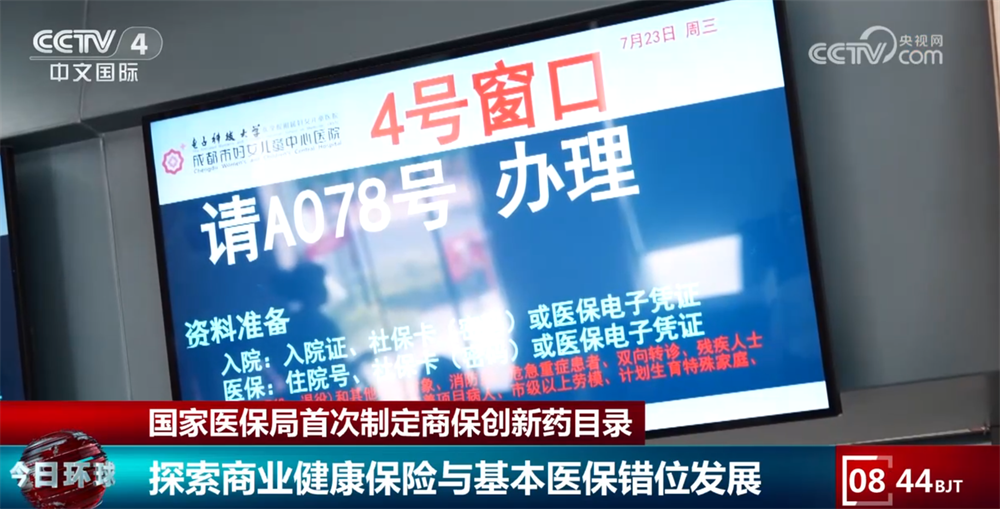
国家医保局首次制定商业健康保险创新药目录 “医保+商保”同步结算惠民生
Yang Shi Wang· 2025-09-02 03:01
Group 1 - The core point of the article is the introduction of a commercial health insurance innovative drug directory in the 2025 national medical insurance catalog adjustment, marking the first time the National Healthcare Security Administration has established such a directory [1] - The adjustment aims to enhance the availability of innovative drugs through commercial insurance, addressing the diverse medication needs of the population [1] - The basic medical insurance coverage rate in China has stabilized around 95%, but the overall funding level remains low, necessitating the inclusion of more innovative drugs in commercial insurance [1] Group 2 - There is a lack of collaboration between basic medical insurance and commercial insurance, leading to issues such as "duplicate insurance" and "coverage gaps" for the public [3] - The National Healthcare Security Administration is exploring ways to support the differentiated development of commercial health insurance alongside basic medical insurance [3] - In the past year, several cities have implemented "commercial insurance + medical insurance" one-stop settlement payment platforms, facilitating automatic recognition of patients' insurance qualifications [5] Group 3 - A national "medical insurance + commercial insurance" clearing settlement center has been launched in Beijing to address the challenges faced by patients seeking cross-province medical services [7] - Patients can now achieve one-stop settlement for both medical and commercial insurance at pilot hospitals in Beijing, such as Peking Union Medical College Hospital and Xuanwu Hospital [7]

今年1-7月职工医保个人账户共济2.31亿人次,共济金额304.57亿元
Yang Shi Wang· 2025-08-31 01:55
Core Insights - The article discusses the implementation and usage of the employee medical insurance personal account pooling system in China, highlighting the significant participation and financial transactions involved in this system during the first seven months of 2025 [1][2]. Group 1: Personal Account Pooling Statistics - From January to July 2025, there were 231 million instances of personal account pooling, amounting to 30.457 billion yuan [1]. - Within the same period, the pooling within the same administrative region accounted for 212 million instances and 26.994 billion yuan, while inter-region pooling reached 1.957 million instances and 3.347 billion yuan [2]. - The funds were primarily used for medical expenses at designated healthcare institutions (27.487 billion yuan), retail pharmacy expenses (1.734 billion yuan), and contributions to basic medical insurance (709 million yuan) [2]. Group 2: Medical Wallet Transfer Statistics - In the same timeframe, there were 170,600 transactions through the medical wallet transfer system, totaling 11.61269 million yuan [3]. - In July 2025 alone, there were 70,500 transactions amounting to 4.95219 million yuan, with 22,900 transactions for medical and pharmaceutical expenses totaling 418,880 yuan [3]. - The breakdown of transactions showed that 38,300 were intra-province transfers (2.74313 million yuan) and 32,200 were inter-province transfers (2.20906 million yuan) [3]. Group 3: Provincial Contributions - A detailed table lists the contributions from various provinces, with Jiangsu leading at 31.83 billion yuan and Zhejiang following at 45.25 billion yuan for personal account pooling [4]. - Other notable contributions include Guangdong (23.07 billion yuan), and Hubei (14.32 billion yuan) [4]. - The data also corrects previous figures for Gansu, indicating 1.081 billion yuan in contributions from January to June [4]. Group 4: July Medical Wallet Usage by Province - In July 2025, the report provides a breakdown of medical wallet usage across provinces, with significant activity in Hebei (2,822 transactions, 254.53 thousand yuan) and Sichuan (5,128 transactions, 320.31 thousand yuan) [5][6]. - The total number of transactions across all provinces reached 38,289, with a total amount of 27.4313 million yuan for intra-province transfers and 22,224 transactions totaling 2.20906 million yuan for inter-province transfers [6].
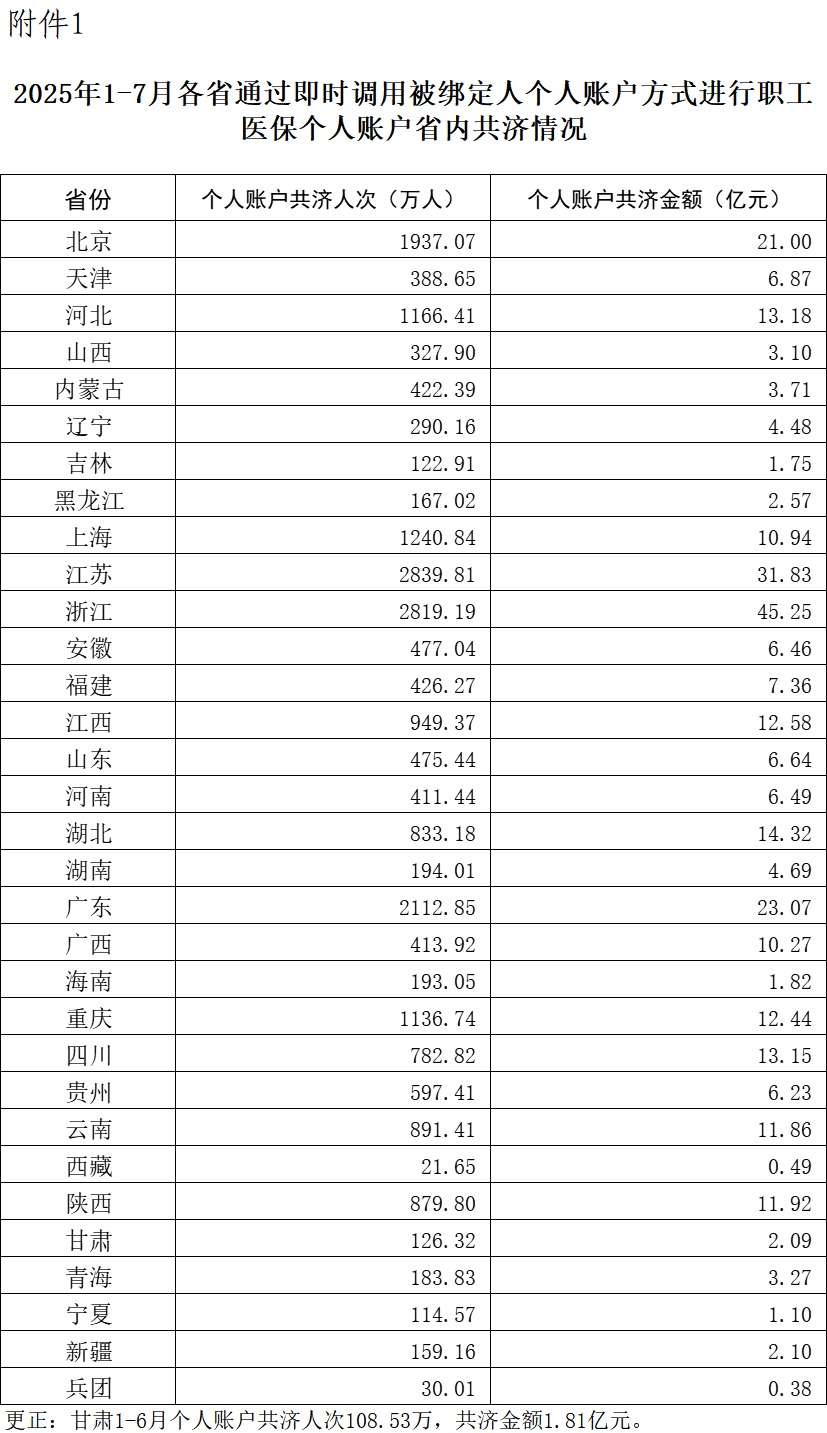
2025年1—7月职工医保个人账户共济2.31亿人次,共济金额304.57亿元
Yang Shi Wang· 2025-08-31 01:36
Core Insights - The article discusses the implementation and usage of the employee medical insurance personal account mutual aid system in China, highlighting the significant participation and financial transactions involved in this system during the first seven months of 2025 [1][2]. Group 1: Mutual Aid Participation - From January to July 2025, there were 231 million instances of mutual aid through the personal accounts of employees, amounting to 30.457 billion yuan [1][2]. - Within the same period, 212 million instances occurred within the same coordination area, totaling 26.994 billion yuan, while 1.957 million instances crossed coordination areas, amounting to 3.347 billion yuan [2]. Group 2: Usage of Funds - The funds were primarily used for personal medical expenses incurred at designated medical institutions, totaling 27.487 billion yuan, and for personal expenses at designated retail pharmacies, which amounted to 1.734 billion yuan [2]. - Additionally, 709 million yuan was allocated for personal contributions to the basic medical insurance for residents [2]. Group 3: Wallet Transfer Transactions - In the same timeframe, there were 170,600 transactions through the medical insurance wallet transfer system, with a total transfer amount of 11.61269 million yuan [3]. - In July 2025 alone, there were 70,500 transactions, with a transfer amount of 4.95219 million yuan, and a total of 22,900 transactions for medical expenses, amounting to 418,880 yuan [3]. Group 4: Provincial Breakdown - A detailed breakdown of mutual aid participation by province shows that Jiangsu had the highest participation with 31.83 billion yuan, followed by Zhejiang with 45.25 billion yuan [4]. - Other notable provinces include Guangdong with 23.07 billion yuan and Shandong with 6.64 billion yuan [4]. Group 5: Wallet Usage by Province - As of July 2025, the cumulative number of people who opened the medical insurance wallet reached 965,400, with 277,900 new openings that month [5][6]. - The provinces with significant cross-province transfers included Hebei with 106.29 million yuan and Xinjiang with 150.31 million yuan [6].
好消息!医保账户余额能转账了
Sou Hu Cai Jing· 2025-08-27 00:53
Group 1 - The core concept of the medical insurance wallet is that it allows insured individuals to transfer funds from their personal medical insurance accounts to the wallets of close relatives for medical expenses and medication purchases, facilitating inter-provincial cooperation in using personal account funds [2][4]. - Previously, personal medical insurance accounts only allowed for intra-provincial cooperation, but now, if an insured person has surplus funds in their account, they can transfer these funds to family members in different provinces, provided the family members are enrolled in basic medical insurance locally [4][3]. - The process to open a medical insurance wallet involves logging into the National Medical Insurance Service Platform and confirming the use of the wallet [10][7]. Group 2 - The transfer process requires the sender to fill in the recipient's basic information and submit a transfer request, with a limit of three transfers per day and a maximum amount of 2000 yuan per transfer [20][31]. - If the recipient does not accept the wallet transfer in a timely manner, the transferred amount will be returned to the sender's account by 6:00 AM the next day [35]. - Medical expenses eligible for reimbursement are managed under a directory system, with specific categories of medical expenses covered by the insurance fund [36][37].

英伟达财报临近推动美股小幅上涨 市场期待AI领域新动向
Xin Lang Cai Jing· 2025-08-26 23:12
(来源:美股情报站) 美国股市在周二呈现小幅上涨的态势,主要受到即将发布财报的英伟达股票上涨推动。标普500指数上 涨0.4%,英伟达作为即将公布业绩的领先公司,其股价表现尤其突出,带动大盘股整体向上。 英伟达将在美东时间周三发布2026财年的第二季度财报,此次业绩报告引起市场高度关注。作为人工智 能领域的核心企业和全球市值领先的科技公司,英伟达的财报不仅关系到自身的发展,更成为AI领域 投资热情与科技股整体走势的重要风向标。 英伟达的股价波动预计将吸引大量期权交易员的关注,这些市场参与者正密切关注着最新财报的发布, 以评估其庞大的市值是否合理。近期股价走势主要受到估值扩张的推动,市场表现已经反映出资本支出 和产品推进的持续性增长,但仍需关注单卡性能和市场对制造难度上升的反应。 分析指出,英伟达即将发布的财报可能会影响整体股市的走势,尤其是在自4月以来的市场"超级牛 市"背景下。同时市场对于AI基础设施需求的持续增长预期推动了英伟达市值的迅速提升,并引发市场 对其未来市值可能突破5万亿美元的热切期望。 周二收盘时,标普500指数上涨0.41%,道琼斯工业平均指数上涨0.3%,纳斯达克综合指数上涨0.44%。 ...

易周资讯2025(8.18—8.24)|关注行业动态,掌握前沿资讯
Sou Hu Cai Jing· 2025-08-25 13:56
Group 1: Digital Social Security - The adjustment of personal pension withdrawal conditions will be implemented starting September 1, expanding the scenarios under which individuals can access their pensions [2][3] - The number of social security cardholders in China has reached 1.39 billion, achieving a coverage rate of 98.9% among the population [2][3] Group 2: Healthcare and Medical Services - The National Healthcare Security Administration (NHSA) is accelerating the construction of a unified cloud data sharing path for medical imaging, with 22 provincial healthcare departments already deploying the software [6][7] - Multiple guidelines for medical service pricing projects have been released, aimed at improving diagnostic quality and standardizing pricing practices [4][6] - By the end of 2024, the total number of healthcare personnel in China is expected to reach 15.78 million, with 5.08 million licensed physicians and assistant physicians [9] Group 3: Digital Economy and Consumption - The digital consumption sector in China is experiencing robust growth, with significant increases in the production of smart drones and vehicle-mounted devices, showing year-on-year growth rates of 80.8% and 21% respectively [11] - Instant retail and live e-commerce transactions have also seen double-digit growth in the first seven months of the year, reflecting a broadening of consumption patterns [11][12] Group 4: Policy and Regulation - The "Artificial Intelligence Generated Synthetic Content Identification Measures" will take effect on September 1, 2025, requiring service providers to label generated content [10] - The National Data Bureau plans to introduce over ten new systems related to data property rights this year, aiming to enhance the market-oriented allocation of data elements [11][15]

织密医疗保障网 我国基本医保制度不断完善
Shang Hai Zheng Quan Bao· 2025-08-24 23:18
Core Viewpoint - The article emphasizes the significant advancements in China's healthcare insurance system during the "14th Five-Year Plan" period, focusing on improving coverage, reducing medical expenses for citizens, and enhancing the overall quality of healthcare services [1][2]. Group 1: Universal Coverage - The national basic medical insurance coverage rate has stabilized at around 95% during the "14th Five-Year Plan" period, with nearly 20 billion instances of insurance reimbursement expected from 2021 to 2024 [2]. - The introduction of measures such as allowing newborns to enroll in insurance using their birth certificates and expanding the coverage of maternity insurance aims to enhance accessibility [3]. Group 2: Benefit Expansion - By June 2025, approximately 253 million people are projected to participate in maternity insurance, with cumulative expenditures reaching 438.3 billion yuan, benefiting over 96.14 million instances [3]. - Various medical assistance policies have benefited 673 million rural low-income individuals, alleviating medical expenses by over 650 billion yuan [3]. Group 3: Healthcare Service Improvement - The introduction of the "medical insurance wallet" allows insured individuals to transfer personal account funds to family members for medical expenses, breaking provincial limitations [4]. - The number of designated medical institutions has reached 1.1 million, and the total number of drugs in the insurance catalog has reached 3,159, further reducing the financial burden on citizens [5]. Group 4: Technological Advancements - The establishment of a unified national medical insurance information platform has significantly improved service efficiency, enabling cross-province handling of high-frequency matters [6]. - The regulatory framework for medical insurance funds has been fully established, recovering over 100 billion yuan in misused funds [6]. Group 5: Future Outlook - The National Medical Insurance Administration aims to continue managing and utilizing medical insurance funds effectively, supporting the development of the pharmaceutical industry and contributing to the overall health of the population [7].
织密医疗保障网——我国基本医保制度不断完善
Xin Hua She· 2025-08-24 08:38
Core Insights - The article emphasizes the continuous improvement of China's basic medical insurance system, aiming to alleviate the medical financial burden on citizens and ensure access to healthcare services [1] Group 1: Coverage and Participation - During the "14th Five-Year Plan" period, the national basic medical insurance participation rate remains stable at around 95%, with nearly 20 billion people benefiting from insurance reimbursements from 2021 to 2024 [2] - The expansion of maternity insurance coverage is highlighted, with 253 million people participating and a total fund expenditure of 438.3 billion yuan, benefiting 96.14 million people [2] Group 2: Benefit Enhancements - The introduction of the "medical insurance wallet" allows insured individuals to transfer personal account funds to family members for medical expenses, breaking provincial limitations [4] - The number of designated medical institutions has reached 1.1 million, and the total number of drugs in the insurance catalog has reached 3,159, further reducing the medical burden on citizens [5] Group 3: Service Upgrades - The establishment of a unified national medical insurance information platform has significantly improved service efficiency, allowing for cross-province handling of high-frequency matters [6] - The implementation of data and AI technologies has enhanced the accessibility of medical insurance services and reduced fraudulent activities [7] Group 4: Financial Management - The cumulative expenditure of the medical insurance fund has reached 12.13 trillion yuan, providing financial support for both healthcare and the pharmaceutical industry [9] - The regulatory framework for medical insurance funds has been fully established, with over 100 billion yuan recovered from fraudulent activities [8]