
燃料电池

Search documents
亿华通(688339):行业需求下滑及公司审慎扩张,销量及利润承压
Changjiang Securities· 2025-09-02 10:42
Investment Rating - The report assigns a rating of "Accumulate" to the company [9]. Core Viewpoints - The fuel cell industry is experiencing a decline in market demand, leading to pressure on the company's sales and profits. The company is adopting a cautious expansion strategy, which has resulted in a significant decrease in both sales volume and profitability [2][6]. - In H1 2025, the company reported revenue of 72 million yuan, a year-on-year decrease of 53.25%. The net profit attributable to the parent company was -163 million yuan, compared to -141 million yuan in the same period last year [2][6]. - The company plans to issue new shares to acquire 100% of Dingzhou Xuyang Hydrogen Energy, with the controlling shareholder potentially changing to Xuyang Group [2][6]. Summary by Sections Financial Performance - In H1 2025, the company achieved a total sales power of 15.96 MW, a year-on-year decrease of 56.54%. The average selling price of the fuel cell system was 3,173 yuan/kW, with a year-on-year increase of 6.5% [13]. - The comprehensive gross margin for H1 2025 was -25.43%, down from 17.7% in the same period last year. The gross margin for the fuel cell system was -37.4%, compared to 22.9% last year [13]. - The operating cash flow significantly improved, with a net cash flow from operating activities of -35 million yuan in H1 2025, compared to -183 million yuan in H1 2024 [13]. Future Projections - Revenue projections for 2025 and 2026 are 258 million yuan and 339 million yuan, respectively [8].

中自科技(688737.SH):正积极与下游客户开展合作,推进电池片在电堆/系统中的匹配验证
Ge Long Hui· 2025-09-02 09:12
Core Viewpoint - The company has been actively developing its hydrogen energy business since 2018 and has established a solid oxide fuel cell (SOFC) team in 2020, indicating a strategic focus on advancing clean energy technologies [1] Group 1: Business Development - The company has built and put into operation a pilot production line for solid oxide fuel cells with an annual capacity of 20,000 pieces, which has already produced various specifications of battery products [1] - The production line is designed with the potential to upgrade to a capacity of 200,000 pieces in the future, showcasing the company's growth ambitions in the hydrogen energy sector [1] Group 2: Technological Advancements - After nearly five years of continuous development, the company's battery technology has reached an advanced level domestically, particularly in terms of durability [1] - The latest verification results show that the battery's degradation is less than 0.5% per 1000 hours, indicating that it meets the initial conditions for promotion and application [1] Group 3: Market Engagement - The company is actively collaborating with downstream customers to advance the matching verification of battery cells in stacks/systems, which is essential for mass production and practical application in end-use power generation systems [1]

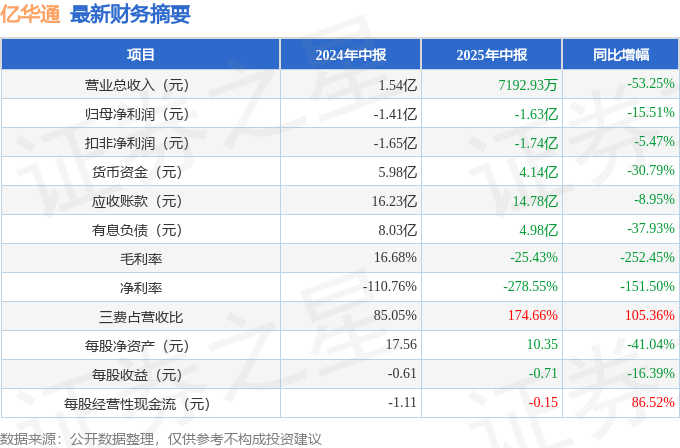
亿华通2025年中报简析:净利润同比下降15.51%,三费占比上升明显
Zheng Quan Zhi Xing· 2025-08-29 22:41
Core Insights - Yihua Tong (688339) reported a significant decline in revenue and net profit for the first half of 2025, with total revenue of 71.93 million yuan, down 53.25% year-on-year, and a net loss of 163 million yuan, a 15.51% decrease compared to the previous year [1] Financial Performance - Total revenue for Q2 2025 was 61.40 million yuan, reflecting a 56.36% year-on-year decline [1] - The net profit for Q2 2025 was a loss of 70.42 million yuan, down 40.04% year-on-year [1] - The company's gross margin was -25.43%, a decrease of 252.45% year-on-year, while the net margin was -278.55%, down 151.5% year-on-year [1] - The total of financial, sales, and administrative expenses reached 126 million yuan, accounting for 174.66% of total revenue, an increase of 105.36% year-on-year [1] Asset and Liability Management - Cash and cash equivalents decreased to 414 million yuan, down 30.79% year-on-year [1] - Accounts receivable stood at 1.478 billion yuan, an 8.95% decrease year-on-year [1] - Interest-bearing debt was reported at 498 million yuan, a reduction of 37.93% year-on-year [1] Shareholder Metrics - Earnings per share (EPS) was -0.71 yuan, a decrease of 16.39% year-on-year [1] - Net asset value per share was 10.35 yuan, down 41.04% year-on-year [1] - Operating cash flow per share was -0.15 yuan, an increase of 86.52% year-on-year [1] Business Evaluation - The company's historical return on invested capital (ROIC) has been poor, with a median ROIC of -1.28% since its listing, and the worst year being 2013 with a ROIC of -103.42% [3] - The company has reported losses in 7 out of 10 years since its IPO, indicating a lack of investment appeal [3] Debt Servicing Capability - The company maintains a healthy cash asset position, but the average operating cash flow over the past three years has been -38.39% relative to current liabilities [3] - Financial expenses have been a concern, with negative net cash flow from operating activities over the past three years [3]

中金:SOFC燃料电池系统或有望成为数据中心供电的新解法
Zheng Quan Shi Bao Wang· 2025-08-29 00:21
Core Insights - Bloom Energy's management announced plans to deploy on-site fuel cell systems for Oracle's data centers in the U.S. during the Q2 2025 earnings call [1] - The company has previously established agreements with Equinix, American Electric Power (AEP), and Quanta Computing [1] - Bloom Energy has deployed over 400 MW of power for data centers globally [1] Industry Outlook - The Solid Oxide Fuel Cell (SOFC) systems are expected to become a new solution for data center power supply [1] - The annual average installed capacity of SOFC in North American data centers is projected to reach between 0.5 GW and 1.25 GW from 2026 to 2030 [1] - SOFC technology is characterized by strong fuel adaptability, environmental friendliness, and flexible deployment, showing potential in fixed power generation, residential micro-cogeneration, transportation, and portable applications [1] - The current economic viability remains a bottleneck for the application of SOFC in data centers [1]

中金 | AI“探电”(九):SOFC—AIDC供电新解法
中金点睛· 2025-08-29 00:07
Core Viewpoint - Bloom Energy is positioning its solid oxide fuel cell (SOFC) systems as a new solution for powering data centers, with significant agreements already in place, including a notable partnership with Oracle for on-site fuel cell deployment [2][6]. Group 1: Market Dynamics - The North American data center power supply landscape is shifting from traditional sources like nuclear and gas to newer technologies such as SOFC, driven by shorter delivery times and increasing demand for reliable power [3][4]. - The projected annual installation capacity for SOFC in North America is expected to reach between 0.5 to 1.25 GW from 2026 to 2030, as data center projects totaling around 68 GW are in various stages of development [3][20][21]. Group 2: SOFC Technology and Economics - SOFC technology is characterized by high efficiency, cleanliness, and flexibility in deployment, making it suitable for various applications, including data centers [4][25]. - Current economic challenges for SOFC include the need to improve system lifespan and efficiency to reduce the cost per kilowatt-hour, with long-term goals set by the U.S. Department of Energy to lower costs to $225/kW for stacks and below $900/kW for systems by 2025/2030 [4][37]. Group 3: Competitive Landscape - Diesel generators remain the dominant choice for backup power in data centers due to their lower capital expenditure (capex) compared to SOFC, which is around $5/W, even after tax credits [14][17]. - The delivery time for SOFC systems is approximately 90 days, significantly shorter than the 2-3 years required for gas turbines, positioning SOFC as a competitive option in the evolving data center power supply market [18][36]. Group 4: Future Outlook - The demand for SOFC is expected to grow as data centers increasingly adopt off-grid power solutions, with a potential 50% of new data centers opting for such models between 2025 and 2030 [20][21]. - As the market for SOFC expands, the technology's adaptability to various fuels, including natural gas and hydrogen, will enhance its appeal, particularly as green energy initiatives gain traction [25][34].


亿华通(02402) - 海外监管公告
2025-08-28 14:28
香港交易及結算所有限公司及香港聯合交易所有限公司對本公告之內容概不負 責,對其準確性或完整性亦不發表任何聲明,並明確表示,概不對因本公告全部 或任何部分內容而產生或因依賴該等內容而引致之任何損失承擔任何責任。 (在中華人民共和國註冊成立的股份有限公司) (股份代號:2402) 海外監管公告 本公告乃根據香港聯合交易所有限公司證券上市規則第13.10B條而作出。 茲 載 列 北 京 億 華 通 科 技 股 份 有 限 公 司(「 本公司 」)於 上 海 證 券 交 易 所 網 站 (www.sse.com.cn)所刊發的公告,僅供參考。 承董事會命 北京億華通科技股份有限公司 董事長 張國強 中國,北京 2025年8月28日 於 本 公 告 日 期,本 公 司 董 事 會 成 員 包 括 執 行 董 事 張 國 強 先 生、宋 海 英 女 士 及 戴東哲女士;非執行董事宋峰先生;獨立非執行董事紀雪洪先生、陳素權先生及 李志杰先生;及職工代表董事張紅黎女士。 北京亿华通科技股份有限公司 2025 年半年度报告 公司代码:688339 公司简称:亿华通 北京亿华通科技股份有限公司 2025 年半年度报告 1 / 1 ...
AI“探电”系列:SOFC - AIDC供电的新解法
2025-08-27 15:19
Summary of Conference Call Records Industry Overview - The focus is on the North American data center industry and its power supply solutions, particularly the transition from traditional power sources to alternative energy solutions like fuel cells and gas turbines [1][2][3][4]. Key Points and Arguments 1. **Current Power Supply Preferences**: - Diesel generators remain the preferred backup power source for North American data centers due to a CAPEX of approximately $1 per watt, significantly lower than alternatives like gas turbines and fuel cells [1][3]. - The shift towards off-grid power systems is driven by resource scarcity and extended approval processes for grid connections [1][4]. 2. **Emerging Technologies**: - Small gas turbines are becoming a popular alternative for off-grid power, despite their costs rising to $2 per watt, due to their favorable LCOE (Levelized Cost of Energy) [1][5]. - Fuel cell technology, particularly from suppliers like Bloom Energy, is gaining traction with significant orders, although their CAPEX remains higher than diesel generators even with ITC subsidies [6][11]. 3. **Market Dynamics**: - There has been a surge in gas turbine orders, with Q1 and Q2 of 2025 seeing around 20 GW each, leading to capacity saturation and extended delivery times of over three years for large turbines [8][9][10]. - Data centers are increasingly opting for smaller gas turbines with shorter delivery times, despite higher unit costs [10]. 4. **Regulatory and Economic Considerations**: - The U.S. energy regulatory body (FERC) has paused large nuclear projects due to ethical concerns, impacting the energy mix for data centers [5]. - Over 50% of new data center projects are developed by major cloud providers with strong ESG commitments, necessitating zero-carbon power sources [2]. 5. **Future Projections**: - The long-term goal is to reduce fuel cell CAPEX to below $1 per watt and LCOE to $50 per MWh by 2030, which would significantly enhance market potential [13][17]. - The anticipated annual off-grid power demand for data centers is projected to be around 5 GW, considering a 50% off-grid adoption rate among new projects [13]. Additional Important Insights - **Fuel Cell Viability**: - Fuel cells are seen as a viable option due to their operational efficiency, but their high initial costs remain a barrier without subsidies [11][12]. - The potential for hydrogen fuel cells exists, but current LCOE remains too high for widespread commercial adoption [12]. - **SOFC Technology**: - Solid Oxide Fuel Cells (SOFC) are gaining attention for their high efficiency and versatility, with Bloom Energy leading the market [14][18]. - Challenges for SOFC commercialization include improving system reliability and reducing costs, with a target to achieve $1 per watt by 2030 [17]. - **Competitive Landscape**: - Companies like 易时通 are making strides in the SOFC market, aiming for significant cost reductions and market expansion by 2026 [20][21]. This summary encapsulates the key discussions and insights from the conference call, highlighting the evolving landscape of power supply solutions for North American data centers.
中国燃电技术加速出海:亿华通助力国产重卡进军澳洲,未势能源船用系统落地巴西
势银能链· 2025-08-27 12:32
Core Viewpoint - The article highlights significant international advancements in the fuel cell sector, showcasing the successful entry of Chinese companies into global markets, specifically through the achievements of Yihua Tong in Australia and Weishi Energy in Brazil [3][5]. Group 1: Yihua Tong's Breakthrough in Australia - Yihua Tong has successfully exported its 240kW hydrogen fuel cell engine (G20+) to Australia, marking a significant milestone for Chinese hydrogen energy heavy trucks [3]. - The hydrogen fuel cell heavy trucks have a maximum range of 500 kilometers and demonstrate industry-leading hydrogen consumption levels, meeting or exceeding local requirements in terms of environmental performance, durability, and overall system safety [3]. Group 2: Weishi Energy's Delivery in Brazil - Weishi Energy has delivered the first domestically produced mobile hydrogen power generation unit for maritime use to Brazil, developed in collaboration with Haida Qingneng for NAUTICA [5]. - This mobile hydrogen power generation unit is designed for a 36-meter research vessel and incorporates advanced hydrogen fuel cell technology, modular hydrogen management technology, and specialized hydrogen safety technology for ships [5].

中金:快速落地大幅缩短工期 SOFC有望成为数据中心供电新解法
智通财经网· 2025-08-26 07:20
Core Insights - The report from CICC indicates a shift in the power supply systems for North American data centers, moving from operational nuclear power to new heavy-duty gas turbines, small gas turbines, and now to new SOFC fuel cells and SMR, with a notable reduction in delivery times [1] Group 1: Market Trends - The expected annual average installation scale of SOFC in North American data centers from 2026 to 2030 could reach between 0.5 to 1.25 GW [1] - Currently, there are approximately 68 GW of data center projects under construction, planned, or in early stages in the U.S., with a projected production capacity of around 50 GW from 2025 to 2030 [1] Group 2: SOFC Characteristics - SOFCs are characterized by high efficiency, cleanliness, and flexible deployment, making them suitable for various applications including fixed power generation, micro-CHP for homes, transportation, and portable fields [2] Group 3: Economic Challenges - The current bottleneck for SOFC applications in data centers lies in economic viability, requiring improvements in system lifespan, power generation efficiency, and production cost reduction [3] - The U.S. Department of Energy's Solid State Energy Conversion Alliance (SECA) has set long-term cost reduction targets for SOFC systems to below $225/kW and $900/kW by 2025 and 2030, respectively [3] Group 4: Relevant Companies - Companies involved in the SOFC industry include Yishitong (688733.SH), Sanhuan Group (300408.SZ), Fuan Energy (002911.SZ), Bloom Energy (BE.US), and FuelCell Energy (FCEL.US) [4]
通用电气取得高性能燃料电池专利
Jin Rong Jie· 2025-08-23 01:28
Core Viewpoint - General Electric has obtained a patent for a "High-Performance Fuel Cell," indicating a strategic move towards advancing its technology in the energy sector [1] Group 1 - The patent was granted by the National Intellectual Property Administration of China, with the announcement number CN115249823B [1] - The application date for the patent was April 2022, suggesting a timeline for development and potential commercialization [1]
