Funds

Search documents
国家发改委:研究设立国家级并购基金;恒旭资本完成第四期旗舰基金首关,规模超20亿丨01.19-01.25
Sou Hu Cai Jing· 2026-01-26 07:16
上周基金重点事件回顾丨01.19-01.25 睿兽分析每周整理最值得关注的基金重点事件,帮助大家及时了解全球私募股权基金市场动向。 国家发改委:研究设立国家级并购基金 1月20日,国新办就落实中央经济工作会议精神,推动"十五五"实现良好开局有关情况举行新闻发布 会。国家发改委副主任王昌林在国新办新闻发布会上表示,要发挥好国家创业投资基金行业标杆作用, 研究设立国家级并购基金,加强政府投资,基金布局规划等,促进创新创业创造,加快培育和发展新质 生产力。(大河财立方) 关于中关村科学城科技成长基金拟投资子基金公示(第十七期) 根据《中关村科学城科技成长基金子基金实施细则(修订版)》等相关规定,中关村科学城党工委、管 委会于2026年1月14日对科技成长基金拟投资的第十七期子基金项目进行公示。本期公示共涉及5只子基 金,分别为:由北京创新工场私募基金管理有限公司管理的"上海创新工场创业投资合伙企业(有限合 伙)"(暂定名);由北京中关村科学城科技投资管理有限公司管理的"北京汇诚水木医疗产业发展创业 投资基金合伙企业(有限合伙)"(暂定名);由北京京西创业投资基金管理有限公司管理的"海淀区首 程机器人产业基金"(暂定 ...


“双十”经理蒋璆“清仓式”卸任,华安基金一年痛失两位权益干将
Zhong Guo Jing Ji Wang· 2026-01-26 02:52
Core Viewpoint - The departure of seasoned fund manager Jiang Qiu from Huazhong Fund marks the second significant loss of an equity talent within a year, raising concerns about the stability and performance of the fund's investment team [1][7]. Group 1: Departure of Key Personnel - Jiang Qiu, a veteran with over 14 years of experience, has resigned and liquidated all nine managed products as of January 19, 2026, potentially moving to private equity [1][2]. - This follows the earlier departure of Li Xin in May 2025, who also left all managed products for personal reasons [1][7]. - The loss of these two key figures has created a gap in Huazhong Fund's mid-level talent, particularly affecting the stability of performance in its equity investment team [1][7]. Group 2: Performance of Managed Products - Jiang Qiu's managed products had a total scale of 55.78 billion yuan, with six out of nine products showing positive returns [2][5]. - The best-performing product, Huazhong Dynamic Flexible Allocation, achieved a return of 202.24% and an annualized return of 11% over more than ten years [2][3]. - Conversely, some products under Jiang Qiu's management, such as Huazhong Innovation, reported negative returns, highlighting performance inconsistencies [5][6]. Group 3: Impact on Fund Management - The current equity team at Huazhong Fund is experiencing significant talent loss, with several managers underperforming [11][12]. - The fund's active equity management scale has decreased from 1,896.99 billion yuan in 2021 to 880.34 billion yuan by the end of 2025, indicating a substantial contraction [13]. - Hu Yibin remains the only fund manager managing over 100 billion yuan, emphasizing the shrinking talent pool within the firm [13][14]. Group 4: Future Outlook and Strategy - Experts suggest that Huazhong Fund needs to strengthen its internal research capabilities and enhance the training of younger fund managers to rebuild its competitive edge [18]. - The firm aims to maintain a balanced investment strategy and improve its performance despite recent challenges [17][18].


从赛道博弈回归能力竞争 全链条规范推动基金行业提质增效
Zhong Guo Zheng Quan Bao· 2026-01-26 00:42
Core Viewpoint - The newly released guidelines and operational details for public fund performance benchmarks aim to establish a comprehensive regulatory framework that addresses existing industry pain points, promoting high-quality development in the public fund sector by shifting focus from scale-driven and short-term ranking practices to long-term value creation [1][5]. Group 1: Performance Benchmark Guidelines - The guidelines require that the selection and use of performance benchmarks prioritize the interests of fund shareholders and adhere to principles of representativeness, objectivity, continuity, and constraint [2]. - The guidelines emphasize that performance benchmarks should reflect the investment style of fund products and align with the fund's investment goals, strategies, and restrictions [2][3]. - The operational details mandate fund managers to establish mechanisms for selecting, disclosing, monitoring, evaluating, and correcting performance benchmarks, thereby enhancing the clarity and stability of investment styles and product positioning [2][4]. Group 2: Impact on Investment Behavior - The new regulations are expected to enhance the discipline of active investment by fund managers, leading to clearer and more stable investment styles, which will attract more long-term capital into the market [2][4]. - The guidelines link performance benchmarks to fund manager compensation, encouraging a focus on long-term returns and aligning the interests of fund managers with those of investors [4][5]. Group 3: Industry Competition and Evaluation - The guidelines aim to shift the industry competition from a focus on short-term market trends to a capability-driven approach, emphasizing sustainable excess returns through solid research [6]. - The guidelines require fund evaluation and award institutions to adopt a more scientific approach to fund performance assessment, using performance benchmarks as a key criterion for evaluating investment management [7][8]. - Fund sales institutions are mandated to display both fund performance and benchmark performance, facilitating better comparisons for investors [8]. Group 4: Ecosystem and Responsibilities - The guidelines establish a multi-dimensional supervision system covering product creation, investment operations, sales services, and performance evaluation, aiming to purify the industry ecosystem and enhance investor experience [8]. - Fund custodians are required to fulfill their supervisory responsibilities, including reviewing fund contracts and monitoring investment style stability [7][8].
从赛道博弈回归能力竞争全链条规范推动基金行业提质增效
Zhong Guo Zheng Quan Bao· 2026-01-25 21:06
Core Insights - The article discusses the recent performance and outlook of the investment banking sector, highlighting key trends and challenges faced by firms in the industry [1] Group 1: Industry Performance - Investment banking revenues have seen a decline of approximately 20% year-over-year, primarily due to reduced deal-making activity and market volatility [1] - Mergers and acquisitions (M&A) activity has dropped significantly, with a reported decrease of 30% in the first half of the year compared to the previous year [1] - Equity capital markets (ECM) have also been affected, with IPO volumes down by 50% as companies delay public offerings amid uncertain market conditions [1] Group 2: Company Strategies - Major investment banks are focusing on cost-cutting measures, including layoffs and restructuring, to adapt to the challenging environment [1] - Firms are increasingly diversifying their service offerings, with a push towards wealth management and advisory services to offset declining revenues from traditional investment banking activities [1] - Technology investments are being prioritized, with banks looking to enhance their digital platforms and improve operational efficiency [1]
This Bond ETF Has a Special Tax Advantage Over One of Fidelity's Top Bond Fund
The Motley Fool· 2026-01-25 19:25
Core Viewpoint - Fidelity's bond market investments are compared with iShares' municipal bond ETF, highlighting differences in risks and tax profiles for income-seeking investors [1] Cost & Size Comparison - MUB has an expense ratio of 0.05% while FBND has a higher expense ratio of 0.36% - As of January 25, 2026, MUB's 1-year return is 1.22% compared to FBND's 2.6% - MUB offers a dividend yield of 3.13%, whereas FBND provides a higher yield of 4.7% - MUB has an AUM of $41.85 billion, significantly larger than FBND's $23.91 billion [2] Performance & Risk Comparison - Over the past five years, MUB experienced a max drawdown of -11.88%, while FBND had a larger drawdown of -17.23% - An investment of $1,000 in MUB would have grown to $922, compared to $862 for FBND over the same period [4] Fund Composition - FBND, launched in 2014, holds 4,459 assets with 67% rated AAA, but also invests up to 20% in lower-quality debt securities like BBB-rated bonds [5] - MUB tracks a mix of investment-grade U.S. municipal bonds with 6,163 holdings, holding no U.S. government bonds and approximately 61% rated AA [6] Investor Implications - Bond ETFs like FBND and MUB behave differently from stock ETFs, with a slow recovery from the 2022 market crash - FBND may yield higher returns over time due to its inclusion of riskier B-rated bonds, while MUB offers tax benefits due to its municipal bond structure [7][9]
白银基金,明日停牌至10:30!银价还会再涨吗?
Xin Lang Cai Jing· 2026-01-25 12:29
Core Viewpoint - The Guotou Ruijin Silver Futures (LOF) fund will suspend trading on January 26, 2026, from market opening until 10:30 AM, with the possibility of extending the suspension if the premium remains high [1][7]. Group 1: Fund Performance and Risk Alerts - Guotou Ruijin Silver LOF has issued 16 premium risk alerts in less than a month since the start of 2026, indicating significant price discrepancies between market trading prices and net asset values [2][8]. - As of January 23, 2026, the fund's closing price was 3.875 yuan, down 1.15%, with a trading volume exceeding 4.4 billion yuan and a turnover rate over 31% [2][8]. - The fund has seen a price increase of over 70% since the beginning of 2026, making it the only public silver futures product in China, characterized as high-risk and high-reward [3][9]. Group 2: Investment Strategy and Market Conditions - The fund manager, Zhao Jian, reported a net asset value growth rate of 62.43% for Class A shares and 62.27% for Class C shares in the fourth quarter of 2025, with performance benchmarks slightly higher [3][9]. - The silver market has been influenced by macroeconomic factors, including the U.S. government's shutdown and interest rate cuts by the Federal Reserve, leading to a significant rise in silver prices [3][9]. - The fund primarily holds silver futures contracts, maintaining a value close to its net asset value, while excess funds are invested in money market instruments [4][11]. Group 3: Future Price Outlook - As of January 23, 2026, spot silver and COMEX silver prices reached historical highs, with COMEX silver rising 7.15% to $103.26 per ounce [5][12]. - Industrial demand for silver is expected to grow, driven by the green economy, while supply from mining is declining, indicating a potential upward trend in prices [5][12]. - Analysts predict that silver prices may experience short-term volatility but have long-term growth potential, supported by rigid industrial demand and upcoming seasonal increases in solar panel production [6][13].
重大新规,最新解读来了!
Zhong Guo Ji Jin Bao· 2026-01-25 04:41
Core Viewpoint - The recent release of the "Guidelines for Performance Benchmarking of Publicly Raised Securities Investment Funds" and "Operational Details" by the China Securities Regulatory Commission and the Asset Management Association of China marks a significant milestone in the high-quality development of the public fund industry, focusing on long-term value and addressing industry pain points such as "ambiguous benchmarks" and "style drift" [1][3]. Group 1: Regulatory Framework - The new regulations establish a comprehensive control system around performance benchmarks, focusing on four dimensions: representation, constraints, assessment, and supervision, thereby reinforcing the "anchor" and "scale" of the investment framework [3][5]. - The guidelines require that performance benchmarks accurately reflect product positioning and investment style, and that fund managers appoint experienced fund managers based on these benchmarks, which cannot be changed arbitrarily [5][6]. Group 2: Industry Impact - Major fund companies support the new regulations, indicating that they will refine product positioning and establish dynamic benchmark evaluation mechanisms, shifting the industry focus from "scale competition" to "capability competition" [4][7]. - The new rules are expected to create a clearer and more stable investment style and product positioning, which will attract more long-term capital to the market [6][7]. Group 3: Investor Benefits - The regulations aim to enhance the clarity and stability of performance benchmarks, providing investors with a practical reference for selecting funds, thus fostering a long-term investment mindset [6][7]. - The linkage between benchmarks and performance compensation is expected to strengthen the alignment of interests between fund managers and investors, focusing on delivering long-term returns [7][8]. Group 4: Future Outlook - The introduction of these guidelines is seen as a historic opportunity for the public fund industry to enhance its core competitiveness and adhere to fiduciary duties within a strict regulatory framework [8]. - A clear, stable, and transparent fund market will better meet the wealth management needs of residents, enhancing investor trust and satisfaction, ultimately promoting steady progress in the high-quality development of the public fund industry [8].
AGG vs. BND: Comparing Two of the Most Widely Traded Bond Funds
The Motley Fool· 2026-01-25 04:08
Core Insights - The article compares two leading U.S. bond market ETFs: Vanguard Total Bond Market ETF (BND) and iShares Core U.S. Aggregate Bond ETF (AGG), both of which provide broad, investment-grade exposure to taxable U.S. bonds [1] Cost & Size - Both BND and AGG have an expense ratio of 0.03% [2] - As of January 24, 2026, BND has a one-year return of 3.11% and AGG has a one-year return of 3.2% [2] - The dividend yield for BND is 3.85% while AGG's is slightly higher at 3.88% [2] - BND has assets under management (AUM) of $384.63 billion, significantly larger than AGG's AUM of $136.5 billion [2] Performance & Risk Comparison - The maximum drawdown over five years for BND is -17.93%, while AGG's is slightly lower at -17.83% [4] - An investment of $1,000 would have grown to $852 with BND and $857 with AGG over five years [4] Holdings Composition - AGG has a track record of 22 years and tracks the total U.S. investment-grade bond market with 13,067 holdings, 74% of which are AA-rated bonds [5] - BND is similar to AGG, with around 50% of its holdings in U.S. government bonds, but 72% of BND's bonds are AAA-rated [5] Investment Implications - BND's higher concentration of AAA-rated bonds indicates a lower risk investment compared to AGG, which has more lower-rated bonds that may offer higher yields [6] - The choice between BND and AGG depends on investor preference for risk and reward, with both ETFs providing monthly dividends [7]
新规落地,公募基金业绩比较基准迎来全面规范
Hua Xia Shi Bao· 2026-01-24 12:37
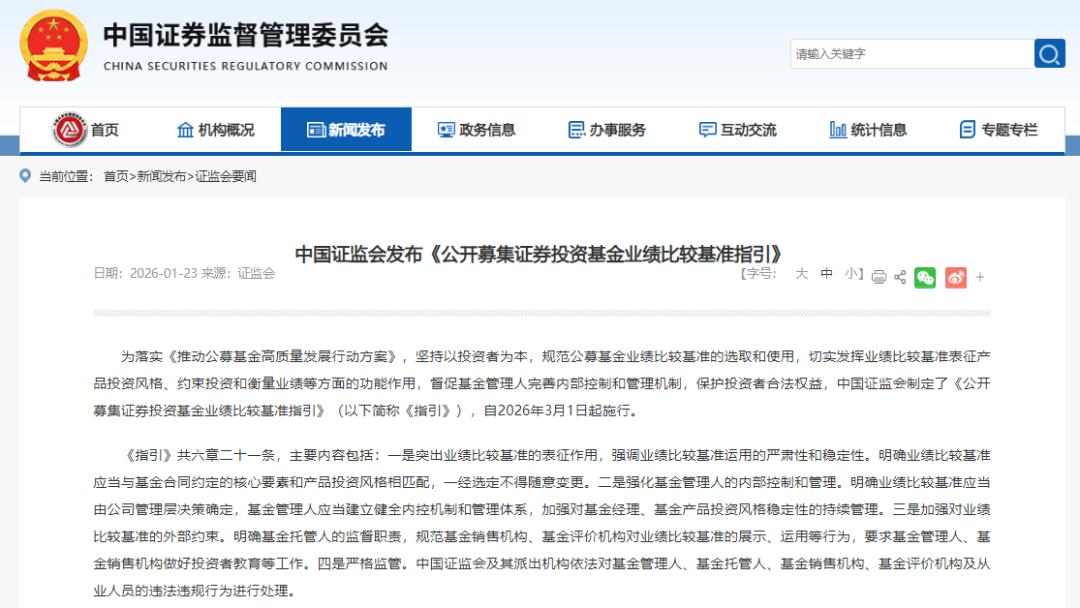
Core Viewpoint - The new guidelines and rules for public fund performance benchmarks aim to address long-standing issues in the industry, such as "ambiguous benchmarks," "style drift," and "fund blind boxes," by enhancing the anchoring role of performance benchmarks and improving investor experience [2][3]. Group 1: Regulatory Framework - The new regulations establish a comprehensive regulatory framework covering the entire lifecycle of performance benchmarks, including selection, internal control, external constraints, and self-regulation [2]. - The guidelines and rules will officially take effect on March 1, 2026, with a transition period of 6 months to 1 year for certain provisions to ensure a smooth industry transition [2]. Group 2: Benchmark Selection Standards - The guidelines impose strict requirements on the selection of performance benchmarks, ensuring they reflect the investment style of fund products and align with the fund contract's investment objectives, scope, strategies, and restrictions [3]. - The rules further detail the criteria for index selection, emphasizing representativeness, reasonable compilation schemes, continuous operation, and good liquidity of constituent securities [4]. Group 3: Internal Control and Supervision - The new regulations extend the focus on performance benchmarks to the internal control systems of fund managers, requiring them to establish comprehensive management systems covering benchmark selection, disclosure, monitoring, evaluation, and accountability [5]. - Fund custodians' supervisory roles are strengthened, with requirements to establish mechanisms for evaluating benchmark-related contract terms, investment supervision, and information disclosure review [5]. Group 4: Information Disclosure and Evaluation - The new rules enhance information disclosure requirements, mandating that fund reports include comparative data on returns and volatility against benchmarks over multiple time periods [6]. - The guidelines specify that fund managers and sales institutions must present past performance alongside benchmark performance in a standardized manner, ensuring clarity for investors [6]. Group 5: Industry Development - The introduction of these new regulations signifies a shift towards high-quality development in the public fund industry, moving beyond traditional scale competition to a more comprehensive focus on governance, research capabilities, and compliance risk management [7].

行业费率改革持续深化 基金公司密集宣布降费
Sou Hu Cai Jing· 2026-01-24 12:36
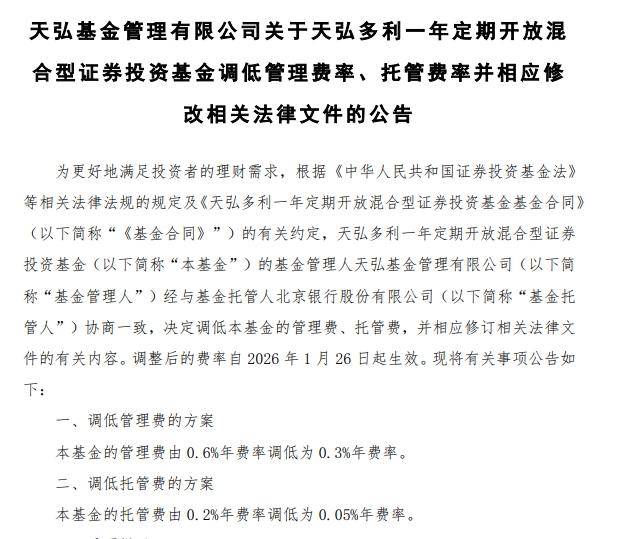
Core Viewpoint - The recent trend in the fund industry shows a significant reduction in management and custody fees by various fund companies, driven by regulatory reforms aimed at lowering overall industry costs and enhancing investor benefits [1][4][7]. Group 1: Fee Reductions by Fund Companies - Tianhong Fund announced a reduction in management fees from 0.6% to 0.3% and custody fees from 0.2% to 0.05%, effective January 26, 2026 [1]. - Prior to this, Tianhong Fund also reduced fees for another fund, lowering management fees from 0.7% to 0.3% and custody fees from 0.15% to 0.05% [3]. - Huaxia Fund reduced management fees for its financial technology ETF from 0.50% to 0.15% and custody fees from 0.10% to 0.05%, effective January 22, 2026 [4]. - Haifutong Fund lowered management fees for its bond fund from 0.5% to 0.4%, effective January 21, 2026 [6]. Group 2: Industry Context and Regulatory Changes - The China Securities Regulatory Commission (CSRC) initiated a fee reform plan for the public fund industry in July 2023, aiming to lower comprehensive fee levels through a structured approach [7]. - As of January 1, 2023, the new regulations on sales fees for publicly offered securities investment funds were implemented, marking a smooth transition in the fee reform [7]. - The CSRC's action plan for promoting high-quality development in public funds, released in May 2025, emphasizes optimizing fund operation models and establishing a floating management fee mechanism linked to fund performance [7]. Group 3: Market Impact and Future Outlook - As of January 24, 2023, nearly 1,200 funds have management fees at or below 0.15%, and over 2,400 funds have custody fees at or below 0.05% [8]. - Research indicates that the fund industry previously relied on a "high scale, high fee, high profit" model, which deviated from the principle of prioritizing investor interests [8]. - Future developments in the public fund industry will increasingly depend on quality improvements, focusing on value creation for investors through product innovation, research, and customer service [8].