
消费金融

Search documents
晋商消费金融成为被执行人 执行标的2万元
Xi Niu Cai Jing· 2025-12-22 03:56
12月15日,中国执行信息公开网发布的信息显示,晋商消费金融股份有限公司(以下简称"晋商消费金融")成为被执行人,执行法院为辽宁省葫芦岛市绥中 县人民法院,立案时间为2025年12月10日,执行标的为20000元。 经过调查,房女士才知道,自己的个人征信是被晋商消费金融股份有限公司上传了这种侮辱性的信息。 2021年5月,人民银行太原中心支行发布公告,为切实保护信息主体征信合法权益,规范金融信用信息基础数据库接入机构的操作行为,决定从即日起暂停 晋商消费金融股份有限公司征信系统查询权限,责成其内部整改,切实落实各项监管要求。 晋商消金官网发布声明称,就房女士个人信用报告中的不当表述及对其所造成的影响致歉,同时表示将进一步严格客户信息审核。 官网等公开信息显示,晋商消费金融成立于2016年2月23日,是全国31家持牌消费金融公司之一,由晋商银行联合上海荣大投资管理有限公司、天津宇信易 诚科技有限公司、山西华宇商业发展股份有限公司及山西美特好连锁超市股份有限公司共同出资成立。当前晋商银行持股比例为40%,是晋商消费金融的大 股东方。截至2024年底,晋商消费金融累计发放消费信贷超1200亿元。 2021年,晋商消 ...


长银五八消费金融获长沙银行增资 其他股东不参与增资
Xi Niu Cai Jing· 2025-12-22 03:56
长银五八成立于2017年,由长沙银行、北京城市网邻信息技术有限公司(以下简称"北京网邻")、长沙通程控股股份有限公司(以下简称"通程控股")共同 发起设立,总部位于湖南长沙。目前,上述三大股东的持股比例分别是56.66%、26.43%和16.91%。 12月16日,长沙银行发布公告称,为进一步增强控股子公司湖南长银五八消费金融股份有限公司(以下简称"长银五八")的资本实力,提升其风险抵御能 力,推动其健康可持续发展,该行拟以自有资金对长银五八增资,增资金额不超过15.5亿元(含),最终金额以经监管部门核准后的实际出资金额为准。 长银五八当前的注册资本为11.24亿元。通程控股在公告中提到,前述增资及股权转让完成后,长银五八的注册资本将由11.24亿元增加至19.45亿元。 值得注意的是,通程控股近日发布公告称,该公司与北京网邻均不参与此次增资。同时,通程控股拟将持有的长银五八1.14亿股股份转让给长沙银行,转让 价格为每股1.8877元,转让金额总计约2.15亿元。转让后,通程控股持有长银五八的股份总数由1.9亿股变更为7600万股。 ...

绿色金融司法服务高质量发展
Xin Lang Cai Jing· 2025-12-21 20:41
Core Viewpoint - Green development is emphasized as a key aspect of high-quality development, with financial mechanisms playing a crucial role in facilitating the transition from ecological to economic benefits [3][4] Group 1: Green Financial Judicial Concepts - The core of green financial justice is harmony, development, and sustainability, with a focus on integrating judicial work into the broader green development strategy [3] - The courts in Hangzhou are implementing innovative judicial mechanisms that incorporate green development principles throughout the financial judicial process [3][4] - A collaborative governance system is being established to enhance information sharing and coordination between financial and judicial sectors [3] Group 2: Focus Areas for Green Financial Judicial Direction - The courts are concentrating on three key areas: investment, production, and consumption, to support the high-quality development of green finance [4] - Efforts are being made to standardize green capital markets and expand investment channels, ensuring that more financial resources are directed towards green and emerging industries [4] - The courts are addressing challenges in green production financing and consumer protection, particularly in emerging sectors like pre-paid consumption [4] Group 3: Innovative Mechanisms for Green Financial Justice - The judicial system is enhancing preventive measures and dispute resolution mechanisms to improve the efficiency of financial dispute handling [4] - A focus on optimizing judicial processes aims to reduce time and costs associated with litigation, with over 60% of financial cases resolved through simplified procedures [4] - The execution of judgments is being improved to align with green development goals, including the introduction of expert consultations in specific cases to maximize asset recovery [4]

WEMONEY研究室·数字金融周报|险资布局硬科技版图浮出水面;银行出清存量贵金属杠杆类业务
Sou Hu Cai Jing· 2025-12-19 10:46
Group 1: Corporate Governance Changes - The six major state-owned banks in China have all abolished their supervisory boards, with Postal Savings Bank being the latest to announce this change, allowing the audit committee of the board to assume the supervisory functions [1] - Other commercial banks, including Huaxia Bank and Beijing Bank, are also in the process of removing their supervisory boards [1] Group 2: Regulatory Investigations - Postal Savings Bank is under self-regulatory investigation for alleged violations during the underwriting of debt financing instruments, which may involve issues like abnormal underwriting fees and price competition [2] Group 3: Deposit Trends - A significant wave of high-interest deposits is set to mature, with an estimated 72 trillion yuan in high-interest deposits maturing by the end of 2025, leading to a potential structural improvement in banks' liability costs [3] - In October, household deposits decreased by 1.34 trillion yuan, while non-bank financial institutions saw an increase of 1.85 trillion yuan in deposits [3] Group 4: Credit Card Issuance Decline - The number of credit cards in China has decreased by 10 million over the past three years, with a total of 7.07 billion credit cards and loan cards issued as of the end of Q3 2023 [4] Group 5: Preferred Stock Redemption - Nine banks have redeemed preferred shares this year, a significant increase compared to only two banks in the previous year, with the largest redemption being 560 billion yuan by Industrial Bank [5] Group 6: Precious Metals Business Adjustments - Banks are increasingly managing risks associated with leveraged precious metals accounts, with recent actions including the termination of agency relationships for long-standing accounts [6] Group 7: Regulatory Penalties - Citic Bank's Chengdu branch was fined 2.3 million yuan for various non-compliant financial practices, while four other branches faced a total fine of 2.5 million yuan [7] Group 8: Insurance Sector Developments - The CEO of Taikang Life, Cheng Kangping, has stepped down after nine years, with Xue Jihua taking over, marking a significant leadership change in the company [8] - Fuzhou Life Insurance has been approved to acquire all insurance business from Jun Kang Life Insurance, indicating consolidation in the insurance sector [8] Group 9: Consumer Finance Updates - Nanyin Fabao Consumer Finance has increased its registered capital to 6 billion yuan, ranking fourth among consumer finance companies in China [9] - Changsha Bank plans to invest up to 1.55 billion yuan in its subsidiary, Hunan Changyin 58 Consumer Finance, to increase its ownership stake [9] Group 10: Financial Technology Changes - Kuaqian Payment's actual controller has changed to Ke Liming, marking a significant shift in ownership away from the Wanda Group [10] - Deyunsheng Microfinance was ordered to rectify issues found during a regulatory inspection, indicating ongoing scrutiny in the microfinance sector [10]
年内 7 家消金公司完成增资 中型公司补充资本需求仍强
2 1 Shi Ji Jing Ji Bao Dao· 2025-12-18 12:01
Core Viewpoint - The consumption finance sector is experiencing a "capital increase wave" starting from 2024, driven by regulatory requirements and market considerations [1][6]. Group 1: Capital Increase Activities - Changsha Bank plans to increase capital in its subsidiary, Changyin 58 Consumer Finance, by up to 1.55 billion yuan, raising its ownership from 56.66% to 80.82% [1][2]. - At least seven consumer finance companies have completed capital increases this year, with several firms raising their registered capital to the 1 billion yuan threshold [3][4]. - Notable increases include Ningyin Consumer Finance's capital rising from 2.911 billion yuan to 3.6 billion yuan and Hubei Consumer Finance's from 1.0058 billion yuan to 1.3589 billion yuan [3]. Group 2: Regulatory Context - The "Management Measures for Consumer Finance Companies" effective from April 2024 mandates a minimum registered capital of 1 billion yuan [4][5]. - The new regulations also require major shareholders to hold at least 50% of the shares, up from 30%, to enhance accountability [5][6]. - Current data shows that five consumer finance companies still have registered capital below 1 billion yuan, and nearly half of the major shareholders do not meet the 50% ownership requirement [5]. Group 3: Market Considerations - Industry insiders suggest that the capital increases are not solely driven by regulatory compliance but also by strategic market choices from shareholders [6]. - Some leading companies are significantly increasing capital to expand credit offerings and capture high-quality customer segments, indicating a proactive growth strategy [6][7]. - Analysts predict that while the capital increase trend will continue, the pace will become more rational and differentiated, with medium-sized firms needing to maintain ROE levels and larger firms exploring various capital-raising methods [7].
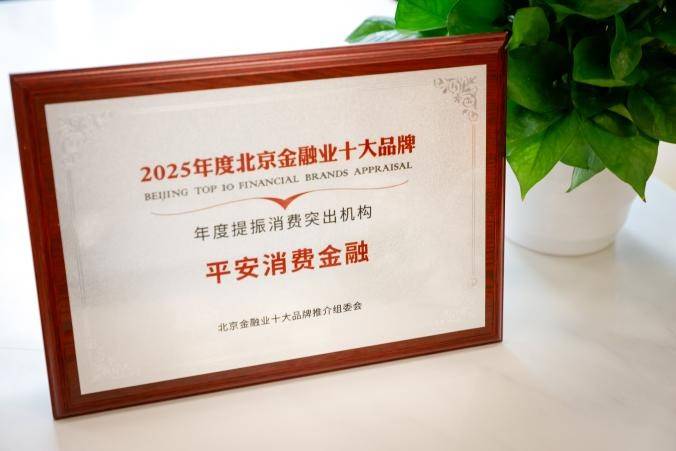
平安消费金融获“年度提振消费突出机构” 以金融活水激发消费新动能
Sou Hu Cai Jing· 2025-12-18 11:07
近日,第十一届北京金融论坛暨年度北京金融业十大品牌评选结果揭晓,平安消费金融凭借在激发消费 活力、助力居民消费方面的成果,获"年度提振消费突出机构"奖项。 自2015年创办以来,该论坛已成为区域内最具影响力、覆盖最广的金融盛事之一,本届论坛以"金融新 势力 创新消费力"为主题,聚焦金融促进消费的新路径,挖掘金融机构在落实金融"五篇大文章"方面的 突出实践。 在河北唐山,央企员工何先生为新居装修面临资金压力,通过平安消费金融的"小橙花"产品快速申请贷 款,及时解了燃眉之急。河南郑州医护人员陈先生工作繁忙,同时又需要一笔资金进行家电置换,其通 过平安消费金融官方APP提供的指引进行贷款申请,在短时间内获得放款、购买了新家电。平安消费金 融将"省心、省时、又省钱"的理念转化为客户可感可知的服务体验,切实以金融之力让人们对美好生活 的憧憬成为现实。 此次获"年度提振消费突出机构",是对平安消费金融在促消费、惠民生方面工作的充分肯定。作为深耕 消费金融领域的机构,平安消费金融将继续提升金融服务质效,持续挖掘消费潜力、充分激发消费活 力,为提振消费引擎、助力美好生活贡献坚实的金融力量。(图片由平安消费金融授权发布) 截至 ...
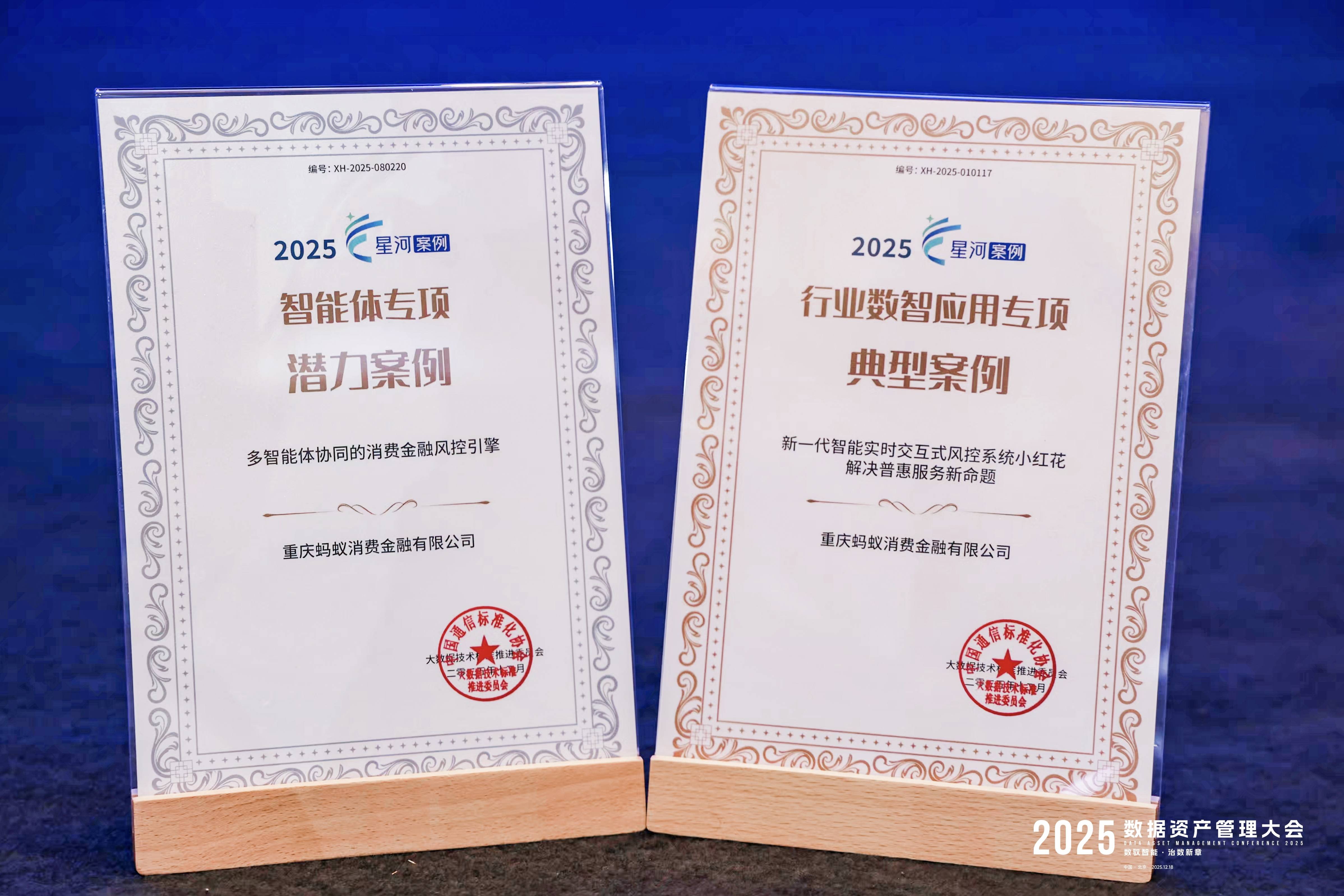
蚂蚁消金“小红花”和“多智能体协同风控”入选信通院数据智能“星河”案例
Sou Hu Cai Jing· 2025-12-18 10:27
Core Insights - The "Star River" case list, evaluated by the China Academy of Information and Communications Technology and the Big Data Technology Standard Promotion Committee, recognized Ant Group's two risk control innovations as exemplary applications in the industry [4] Group 1: Innovations in Risk Control - Ant Group's "Little Red Flower" real-time interactive intelligent risk control and the "Multi-Agent Collaborative Consumer Finance Risk Control Engine" were selected as typical cases, highlighting their industry benchmark value [4] - The "Little Red Flower" innovation breaks traditional credit models by integrating high-frequency user interaction data, enhancing the ability to process unstructured data, and enabling two-way interaction between users and financial institutions regarding credit limits [4] - Users can submit over 1,000 types of materials to apply for credit limit increases, including various professional qualification certificates and even photos of work badges, allowing for a more diverse demonstration of credit value [4] Group 2: Efficiency and Automation - The "Multi-Agent Collaborative Consumer Finance Risk Control Engine" focuses on improving efficiency and accuracy throughout the risk control process by integrating heterogeneous data and large model technology, achieving full-link automation from customer analysis to decision execution [4][5] - The system identifies over 120 credit feature tags, providing deep insights into user needs and risks, while reducing the model building and strategy development cycle from 30 days to 72 hours, with an automation rate exceeding 90% [5] - The decision-making process is dynamically adjusted based on real-time data, enhancing the approval rate of legitimate requests and improving fraud prevention, saving over 10,000 hours of expert labor annually [5] Group 3: Strategic Importance of Data - The national data strategy is becoming a crucial support for building new competitive advantages, with the "Data Element X" three-year action plan (2024-2026) accelerating the potential release of data as a new production factor [5] - The financial industry, being data-intensive, benefits from the deep integration of AI technology and data elements, improving service efficiency and expanding the coverage of inclusive finance [5] - The inclusion of Ant Group's applications in the "Star River" typical cases reflects the concentrated value of data elements in financial scenarios, indicating a shift from experience-driven to data-driven financial services [5]
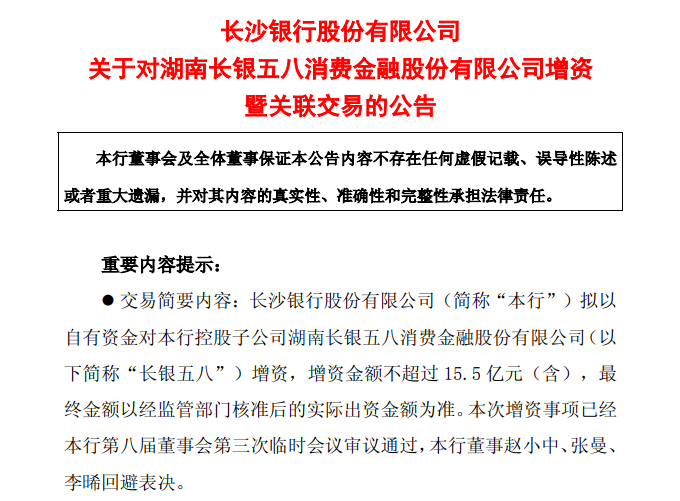
长沙银行拟对长银五八增资,增资后持股比例将提升至74.96%
Jin Rong Jie· 2025-12-18 07:48
Group 1 - Changsha Bank announced a capital increase of up to 1.55 billion yuan for its subsidiary Hunan Changyin 58 Consumer Finance Co., Ltd. at a price of 1.8877 yuan per share [1][6] - After the capital increase, the registered capital of Changyin 58 will rise from 1.124 billion yuan to 1.945 billion yuan, and Changsha Bank's shareholding will increase from 56.66% to 74.96% [4][5] - The capital increase is in response to the new regulatory requirements that raise the minimum registered capital for consumer finance companies from 300 million yuan to 1 billion yuan and increase the major shareholder's ownership requirement from 30% to 50% [4] Group 2 - As of December 31, 2024, Changyin 58's total assets were 29.62 billion yuan, with net assets of 3.58 billion yuan, and an audited net profit of 34 million yuan [4] - For the first three quarters of 2025, Changyin 58 reported total revenue of 1.67 billion yuan and an unaudited net profit of 21 million yuan [4]
政策协同发力!消金机构掘金下沉消费赛道
Xin Lang Cai Jing· 2025-12-18 03:44
Core Viewpoint - Accelerating the filling of the domestic demand gap, especially in consumption, has become a crucial topic for driving China's economic growth, with expanding domestic demand being prioritized as one of the eight key tasks for economic work in 2026 [1][10]. Policy Measures - The Ministry of Commerce and other departments have jointly issued a notification to strengthen the collaboration between commerce and finance to boost consumption, outlining 11 measures to enhance financial support in key areas and expand cooperation between government, finance, and enterprises [1][12]. - Recent policies have been introduced to stimulate market vitality and release consumption potential, including guidelines encouraging financial institutions to increase consumer loan issuance and support service consumption [2][11]. Financial Support and Collaboration - The notification emphasizes the need for a "combination punch" of policies, enhancing collaboration between financial institutions and retail platforms to improve payment services and support for consumer financing [3][12]. - Financial institutions are encouraged to innovate financial products and services that integrate into consumption scenarios, focusing on areas such as home services, education, and health, to stimulate new consumption patterns [3][13]. Market Response and Impact - Following the implementation of the consumption loan subsidy policy, significant market activity has been observed, with companies like Zhaolian Consumer Finance reporting substantial loan issuance and customer engagement [5][15]. - Merchants have gained confidence from financial policies, with promotional tools like interest-free installment plans leading to increased sales and customer engagement [5][15]. Targeting Underdeveloped Markets - The notification highlights the importance of expanding consumption in county-level markets and rural areas, recognizing their potential for growth and the need for targeted financial support [7][17]. - Financial institutions are focusing on providing services to underserved populations, including new citizens and small businesses, to enhance financial inclusion and stimulate local consumption [18][19]. Long-term Strategy - The overall strategy for boosting consumption is shifting from short-term stimulus measures to long-term, systematic approaches aimed at enhancing consumer capacity and addressing structural issues in the economy [20].
FICC-Secondary Market Daily Recap|20251217
Xin Lang Cai Jing· 2025-12-17 14:20
Interest-rate Bond Market - Main interbank cash bond yields trended down, with the 10Y CDB 250215 yield falling by 3.2bps to 1.9%, the 5Y CDB 250208 yield down by 2.25bps to 1.74%, and the 3Y CDB 230208 yield down by 2bps to 1.64% [14] - The 10Y CGB 250016 yield decreased by 1.75bps to 1.835%, the 5Y CGB 250003 yield fell by 1.5bps to 1.5475%, while the 3Y CGB 2500010 closed at 1.40% [14] - CGB futures traded up, with the 30Y main contract up 0.63%, the 10Y up 0.1%, the 5Y up 0.06%, and the 2Y up 0.01% [14] Credit Bond Market - Credit bond yields fell across most tenors by 0.3-2bps, except for the 5Y tenor, where yields mostly rose by around 0.2–1.5bps [15] - Compared with CDB bonds, 5Y credit spreads across all ratings widened by about 1.1-3.1bps, while 10Y spreads widened by around 2.2-2.6bps [15] - In exchange-traded markets, real estate bonds edged up on low trading volume, with "22 Vanke 04" (1.47 years to maturity) rising 1.03% to a clean price of 23.114 yuan, and "21 Financial Street Holdings 07" (364 days to maturity) rising 0.51% to a clean price of 101.618 yuan [15][16] ABS and REITs Market - The secondary ABS market was active, with the trading amount of the whole market rising 24% to RMB 8.9 billion compared with the previous day [19] - The trading amount of the Shanghai Stock Exchange was flat compared with yesterday at RMB 4.2 billion [19] - In the C-REITs market, trading activity rose, with the average trading amount of RMB 5.45 million, and China Communications Construction, China Resources Commercial REIT, and ProLogis ranked as the top 3 among all REITs [21]
