Semiconductor

Search documents
授权费延后、无限流片:Arm IP怎么用最省钱?
芯世相· 2026-03-12 02:06
Core Insights - The article discusses the recent adjustments to the Arm Flexible Access program, which aims to provide chip design teams with a more flexible R&D investment arrangement, impacting both cost structure and risk control [1] Summary by Sections Arm Flexible Access Program - The annual fee for joining the Arm Flexible Access program is set at $85,000, which includes unlimited tape-out rights, allowing companies to expand according to their development needs [2] - Members of the Arm Flexible Access program can access a rich portfolio of Arm IP products and tools, including new technologies such as the Ethos-U85 NPU, Corstone-320 reference platform, and Cortex-M52 processor, enhancing options for various chip projects [3] Financial Optimization - The traditional IP licensing model requires chip design teams to pay licensing fees early in the project, creating financial pressure before any revenue is generated. The Arm Flexible Access model allows teams to use IP for design and simulation during R&D without upfront costs, deferring payments until the chips are ready for mass production, thus improving cash flow for early-stage projects [6] Design Flexibility and Cost Reduction - The "unlimited tape-out rights" feature reduces R&D investment and decision-making pressure, as traditional models require separate negotiations and payments for each tape-out, leading to increased costs with each iteration. The new model allows teams to test multiple solutions in parallel and only pay for the IP used in the final SoC design [8] - This model is attractive not only for startups but also for established teams exploring new directions or needing rapid prototyping, providing a low-cost entry point without the need for separate budgets for each exploratory project [9] Industry Impact - The optimized commercial collaboration model lowers the barriers and financial risks for companies, supporting teams from early exploration to product mass production, thereby enhancing the cost-effectiveness of R&D investments. The program has already helped over 100 companies successfully launch more than 400 chip products, demonstrating its commercial value and cost advantages [9]


神秘网络芯片公司,浮出水面
半导体行业观察· 2026-03-12 01:39
Core Insights - The article discusses the emergence of Eridu, a startup that has raised over $200 million in Series A funding to create a high-radix switching system for AI clusters, aiming to reduce network costs which account for over 20% of the total hardware acquisition cost for AI clusters [2][9] - The founders of Eridu have significant backgrounds in telecommunications and service provision, which may enhance their potential for innovation and commercialization in the AI hardware space [4][5][8] Funding and Market Potential - Eridu has raised over $200 million, with seed funding around $30 million and Series A funding exceeding $200 million, which is crucial for competing against established players like NVIDIA and Broadcom in the AI hardware market [9][10] - The AI hardware spending is projected to reach between $3 trillion to $5 trillion by the end of the decade, indicating substantial opportunities in the networking sector, with investments potentially ranging from $600 billion to $1.5 trillion [10][11] Technical Innovations - Eridu aims to develop a new switching ASIC architecture that can interconnect thousands of GPUs and XPUs in a vertical scaling network and millions in a horizontal scaling configuration, addressing the current limitations in network performance [14][19] - The company claims it can reduce the number of switches by 30 times while aiming to lower infrastructure costs by 40% and network power consumption by 70%, presenting a pathway to significant profitability [19] Founders' Background - Drew Perkins, one of the co-founders, has a rich history in the tech industry, including the development of early Ethernet switches and significant roles in various successful tech companies [5][6][7] - Omar Hassen and Mike Capuano, the other co-founders, bring extensive experience from their previous roles in companies like Ventana Systems and Infinera, further strengthening Eridu's leadership team [8][9]

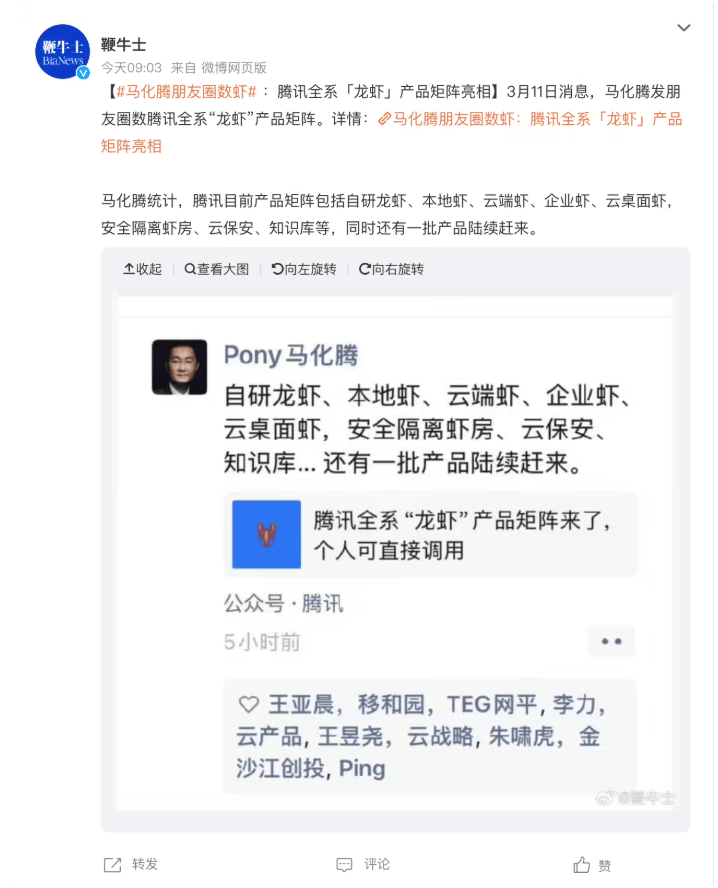
马化腾凌晨发声:腾讯还有一批“龙虾系”产品陆续赶来;英伟达宣布投入 260 亿美元打造开源模型;小伙手搓悬停火箭火爆全网|极客早知道
Sou Hu Cai Jing· 2026-03-12 01:25
Group 1 - The core topic revolves around the rapid rise of OpenClaw, an open-source AI project, which has sparked significant interest and policy support across various regions in China [1][2] - Multiple cities, including Hefei and Shenzhen, have introduced measures to support the development of OpenClaw and one-person companies (OPC), with Hefei offering up to 10 million yuan in funding [1][2] - Concerns regarding the security of OpenClaw have been raised, highlighting its high-level permissions and the lack of strict security audits in the skill package market [2] Group 2 - Tencent has announced a series of products under the "lobster" brand, including WorkBuddy, which is fully compatible with OpenClaw and aims to enhance usability and security [3][4] - Nvidia plans to invest $26 billion over the next five years to develop open-source AI models, marking a strategic shift from being solely a chip manufacturer to becoming a leading AI laboratory [4][5][6] - The investment will cover model development, computational infrastructure, talent acquisition, and ecosystem building, with the first models expected to be released by late 2026 or early 2027 [6][8] Group 3 - Google has completed a $32 billion acquisition of Wiz, marking its largest acquisition to date, aimed at enhancing its cloud security capabilities [11][12] - The acquisition is part of Google's strategy to strengthen its position in the cloud computing and AI sectors, responding to the growing demand for secure AI infrastructure [11][12] - Wiz will continue to operate with a multi-cloud service strategy, providing its products through competitors' platforms like AWS and Azure [12] Group 4 - Xiaomi has launched its official car insurance, FaBa Tianxing, which offers competitive pricing and additional services compared to other insurance providers [18] - The insurance is currently available for renewal in Beijing, with a focus on providing enhanced services to customers [18][19] Group 5 - NIO's CEO Li Bin emphasized that the company's first quarterly profit is just a starting point, indicating a long-term competitive strategy in the automotive industry [20][21] - NIO plans to maintain a quarterly R&D investment of 2 to 2.5 billion yuan in 2026, focusing on improving efficiency and ensuring strong investment in key products and technologies [20][21]





Nebius Group (NBIS) Climbs 16% on Nvidia $2-Billion Backing
Yahoo Finance· 2026-03-12 00:46
Core Viewpoint - Nebius Group NV (NASDAQ:NBIS) has seen a significant stock price increase of 16.14% to $112, driven by Nvidia Corp.'s acquisition of a $2 billion stake in the company, indicating strong investor confidence in the partnership and future growth potential [1]. Group 1: Partnership and Investment - Nvidia's $2 billion investment complements a partnership with Nebius for the joint development of next-generation hyperscale cloud solutions for the AI market [2]. - The collaboration includes AI factory design and support, access to partner design materials, and regular business and technical reviews [2][3]. - Nebius will utilize Nvidia's latest software technologies and infrastructure across its platform, enhancing its AI capabilities [3]. Group 2: AI Factory Development - Nebius is developing an AI factory with a capacity of 5 GW, with deployment expected to commence over the next four years [4].

Roth Capital Cuts Daqo New Energy Corp. (DQ) Target After Mixed Q4
Yahoo Finance· 2026-03-11 21:19
Core Viewpoint - Daqo New Energy Corp. (NYSE:DQ) is recognized as a small-cap semiconductor stock with potential, despite recent mixed financial results and a price target reduction by Roth Capital from $30 to $25, maintaining a Neutral rating until industry clarity improves [1]. Financial Performance - For Q4, Daqo reported a narrowed net loss of $7.3 million, with an EPS of -$0.11, which was better than analyst expectations of -$0.26 [2]. - The company experienced a decline in revenue but reported a positive EBITDA of $1.7 million, a significant improvement from the negative EBITDA of $337.4 million in 2024 [3]. Production Outlook - Daqo anticipates production levels between 140,000 to 170,000 metric tons in 2026, indicating a potential market rebound [3]. Business Overview - Daqo New Energy Corp. specializes in providing polysilicon to photovoltaic product manufacturers, with its products used in solar power solutions including ingots, wafers, and modules [4].

Oracle Earnings Heated Up Its Stock—But Couldn't Spark an AI Rally
Investopedia· 2026-03-11 20:15
Group 1 - Oracle reported better-than-expected quarterly results, indicating strong demand for AI, which led to a significant increase in its stock price [1] - The company's backlog grew by $29 billion sequentially, reinforcing its position in the AI market and boosting investor interest [1] - Oracle raised its fiscal year 2027 revenue guidance to $90 billion from $85 billion, reflecting broad demand for its AI infrastructure and cloud computing services [1] Group 2 - Despite Oracle's strong results, the broader market and most AI stocks struggled due to rising oil prices and geopolitical tensions, indicating a challenging environment for AI investments [1] - The PHLX Semiconductor Index rose by 0.6% following Oracle's earnings report, while shares of companies like Micron and Sandisk also saw gains, highlighting a positive impact on semiconductor stocks [1] - Concerns over sustained high oil prices and their potential impact on economic growth and inflation have created a cautious sentiment among investors, affecting market performance [1]


Qnity Expands Domestic Manufacturing Footprint to Accelerate Semiconductor Industry Growth
Businesswire· 2026-03-11 20:10
Core Insights - Qnity Electronics, Inc. has opened a new 385,000-square-foot manufacturing facility in Newark, Delaware, aimed at enhancing domestic semiconductor production to meet increasing demand driven by AI and high-performance computing [1] - The new facility is part of a multi-year investment strategy to expand advanced manufacturing capabilities, with projections indicating the semiconductor industry could reach $1 trillion in global revenue in the coming years [1] - The facility features a newly commissioned manufacturing line for chemical mechanical planarization (CMP) pads, which are essential for chip fabrication, particularly in advanced AI chip production [1] Company Developments - The opening ceremony was attended by Delaware Governor Matt Meyer, highlighting the importance of local manufacturing in powering next-generation technologies and creating job opportunities [1] - Qnity's CEO, Jon Kemp, emphasized that the expansion enhances operational agility and supports collaborative innovation through strategic investments [1] - The facility's production capabilities are expected to improve reliability and quality for CMP pads, which are critical in the increasingly complex AI chip fabrication process [1] Industry Context - The semiconductor industry is experiencing rapid growth due to advancements in AI, high-performance computing, and advanced connectivity, necessitating increased production capacity for semiconductor materials [1] - Qnity's investment in domestic manufacturing aligns with broader industry trends that forecast significant revenue growth in the semiconductor sector [1]

HyperLight, UMC, and Wavetek Announce Strategic Partnership for High-Volume Foundry Production of TFLN Chiplet™ Platform
Businesswire· 2026-03-11 18:03
Core Insights - HyperLight Corporation, United Microelectronics Corporation (UMC), and Wavetek Microelectronics Corporation have formed a strategic manufacturing partnership for high-volume foundry production of HyperLight's TFLN Chiplet Platform [1] Group 1: Partnership Details - The collaboration will focus on the production of TFLN Chiplet Platform on both 6-inch and 8-inch wafers [1] - This partnership signifies a major inflection point in the commercialization of HyperLight's technology [1]


Synopsys Unveils New Tools For Designing AI Chips, Systems
Investors· 2026-03-11 16:31
Core Viewpoint - Synopsys has introduced new AI-powered engineering solutions aimed at enhancing the design, verification, and delivery of next-generation AI chips and systems, despite a slight decline in its stock price following the announcement [1]. Group 1: New Product Offerings - Synopsys unveiled its Multiphysics Fusion technology, the first EDA product integrating Synopsys and Ansys technologies for semiconductor design, addressing critical chip design challenges related to electromagnetics, thermal, and mechanical effects [1]. - The company showcased the industry's first orchestrated, multi-agent design and verification workflow, utilizing Synopsys AgentEngineer technology [1]. - An upgrade to the core Ansys product offering was also announced, featuring AI-driven multiphysics simulation and real-world digital twin technologies [1]. Group 2: Strategic Context - The introduction of these technologies follows Synopsys' $35 billion cash-and-stock acquisition of Ansys completed in July [1]. - Synopsys' CEO emphasized the need for a new engineering approach to tackle the complexity of next-generation intelligent systems, integrating software and hardware co-design, and leveraging digital twins and AI to enhance R&D efficiency [1]. Group 3: Market Reaction - Following the announcement, Synopsys stock experienced a decline of over 1%, trading at $427.50 [1]. - The company's Composite Rating stands at 51 out of 99, indicating room for improvement compared to top growth stocks, which typically have a rating of 90 or higher [1].

Synopsys CEO: We're Using AI Everywhere in Our Products
Youtube· 2026-03-11 16:07
Core Insights - The company is focusing on its relationship with Nvidia and the implications of its recent acquisition of NCIS, emphasizing the need to communicate its technology roadmap and future plans [1][4] Group 1: Acquisition and Market Expansion - The acquisition of NCIS is aimed at addressing the increasing engineering complexity in chip design and AI-infused products, enhancing the company's capabilities in the semiconductor space [2][4] - The customer base has expanded significantly, with over 90% of automotive OEMs now utilizing the company's software for both electronic and physical design aspects [5] Group 2: Engineering Complexity and AI Integration - The integration of AI into the design process is crucial for managing the complexity of multi-domain engineering, allowing for the creation of virtual representations of products [6][8] - The company emphasizes the importance of physics and algorithms in software development, which are essential for ensuring that designs translate into manufacturable products [7][15] Group 3: Challenges and Opportunities - Current challenges include supply chain issues and a shortage of engineers, which are impacting the ability to design and manufacture products efficiently [9][10] - Despite headwinds, including a slowdown in the Chinese market, the company remains committed to achieving double-digit growth in EDA and IP, driven by the increasing complexity of silicon design [18][19]