农产品贸易

Search documents
事到临头再谈判没用!中国没买加拿大油菜,澳大利亚补位成功
Sou Hu Cai Jing· 2025-11-05 04:07
Group 1 - Canadian Prime Minister Carney's recent decision to meet with China aims to resolve tariff issues, marking a significant shift after previous indecisiveness [1] - The relationship between Canada and China has deteriorated due to increased tariffs on steel and electric vehicles, leading to a loss of patience from China [1] - Australia has begun exporting canola to China, filling the market gap left by Canada, indicating a potential long-term shift in supply sources [1][3] Group 2 - Australia, as the second-largest canola exporter, has quickly responded to the market opportunity, completing significant orders to China shortly after the tariff imposition [3] - China's diversification of import sources has led to increased canola exports from countries like Russia and Mongolia, reducing reliance on any single supplier [5] - The situation highlights the risks of unilateral trade policies, as Canada has lost a key trading partner while failing to address its dependency on the U.S. market [7]


倒计时40天!全国首个“媒体+”农业B2B盛会来了!
Nan Fang Nong Cun Bao· 2025-11-05 04:03
Group 1 - The first "Media+" agricultural B2B event in the country, the Greater Bay Area Agricultural Products Trade Fair, is set to take place from December 12-14 in Guangzhou [3][4] - This event aims to create a "Canton Fair" for the agricultural sector, focusing on B2B transactions and leveraging a "Media+" strategy for full-chain empowerment [5][4] - The event has already generated significant interest, with over 10,000 professional buyers invited, including diverse groups such as export traders, Michelin restaurants, and large e-commerce platforms [19][20] Group 2 - A comprehensive media matrix has been established, including central media, local government media, industry vertical media, and social platforms, achieving over 10 million exposures and 38,000 interactions [11][12] - The event will facilitate precise matching between exhibitors and buyers through pre-publicized procurement lists and online reservations, enhancing the effectiveness of the exhibition [26][28] - Innovative activities such as "big buyer selection meetings" and "reverse procurement meetings" will be held to drive direct sales from exhibition samples to live-streaming orders [29][30] Group 3 - The fair will serve as a platform for agricultural brands to elevate their visibility, with the announcement of the "Top 50 Agricultural Enterprises Brand Value in Guangdong" and the release of the "Annual Development Report on Agricultural Brands in China" [34][35] - An international section will be established, with over 600 core buyers confirmed to attend, including international purchasers from Japan and South Korea, creating a fast track for domestic quality agricultural products to enter global markets [41][42] - The event is expected to showcase over 200 regional landmark agricultural products, highlighting the comprehensive development of agriculture from poverty alleviation to revitalization [38][39]

变“众智成城”为“发展共赢”——从中拉智库合作对话会看河南与拉美合作进阶
He Nan Ri Bao· 2025-11-04 23:48
Group 1 - The 18th China-Latin America Entrepreneurs Summit focused on cultural exchange and practical cooperation, emphasizing the theme "Collective Wisdom for New Prosperity" [1] - The event highlighted the deep cultural connections between Chinese and Latin American civilizations, with performances like traditional Henan opera impressing Latin American guests [1] - The summit showcased the potential for deepening cooperation beyond mere trade, moving towards cultural integration and mutual learning [1] Group 2 - China is the second-largest trading partner for Latin America, with a projected bilateral trade volume of $518.47 billion in 2024, reflecting a 6% year-on-year growth [2] - China's investment in Latin America exceeds $600 billion, making it the third-largest source of investment in the region, with a focus on emerging sectors like renewable energy and digital economy [2] - Zhengzhou's trade with Latin America is significant, with a projected import-export total of $29.28 billion in 2024 and a recent signing of agreements worth $12 billion during a trade promotion event [2] Group 3 - Experts at the summit discussed the need for consensus on customs efficiency and digital trade rules as Latin America seeks new development models [3] - The dialogue emphasized the transformation of Henan from an inland region to an open frontier, positioning it as a key hub for China-Latin America cooperation [3] - The summit served as a platform for building "bridges of thought," aiming to clarify cooperation directions and enhance practical actions between Henan and Latin America [3]
中美握手言和?重磅消息传出,中国一口气下单,近18万吨美国大豆?特朗普松口:下调对华关税
Sou Hu Cai Jing· 2025-11-04 12:41
Core Insights - The article highlights a potential reduction of 10% in U.S. tariffs on Chinese fentanyl, indicating a possible compromise in U.S.-China trade relations [1] - Concurrently, China has resumed purchasing U.S. soybeans, with three orders totaling nearly 180,000 tons, suggesting a thaw in trade tensions [1] - These developments are linked to the outcomes of the fifth round of U.S.-China economic talks in Kuala Lumpur, signaling a significant easing of long-standing trade frictions [1] U.S. Perspective - The U.S. decision to lower tariffs is driven by domestic pressures, particularly from American soybean farmers facing a surplus due to lack of Chinese purchases [3] - The U.S. agricultural sector has been vocal in urging the government to engage constructively with China, as the absence of the Chinese market poses a risk for the upcoming midterm elections [3] - Internal contradictions within the U.S. government are evident, with conflicting statements from officials regarding trade agreements, reflecting a struggle among various interest groups [3] China’s Strategy - The soybean orders from China, while significant, represent only a small fraction of its overall imports, indicating a strategic approach to diversify supply sources [5] - China has developed a multi-source supply chain for soybeans, reducing reliance on U.S. imports, which serves as a buffer against U.S. trade policy fluctuations [5] - The decision to engage in soybean purchases is seen as a pragmatic move to test U.S. intentions while maintaining leverage in negotiations [5] Global Trade Implications - The U.S.-China soybean and tariff negotiations reflect broader shifts in global trade dynamics, with China moving away from dependence on U.S. agricultural products [8] - The article suggests that the U.S. has lost trust among its largest buyers due to its trade policies, which could have long-term repercussions for American farmers [8] - The interactions between the two largest economies highlight the necessity for cooperation, but also underscore the challenges posed by internal divisions within the U.S. government and the need for genuine commitment from both sides to rebuild trust [8]
前三季度云南对APEC其他经济体进出口逾764亿元
Xin Lang Cai Jing· 2025-11-04 11:39
据昆明海关消息,今年前三季度,云南对亚太经合组织(APEC)其他经济体进出口764.3亿元,同比增 长1.3%,占云南整体外贸的37.9%。其中,与相关经济体农产品贸易246.3亿元,增长16.1%,占云南农 产品进出口总值的57.5%。 ...
【环球财经】南美大豆升贴水报价回落 中国进口商加购巴西大豆
Xin Hua Cai Jing· 2025-11-04 11:38
Core Insights - The global soybean market is stabilizing amid signs of easing US-China trade relations, with Brazilian soybean prices now lower than US counterparts, prompting Chinese importers to accelerate purchases of Brazilian soybeans [1][2] - Recent trade talks in Kuala Lumpur between the US and China have led to preliminary agreements on key economic issues, positively impacting soybean futures prices in Chicago [1] - Brazilian soybean prices have increased across major production areas, driven by a strong dollar and demand from China, indicating potential competitive pressure on Brazilian exports if US-China agricultural trade resumes [2] Group 1 - The Chicago Board of Trade (CBOT) soybean futures saw a nearly 1% increase, reaching a 15-month high, with a cumulative rise of nearly 6% since mid-October [1] - Brazilian soybean quotes have dropped below those of US soybeans, with December shipments priced at a premium of 225 to 230 cents per bushel compared to 240 cents for Gulf Coast shipments [1] - Chinese buyers have recently ordered approximately 10 batches of Brazilian soybeans for December shipment and another 10 batches for March to July 2026 [2] Group 2 - In October, the price index for 60 kg bags of soybeans in Brazil's major production areas rose, with Paraná state increasing by 4.68% and Mato Grosso state by 7.9% [2] - As of October 31, the price for a 60 kg bag of soybeans was 129.50 reais (approximately 170 RMB) [2] - The demand for diversified soybean supply sources from China is expected to provide stable market opportunities for major South American producers in the long term [2]
中美贸易变化,CNN做了4张图
Huan Qiu Shi Bao· 2025-11-04 00:13
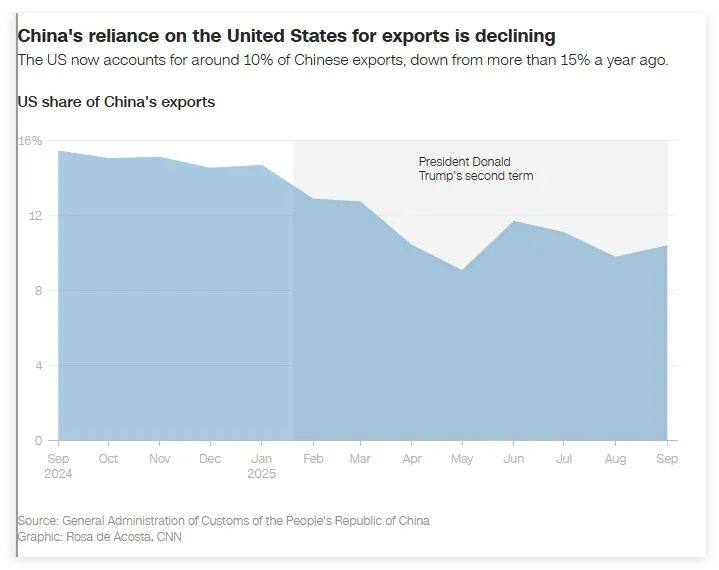
Core Insights - The article discusses the recent changes in trade dynamics between China and the United States, highlighting a decrease in China's reliance on the U.S. market for exports and an increase in trade with other regions [1][3]. Group 1: Trade Data Analysis - A chart presented by CNN shows that the proportion of U.S. exports in China's trade has decreased from 15% a year ago to approximately 10% as of now [1]. - Despite a decline in exports to the U.S., China's overall export total has increased by 6.1% year-on-year, driven by growth in exports to other markets such as the EU and ASEAN [3]. - China has quickly found alternative sources for U.S. agricultural products, such as soybeans and beef, from countries like Brazil, Australia, and Argentina [6]. Group 2: Strategic Shifts - The article emphasizes that China is diversifying its exports and increasing imports from other countries to replace U.S. goods [12]. - The "Belt and Road Initiative" is noted for playing a positive role in this trade diversification, as it has helped China expand its export markets and enhance the industrial capabilities of partner countries [12].
戴维斯商业评估价值10亿美元的ESG代币化收益走廊以连接亚洲、非洲和拉丁美洲
Globenewswire· 2025-11-03 17:15
Core Insights - Davis Commercial Ltd. is evaluating the establishment of a cross-regional ESG tokenized yield corridor based on its Real Yield Token (RYT) ecosystem and certified commodity finance [1][2] - The proposed corridor aims to bridge capital demand and verified supply chains across trade routes in Asia, Africa, and Latin America through programmable financial tracks [1][2] Group 1: Tokenized Yield Corridor Definition - The tokenized yield corridor is a programmable financial infrastructure designed to connect investors, trade flows, and cross-regional ESG-certified assets [2] - It combines agricultural product trading with blockchain settlement and digital yield tools to reduce friction, enhance transparency, and create new access points for sustainable finance [2] - Initial modeling indicates that integrating recognized sustainability certifications directly into the tokenized yield stream could enable large-scale access to verified, commodity-backed yield instruments for impact funds and sustainability-linked institutional investors [2] Group 2: Executive Commentary - The Executive Chairman of Davis Commercial, Li Peng Leck, highlighted that emerging markets often face high foreign exchange spreads and slow banking cycles [3] - The company aims to explore how programmable capital can significantly promote sustainable commodity trade while maintaining transparency and regulatory compliance [3] Group 3: Next Steps and Market Engagement - Davis Commercial is currently in discussions with various institutions, and any operational initiatives will depend on regulatory reviews, market conditions, and stakeholder feedback [3] Group 4: Company Overview - Davis Commercial Ltd., headquartered in Singapore, focuses on trading sugar, rice, and oilseed products across multiple markets, including Asia, Africa, and the Middle East [4] - The company operates under two main brands, Maxwill and Taffy, which handle procurement, marketing, and distribution of commodities [4] - Following phased implementation, the capitalized scale of the yield corridor is expected to reach $1 billion, with a projected efficiency improvement of 50% to 80% in trade settlement costs compared to traditional SWIFT systems [4]

敲山震虎?中方买美大豆只是顺水人情,敲打趁机涨价的巴西才是真
Sou Hu Cai Jing· 2025-11-03 14:17
Group 1 - China resumed purchasing 180,000 tons of U.S. soybeans, marking the first order after a five-month pause, which is perceived as a gesture of goodwill amid easing U.S.-China trade tensions [2][6][8] - The decision to purchase U.S. soybeans comes at a time when Brazilian soybean prices have surged, causing concern among Brazilian exporters who have seen their products pile up at ports [4][21][23] - The U.S. soybean farmers have suffered significantly due to China's absence in the market, with many facing storage issues and financial losses [6][19][32] Group 2 - The timing of China's soybean purchase is strategic, aimed at signaling to Brazil that it has alternative sources for soybeans, thus discouraging price gouging [15][19][30] - Brazilian soybean prices have increased dramatically, from $360 per ton to $650 per ton, reflecting an 80% rise, which has led to operational losses for Chinese oil mills [23][25][27] - The logistical challenges in Brazil, including strikes and adverse weather conditions, have compounded the issues, leading to increased transportation costs and inventory buildup [21][34][40] Group 3 - China's actions have prompted a reevaluation of trade relationships, as it demonstrates its ability to pivot suppliers and maintain market stability despite price fluctuations [19][42] - The situation has highlighted the risks of over-reliance on a single supplier, as Brazilian exporters misjudged China's market position and response capabilities [29][30][42] - The overall soybean trade dynamics are shifting, with Brazil's high pricing strategy failing to hold up against China's decisive purchasing strategy from the U.S. [36][38][40]
中美达成四大经贸共识,阶段性胜利超预期,全球产业链迎稳步缓冲
Sou Hu Cai Jing· 2025-11-02 20:14
海事和造船领域也免不了谈判内容,美方暂停一年对华的301调查措施,换言之美国征收中国船舶入港 费这事儿按下暂停键,中方对应地也把对美国船舶的入港费暂停一年,短期内这给航运和全球供应链送 来了一口气。 芬太尼合作与农产品,特别是美国大豆问题,是被媒体放大的两点,官方通稿确认了芬太尼禁毒合作和 扩大农产品贸易的讨论,并在个案层面继续处理企业问题,芬太尼这块历史上就是敏感点,但双方在会 谈里取得了可执行的共识。 超预期的阶段性胜利,中美在吉隆坡握了手,但别以为那是终局,本篇把来龙去脉讲清楚,顺着时间线 把关键点一条条摆明,让你知道谁让步、谁暂缓、哪几项真能缓解全球产业链压力,而这些决定又会在 什么时候到期,就差把那张会议纪要摊你面前了。 9月29日,美国先放话要推50%穿透性出口管制规则,随后步子一大,中国也在10月9日回应,宣布自己 的相关出口管制——两边气氛一下子紧张起来,但随后在吉隆坡会谈里有了变化,一年期限的暂停被写 进了协议当中。 美方此前对中国产品征收的20%"芬太尼关税"先降到10%,现在又宣布取消多出的10%,留下10%作为 观测空间,一并把原来对中国产品加征的24%对等关税再延期一年,中美相互调整 ...