
消费金融

Search documents
沈建光获批任京东消费金融董事
Bei Jing Shang Bao· 2025-12-05 10:11
北京商报讯(记者 岳品瑜 董晗萱)12月5日,据国家金融监督管理总局行政许可信息,天津金融监管局 核准沈建光天津京东消费金融有限公司董事的任职资格。 简历显示,沈建光现任京东集团副总裁、首席经济学家。 ...

又一消金公司被罚 消保与个贷审查成为关注点
Zhong Guo Jing Ying Bao· 2025-12-05 08:13
中经记者 郑瑜 北京报道 日前,国家金融监督管理总局厦门监管局行政处罚信息公开表显示,厦门金美信消费金融有限责任公司 (以下简称"金美信消金")因第三方合作机构管理不到位、消费者权益保护工作不到位、个人消费贷款 业务调查审查不审慎,受到行政处罚。 在消费金融领域,信用信息的规范采集、提供与查询,是保障消费者信息安全、信用权益与资金安全的 关键支撑。 本次罚款金额为120万元,对两名负责人进行警告。公开资料显示,其中一位负责人涉及市场营销部、 线上业务部条线。 对于被处罚的具体事宜,《中国经营报》记者向金美信消金方面发去采访函,截至发稿尚未收到回应。 公开资料显示,金美信消金于2018年4月27日获批筹建,9月29日获开业批复。截至2024年年底,资产总 额为55.16亿元,与上年年末相比下降12.6%,处于行业尾部位置;实现净利润2056万元,同比下降 71.4%。 金美信消金在2024年社会责任报告中曾披露,截至2024年12月末,公司累计放款482亿元,服务客户数 437万人,2024年新增放款89亿元。 值得注意的是,今年6月,金美信消金也曾因存在违法违规行为受到行政处罚。彼时原因为违反信用信 息采集、 ...
促消费再升级 海尔消金多元服务助新市民城市扎根
Sou Hu Cai Jing· 2025-12-04 03:43
Core Insights - The implementation of the "Implementation Plan for Enhancing the Adaptability of Supply and Demand for Consumer Goods" by six departments, including the Ministry of Industry and Information Technology, positions consumer finance institutions as key players in stimulating domestic demand and supporting new urbanization [1][3] - Haier Consumer Finance aligns its strategy with the policy's focus on enhancing financial support and diversifying consumer finance products, specifically targeting the needs of new urban residents [1][3] Group 1: Financial Services and Product Offerings - Haier Consumer Finance has developed a comprehensive financial service system that addresses the lifecycle needs of new urban residents in key areas such as home appliances, training, and health [1] - The "Smart Home Installment" product, available through over 2,000 Haier stores, has facilitated a total installment transaction volume of 130 million yuan, resulting in a retail sales increase of over 30% for partner stores [1] - The policy of "0 down payment, 0 interest, 0 fees" significantly lowers the barriers for new urban residents to purchase high-end smart home appliances, with single event transactions during "Double 11" reaching millions [1] Group 2: Market Expansion and Technological Empowerment - Haier Consumer Finance is expanding its service offerings beyond core home appliance consumption to include diverse life scenarios such as vocational training and healthcare, aligning with the aspirations of new urban residents for quality living [3] - The implementation of a multi-modal intelligent risk control system allows for millisecond-level approval responses, enabling new urban residents to complete loan approvals in 3-5 seconds through digital identification methods [3] - This digital service capability has increased the average transaction value by 2.7 times, effectively driving the upgrade of quality consumer goods supply [3] Group 3: Rural Market Penetration and Policy Alignment - Haier Consumer Finance is extending its financial services to county-level and below markets, addressing the "last mile" of inclusive finance and responding to the policy's call for upgrading rural consumer goods [4] - The company’s services have reached multiple provinces and cities, supporting new urban residents in their transition from "settling in cities" to "rooting in cities" [4] - By integrating policy alignment, scenario fusion, and technological empowerment, Haier Consumer Finance is not only providing warm financial services but also driving supply-side upgrades in response to consumer demand [4]


官方通报!55款涉金融应用小程序,存在风险!
券商中国· 2025-12-04 02:54
Core Viewpoint - The rapid development of financial technology and the popularity of mobile internet have made mini-programs a crucial channel for financial institutions to provide online services, despite exposing significant security risks and compliance loopholes [1][2]. Group 1: Security Risks in Financial Mini-Programs - A recent inspection by the China Internet Finance Association revealed that all 55 sampled financial mini-programs exhibited varying degrees of security risks, with an average of 18.13 risk issues per program [5][6]. - High-risk issues, which threaten core financial security, were found in 18.19% of the inspected mini-programs, primarily related to "key leakage" and "application error vulnerabilities" [6]. - Medium-risk issues were highly concentrated, with 38 programs showing "unobfuscated code" risks and 30 programs having "internal domain leakage" risks [6]. Group 2: Regulatory and Compliance Issues - Some local financial organizations were found to be using mini-programs to conduct illegal financial activities, such as high-interest lending, violating national regulations on interest rate management and financial marketing [9]. - The association has requested the removal of these problematic mini-programs from the WeChat platform and will refer the cases to relevant authorities [9]. Group 3: Recommendations for Enhancing Financial Security - The China Internet Finance Association recommends that financial institutions strengthen their management responsibilities for digital channels, including mini-programs, and enhance their security governance systems [10]. - Mini-program platforms should establish comprehensive admission review, daily monitoring, and violation handling mechanisms to maintain a clear digital financial ecosystem [10]. - Financial consumers are encouraged to improve their self-protection awareness and risk identification capabilities, carefully assess their repayment abilities, and be cautious of excessive marketing and false advertising [10]. Group 4: Ongoing Self-Regulation Efforts - The association plans to enhance self-regulation of financial apps and mini-programs, conducting regular self-checks and initiating mini-program filing work to improve industry safety and compliance levels [11]. - The initiation of mini-program filing work indicates a shift towards proactive regulation, allowing for better oversight and risk prevention from the outset [11].

超百亿元!消金公司加速转让不良贷款,年末冲刺“出清”
Bei Jing Shang Bao· 2025-12-03 13:36
临近年末,消费金融行业掀起不良资产处置"冲刺潮"。12月3日,北京商报记者注意到,12月以来仅3天,已有中邮消费金融、马上消费金融、湖北消费金 融、唯品富邦消费金融、兴业消费金融公司密集在银行业信贷资产登记流转中心(以下简称"银登中心")发布不良贷款转让相关消息,汇总来看,单月待消 金业转让的不良规模超百亿元,其中既有不到百日的逾期资产,但更多的是超3年、5年的长期逾期资产。 业内认为,今年以来,消费金融公司对外挂牌转让不良资产的规模和频率上升,既反映行业整体风险水位抬升,也体现监管引导下风险处置机制日趋成熟, 频繁出清是理性选择,但"卖得快"不代表"管得好",下一步,消费金融机构要注意将风控向源头前移,强化贷前准入、完善贷中动态监控。 月初5家消金公司密集转不良 12月过去不到3天,已有5家消金公司发布不良资产转让信息。从挂牌数据来看,部分消金公司不良资产处置呈现规模大、逾期长的特征。 以兴业消费金融发布的2025年第31期、32期个人不良贷款为例,其拟转让不良贷款分别合计121787笔、81833笔,未偿本金总额共计98.40亿元、9.49亿元, 加权平均逾期天数长达1188天、2033天,从逾期时间来看 ...

金美信消金再吃罚单,因第三方机构管理不到位被罚120万
2 1 Shi Ji Jing Ji Bao Dao· 2025-12-03 10:47
Core Viewpoint - Xiamen Jinmeixin Consumer Finance Co., Ltd. has been fined 1.2 million yuan due to inadequate management of third-party partners, insufficient consumer rights protection, and imprudent investigation of personal consumer loan business [1][2]. Group 1: Regulatory Actions - The Xiamen Financial Supervision Administration imposed a fine of 1.2 million yuan on Jinmeixin for various compliance failures [1][2]. - This is not the first penalty for Jinmeixin in 2023; previously, it was fined 820,000 yuan for violating credit information management regulations [1][2]. Group 2: Company Background - Jinmeixin was established on April 27, 2018, with approval from the China Banking and Insurance Regulatory Commission, and began operations on September 29, 2018 [2]. - The company is jointly owned by three major shareholders: Jinyuan Jinkong (33%), Gome Holdings Group (33%), and China Trust Commercial Bank (34%) [2]. Group 3: Product Offerings - Jinmeixin offers two loan products: "Jisu Loan 2.0" with a limit of 50,000 yuan and an annual interest rate between 18% and 24%, and "Life Loan" with a maximum limit of 200,000 yuan and an annual interest rate between 4.88% and 24% [3]. - The company has recently disclosed 51 third-party partners, including 32 lead generation partners, 13 guarantee institutions, and 5 external collection agencies [3]. Group 4: Industry Trends - In 2023, a total of 11 consumer finance institutions have faced regulatory penalties, primarily focusing on three areas: management of third-party partners, consumer rights protection, and data compliance [3]. - Regulatory emphasis is placed on the prudent management of third-party partners, consumer rights protection against misleading marketing and improper collection practices, and adherence to data security and compliance regulations [3].
涉第三方合作机构管理不到位等违法违规行为,厦门金美信消费金融被罚款120万元
Cai Jing Wang· 2025-12-03 05:08
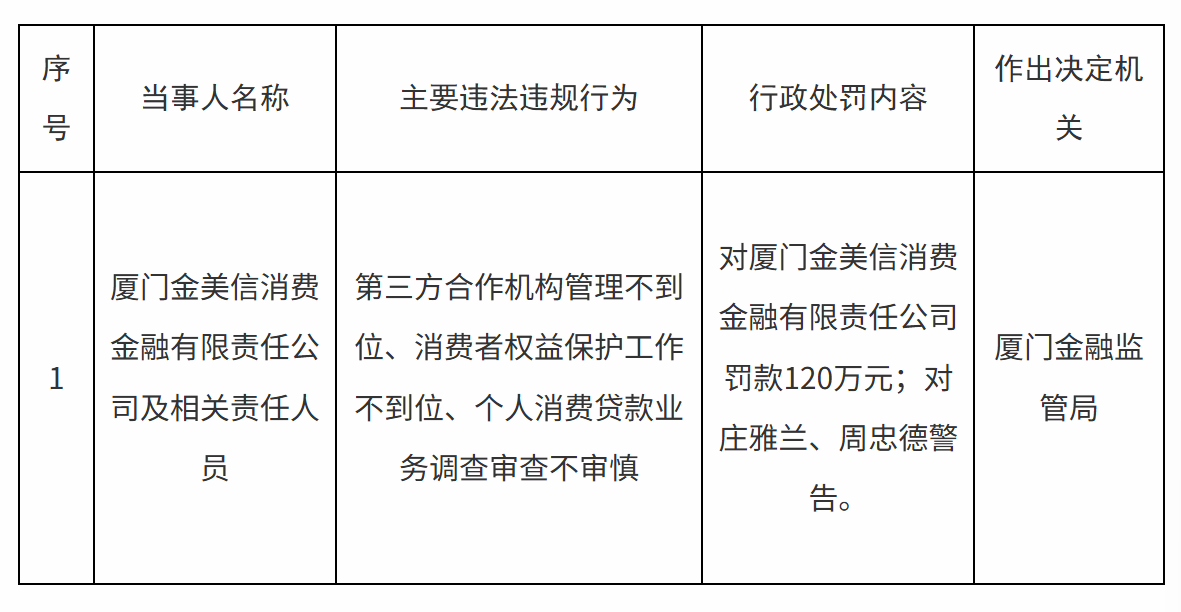
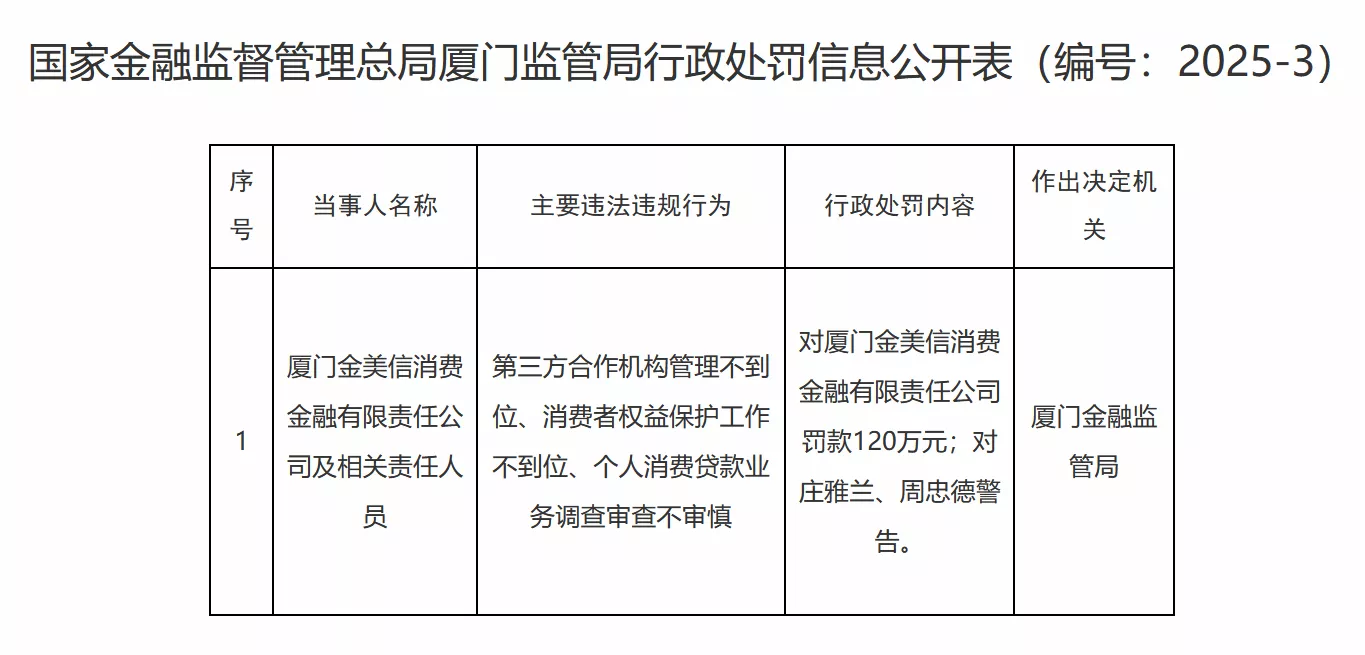
(国家金融监督管理总局) 近日,国家金融监督管理总局厦门监管局发布的行政处罚信息显示,厦门金美信消费金融有限责任公司因存在以下主要违法违规行为:第三方合作机构管理 不到位、消费者权益保护工作不到位、个人消费贷款业务调查审查不审慎,被罚款120万元,相关责任人员庄雅兰、周忠德被警告。 | 序 | 当事人名称 | 主要违法违规行为 | 行政处罚内容 | 作出过 | | --- | --- | --- | --- | --- | | 특 | | | | イ | | 7 | 厦门金美信消费 | 第三方合作机构管理不到 | 对厦门金美信消费 金融有限责任公司 罚款120万元;对 | 厦门台 | | | 金融有限责任公 | 位、消费者权益保护工作 | | | | | 司及相关责任人 | 不到位、个人消费贷款业 | | 管 | | | | | 庄雅兰、周忠德警 | | | | 员 | 务调查审查不审慎 | 告。 | | ...
建信消金副总裁贺照艳任职资格获批
Xi Niu Cai Jing· 2025-12-03 03:48
9月份,建信消金新任总裁宫永媛任职资格获批。公开信息显示,宫永媛于2001年7月加入建设银行,先后在总行个人银行业务部、个人金融部、个人存款与 投资部任职,2015年11月任个人存款与投资部资深副总经理;2018年6月任建信基金管理公司纪委书记、党委委员,后先后担任建信基金副总裁,兼任财务 负责人、首席信息官。 公开资料显示,建信消金已于9月完成首期个人不良贷款的批量转让,建信消金2025年第1期个人不良贷款未偿本息总额为1.28亿元,起始价为1034万元,约 为0.8折。 11月28日,北京金融监管局发布关于贺照艳建信消费金融有限责任公司(以下简称"建信消金")副总裁任职资格的批复,核准贺照艳建信消金副总裁的任职 资格。与此同时,北京金融监管局还发布了关于窦振建信消金董事任职资格的批复。 ...

坚守普惠金融初心 服务消费提质升级 访兴业消费金融股份公司董事长戴叙贤
Jin Rong Shi Bao· 2025-12-03 02:01
Core Viewpoint - The average contribution rate of final consumption to China's economic growth reached 56.2% over the past four years, an increase of 8.6 percentage points compared to the "13th Five-Year Plan" period, indicating a strong focus on consumption-driven growth in the "14th Five-Year Plan" [2] Group 1: Strategic Positioning and Development - The company is adopting a differentiated and market-oriented development strategy during the "14th Five-Year Plan," focusing on inclusive service, collaborative development, and innovative breakthroughs [3] - Emphasis on party leadership in financial work is seen as essential for ensuring the correct direction of financial services and maintaining systemic risk control [3] Group 2: Service to Underrepresented Groups - The company aims to provide modern consumer finance services to underserved groups such as individual businesses, self-employed individuals, and urban-rural residents, addressing issues like information asymmetry and incomplete credit records [3] - As of June 2025, the company has served over 28 million customers, primarily from demographics traditionally underserved by financial services [3] Group 3: Digital Transformation and Risk Management - The company is shifting its strategy from offline to a hybrid online-offline model to better adapt to external changes and enhance consumer service [4] - A comprehensive risk management system has been established, covering all processes and stages of lending, including risk identification, early warning, and handling [4][5] Group 4: Product and Service Strategy Adjustments - The company has implemented strategic adjustments to balance the coverage of inclusive finance and service quality, achieving a positive cycle between the two [4] - Key initiatives include the "Xingcai Plan" to alleviate financial pressure on students, deep exploration of regional characteristics to match consumer needs, and expansion of digital inclusive finance offerings [4] Group 5: Future Outlook and Goals - The company plans to strengthen digital governance and talent development while ensuring compliance in data usage, aiming for comprehensive integration of financial technology across all lending processes [6] - The focus will remain on inclusive finance, adapting to market changes, and contributing to economic growth through innovative measures and enhanced consumer protection mechanisms [6]

坚守普惠金融初心 服务消费提质升级
Jin Rong Shi Bao· 2025-12-03 01:58
Core Viewpoint - The average contribution rate of final consumption to China's economic growth over the past four years has reached 56.2%, an increase of 8.6 percentage points compared to the "13th Five-Year Plan" period, indicating a strong focus on high-quality development in the consumption finance sector during the "14th Five-Year Plan" period [2]. Group 1: Strategic Positioning and Development - The company is adopting a differentiated and market-oriented development strategy, focusing on inclusive service, collaborative development, and innovative breakthroughs [3]. - The company emphasizes the importance of party leadership in financial work to ensure the correct direction of financial services and to mitigate systemic risks [3]. - The company aims to serve underrepresented customer groups, such as individual businesses and new citizens, by providing modern consumption finance services, having served over 28 million customers by June 2025 [3]. Group 2: Digital Transformation and Risk Management - The company is shifting its strategy from offline to a hybrid online-offline approach to better align with external changes and enhance consumer services [4]. - A comprehensive risk management system has been established to cover all stages of the lending process, addressing common risks such as credit and data risks [6]. - The company is leveraging advanced technologies like AI and big data to enhance its risk management capabilities, creating a data-driven decision-making model [7]. Group 3: Product Design and Service Quality - The company believes that it is possible to achieve a balance between inclusive coverage and service quality through strategic adjustments, creating a positive feedback loop [5]. - Key strategies include the "Xingcai Plan" to alleviate financial pressure on students, matching regional characteristics with consumer needs, and expanding digital inclusive finance offerings [5]. Group 4: Future Outlook and Goals - The company plans to deepen its understanding of regional economic structures and consumer characteristics to optimize customer segmentation and enhance service precision [8]. - Emphasizing technology as a core driver for high-quality development, the company will strengthen digital governance and ensure compliance in data usage [8]. - The company aims to maintain its commitment to inclusive finance while adapting to market changes and contributing to the promotion of consumption and high-quality industry development [8].
