
光热发电

Search documents
青海众控德令哈35万千瓦光热发电示范(试点)项目开工
Xin Lang Cai Jing· 2026-01-01 20:49
Group 1 - The Qinghai Zhongkong Delingha 350,000 kW solar thermal power demonstration project is the largest tower solar thermal power project under construction and planning globally, marking a new development stage in the solar thermal power sector [1] - The total investment for the project is approximately 5.567 billion yuan, featuring a 14-hour ultra-long energy storage system to address the industry's challenge of energy generation during the day and consumption at night [1] - Once completed, the project is expected to generate an annual electricity output of 985 million kWh, sufficient to meet the annual clean electricity needs of 500,000 households, saving 295,000 tons of standard coal and reducing carbon dioxide emissions by 1.5303 million tons each year [1] Group 2 - The project aligns with national strategies, aiming for a total installed capacity of 15 million kW for solar thermal power in China by 2030, with electricity costs comparable to coal power [2] - The Delingha project is a key initiative for Qinghai to establish itself as a national clean energy industry hub, providing essential support for China's dual carbon goals [2] - The project will enhance grid peak regulation capabilities and improve the absorption of renewable energy, contributing significantly to the construction of a new power system [2]
能源转型迎来“光热时刻”
Jing Ji Ri Bao· 2026-01-01 01:56
Core Viewpoint - The development of concentrated solar power (CSP) is crucial for energy transition, aiming for a total installed capacity of approximately 15 million kilowatts by 2030, with electricity costs comparable to coal power [1][2]. Group 1: Importance of CSP - CSP acts as a stabilizer and regulator for the power grid, providing continuous and stable electricity supply even during nighttime or cloudy days [2]. - CSP is a new engine for industrial chain upgrades, involving high-end manufacturing and driving the development of precision machinery, special molten salts, and high-temperature heat collectors [2]. - China has successfully mastered mainstream CSP technologies and built a leading global CSP industry chain, with construction costs per kilowatt decreasing from approximately 30,000 yuan to 15,000 yuan over the past decade [2]. Group 2: Challenges and Policy Solutions - The initial investment for CSP is high, and market competitiveness is weak; policies aim to reduce costs through large-scale deployment and the establishment of supporting renewable energy stations [3]. - The reliance on imported core technologies and materials contributes to high project costs; policies encourage domestic production and performance optimization of key equipment [3]. - CSP needs to find its optimal role within the power system; policies clarify its role in multi-energy complementary bases and promote integrated projects with other energy sectors [3]. Group 3: Future Trends - The future will see a fusion of application scenarios, with CSP integrated with photovoltaic and wind power bases as a stable energy source [4]. - Diverse and refined technological routes will emerge, focusing on efficiency and cost reduction rather than just installed capacity [5]. - CSP companies will evolve from merely providing electricity to offering comprehensive energy services, including peak regulation and backup power [5].
经济日报:能源转型迎来“光热时刻”
Jing Ji Ri Bao· 2025-12-31 23:44
Core Viewpoint - The Chinese government aims to promote the large-scale development of solar thermal power, targeting a total installed capacity of approximately 15 million kilowatts by 2030, with the cost of electricity per kilowatt-hour expected to be comparable to that of coal power [1][2]. Group 1: Importance of Solar Thermal Power - Solar thermal power acts as a stabilizer and regulator for the power grid, providing continuous and stable electricity even during nighttime or cloudy days, which is crucial as wind and solar power generation increases [2]. - It serves as a new engine for industrial chain upgrades, involving high-end manufacturing sectors such as precision machinery and high-temperature materials, thereby enhancing China's competitiveness in the global renewable energy industry [2][3]. - The cost of solar thermal power has significantly decreased, with the construction cost per kilowatt dropping from approximately 30,000 yuan to 15,000 yuan over the past decade, and the cost per kilowatt-hour now around 0.6 yuan, indicating a foundation for large-scale development [2][3]. Group 2: Challenges and Policy Solutions - The initial investment for solar thermal power is high, and its market competitiveness is weak; policies aim to reduce costs through large-scale deployment and the establishment of supporting renewable energy stations, potentially increasing annual installed capacity by nearly 3 million kilowatts [3]. - The reliance on imported core technologies and materials contributes to high project costs; policies encourage domestic production and performance optimization of key equipment to enhance efficiency and reduce dependency on imports [3]. - The integration of solar thermal power into the electricity system requires clear positioning; policies address concerns regarding scheduling and pricing, promoting integrated projects that combine solar thermal power with other energy sources [3]. Group 3: Future Trends - By 2030, solar thermal power is expected to integrate with other energy sources, such as photovoltaic and wind power, enhancing overall system value [4]. - The industry will see diverse and refined technological routes, focusing on efficiency improvements and cost reductions rather than merely increasing installed capacity [4]. - Solar thermal power companies will evolve from merely providing electricity to offering comprehensive energy services, including peak regulation and backup power, becoming essential components of the new energy system [5].
【能源广角】能源转型迎来“光热时刻”
Sou Hu Cai Jing· 2025-12-31 22:37
Core Viewpoint - The Chinese government aims to promote the large-scale development of solar thermal power, targeting a total installed capacity of approximately 15 million kilowatts by 2030, with electricity costs comparable to coal power [2][3]. Group 1: Importance of Solar Thermal Power - Solar thermal power acts as a stabilizer and regulator for the power grid, providing continuous and stable electricity even during nighttime or cloudy days, which is crucial as wind and solar power generation increases [3]. - It serves as a new engine for industrial chain upgrades, involving high-end manufacturing sectors such as precision machinery and high-temperature materials, thereby enhancing China's competitiveness in the global renewable energy industry [3]. - China has successfully mastered mainstream solar thermal technologies, with the cost of power generation dropping from approximately 0.6 yuan per kilowatt-hour to a competitive level, establishing a foundation for large-scale development [3][4]. Group 2: Addressing Challenges - The initial investment for solar thermal power is high, and the market competitiveness is weak; policies aim to reduce costs through large-scale deployment and the establishment of supportive energy stations, potentially increasing installed capacity by nearly 3 million kilowatts annually [4]. - The reliance on imported core technologies and materials contributes to high project costs; policies encourage domestic production and performance optimization of key equipment to enhance efficiency and longevity [5]. - The integration of solar thermal power into the electricity system requires finding optimal positions within multi-energy complementary bases, addressing concerns from grid companies regarding scheduling and pricing [5]. Group 3: Future Trends - By 2030, solar thermal power is expected to integrate with other energy sources, such as photovoltaic and wind power, enhancing overall system value [6]. - The industry will shift towards diverse and refined technological routes, focusing on operational efficiency and cost reduction rather than merely increasing installed capacity [6]. - Solar thermal power companies will evolve from merely providing electricity to offering comprehensive energy services, including peak regulation and backup power, becoming essential components of the new energy system [6].

国家能源集团首个塔式光热项目并网发电
Zhong Guo Dian Li Bao· 2025-12-31 01:08
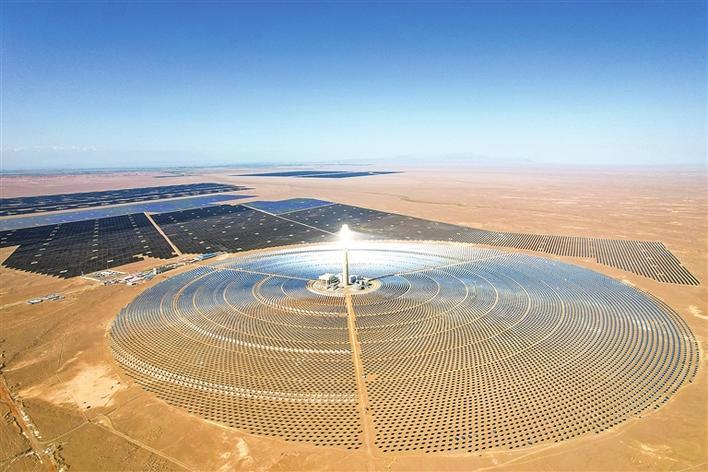
Group 1 - The core viewpoint of the article highlights the successful grid connection of the first tower solar thermal project by the National Energy Group, which utilizes an innovative "solar thermal + photovoltaic" complementary model [1] - The project, located in Qinghai, has a capacity of 100,000 kilowatts and features a 12-hour heat storage system, allowing for the storage of excess solar energy and stable power supply [1] - Upon operation, the project is expected to generate an average annual electricity output of approximately 223 million kilowatt-hours, saving 68,100 tons of standard coal and reducing carbon dioxide emissions by about 185,400 tons each year [1]
我国开启光热发电规模化发展新征程
Xin Lang Cai Jing· 2025-12-30 19:09
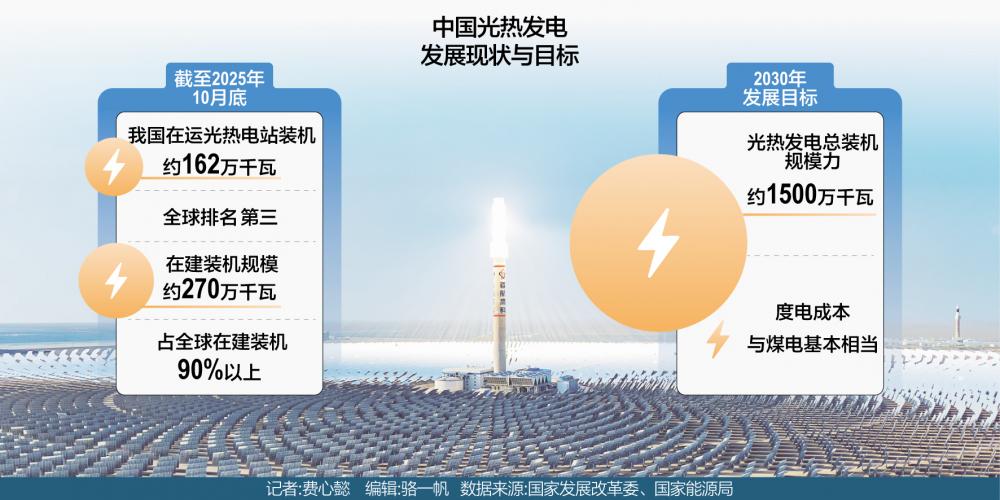
Core Viewpoint - The article emphasizes the importance of promoting the large-scale development of solar thermal power generation in China, aiming for a total installed capacity of approximately 15 million kilowatts by 2030, with costs comparable to coal power and achieving international leadership in technology [3][4]. Group 1: Policy and Strategic Goals - The National Development and Reform Commission and the National Energy Administration have issued opinions to promote the industrialization and large-scale development of solar thermal power [3][4]. - The goal of 15 million kilowatts of installed capacity is set to enhance system regulation capabilities and support the integration of wind and solar power [5][6]. - The opinions call for strategic planning and top-level design to facilitate the large-scale development of solar thermal power [4][5]. Group 2: Resource Potential and Regional Development - China has significant solar thermal resource potential, mainly distributed in regions like Inner Mongolia, Qinghai, Gansu, Xinjiang, and Tibet, which have relatively weak power systems [5]. - The opinions encourage the development of solar thermal projects tailored to local resource conditions and power system structures [5][6]. Group 3: Application Markets - Solar thermal power can serve multiple applications, including power generation and heating, with three main categories identified: integration with renewable energy bases, regional power systems, and integrated source-grid-load-storage systems [5][6]. - The opinions provide clear requirements for these application categories to support project implementation [6]. Group 4: Technological and Industrial Innovation - Continuous innovation in technology and industry is essential for reducing costs in solar thermal power generation [8]. - Key areas for technological breakthroughs include high-efficiency heat absorption, long-duration thermal storage, and smart control systems [8][9]. - The opinions support technological innovation and collaboration across the solar thermal industry to enhance competitiveness [8][9]. Group 5: Financial and Policy Support - Initial investment and costs for solar thermal power remain high, necessitating policy support to create a favorable environment for large-scale development [9]. - Recommendations include increasing policy support, innovative financing models, and establishing incentive mechanisms based on project performance [9].
全身而退!北京一家5口完美套现24亿,临走前又坑了甘肃国资一把
Sou Hu Cai Jing· 2025-12-30 11:08
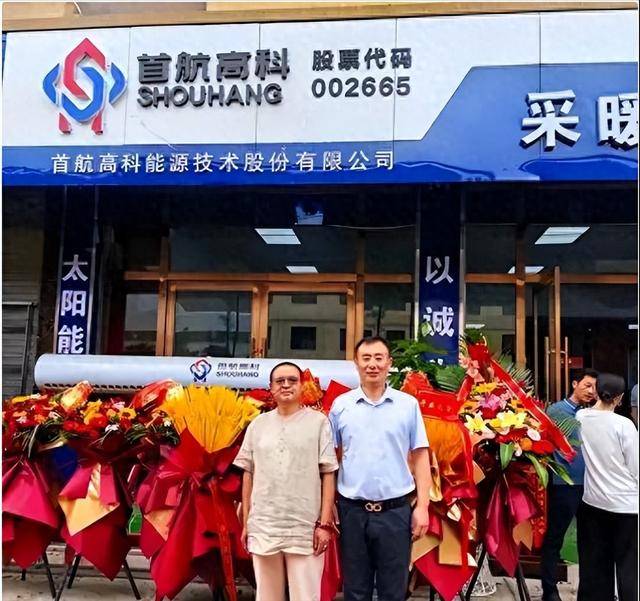
Core Viewpoint - The company Shihang High-Tech, a leading player in the energy sector, has officially exited the A-share market after 12 years, resulting in significant losses for shareholders, while the Huang family behind the company managed to cash out 2.4 billion yuan before the collapse [1][28]. Group 1: Company History and Growth - The Huang family started with a small business selling plumbing parts and later expanded into hardware and electrical trading, eventually founding Shihang in 1997 [3]. - From 2001 to 2006, the family capitalized on the growth of the power industry, expanding into ventilation equipment and breaking foreign technology monopolies, achieving a market share of 22% at their peak [5][6]. - Shihang went public in 2012, raising 1 billion yuan and reaching a market valuation of over 25 billion yuan, marking a significant turnaround for the Huang family [8]. Group 2: Decline and Mismanagement - The company's fortunes declined after 2015 due to a shift towards clean energy, leading to a total loss of over 1.6 billion yuan from 2020 to 2023 and 1.264 billion yuan over its entire listing period [10][12]. - The Huang family attempted to pivot the business towards capital-intensive projects like solar thermal power and seawater desalination, which ultimately failed and drained financial resources [12][13]. - By 2024, the company's stock price fell below 1 yuan, triggering mandatory delisting procedures, culminating in its removal from the stock market in August [26]. Group 3: Financial Manipulation and Exit Strategy - The Huang family began cashing out shortly after the IPO, pledging over 90% of their shares for loans and later selling shares worth 1.06 billion yuan despite the company's declining performance [17][19]. - In 2019, as the company neared bankruptcy, the family sold 251 million shares to a rescue fund for 972 million yuan, effectively using the fund as a final exit strategy [19][30]. - The family maintained control over the company by modifying governance structures and increasing executive compensation, even during periods of significant losses [22][24]. Group 4: Consequences and Regulatory Response - The fallout from the company's collapse left 140,000 shareholders with substantial losses, while the rescue fund's investment became nearly worthless [28]. - The Huang family, having extracted 2.4 billion yuan, faced minimal penalties, with regulatory actions deemed insufficient compared to their financial gains [30][31]. - The case highlights the need for a fair and just market environment to protect investors and uphold ethical standards in capital markets [33].
股指:申万期货品种策略日报-20251230
Shen Yin Wan Guo Qi Huo· 2025-12-30 07:56
1. Investment Rating of the Reported Industry - No investment rating information is provided in the report. 2. Core Viewpoints of the Report - In the context of further institutional improvements, renewed capital expansion, and continuous industrial empowerment, the long - term and steady bullish pattern of A - shares is expected to be consolidated, forming a triple resonance of "policy support, capital protection, and industrial drive." The expected interest rate cut by the Fed in December is likely to boost global capital flows and risk appetite, and continuous capital market reforms will further strengthen the foundation for the steady bull market. With the gradual implementation of the key meeting's tone in December, the positive policy signals and the Fed's interest rate cut will resonate, potentially increasing market risk appetite again [2]. 3. Summary by Relevant Catalogs 3.1 Stock Index Futures Market - **IF Contracts**: The previous day's closing prices of IF contracts (current month, next month, next quarter, and far - quarter) were 4574.00, 4555.60, 4531.00, and 4489.00 respectively, with increases of 29.80, 27.40, 28.00, and 29.60, and increases of 0.66%, 0.61%, 0.62%, and 0.66% respectively. The trading volumes were 74003.00, 8279.00, 35116.00, and 7056.00, and the open interests were 113155.00, 20301.00, 118268.00, and 31235.00, with changes in open interests of 1266.00, 3152.00, 8332.00, and 1133.00 [1]. - **IH Contracts**: The previous day's closing prices of IH contracts (current month, next month, next quarter, and far - quarter) were 2986.80, 2980.00, 2979.80, and 2966.40 respectively, with increases of 21.20, 20.00, 22.80, and 22.20, and increases of 0.71%, 0.68%, 0.77%, and 0.75% respectively. The trading volumes were 32570.00, 3336.00, 15385.00, and 2310.00, and the open interests were 47489.00, 6153.00, 33343.00, and 10023.00, with changes in open interests of - 211.00, 704.00, 3314.00, and 60.00 [1]. - **IC Contracts**: The previous day's closing prices of IC contracts (current month, next month, next quarter, and far - quarter) were 7223.60, 7174.40, 7133.20, and 6940.60 respectively, with increases of 3.20, 2.80, 3.20, and 5.00, and increases of 0.04%, 0.04%, 0.04%, and 0.07% respectively. The trading volumes were 28350.00, 2736.00, 53906.00, and 11102.00, and the open interests were 67344.00, 3282.00, 136107.00, and 49027.00, with changes in open interests of - 77.00, 56.00, - 2042.00, and 1039.00 [1]. - **IM Contracts**: The previous day's closing prices of IM contracts (current month, next month, next quarter, and far - quarter) were 7361.80, 7286.20, 7119.80, and 6880.00 respectively, with increases of 49.40, 55.00, 52.80, and 56.80, and increases of 0.68%, 0.76%, 0.75%, and 0.83% respectively. The trading volumes were 126483.00, 16755.00, 56716.00, and 17722.00, and the open interests were 149811.00, 35293.00, 127987.00, and 65089.00, with changes in open interests of - 2749.00, 5989.00, 6429.00, and 154.00 [1]. - **Inter - month Spreads**: The current values of IF next month - IF current month, IH next month - IH current month, IC next month - IC current month, and IM next month - IM current month are - 18.40, - 6.80, - 49.20, and - 75.60 respectively, compared with previous values of - 16.80, - 7.20, - 49.80, and - 81.80 [1]. 3.2 Stock Index Spot Market - **CSI 300 Index**: The previous value of the index was 4620.73, with a trading volume of 169.26 billion lots and a total trading value of 4331.41 billion yuan, showing an increase of 0.20% compared to the value two days ago [1]. - **SSE 50 Index**: The previous value of the index was 3027.52, with a trading volume of 35.89 billion lots and a total trading value of 1104.70 billion yuan, showing an increase of 0.24% compared to the value two days ago [1]. - **CSI 500 Index**: The previous value of the index was 7256.79, with a trading volume of 173.48 billion lots and a total trading value of 3285.59 billion yuan, showing an increase of 0.02% compared to the value two days ago [1]. - **CSI 1000 Index**: The previous value of the index was 7370.94, with a trading volume of 243.53 billion lots and a total trading value of 4227.79 billion yuan, showing an increase of 0.81% compared to the value two days ago [1]. - **CSI 300 Industry Index**: Different industries in the CSI 300 had varying increases or decreases. For example, the energy industry decreased by 0.52%, while the raw materials industry increased by 0.94%, the industrial industry increased by 0.89%, and the optional consumption industry increased by 0.58%. Other industries also had their respective changes [1]. 3.3 Futures - Spot Basis - **CSI 300 Futures - Spot Basis**: The previous values of IF current month - CSI 300, IF next month - CSI 300, IF next quarter - CSI 300, and IF far - quarter - CSI 300 were - 21.93, - 39.13, - 49.33, and - 99.53 respectively [1]. - **SSE 50 Futures - Spot Basis**: The previous values of IH current month - SSE 50, IH next month - SSE 50, IH next quarter - SSE 50, and IH far - quarter - SSE 50 were - 7.84, - 14.64, - 14.84, and - 28.24 respectively [1]. - **CSI 500 Futures - Spot Basis**: The previous values of IC current month - CSI 500, IC next month - CSI 500, IC next quarter - CSI 500, and IC far - quarter - CSI 500 were 4.21, - 54.79, - 170.99, and - 374.39 respectively [1]. - **CSI 1000 Futures - Spot Basis**: The previous values of IM current month - CSI 1000, IM next month - CSI 1000, IM next quarter - CSI 1000, and IM far - quarter - CSI 1000 were - 49.42, - 127.62, - 195.02, and - 433.22 respectively [1]. 3.4 Other Major Domestic and Overseas Indexes - **Domestic Indexes**: The previous values of the Shanghai Composite Index, Shenzhen Component Index, Small and Medium - sized Board Index, and ChiNext Index were 3919.98, 13368.99, 8111.91, and 3205.01 respectively, with increases of 0.07%, 0.27%, 0.35%, and 0.41% respectively compared to the values two days ago [1]. - **Overseas Indexes**: The previous values of the Hang Seng Index, Nikkei 225, S&P 500, and DAX Index were 25774.14, 50402.39, 6909.79, and 24340.06 respectively, with changes of - 0.11%, 1.81%, 0.46%, and 0.23% respectively compared to the values two days ago [1]. 3.5 Macroeconomic Information - **Exchange Rate**: On December 23, the offshore RMB against the US dollar rose above the 7.02 mark for the first time since October 2024, and the on - shore RMB against the US dollar rose above the 7.03 mark, up nearly 100 points. The weakening of the US dollar index and the release of year - end settlement demand are the main drivers for the RMB's rise [2]. - **A - share Market**: The total trading volume of A - shares this year has exceeded 400 trillion yuan for the first time in history. The annual average turnover rate is close to 1.74%, expected to reach a new high since 2016. Nineteen stocks have a trading volume of over one trillion yuan this year [2]. - **Precious Metals**: The prices of gold and silver have reached new historical highs. COMEX gold futures have broken through the $4510 mark, up more than 1%. COMEX silver futures have risen more than 4%, reaching a maximum of $71.79 per ounce. Platinum and palladium futures have risen 10% and 7% respectively. Since the beginning of this year, the gold price has risen more than 71%, and the silver price has risen about 147% [2]. - **Government Policies**: The President emphasized that central enterprises should focus on their main business, optimize the layout of the state - owned economy, enhance core functions and competitiveness, and promote the integration of technological and industrial innovation. The Ministry of Transport expects that China will complete more than 3.6 trillion yuan in transportation fixed - asset investment this year, with more than 2000 kilometers of new high - speed railways and about 8000 kilometers of new highways added [2]. 3.6 Industry Information - **Real Estate**: The National Housing and Urban - Rural Development Work Conference has deployed key tasks for 2026, including local governments using their autonomy in real - estate regulation, adjusting and optimizing policies, and promoting the construction of a new real - estate development model [2]. - **Photothermal Power Generation**: The National Development and Reform Commission and the National Energy Administration have issued an opinion aiming to reach a total installed capacity of about 15 million kilowatts for photothermal power generation by 2030 [2]. - **Electric Vehicle Charging Infrastructure**: As of the end of November, the total number of electric - vehicle charging facilities in China reached 19.322 million, a year - on - year increase of 52%. Among them, public charging facilities were 4.625 million, a year - on - year increase of 36.0%, and private charging facilities were 14.697 million, a year - on - year increase of 57.8% [2]. - **Cultural Relics**: The National Cultural Heritage Administration has attached great importance to the media reports about the "Jiangnan Spring" scroll from the Nanjing Museum appearing in the auction market and has sent a working group to Nanjing. The Jiangsu provincial government has also established an investigation team [2].
剑指1500万千瓦装机目标 光热发电要与煤电度电成本看齐
2 1 Shi Ji Jing Ji Bao Dao· 2025-12-29 23:06
Core Viewpoint - The National Development and Reform Commission and the National Energy Administration have issued guidelines aiming for a significant expansion of solar thermal power capacity in China, targeting 15 million kilowatts by 2030, with costs comparable to coal power [1][2]. Group 1: Development Goals and Challenges - The overall goal for solar thermal power is to reach a total installed capacity of approximately 15 million kilowatts by 2030, with electricity costs on par with coal power [1][2]. - Current challenges include high initial investment, weak market competitiveness, underutilization of system support value, and the need for technological advancements [2][5]. - The cost of electricity from solar thermal power has decreased significantly, with construction costs dropping from approximately 300,000 yuan per kilowatt to 150,000 yuan, and electricity costs around 0.6 yuan per kilowatt-hour [5][6]. Group 2: Policy Measures and Support - Five policy measures have been proposed to address the bottlenecks in solar thermal power development: strengthening planning guidance, enhancing market cultivation, supporting system regulation, encouraging technological innovation, and improving policy guarantees [2][6]. - The government aims to create a fair and orderly market environment to convert the system value of solar thermal power into economic benefits [11]. Group 3: Technological and Industrial Development - The focus will be on advancing technology through the construction of larger solar thermal power plants, enhancing efficiency, and reducing costs through economies of scale [6][7]. - The establishment of solar thermal industrial parks or clusters is encouraged to promote deep cooperation between upstream and downstream sectors, achieving cost reduction and efficiency [7][8]. Group 4: Integration into the Energy System - Solar thermal power is recognized for its dual role as a peak-shaving power source and long-duration energy storage, which can stabilize the output fluctuations of wind and solar energy [1][9]. - The guidelines suggest three application scenarios for solar thermal power: construction in large energy bases, support for load centers, and the development of integrated systems that enhance supply security [9][10].
亨鑫科技附属就建德令哈35万千瓦光热发电示范(试点)项目订立租赁用地补偿协议
Zhi Tong Cai Jing· 2025-12-29 11:57
根据中华人民共和国青海省发展和改革委员会及财政厅关于我省草原植被恢复费收费标准及有关事项的 通知(QHFSO2-2018-0009)。在中华人民共和国青海省境内进行工程建设征用或使用草原的单位,应向 草原行政部门或其委托的草原监理站(所)缴纳草原植被恢复费。就此承租方同时须被德令哈市政府征收 草原植被恢复费。 亨鑫科技(01085)发布公告,于2025年12月29日,青海众控(公司间接非全资附属公司)(作为承租方)与租 赁方就公司拟建德令哈35万千瓦光热发电示范(试点)项目用电的营运订立租赁期限不超过二十年(可自行 续约二十年)用地补偿协议。据董事所知,租赁方及其土地使用权所有人均为独立第三方。 ...