
太空算力

Search documents
计算机行业周报:朱雀飞天,算力升空-20251207
HUAXI Securities· 2025-12-07 09:57
朱雀飞天,算力升空 [Table_Title2] 计算机行业周报 [Table_Summary] 本周观点: ► 一、朱雀三号首飞:入轨成功,回收失败 朱雀三号的首飞远超简单成败界定。此次飞行获取的 海量真实飞行数据,为后续攻克回收难关、实现低成 本太空运输目标提供了至关重要的依据。随着朱雀三 号后续型号快速迭代,中国商业航天有望迎来成本大 幅降低、发射频次持续提升的新阶段。 ► 二、太空算力,重塑未来数字基石 太空算力正成为重塑未来数字基石的战略焦点。北京 市规划于晨昏轨道部署千兆瓦级太空数据中心,分三 阶段实现从"天数天算"到"天基主算"的跨越,以 突破地面算力的能源、散热与资源瓶颈。中国已通过 "三体计算星座"和"一星多卡"架构等技术率先推 进工程实践。与此同时,SpaceX 凭借星链巨型星座与 可复用火箭体系,构建起全球覆盖的低延迟天基网 络,其估值飙升至近 8000 亿美元,凸显市场对太空 算力基础设施的战略看好。全球竞赛已启,谁主导轨 道资源与天基算力架构,谁将掌控下一代数字生态的 制高点。 ► 三、投资建议 受益标的: 火箭:航天动力、斯瑞新材、超捷股份、高华科技、 西部材料、航天机电、航天宏图 ...
2025年第48周计算机行业周报:商业航天司成立,关注商业航天投资机遇-20251202
Changjiang Securities· 2025-12-02 09:11
Investment Rating - The report maintains a "Positive" investment rating for the software and services industry [7]. Core Insights - The establishment of the Commercial Aerospace Administration is expected to accelerate the development of the commercial aerospace industry in China, simplifying approval processes and promoting high-quality growth [6][45][55]. - The report highlights the recent rebound in the computer sector, which saw a 3.14% increase, ranking 13th among major industries in the Yangtze River region [2][4][14]. - Key areas of focus include the construction of a national integrated data market, advancements in space computing capabilities, and the development of the low-altitude economy [5][18][37]. Summary by Sections National Integrated Data Market - The National Data Bureau aims to build an open, shared, and secure national integrated data market, enhancing the data industry ecosystem and stimulating market vitality [10][21]. - The data trading market is projected to grow significantly, with an estimated market size of 2,840.9 billion by 2025 and potentially exceeding 7,159 billion by 2030, reflecting a compound annual growth rate of 20.3% [25][27]. Space Computing - Beijing plans to establish a large-scale space data center in the 700-800 km twilight orbit, aiming to leverage solar energy for AI computing [28][30]. - Multiple projects are underway to develop space computing capabilities, with significant advancements expected in the coming years [30][36]. Low-Altitude Economy - Chongqing has introduced policies to foster the development of a high-quality low-altitude economy, with 17 measures aimed at supporting innovation and market demand [37][44]. - The low-altitude economy is anticipated to reach a market size of 15 trillion by 2025 and over 20 trillion by 2030, driven by policy support and industry growth [44].
计算机行业“一周解码”:网络安全政策再加码
Bank of China Securities· 2025-12-01 05:47
Investment Rating - The report rates the computer industry as "Outperform" [1] Core Insights - The report highlights the acceleration of AI applications in China, with the launch of Ant Group's AI assistant "Lingguang" achieving over 2 million downloads in just six days, indicating strong market demand for high-quality AI products [21][22] - The Chinese government is enhancing cybersecurity governance, with new regulations marking a shift towards more detailed and effective management of cybersecurity incidents [13][14] - China is leading the space computing race, with a three-phase plan for space data centers aiming for significant advancements in computational power and efficiency [16][20] - The human-shaped robot industry in Beijing is rapidly evolving, with government support aimed at commercializing and scaling production [24][26] - Singapore's shift to using Alibaba's Qwen model for its national AI program signifies a structural shift in the global AI landscape, showcasing the growing influence of Chinese AI technologies [29][31] Summary by Sections Cybersecurity - The report discusses the recent emphasis on cybersecurity governance by the Chinese government, including the implementation of the "National Cybersecurity Incident Reporting Management Measures" which aims to enhance accountability and efficiency in reporting incidents [13][14] - The new cybersecurity law set to take effect in January 2026 complements these measures, establishing a robust legal framework for cybersecurity management [15] Space Computing - A three-phase construction plan for space data centers has been outlined, with the first phase targeting a total power of 200KW and a computational capacity of 1000POPS by 2027 [16][17] - The report notes that advancements in AI and satellite technology are expected to drive down costs and enhance the scalability of space computing [20] AI Applications - The rapid adoption of AI applications in various sectors is highlighted, with "Lingguang" setting records for downloads, reflecting a shift towards practical and user-friendly AI solutions [21][22] - The report emphasizes the importance of a supportive ecosystem for AI development in China, including a robust industrial framework and a large user base [22][23] Human-Shaped Robots - The report outlines Beijing's strategic focus on developing the human-shaped robot industry, with significant government backing to foster innovation and commercialization [24][26] - Companies in this sector are already achieving substantial production milestones, indicating a promising market outlook [25][28] Global AI Landscape - The collaboration between Alibaba and Singapore's AI initiative marks a significant recognition of Chinese AI capabilities on the global stage, suggesting a shift in the competitive dynamics of AI technology [29][31] - The report notes that this partnership reflects a broader trend of countries seeking to establish sovereign AI capabilities, leveraging local technologies [30][31]
指数虚假繁荣背后:67%散户正在犯错
Sou Hu Cai Jing· 2025-11-30 17:32
Group 1 - The core idea revolves around the competition between China and the US in the space computing sector, with Beijing planning to build a space data center with over 1,000 megawatts capacity in three phases [2] - The A-share market is experiencing fluctuations around the 4,000-point mark, reminiscent of 2015, with a historical 67.6% probability of A-shares rising in November over the past 34 years [2] - The current market scenario is characterized as an "index bull market, individual stock bear market," where only 60% of stocks are rising compared to 80% in 2020 [2] Group 2 - November is a critical month for A-shares, akin to Thanksgiving on Wall Street, where institutional investors engage in strategic maneuvers to boost or protect their year-end performance [2] - The comparison of two stocks illustrates the importance of following institutional capital flows, as one stock sees significant inflows while the other remains stagnant [5][7] - Historical breakthroughs in technology often stem from seemingly improbable events, suggesting that the space data center initiative could lead to significant advancements in the future [10][12] Group 3 - Investment in cutting-edge technologies like space data centers and quantum computing is associated with high volatility, recommending a cautious approach with no more than 10% of the portfolio allocated to such ventures [10] - Ordinary investors are advised to be wary of index performance, as not all components perform equally well, echoing Warren Buffett's sentiment about market realities [11] - Monitoring capital flows is emphasized as a more reliable indicator than technical metrics, alongside the use of quantitative tools available on various platforms [11]

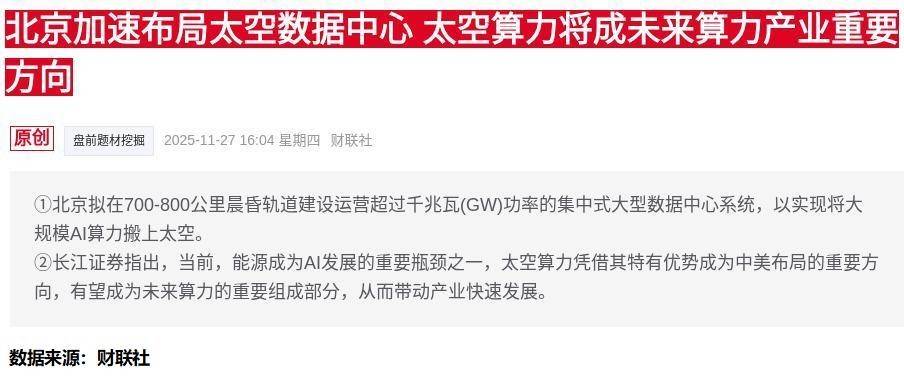
北美光通信企业当季业绩表现亮眼,英伟达、谷歌推进太空算力部署
2025-11-10 03:34
Summary of Conference Call Records Industry Overview - The conference call discusses the rapid development of the space computing industry, particularly in commercial aerospace, with major tech companies like NVIDIA and Google launching initiatives such as the Starlink project and Project Suncatch, respectively, to deploy advanced computing capabilities in space [1][2][3] - China is also making significant strides in this area, planning to launch between 1,000 to 3,000 satellites to support its three-body computing constellation, with Potevio Technology as a key supplier [1][3] Key Points and Arguments Space Computing - NVIDIA's Starlink initiative aims to send its first H100 GPU to space by November 2025, while Google's Project Suncatch plans to launch satellites equipped with TPU 6 chips by 2027 [2] - The efficiency of space computing, powered by solar energy, is several times greater than ground-based power, addressing energy shortages [2] - The commercial model for space computing is gradually taking shape, with companies like Nanjing Blue Tower exploring B-end services through satellite interconnectivity [1][3] AI Industry - There is ongoing debate regarding the existence of a bubble in the AI industry, highlighted by OpenAI's projected investment of $1.4 trillion against a quarterly revenue of over $4 billion and losses exceeding $10 billion [4] - Concerns have been raised about the low return on investment (ROI) for cloud service providers in North America, but the long-term growth potential of AI remains strong despite short-term financial data [4][6] Optical Communication Industry - The optical communication sector is experiencing significant growth, with strong demand for 1.6T optical modules and second-generation optical modules, alongside a robust supply chain for optical chips and lasers [5][7] - Companies like Lumentum and Coherent Finisar reported better-than-expected earnings, driven by data center interconnectivity and expanding production capabilities [7] - The demand for 1.6T modules is expected to reach 20 to 30 million units by 2026, while 800G demand could reach 40 to 50 million units [7] Additional Important Insights - Liquid cooling technology is highlighted as a key area of interest, with NVIDIA projecting a market size of $7 billion by 2026, indicating a significant growth opportunity [2][6] - The optical communication industry is seeing technological advancements and capacity expansions, with companies like ZTE pushing for new technology applications [5][7] - Investors are encouraged to focus on leading companies in the optical communication space, such as Zhongji Xuchuang and Tianfu Technology, as well as laser chip companies like Yuanjie Technology and Shijia Photonics [7]

晚报 | 11月10日主题前瞻
Xuan Gu Bao· 2025-11-09 14:19
Carbon Neutrality - The State Council's white paper emphasizes the importance of energy storage in building a new power system, promoting the integration of "new energy + storage" and multi-energy complementarity [1] - By the end of 2024, new energy storage installations are expected to reach 73.76 million kilowatts (168 million kilowatt-hours), which is 20 times that of 2020, accounting for over 40% of global installations [1] Space Computing - Several U.S. space companies are advancing orbital data center plans, utilizing solar energy to address AI energy consumption [2] - SpaceX is expected to increase its share of global orbital launches from 90% to 99% with the frequent launches of Starship [2] - The competition in space computing is intensifying, with China leading in the development of space computing capabilities [3] Ultra High Definition Video - The World Ultra High Definition Video Industry Alliance held a conference in Shenzhen, releasing key technologies and marking a new stage in the industrialization of ultra HD standards in China [4] - The market for ultra HD video is projected to reach 5-6 trillion yuan by 2025, driven by the rapid development of new displays and consumer electronics [4] Proton Therapy - An international standard for medical proton accelerators has been published, highlighting the global collaboration in developing advanced cancer treatment technologies [5] Smart Agriculture - The Ministry of Agriculture and Rural Affairs released guidelines for building a smart agriculture standard system by 2030, aiming to enhance agricultural efficiency and technology [6] E-sports - The KPL annual finals set a Guinness World Record for the highest attendance at an e-sports event, with 62,196 attendees [6] - The e-sports industry is evolving into a significant cultural phenomenon, with increasing integration into the entertainment sector [6] Commercial Space - The successful launch of the Kuaizhou-1A rocket marks a milestone for China's commercial space sector, with significant advancements in reusable rocket technology [7] Macro and Industry News - The State Council issued opinions to accelerate the application of new scenarios in artificial intelligence and promote clean energy in coal and new energy integration [8]
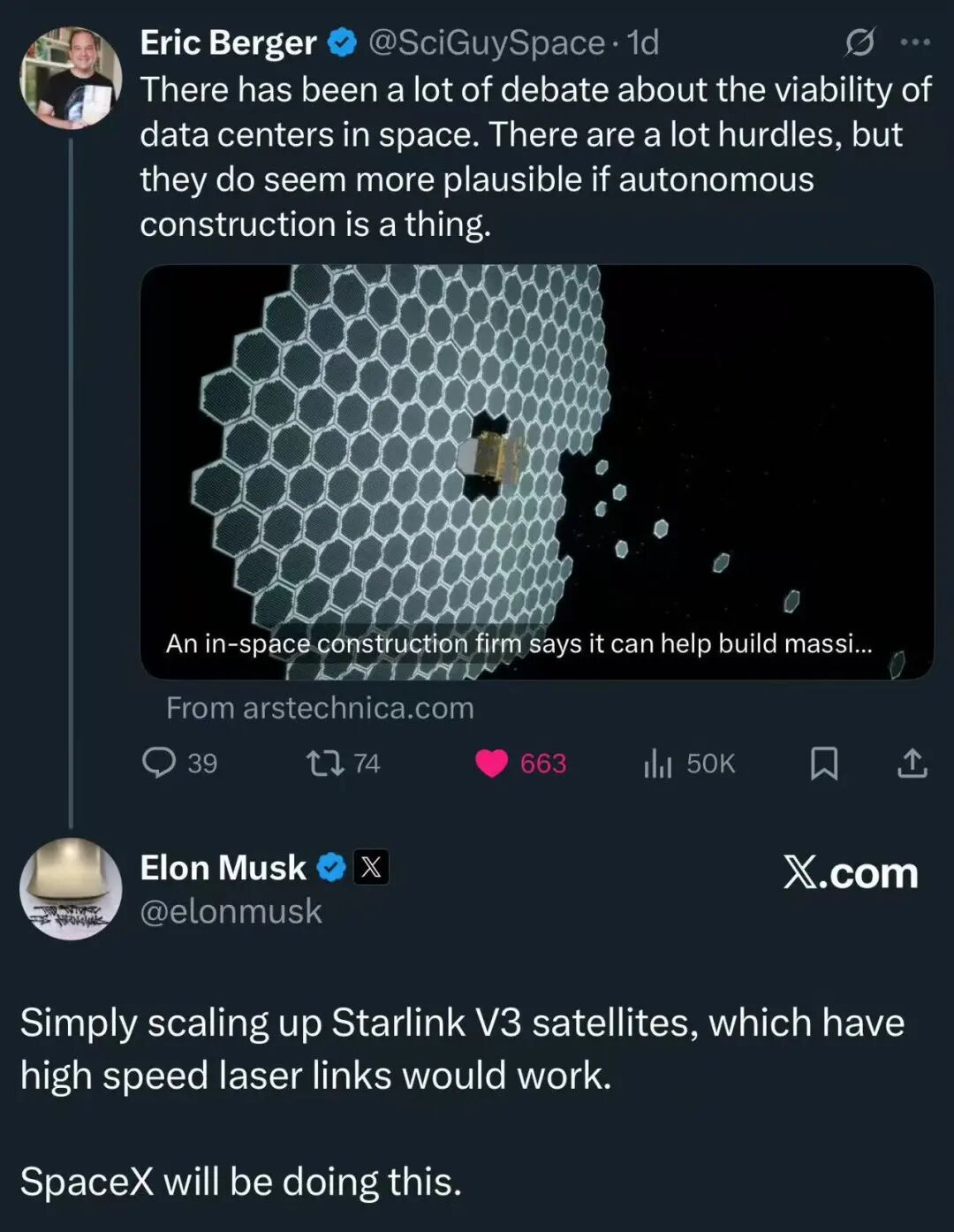
Elon Musk:扩大Starlink V3规模,进军太空算力
3 6 Ke· 2025-11-04 01:05
Core Viewpoint - Elon Musk announced that SpaceX will expand the scale of Starlink V3 satellites and begin constructing data centers in space to address the growing demand for computing power in the AI era [1][3]. Group 1: Space-Based Computing - The interest in space-based computing is rapidly increasing due to the significant growth in computing power demand driven by artificial intelligence [3]. - SpaceX's current Starlink V2 mini-satellites have a maximum downlink capacity of approximately 100 Gbps, while the V3 satellites are expected to increase this capacity tenfold to 1 Tbps [3][5]. Group 2: Unique Value of Space-Based Data Centers - Space-based data centers are modular computing infrastructures deployed in orbit, designed to process massive amounts of data directly in space, overcoming physical expansion limitations faced by ground-based data centers [5][7]. - By utilizing efficient solar arrays, space-based data centers can generate power from solar energy, achieving five times the power generation per unit area compared to ground facilities [5][12]. Group 3: Advantages Over Traditional Data Centers - Space-based data centers exhibit disruptive advantages in technology architecture, cost structure, deployment mode, energy efficiency, and scalability compared to traditional ground data centers [10][12]. - The total cost for operating a 40 MW cluster in space for ten years is estimated at approximately $8.2 million, significantly lower than the $167 million cost for a similar ground-based operation [12][13]. Group 4: Technical Challenges - Key technical challenges for space-based computing include radiation resistance and hardware reliability, heat dissipation system design, stable energy supply, communication bottlenecks, and launch costs [14][15][20]. - Solutions being explored include using military-grade equipment to withstand radiation, innovative cooling systems, and large solar arrays for energy generation [15][17]. Group 5: Major Players in Space-Based Computing - Major players in the space-based computing sector include startups like Starcloud, Axiom Space, and Lonestar, as well as tech giants like NVIDIA, Amazon, and Microsoft [21][22]. - Starcloud aims to launch the first AI satellite equipped with NVIDIA H100 chips, targeting the construction of a gigawatt-level orbital data center [21]. Group 6: Industry Chain Overview - The upstream of the space-based computing industry chain involves satellite manufacturers and launch service providers, including companies like Maxar, Thales Alenia, and SpaceX [23]. - The midstream includes companies providing space-hardened computing hardware and high-speed communication technologies, while the downstream focuses on applications that convert technological advantages into productivity [24].
科技还有那些低估方向?
2025-08-25 14:36
Summary of Key Points from Conference Call Records Industry or Company Involved - Focus on the AI industry, particularly the developments surrounding DBC V3.1 and its implications for the broader technology and financial IT sectors [1][2][5][6][14] Core Insights and Arguments - DBC V3.1 has shown improvements in inference efficiency and compatibility with domestic chips but has not achieved paradigm-level innovation, leading to lower-than-expected market performance [1][2] - Financial IT firms are positioned to benefit from a bullish market, driven by increased transaction volumes, IT budget releases, and rising valuations, with companies like Tonghuashun, Hengsheng Electronics, Wealth Trend, and Top Point Software recommended for investment [1][5] - The global AI trend remains positive, with expectations for sustained growth in the AI industry chain, including overseas inference computing, optical modules, PCBs, and AI servers, projected to last for one to two years [1][6] - The optical module industry is experiencing exponential growth, with demand for 800G and 1.6T modules exceeding expectations, indicating significant investment value [3][11][12] - The gaming sector is currently undervalued, with record revenues in both domestic and overseas markets, and a strong pipeline of new games expected to drive future growth [3][13] - The space computing sector is emerging as a new frontier, with significant market potential estimated at 30 billion RMB, driven by satellite capabilities for data processing and high-precision monitoring [8][10] Other Important but Possibly Overlooked Content - The release of DBC V3.1 has extended the narrative cycle for performance realization, despite its technical shortcomings [2] - The communication sector, particularly optical modules, is highlighted as a key area for investment, with a focus on companies that are undervalued but have clear growth potential [7][9] - The space computing market is expected to grow significantly, with companies like Putian Technology positioned to capture a substantial market share, potentially leading to significant profit growth [10] - The gaming industry is expected to maintain an upward trend, supported by innovation and AI integration, making it a viable investment opportunity [13] - The semiconductor sector is poised for growth as demand increases, particularly in wafer foundries and storage chips, which are currently undervalued [20] This summary encapsulates the essential insights and projections from the conference call records, providing a comprehensive overview of the current state and future outlook of the relevant industries.