
果汁饮料

Search documents
汇源控制权之争再升级
Bei Jing Shang Bao· 2026-01-08 15:45
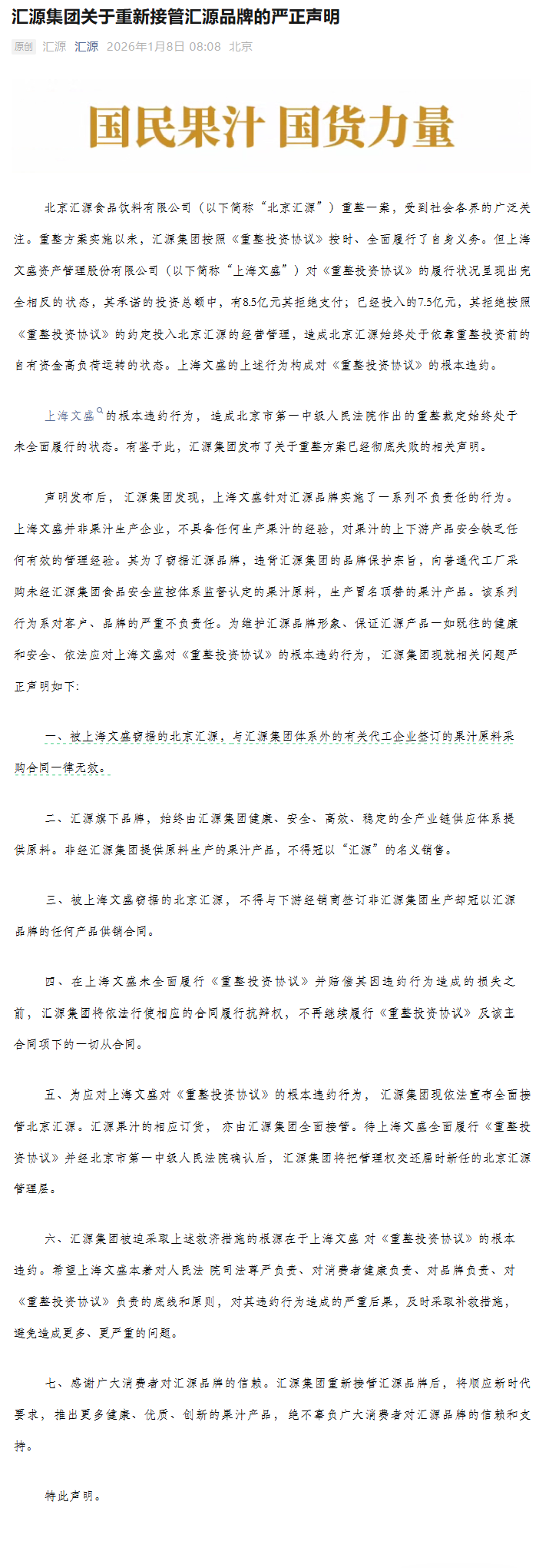
"上海文盛的根本违约行为,造成北京市第一中级人民法院作出的重整裁定始终处于未全面履行的状 态。"汇源集团方面表示,重整方案已彻底失败,汇源集团宣布全面接管北京汇源,汇源果汁的相应订 货,亦由汇源集团全面接管。待上海文盛全面履行《重整投资协议》并经北京市第一中级人民法院确认 后,汇源集团将把管理权交还届时新任的北京汇源管理层。 汇源集团方面在声明中提到,北京汇源重整一案,受到社会各界的广泛关注。重整方案实施以来,汇源 集团按照《重整投资协议》按时、全面履行了自身义务。但同时,上海文盛承诺的投资总额中,有8.5 亿元拒绝支付,已投入的7.5亿元则拒绝按照《重整投资协议》的约定投入北京汇源的经营管理,造成 北京汇源始终处于依靠重整投资前的自有资金高负荷运转的状态。 中国食品产业分析师朱丹蓬表示,"汇源集团的最新声明,再一次凸显出重整未达预期。从《重整投资 协议》的履行方面来说,上海文盛违反了合同的相关内容,其虽然拥有汇源的商标权,但没有工厂、渠 道、团队和客户,这些或让汇源集团占据主动权"。 这是汇源半年以来第四次发布声明。2025年8月9日,北京汇源发布《致全体股东及转股债权人的公开 信》,公开披露文盛资产重整资 ...

朱新礼家族,计划夺回汇源果汁
Xin Lang Cai Jing· 2026-01-08 13:45
炒股就看金麒麟分析师研报,权威,专业,及时,全面,助您挖掘潜力主题机会! 来源:21财闻汇 作者:谭璐 编辑:陈晓平 图源:网络 汇源果汁的控制权之争,再度升级。 1月8日,汇源集团宣布,文盛资产主导的重整方案彻底失败,将全面接管北京汇源。 让汇源集团难以容忍的是,文盛方面拒绝支付约定的8.5亿投资款项,还让代工厂生产冒名顶替的果汁 产品。 有了解内情的人士告诉《21CBR》,包括汇源果汁的品牌、运营、销售、订货等,都由汇源集团全面接 管。至于北京汇源管理层的具体变动,暂不清楚。 外界猜测,朱新礼家族可能重掌北京汇源。 1 两者归属不同所有方,本来由北京汇源向汇源集团采购成品。 "汇源干了34年,拥有完整的产业链,不是找个代工厂,生产出来的就叫汇源。"汇源集团人士对 《21CBR》表示。 矛盾升级 《21CBR》从内部人士处了解到,1月8日上午汇源集团发出声明之后,到当天下午17点左右,上海文盛 方面尚未有正式表态。 而代表文盛方面的北京汇源CEO王清汉,则转发了一条汇源果汁官方微信号的视频,庆祝安徽滁州华冠 工厂正式开工。 这家代工厂,恰好就是汇源集团指出的问题所在。文盛向普通代工厂采购未经汇源集团食品安全 ...
汇源集团宣布重掌汇源品牌
2 1 Shi Ji Jing Ji Bao Dao· 2026-01-08 12:56
Core Viewpoint - The Huyuan Group has announced a complete takeover of Beijing Huyuan and terminated its cooperation with Shanghai Wensheng Asset Management Co., Ltd due to significant breaches of the restructuring agreement by Shanghai Wensheng [1][2][4]. Group 1: Restructuring and Investment - Huyuan's restructuring began in June 2022, with a court-approved plan that included a commitment from Shanghai Wensheng to invest 1.6 billion yuan over three years for a 70% stake in Beijing Huyuan [1]. - Shanghai Wensheng failed to fulfill its obligations under the restructuring agreement, including not paying 850 million yuan of the agreed investment and mismanaging the funds already invested [1][4]. Group 2: Operational Management Issues - Huyuan Group discovered that Shanghai Wensheng lacked the necessary experience in beverage production, leading to the procurement of unverified juice raw materials from ordinary processing plants, which compromised product safety [1][4]. - The actions of Shanghai Wensheng were deemed irresponsible and detrimental to the Huyuan brand, prompting the group to take necessary measures to protect its brand image and product safety [4]. Group 3: Legal and Contractual Actions - Huyuan Group declared all contracts signed by Shanghai Wensheng with non-affiliated processing companies for juice raw material procurement as invalid [2][5]. - The group will exercise its right to suspend the performance of the restructuring agreement and related contracts until Shanghai Wensheng fully complies with the agreement and compensates for the damages caused by its breaches [2][5].
氪星晚报 |汇源集团宣称重新接管汇源品牌;雷军:规划未来五年再投2000亿元;高盛:美国2030年将面临电力危机
3 6 Ke· 2026-01-08 11:53
Group 1: Company Developments - Lei Jun announced plans to invest an additional 200 billion yuan in R&D over the next five years, building on a previous commitment of 100 billion yuan made in 2020 [1] - Huayuan Group declared it will regain control of the Huayuan brand amidst ongoing disputes with Wensheng Assets, which currently controls the brand [1] - Jilin Yong Magnetic expects a net profit of 660 million to 760 million yuan in 2025, representing a year-on-year increase of 127% to 161% [2] - SpaceX CEO Elon Musk revealed an ambitious goal to produce 10,000 Starship spacecraft annually, supported by a new GigaBay factory [3] - Luyuan Pharmaceutical confirmed that its operations are normal and there are no undisclosed significant matters affecting the company [4] - Samsung Electronics anticipates a nearly threefold increase in profits due to soaring storage chip prices driven by AI demand, projecting Q4 operating profit to reach 20 trillion won [4] - Xiaopeng Motors' CEO He Xiaopeng stated that 2026 will mark the true beginning of autonomous driving in China and the U.S. with the launch of their second-generation VLA [5] - BaWang Tea responded to rumors of a secondary listing in Hong Kong, stating there are no current plans [5] - Taobao's flash purchase orders have stabilized at an average of 10 million daily [5] - Former Xiaomi executive Wang Teng announced the establishment of a new company focused on sleep health products [5] - Lei Jun clarified that there are no plans for a Xiaomi SU3 model [6] Group 2: Investment and Financing - Turing Quantum completed a strategic financing round worth several hundred million yuan, aimed at advancing research and commercialization in optical quantum computing [6] Group 3: Market Trends and Insights - Gaode's "Street Ranking" feature attracted 860,000 new merchants in its first 100 days, with merchant order volume increasing over 330% [7] - Goldman Sachs predicts that the U.S. will face a power crisis by 2030 due to surging electricity demand from data centers [8] - The Ministry of Industry and Information Technology warned against irrational competition in the lithium battery industry, convening a meeting with major players including CATL and BYD [9]

控制权拉锯战升级:汇源接管背后的资本博弈与经营困局
Xin Lang Cai Jing· 2026-01-08 10:22
Core Viewpoint - The long-standing juice brand Huiyuan is facing a significant operational crisis due to a power struggle between its parent company and its investor, Wensheng Assets, which has allegedly defaulted on a 850 million yuan investment and misused the brand to produce counterfeit products [1][2]. Group 1: Investment and Financial Issues - Huiyuan Group announced a complete takeover of Beijing Huiyuan and related ordering businesses due to Wensheng Assets' fundamental breach of the restructuring investment agreement, specifically the failure to pay 850 million yuan and misuse of the brand [1][2]. - In 2022, Wensheng Assets invested 1.6 billion yuan for a 60% stake in Beijing Huiyuan, promising to inject funds over three years to clear debts and support operations, but has failed to fulfill these commitments [1][5]. - Wensheng Assets has not only refused to pay the remaining 850 million yuan but also failed to inject the previously invested 750 million yuan into operations, leading to a reliance on pre-restructuring funds [5][6]. Group 2: Operational and Market Impact - The conflict has escalated over time, with Huiyuan Group issuing six statements since August 2025, highlighting Wensheng Assets' breaches, which have evolved from financial disputes to control over operations [2][5]. - Huiyuan's market share has been declining for three consecutive years, dropping from 5.08% in Q3 2023 to 3.45% in Q3 2025, reflecting the impact of internal conflicts on consumer trust and purchasing channels [6][7]. - The internal strife has led to confusion in distribution channels, affecting sales and causing downstream distributors to hesitate in placing orders, which could significantly impact short-term operations [6][7]. Group 3: Historical Context and Future Outlook - Huiyuan, with over 30 years of history, once achieved significant milestones, including a record IPO in Hong Kong in 2007 and a near acquisition by Coca-Cola for 2.4 billion USD in 2008, but has faced a series of setbacks leading to its delisting in 2021 [3][6]. - The involvement of Wensheng Assets was initially seen as a turning point, but differences in operational philosophy and funding have turned the restructuring into a protracted struggle, causing Huiyuan to miss recovery opportunities in the industry [3][6]. - The resolution of internal conflicts and stabilization of operations are crucial for Huiyuan's survival, as its fate is closely watched within the food and beverage industry, potentially offering insights into brand restructuring [7].
汇源集团宣称重新接管汇源品牌
Di Yi Cai Jing· 2026-01-08 10:01
Group 1 - The conflict between Huiyuan Group and Wensheng Assets has intensified, with Huiyuan Group announcing a full takeover of the Huiyuan brand due to alleged fundamental breaches by Wensheng Assets in the restructuring case of Beijing Huiyuan [1] - Wensheng Assets has partnered with a new factory to produce "Huiyuan" products independently, leading to a competitive situation in the market with two entities using the same brand [2] - The key issue in the dispute is the control of the trademark, with Beijing Huiyuan holding the rights to the "Huiyuan" trademark, while currently being under the control of Wensheng Assets [2][3] Group 2 - Beijing Huiyuan operates on a light asset model, leasing 80% of its production lines back to Huiyuan Group and sourcing finished products from them [2] - The legal proceedings initiated by Huiyuan Group include a lawsuit for breach of contract and a request for asset preservation, which has resulted in the freezing of Wensheng Assets' 640 million yuan equity in Beijing Huiyuan [1] - Industry experts believe that the competition for the Huiyuan brand may not escalate to the level of protracted disputes seen in other brand conflicts, as Wensheng Assets lacks a strong background in the beverage industry [3]
宣告重整失败后,汇源集团严正声明
新华网财经· 2026-01-08 09:17
Core Viewpoint - Beijing Huiyuan Food and Beverage Co., Ltd. (referred to as "Beijing Huiyuan") is facing a significant operational crisis due to the failure of its restructuring investor, Shanghai Wensheng, to fulfill its investment commitments, leading to a complete takeover of the brand by Huiyuan Group [1][2][5]. Group 1: Investment and Financial Issues - Shanghai Wensheng has failed to pay 850 million yuan in investment funds and has not adhered to the operational management commitments outlined in the restructuring agreement, resulting in Beijing Huiyuan relying on its pre-restructuring funds to operate [1][2][12]. - The restructuring plan has been declared a complete failure by Huiyuan Group due to Shanghai Wensheng's fundamental breach of the restructuring agreement [1][5]. Group 2: Brand and Production Concerns - Huiyuan Group accused Shanghai Wensheng of producing counterfeit juice products using unapproved raw materials from ordinary processing factories, which violates the brand protection principles of Huiyuan Group [4][5]. - All contracts for juice raw material procurement signed by Beijing Huiyuan with external processing companies are deemed invalid, and products not produced with Huiyuan Group's raw materials cannot be sold under the "Huiyuan" brand [4][5]. Group 3: Legal and Operational Actions - Huiyuan Group will not continue to fulfill the restructuring agreement or any related contracts until Shanghai Wensheng fully complies with the agreement and compensates for the damages caused by its breach [5][12]. - The management of Beijing Huiyuan will be fully taken over by Huiyuan Group, and any orders for Huiyuan juice will also be managed by Huiyuan Group until the restructuring agreement is honored [5][12].
大股东窃据品牌、生产冒名顶替果汁产品,汇源集团宣布重掌汇源品牌
2 1 Shi Ji Jing Ji Bao Dao· 2026-01-08 04:43
Core Viewpoint - The Huyuan Group has announced a complete takeover of Beijing Huyuan and terminated its cooperation with Shanghai Wensheng Asset Management Co., Ltd due to significant breaches of the restructuring agreement by Shanghai Wensheng [1][2][4]. Group 1: Restructuring and Investment Issues - Huyuan's restructuring began in June 2022, with a court-approved plan that included a commitment from Shanghai Wensheng to invest 1.6 billion yuan over three years for a 70% stake in Beijing Huyuan [1]. - Shanghai Wensheng failed to fulfill its obligations under the restructuring investment agreement, not paying the agreed 850 million yuan and mismanaging the 750 million yuan already invested, leading to a declaration of the restructuring plan's failure [1][4]. Group 2: Operational Management Failures - Huyuan Group discovered that Shanghai Wensheng, lacking beverage production experience, sourced juice materials from unverified suppliers, resulting in the production of unauthorized juice products [1][4]. - This behavior was deemed irresponsible and detrimental to the Huyuan brand and customer trust [1][4]. Group 3: Legal and Contractual Actions - Huyuan Group declared all contracts signed by Shanghai Wensheng with non-affiliated manufacturers for juice material procurement as invalid [2][5]. - Huyuan will exercise its right to suspend the performance of the restructuring agreement and related contracts until Shanghai Wensheng fully complies with the agreement and compensates for losses incurred due to its breaches [2][5].
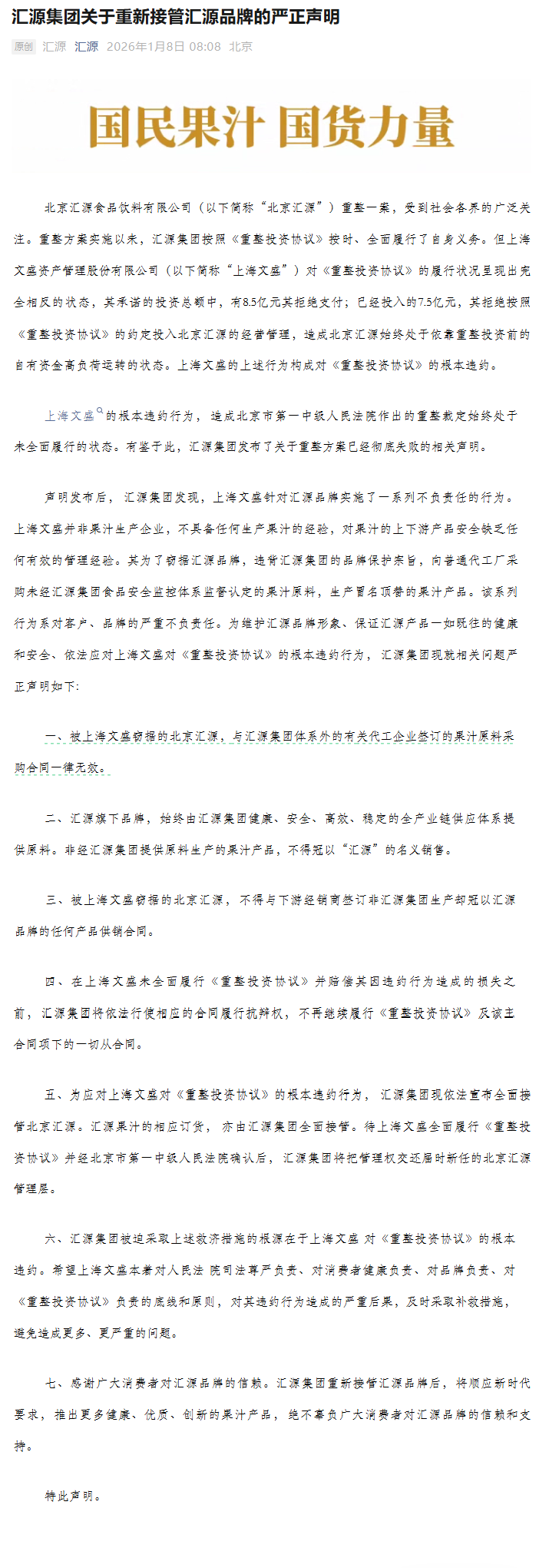
汇源集团再发声明:重新接管!
Shen Zhen Shang Bao· 2026-01-08 03:20
1月8日,汇源集团官方微信公众号发布关于重新接管汇源品牌的声明。 汇源集团称,股东方上海文盛针对汇源品牌实施了一系列不负责任的行为,向普通代工厂采购未经汇源集团食品安全监控体系监督认定的果汁原料,生产 冒名顶替的果汁产品等。汇源集团声明,被上海文盛窃据的北京汇源,与汇源集团体系外的有关代工企业签订的果汁原料采购合同一律无效;非经汇源集 团提供原料生产的果汁产品,不得冠以"汇源"的名义销售。 汇源集团表示,为应对上海文盛对《重整投资协议》的根本违约行为, 汇源集团现依法宣布全面接管北京汇源。汇源果汁的相应订货,也由汇源集团全 面接管。 ...
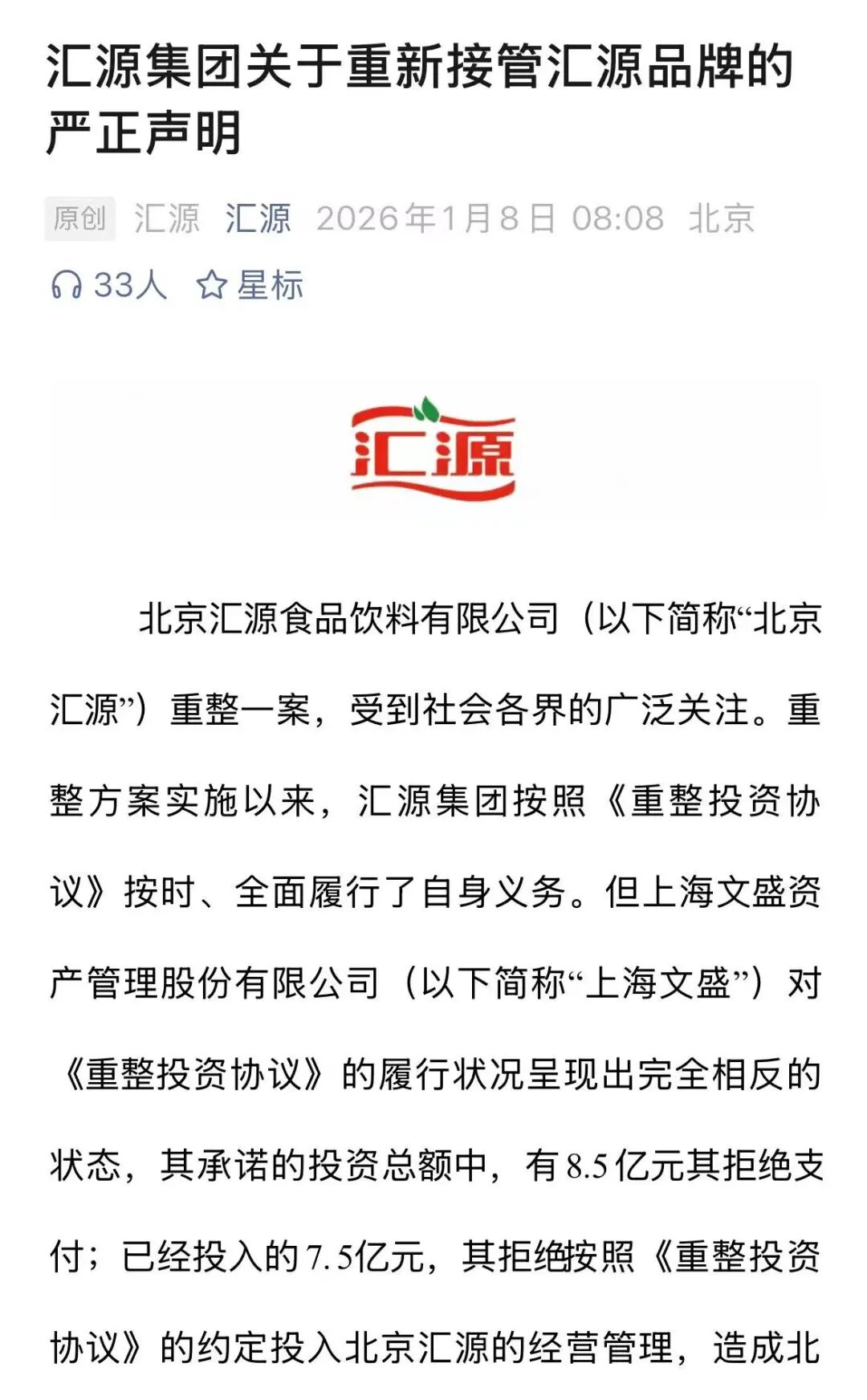
汇源集团:重新接管汇源品牌及相应订货
Bei Jing Shang Bao· 2026-01-08 02:53
北京商报讯(记者 孔文燮)1月8日,汇源集团通过公众号发布声明称,北京汇源食品饮料有限公司 (以下简称"北京汇源")重整一案,受到社会各界的广泛关注。重整方案实施以来,汇源集团按照《重 整投资协议》按时、全面履行了自身义务。但上海文盛资产管理股份有限公司(以下简称"上海文盛") 对《重整投资协议》的履行状况呈现出完全相反的状态,其承诺的投资总额中,有8.5亿元其拒绝支 付;已经投入的7.5亿元,其拒绝按照《重整投资协议》的约定投入北京汇源的经营管理,造成北京汇 源始终处于依靠重整投资前的自有资金高负荷运转的状态。 汇源集团表示,"为应对上海文盛对《重整投资协议》的根本违约行为,汇源集团现依法宣布全面接管 北京汇源。汇源果汁的相应订货,亦由汇源集团全面接管。待上海文盛全面履行《重整投资协议》并经 北京市第一中级人民法院确认后, 汇源集团将把管理权交还届时新任的北京汇源管理层"。 汇源集团还表示,汇源旗下品牌,始终由汇源集团健康、安全、高效、稳定的全产业链供应体系提供原 料。非经汇源集团提供原料生产的果汁产品,不得冠以"汇源"的名义销售。 ...