果汁

Search documents
中国食品(00506.HK):能量饮料魔爪表现亮眼 全年利润稳健增长
Ge Long Hui· 2026-03-30 00:26
Performance Review - The company's 2025 performance was below expectations, with revenue increasing by 2.7% year-on-year to 22.1 billion, and net profit attributable to shareholders rising by 4.2% to 0.9 billion, with 2H25 revenue declining by 3.6% to 9.79 billion and net profit increasing by 7.9% to 0.32 billion, primarily due to pressure on gross margins [1] Development Trends - Energy drinks, particularly Monster, showed double-digit growth, while juice revenue faced pressure. In 2H25, total revenue declined by 3.6%, with volume and price down by 2% and 1.6% respectively. Soda revenue fell by 6.4%, juice revenue dropped by 8.1%, and packaged water revenue decreased by 1.6%. Energy drinks are expected to see a revenue increase of approximately 28% in 2025, with Monster's revenue projected to grow by around 40%, outperforming competitors [1] - Gross margin was under pressure in 2H25, decreasing by 5.6 percentage points to 35.8%, mainly due to increased sales of low-priced packaged water and high aluminum can prices. However, the company improved distribution efficiency, reducing the sales expense ratio by 4.9 percentage points to 27.7% and managing expenses effectively, resulting in a slight increase in net profit margin by 0.3 percentage points [1] Future Outlook - For 2026, the company anticipates steady revenue growth, with double-digit growth in soda sales expected in January and February due to the timing of the Spring Festival. Energy drink revenue is projected to grow in the high double digits, and electrolyte drink sales, although small, are expected to double. Overall, the company forecasts mid-single-digit revenue growth for 2026, with stable profit margins due to pre-locked aluminum prices and steady expense ratios [2] - The company has revised its 2026 profit forecast down by 6.5% to 0.94 billion, with a new 2027 forecast introduced at 1 billion. The current trading multiples for 2026 and 2027 are 10 and 9.3 times P/E, respectively, with a target price reduction of 6.12% to 4.6 HKD, reflecting a valuation P/E of 12.2 and 11.3 times for 2026 and 2027, indicating a 22% upside potential while maintaining an outperform rating [2]
农夫山泉(9633)年报点评:包装水良好恢复,茶继续动能强劲
GUOTAI HAITONG SECURITIES· 2026-03-27 10:35
Investment Rating - The report maintains a "Buy" rating for Nongfu Spring (9633) [1][2] Core Insights - The company has shown strong revenue and profit growth over the past 25 years, with a steady recovery in packaged water and robust momentum in tea beverages, leading to the continued "Buy" rating [2] Financial Summary - Total revenue projections are as follows: - 2024A: 42,896 million - 2025A: 52,553 million (YOY +22.5%) - 2026E: 61,133 million (YOY +16.3%) - 2027E: 70,117 million (YOY +14.7%) - 2028E: 79,391 million (YOY +13.2%) [4] - Gross profit and net profit forecasts: - Gross profit for 2025A: 31,808 million - Net profit for 2025A: 15,868 million (YOY +30.9%) [4] - The company’s PE ratio is projected to decrease from 35.83 in 2024A to 17.99 in 2028E, indicating improving valuation [4] Revenue Breakdown - Packaged water sales for 2025 are expected to reach 18,710 million (YOY +17.3%), with a segment profit margin increase of 6.26 percentage points [10] - Tea beverage revenue is projected at 21,596 million (YOY +29.0%), with a segment profit margin increase of 2.87 percentage points [10] - Functional beverages are expected to generate 5,762 million (YOY +16.8%), while juice sales are projected at 5,176 million (YOY +26.7%) [10] Earnings Forecast and Investment Recommendations - The EPS for 2026E is revised to 1.62, with a new target price of 55.23 HKD per share, based on a 30x PE multiple [10] - The company is expected to maintain high growth in overall performance, with significant profit expansion anticipated [10]
农夫山泉(09633):年报点评:包装水良好恢复,茶继续动能强劲
GUOTAI HAITONG SECURITIES· 2026-03-27 09:05
Investment Rating - The report maintains a "Buy" rating for the company [1][2]. Core Insights - The company has shown strong revenue and profit growth over the past 25 years, with a steady recovery in packaged water and robust momentum in tea beverages, leading to the continued "Buy" rating [2]. Financial Summary - Total revenue projections are as follows: - 2024A: 42,896 million - 2025A: 52,553 million (YOY +22.5%) - 2026E: 61,133 million (YOY +16.3%) - 2027E: 70,117 million (YOY +14.7%) - 2028E: 79,391 million (YOY +13.2%) [4] - Gross profit and net profit forecasts are: - Gross profit for 2025A: 31,808 million - Net profit for 2025A: 15,868 million (YOY +30.9%) [4] - The company’s PE ratio is projected to decrease from 35.83 in 2024A to 17.99 in 2028E, indicating improving valuation [4]. Revenue Breakdown - Packaged water sales for 2025 are expected to reach 18,710 million (YOY +17.3%), with a profit margin increase of 6.26 percentage points [10]. - Tea beverage revenue is projected at 21,596 million (YOY +29.0%), with a profit margin increase of 2.87 percentage points [10]. - Functional beverages are expected to generate 5,762 million (YOY +16.8%), while juice sales are projected at 5,176 million (YOY +26.7%) [10]. Market Position - The company maintains a strong market leadership in packaged water, with ongoing efforts to enhance its market share through various channel developments [10]. - The tea beverage segment continues to attract new consumer groups through innovative flavors and packaging [10].

瑞银:维持中国食品(00506)“买入”评级 目标价下调至4.89港元
智通财经网· 2026-03-27 08:50
Core Viewpoint - UBS maintains a "Buy" rating on China Foods (00506) while slightly adjusting its profit forecast, lowering the target price from HKD 5.07 to HKD 4.89 [1] Financial Performance - China Foods reported a revenue increase of 2.7% year-on-year to RMB 22.07 billion, driven by resilient carbonated beverage sales, recovery in water business revenue, and strong growth in energy drinks, partially offset by a decline in juice revenue [1] - Gross margin decreased by 0.7 percentage points to 37.1%, primarily due to a higher proportion of low-margin water products and rising aluminum can costs [1] - EBITDA increased by 5.1% year-on-year to RMB 1.925 billion, while net profit remained stable at RMB 862 million, mainly impacted by a rising tax rate, with a maintained dividend payout ratio of 50% [1] Market Trends and Strategies - The company experienced double-digit sales growth in the first two months, indicating a strong start, supported by price increases for aluminum can carbonated beverages in March [1] - New distribution channels such as vending machines, e-commerce, discount snack stores, and instant retail are showing strong growth, with the company reducing channel conflicts through differentiated packaging [1] - Management anticipates long-term profit growth driven by operational leverage rather than input costs [1] Strategic Initiatives - COFCO Group will promote a nutrition and health food strategy under the "14th Five-Year Plan," with China Foods leveraging its direct-to-consumer model and approximately 130,000 vending machines to distribute non-cola products [1] - Although short-term profit impacts are limited, this strategy could become a long-term growth driver [1]
招银国际:升农夫山泉目标价至60.88港元 维持“买入”评级
Xin Lang Cai Jing· 2026-03-27 06:02
Core Viewpoint - The report from CMB International indicates that Nongfu Spring (09633) is expected to achieve a revenue growth of 22.5% year-on-year to RMB 52.6 billion for the fiscal year 2025, exceeding market expectations by 4% [1][3] - The net profit is projected to grow by 30.9% year-on-year to RMB 15.9 billion, surpassing market forecasts by 6% [1][3] - The strong performance is attributed to the recovery of the bottled water business, better-than-expected results in tea and juice segments, and significant reductions in sales and administrative expenses following the Olympic year [1][3] Financial Projections - Nongfu Spring aims to maintain a double-digit revenue growth target for the fiscal year 2026 [1][5] - The firm forecasts a compound annual growth rate (CAGR) of approximately 11% for revenue and profit from 2026 to 2028 [1][5] Investment Rating - The report maintains a "Buy" rating for Nongfu Spring and raises the target price by 5% to HKD 60.88 [1][5]

大行评级丨招银国际:上调农夫山泉目标价至60.88港元,维持“买入”评级
Ge Long Hui· 2026-03-27 03:51
Core Viewpoint - The report from CMB International indicates that Nongfu Spring is expected to achieve a revenue growth of 22.5% year-on-year to 52.6 billion yuan for the fiscal year 2025, exceeding market forecasts by 4% [1] - The net profit is projected to grow by 30.9% year-on-year to 15.9 billion yuan, surpassing market expectations by 6% [1] Group 1 - The performance is attributed to the recovery in bottled water business, stronger-than-expected tea and juice segments, and significant reductions in sales and administrative expenses following the Olympic year [1] - Nongfu Spring maintains its target for double-digit revenue growth for the fiscal year 2026 but has not provided guidance on gross margin or net profit due to current environmental uncertainties [1] - The forecast for the compound annual growth rate of revenue and profit from 2026 to 2028 is approximately 11% [1] Group 2 - CMB International maintains a "Buy" rating on Nongfu Spring and raises the target price by 5% to 60.88 HKD [1]
招银国际:升农夫山泉(09633)目标价至60.88港元 维持“买入”评级
智通财经网· 2026-03-27 03:37AI Processing
智通财经APP获悉,招银国际发布研报称,农夫山泉(09633)2025财年收入同比增长22.5%至526亿元人 民币,较市场预测高出4%; 净利润同比增长30.9%至159亿元,较市场预测高出6%。业绩表现受惠于饮 用水业务复苏、茶饮及果汁业务强于预期,以及奥运年后销售及行政费用大幅下降。农夫山泉维持2026 财年双位数收入增长目标,该行预测其2026-2028年收入及盈利复合年增长率约为11%。维持"买入"评 级,并将目标价上调5%至60.88港元。 ...
农夫山泉(09633):增长韧性再获验证
citic securities· 2026-03-26 13:48
Investment Rating - The report maintains a positive outlook on the company, indicating strong growth potential and reaffirming the double-digit revenue growth target for 2026 [5][7]. Core Insights - The company demonstrated robust performance in 2025, with sales increasing by 30% year-on-year to 26.931 billion yuan, exceeding market expectations by 5% [6]. - The net profit for 2025 rose by 40.2% to 8.246 billion yuan, also surpassing market consensus by 11% [6]. - The management highlighted that the performance aligns with the goal of double-digit revenue growth for 2026, with packaging water revenue expected to recover to 2023 levels [7]. Summary by Sections Financial Performance - In 2025, total revenue grew by 22.5% to 52.553 billion yuan, while net profit increased by 30.9% to 15.868 billion yuan [6]. - The growth was driven by strong sales across various product categories, including packaged water (+25%), ready-to-drink tea (+38%), functional beverages (+20%), and juice (+33%) [6]. Market Dynamics - The company is expected to benefit from a recovering packaging water market and the introduction of new products, including electrolyte water [7]. - The PET price has increased by 36% year-on-year, impacting profit margins; however, the company is less sensitive to these fluctuations compared to peers due to its higher profit margins and optimized product mix [8]. Catalysts for Growth - Key growth catalysts include an increasing market share in packaged water, favorable PET price trends, faster-than-expected macroeconomic recovery, continuous new product launches, and strong growth in the no-sugar tea beverage segment [9].
农夫山泉:去年业绩胜预期,评级为“买入”-20260326
Goldman Sachs· 2026-03-26 09:40
Investment Rating - The report maintains a "Buy" rating for Nongfu Spring with a target price of 60 HKD [1] Core Insights - Nongfu Spring's projected sales and net profit for 2025 are 52.6 billion RMB and 15.9 billion RMB, representing year-on-year growth of 23% and 31%, respectively, exceeding the bank's forecasts by 3% and 4% [1] - The sales of packaged water are expected to grow by 17.3% year-on-year [1] - Significant growth in tea beverage sales of 38% year-on-year was noted in the second half of last year, surpassing expectations by 21%, indicating the effectiveness of the "Open Cap Win Prize" promotional campaign and successful winter channel strategies [1] - Juice sales also experienced a year-on-year increase of 33%, exceeding projections [1] - The gross profit margin expanded by 3.4 percentage points, benefiting from lower costs of PET, pulp, and sugar, as well as an increased proportion of tea beverages [1]
农夫山泉:防御转进攻,“水茅” 强势狂飙
3 6 Ke· 2026-03-26 03:15
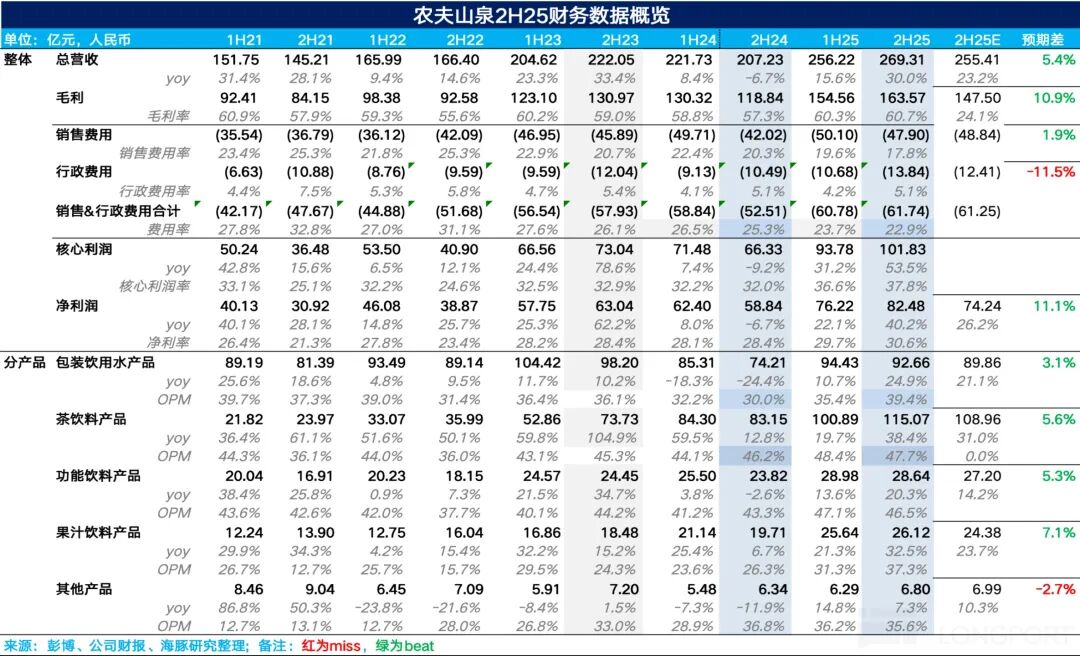
Core Viewpoint - The company delivered a strong performance in H2 2025, exceeding expectations, driven by aggressive channel strategies and growth in both packaged water and tea beverage segments [1][15]. Packaged Water Business - In H2 2025, the packaged water segment achieved revenue of 9.27 billion RMB, a year-on-year increase of 25%, with further acceleration in growth compared to H1 2025 [2][17]. - The company implemented a "ten thousand boxes display" strategy, enhancing control over terminal displays and increasing the proportion of red bottle water in revenue to approximately 82% [3][17]. - The operating profit margin for packaged water reached a record high of 39.4% [3][17]. Tea Beverage Business - The tea beverage segment generated revenue of 11.5 billion RMB in H2 2025, marking a year-on-year growth of 38.4%, officially surpassing packaged water to become the largest growth driver for the company [4][20]. - The company expanded its product offerings by introducing hot drink cabinets nationwide, transforming traditional cold tea products into winter hot beverage options [5][20]. - Despite a slight decrease in operating profit margin to 47.7% due to promotional activities, tea remains the most profitable segment for the company [6][20]. Functional Beverages & Juice - Functional beverages saw a revenue increase of 20% year-on-year, benefiting from accelerated distribution of electrolyte water and product upgrades [6][22]. - Juice revenue grew by 33%, with the introduction of 1L family-sized packaging contributing to the expansion of consumption scenarios [6][22]. Gross Margin Improvement - The company's gross margin increased by 3.4 percentage points to 60.7%, supported by low raw material costs and the growth of high-margin products [6][26]. Operating Leverage and Profitability - The company reduced ineffective advertising expenses, shifting to new media channels, resulting in a sales expense ratio decline to 17.8%, a record low [7][28]. - The net profit margin reached 30.6%, exceeding market expectations [7][28].