
网络货运

Search documents
江苏省消保委发布调查报告!货主、司机“有话说”→
Zhong Guo Zhi Liang Xin Wen Wang· 2025-12-15 06:20
Core Viewpoint - The rapid development of China's online freight industry has led to a growing market size, prompting the Jiangsu Consumer Protection Committee to conduct a consumer survey to protect the rights of consumers and industry workers, and to promote standardized industry development [1] Survey Overview - The survey utilized a combination of questionnaire surveys, interviews, order experiences, and public opinion data analysis, collecting 645 valid online questionnaires and conducting interviews with 6 consumers [3] Survey Results Pricing Mechanism - Consumers prioritize "transportation price rationality" when choosing platforms, with 80% considering it the most important factor; 15.7% of respondents found the freight calculation method unclear, indicating issues with price ambiguity and hidden fees [4][5] Consumer Perspective - The lack of transparency in pricing and ambiguous additional costs are significant issues; platforms often present freight as a fixed or estimated price without clear breakdowns, making it difficult for shippers to understand pricing logic during decision-making [5][8] Driver Perspective - Disputes over commission and fee structures are common; platforms like Huolala use a tiered membership system with varying commission rates, while Kuaigou has announced reforms to eliminate dual charging models [13][14] Service Quality - Issues with service quality include delays in delivery (14.3%), difficulties in contacting drivers (11.4%), and instances of damaged or lost goods (11.4%), indicating a need for improvement in service timeliness and safety [20] Dispute Resolution - The dispute resolution process is inefficient and often biased, with platforms favoring one party in disputes; both shippers and drivers report difficulties in asserting their rights due to complex processes and lack of timely responses [21][22][23] Recommendations - The survey indicates that consumers believe the most critical improvements for freight platforms include fee transparency (62.9%), optimization of dispute resolution mechanisms (44.3%), and enhanced driver qualification checks (41.4%) [24] Industry Development Suggestions - Platforms should take responsibility for optimizing services and rules, focusing on transparency and standardization to reduce disputes [26] - Regulatory bodies need to enhance oversight and establish a comprehensive regulatory framework to protect consumer and driver rights [27] - Users should improve their awareness of rights and actively safeguard their interests by verifying pricing rules and documenting communications [28]


货拉拉等平台被约谈:约车「张冠李戴」,司机收入缩水
Yang Shi Xin Wen· 2025-12-14 11:21
Core Insights - The rapid growth of China's online freight market has surpassed 93 billion yuan in 2024, but issues such as unclear pricing and chaotic vehicle information are affecting consumer experiences [1] - Consumers often find discrepancies between the service expected and what is delivered, leading to complaints from both consumers and drivers regarding income and platform transparency [1] Consumer Experience Issues - A consumer reported a mismatch between the ordered vehicle type and the one that arrived, causing logistical issues [2][5] - The customer service of the freight platform acknowledged that during peak times, higher-tier vehicles may be dispatched, but they must comply with local regulations [6] - Complaints about vehicle mismatches are not isolated incidents, raising concerns about safety and potential rights violations for consumers [10][12] Driver Challenges - Drivers express confusion over commission rates and report a significant decrease in income, with many orders yielding lower prices than before [18][19] - A driver shared that the income per kilometer has dropped, requiring longer working hours to meet daily income goals [22][30] - The pricing structure is often unclear, with floating rates leading to unpredictable earnings for drivers [23][27] Commission and Membership Models - Many platforms employ a "membership + commission" model, where drivers pay a monthly fee and also face commission deductions from their earnings [34][46] - This dual charging system has led to dissatisfaction among drivers, who feel their earnings are being unfairly reduced [41][51] - A driver noted that the shift from a fixed membership fee to a model that includes both fees and commissions has negatively impacted their income [37][40] Regulatory and Consumer Protection Insights - Recent investigations by consumer protection agencies have highlighted issues such as non-transparent pricing mechanisms and discrepancies between ordered and delivered services [44][52] - Recommendations have been made for clearer regulations and responsibilities for platforms to ensure fair treatment of both consumers and drivers [65][69] - The need for improved algorithms and transparent pricing structures has been emphasized to foster a healthier industry environment [75]

货拉拉等平台被调查
Di Yi Cai Jing Zi Xun· 2025-12-14 11:11
Core Insights - The rapid growth of China's online freight market has surpassed 93 billion yuan in 2024, but issues such as unclear pricing and vehicle information chaos are affecting consumer experiences [1] - Consumers often find discrepancies between the service they expect and what is delivered, leading to complaints about service quality and transparency [2][4] - Drivers are facing income reductions and unclear commission structures, raising concerns about their earnings and the fairness of platform fees [13][19] Group 1: Consumer Experience Issues - A consumer reported a mismatch between the ordered vehicle type and the one that arrived, causing logistical issues [2][4] - Complaints about service discrepancies are common, with a significant number of complaints filed against online freight services in the past six months [10][12] - The lack of transparency in pricing and service delivery has led to consumer distrust and concerns about safety [8][9] Group 2: Driver Challenges - Drivers have expressed frustration over unclear commission rates and reduced earnings, with many reporting that their income has significantly decreased [13][18] - The shift to a dual fee structure, where drivers pay membership fees in addition to commission fees, has further strained their earnings [24][26] - Drivers are increasingly concerned about the lack of transparency in pricing mechanisms, which affects their ability to predict earnings [19][50] Group 3: Regulatory and Industry Response - Local consumer protection organizations are investigating the issues within the online freight industry, focusing on both consumer and driver rights [32][36] - Recommendations have been made for platforms to improve transparency in pricing and service delivery, as well as to clarify commission structures [48][50] - Platforms are being urged to adopt more standardized practices to ensure fair treatment of both consumers and drivers, with a focus on building a healthier industry ecosystem [55]

货拉拉等平台被调查
第一财经· 2025-12-14 11:06
Core Viewpoint - The rapid growth of China's online freight market, which has surpassed 93 billion yuan in 2024, is accompanied by significant issues such as unclear pricing and chaotic vehicle information, negatively impacting consumer experiences and driver incomes [1]. Group 1: Consumer Experience Issues - Consumers often face discrepancies between the ordered service and the actual service provided, leading to dissatisfaction [5][9]. - A specific case highlighted involved a consumer who ordered a medium-sized van but received a larger vehicle that could not access the designated parking area, causing delays [2][4]. - Complaints about mismatched vehicle information are common, raising safety concerns among consumers [11][12]. Group 2: Driver Income and Platform Transparency - Drivers report a lack of clarity regarding commission rates from freight platforms, leading to income reductions [16]. - A driver shared that the earnings per kilometer have significantly decreased, requiring longer working hours to meet income goals [18][19]. - The pricing structure is often opaque, with floating rates that vary widely, making it difficult for drivers to understand their actual earnings [23][26]. Group 3: Platform Fee Structures - Many platforms employ a "membership + commission" model, where drivers pay a monthly fee and also face commission deductions from their earnings [29][40]. - This dual fee structure has led to increased financial strain on drivers, who feel their income is being unfairly reduced [31][42]. - A driver noted that the shift from a fixed fee model to one that includes both membership fees and commissions has negatively impacted their earnings [31]. Group 4: Regulatory and Consumer Protection Insights - Recent investigations by consumer protection agencies have revealed widespread issues with pricing transparency and service discrepancies across major platforms [38][44]. - Recommendations have been made for regulatory bodies to establish clearer service standards and hold platforms accountable for their pricing practices [54][56]. - The need for a more transparent and standardized approach to pricing and service delivery in the online freight industry has been emphasized to protect both consumers and drivers [58][62].

约车“张冠李戴” 司机收入缩水 媒体调查网络货运消费乱象
Yang Shi Xin Wen Ke Hu Duan· 2025-12-14 07:30
Core Insights - The rapid growth of China's online freight market has surpassed 93 billion yuan in 2024, but issues such as unclear pricing and vehicle information chaos are affecting consumer experiences [1][3] - Consumers often find discrepancies between the service they expect and what is delivered, leading to complaints about service quality and safety concerns [9][41] - Freight drivers are facing income reductions and lack transparency regarding platform commission rates, which has led to widespread dissatisfaction [14][36] Consumer Experience Issues - A consumer reported a mismatch between the ordered vehicle type and the one that arrived, causing logistical problems [3][5] - Complaints about service discrepancies have been prevalent, with a total of 14,963 complaints regarding online freight services in the past six months [11][13] - The lack of clarity in pricing and service delivery has resulted in significant consumer grievances, particularly regarding after-sales service and pricing transparency [13][40] Driver Challenges - Drivers have expressed concerns over unclear commission structures, leading to reduced earnings; many report needing to work longer hours to achieve previous income levels [14][16] - The pricing model has shifted to a floating rate, which has decreased drivers' per-kilometer earnings significantly [20][22] - A dual charging model, where drivers pay a membership fee in addition to commission, has further strained their income [26][28] Regulatory and Industry Response - Local consumer protection organizations are investigating the opaque pricing mechanisms and service discrepancies in the online freight sector [32][36] - The Jiangsu Consumer Protection Committee has highlighted four main issues: pricing transparency, service delivery discrepancies, variable service quality, and ineffective dispute resolution mechanisms [40][41] - Platforms are being urged to adopt clearer pricing and commission structures, ensuring that both consumers and drivers have a better understanding of costs and services [52][54] Future Directions - Platforms like Huolala are committing to optimize commission algorithms and reduce fees to improve driver earnings and service quality [56][58] - Experts suggest that addressing these issues through algorithm optimization and transparent practices is crucial for the sustainable development of the online freight industry [58]

三到哥哥:网络货运还能走多远?
Sou Hu Cai Jing· 2025-12-10 18:09
Group 1: Industry Overview - The core viewpoint is that the online freight industry is transitioning from scale expansion to high-quality development, supported by policies, technology, and market demand, with significant growth potential ahead [1][8] - The industry is expected to see a compound annual growth rate of approximately 12.3% from 2025 to 2030, with the market size projected to exceed 3.2 trillion yuan by 2030 [3] Group 2: Supporting Factors for Long-term Development - A comprehensive policy framework has been established, with national regulations promoting tax compliance and credit system construction, leading to over 3,600 online freight companies completing compliance registration by the end of 2025 [1] - Technological innovations such as AI, big data, and blockchain are driving efficiency improvements, with examples like the collaboration between Alibaba Cloud and JD Logistics achieving an 18% increase in scheduling efficiency and a 35% reduction in manual intervention [3] - Market demand remains robust and diverse, with B2B and B2C models expanding, and cross-border business expected to account for over 20% of the market by 2028 [3] Group 3: Challenges to Overcome - Tax and compliance pressures are significant, with individual drivers struggling to issue VAT invoices, leading to a broken VAT deduction chain, and head companies facing effective VAT rates above 8% [4] - The industry faces challenges in standardizing capacity and service quality, with a concentration of market power among leading platforms, potentially sidelining smaller players lacking differentiated services [6] - Profitability and model transformation pressures exist, as many small platforms rely on single transportation commission revenues, making them vulnerable unless they can adapt to a more integrated service model [6]

华泰股份:泰运通是按照国家标准要求建设的网络货运平台
Zheng Quan Ri Bao Wang· 2025-11-10 14:13
Core Viewpoint - Huatai Co., Ltd. (600308) has developed the Taiyun Tong network freight platform in accordance with national standards, which has significantly improved logistics efficiency and reduced costs [1] Group 1: Cost Reduction and Efficiency - The implementation of the no-vehicle carrier concept has allowed the company to directly control actual transport capacity, reducing average transportation costs by over 13% [1] - The platform has established over 3,000 dedicated routes and has a reserve capacity of 25,000 vehicles, indicating a robust logistics network [1] Group 2: Logistics Management and Quality Control - The platform facilitates the transition from internal to external logistics, enhancing the visibility of the logistics chain and improving the management of key raw material origins for better product quality control [1] - It enables precise management of sales regions and reasonable control of area pricing, contributing to overall operational efficiency [1] Group 3: Future Development and Functionality - The company plans to further deepen the application of the platform's functionalities, including intelligent scheduling, multimodal transport, route matching, and capacity matching, to maximize the market value of transport resources and data assets [1]

快狗打车被点名,姚劲波“食言了”
Sou Hu Cai Jing· 2025-11-05 02:49
Core Viewpoint - Kuaigou Dache has failed to implement real-name registration for freight owners as promised, reflecting a lack of commitment to the self-regulatory agreement signed with other logistics platforms [2][3]. Group 1: Company Performance - In the first half of 2025, Kuaigou Dache reported revenues of 328 million yuan, a year-on-year increase of 1.3%, but incurred a loss of 114 million yuan, which is a 37% increase in losses compared to the previous year [3]. - The total loss for Kuaigou Dache from 2018 to 2024 is approximately 5.29 billion yuan, with an adjusted net loss totaling about 2.163 billion yuan [4]. - The company has announced plans to eliminate the "double charging" model for membership and information service fees starting July 2025, and will reduce the non-member commission cap from 20% to 16% [5]. Group 2: Market Position - Kuaigou Dache's brand recognition in mainland China has diminished compared to its competitors [6]. - The company's revenue contribution from mainland China has decreased from 45% in 2022 to 38% in 2023, and is projected to drop to 25% in 2024, while overseas revenue is increasing [7]. - The number of completed shipping orders on the platform has declined from 32.4 million in 2018 to 14.5 million in 2024, with the domestic market share falling to 0.8% [7]. Group 3: Leadership Changes - The founder of Kuaigou Dache, Chen Xiaohua, resigned as chairman and executive director in December 2023, with Lin Kaiyuan appointed as the new chairman [8]. - Chen Xiaohua was a key figure in the company's history, having founded its predecessor, 58 Suyun, and played significant roles in 58 Tongcheng and other ventures [8].
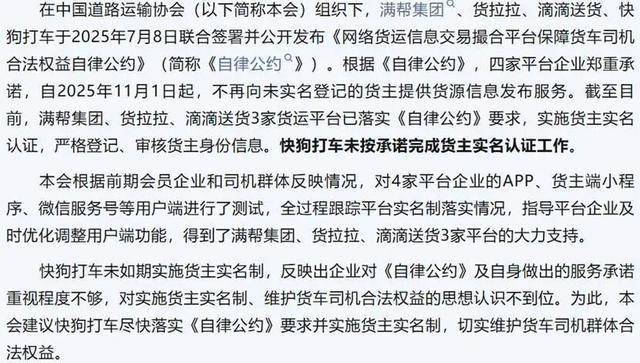
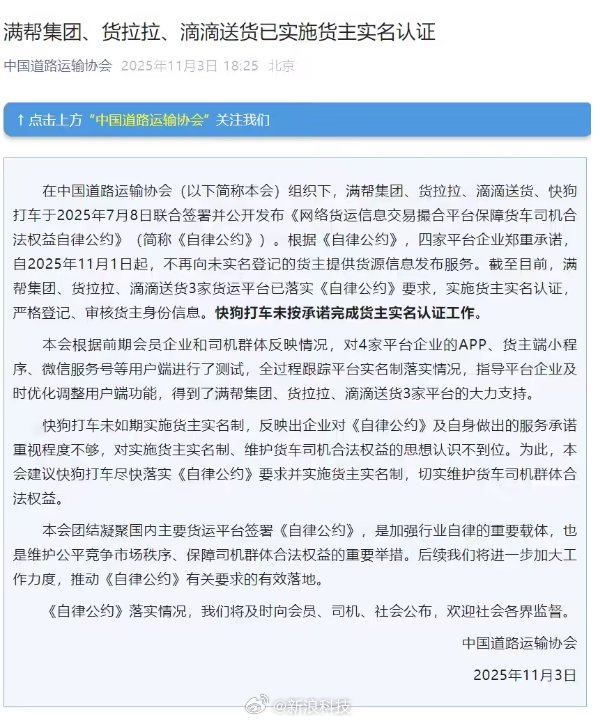
快狗打车未落实货主实名认证被点名
Xin Lang Ke Ji· 2025-11-03 14:33
Group 1 - The China Road Transport Association has pointed out that Kuaigou Dache has not fulfilled its commitment to complete the real-name authentication of cargo owners as per the Self-Discipline Convention signed by four logistics platforms [1][2] - The Self-Discipline Convention, effective from November 1, 2025, mandates that the four platforms, including Kuaigou Dache, must not provide cargo information services to unregistered cargo owners [1] - Three platforms, namely Manbang Group, Huo Lala, and Didi Delivery, have complied with the real-name authentication requirements, while Kuaigou Dache has failed to do so [1] Group 2 - The China Road Transport Association indicates that Kuaigou Dache's failure to implement real-name authentication reflects a lack of seriousness towards the Self-Discipline Convention and the protection of truck drivers' rights [2] - The Association recommends that Kuaigou Dache promptly implement the real-name authentication requirements to safeguard the legal rights of truck drivers [2]
天津市网络货运规模位居全国第一
Zhong Guo Jing Ying Bao· 2025-10-31 17:43
Core Insights - Tianjin has made significant progress in transportation infrastructure over the past five years, establishing a comprehensive multi-dimensional transportation network and enhancing its port capabilities [1][2][3][4] Group 1: Transportation Infrastructure Development - Tianjin has completed the main framework of its comprehensive transportation network, including "one belt, three axes, and two corridors" [1] - The number of berths for vessels over 10,000 tons has increased by 24 since 2020, reaching a total of 147 [1] - High-speed rail mileage has increased by 32%, totaling 410 kilometers, with 88% of the planned "nine horizontal and six vertical" expressway network completed, amounting to 1,358 kilometers [1] Group 2: Economic and Strategic Integration - The city has supported the integration of the Beijing-Tianjin-Hebei region, transitioning from "short board supplementation" to "network optimization and quality enhancement" [2] - Four high-speed rail lines connect to Beijing, and the framework for "railway-based Beijing-Tianjin-Hebei" has been established with 12 high-speed rail stations in operation [2] Group 3: Service Quality and Efficiency - The city has implemented quality improvement actions across ten transportation sectors, with projected passenger volumes for rail, air, and urban transit in 2024 reaching 56.69 million, 18.44 million, and 640 million respectively [3] - The annual traffic volume on highways is expected to reach 254 million trips, with a growth rate of 4.4% [3] - The logistics sector has seen significant growth, with railway, highway, and waterway freight turnover projected to reach 55.1 billion, 71.6 billion, and 181.1 billion ton-kilometers respectively in 2024 [3] Group 4: Innovation and Sustainability - Tianjin is focusing on smart, green, safe, and high-quality development in transportation, with initiatives for digital transformation and autonomous driving testing [4] - The city has achieved a high percentage of new energy vehicles in public transport, with 87.2% in buses and 74% in taxis [4] - Safety measures in the transportation sector have improved, with significant progress in risk prevention and safety regulation [4]