
钢铁行业

Search documents
沙钢股份:预计2025年归母净利润2.45亿元-2.9亿元,同比增长50.69%-78.37%
Xin Lang Cai Jing· 2026-01-23 13:00
Group 1 - The company, Shagang Group, announced on January 23 that it expects a net profit attributable to shareholders of 245 million to 290 million yuan for 2025, representing a year-on-year growth of 50.69% to 78.37% [1]

【冠通期货研究报告】热卷日报:震荡偏强-20260123
Guan Tong Qi Huo· 2026-01-23 11:38
Group 1: Investment Rating - The investment rating for the hot - rolled coil industry is "Oscillating with an upward bias" [1] Group 2: Core View - Currently, the supply of hot - rolled coils is contracting, while the demand is resilient. The overall supply - demand is in a tight balance. Pre - holiday winter stockpiling supports the current demand, the social inventory is decreasing month - on - month, and the factory inventory pressure is controllable. The overall inventory risk is gradually improving, but it is still relatively high year - on - year. Attention should be paid to the impact of the post - holiday resumption of work and production on supply and demand. The supply - demand tight balance and inventory reduction support the price. In the future, attention should be paid to raw material costs and the strength of post - holiday demand recovery. Technically, it has stood firm on the 5 - day and 30 - day moving averages, and it is expected to oscillate with an upward bias in the short term, maintaining a bullish view [5] Group 3: Summary by Directory Market行情回顾 - **Futures price**: The hot - rolled coil futures main contract increased its open interest by 33,977 lots on Friday, with a trading volume of 304,877 lots. Compared with the previous trading day, the volume increased. The intraday low was 3,283 yuan, and the high was 3,310 yuan. It oscillated with an upward bias during the day. From the perspective of the daily moving average, it stood above the 5 - day and 30 - day moving averages. If it stands firm, the probability of continued strength in the short and medium - term is relatively high. It closed at 3,305 yuan/ton, up 17 yuan, or 0.52% [1] - **Spot price**: The price of hot - rolled coils in the mainstream Shanghai area was reported at 3,290 yuan/ton, up 10 yuan compared with the previous trading day [2] - **Basis**: The basis between futures and spot is - 15 yuan, and the futures are slightly at a premium to the spot [3] Fundamental Data - **Supply**: As of January 22, the weekly output of hot - rolled coils decreased by 29,500 tons month - on - month to 3.0541 million tons, and decreased by 172,300 tons year - on - year. The output decline reflects that the steel mill's production capacity release has converged, which may be affected by factors such as maintenance arrangements and profit fluctuations, and supports the price [3] - **Demand**: As of January 22, the weekly apparent consumption decreased by 42,000 tons month - on - month to 3.0996 million tons, and increased by 73,900 tons year - on - year. The demand decreased slightly month - on - month but maintained growth year - on - year. Pre - holiday stockpiling supported the demand, and the overall demand was resilient [3] - **Inventory**: As of January 22, the total inventory decreased by 45,500 tons month - on - month to 3.5778 million tons (the social inventory decreased by 46,600 tons month - on - month, and the steel mill inventory increased by 1,100 tons). It increased by 212,700 tons year - on - year (the social inventory increased by 241,800 tons year - on - year, and the factory inventory decreased by 29,100 tons year - on - year). The total inventory decreased month - on - month, and the inventory pressure was marginally relieved. The year - on - year increase reflects that the inventory accumulation speed this year is slightly faster than last year, and the overall risk is controllable [3] - **Policy**: The new regulations on the export license management of steel products will cause short - term export fluctuations, increase supply, and put pressure on prices. In the long term, it will promote industrial upgrading, structural optimization, and competitiveness improvement. The Central Economic Work Conference in December proposed a positive fiscal policy and a moderately loose monetary policy, and listed the in - depth rectification of involution - style competition as a key task for 2026, which is beneficial to prices and industry profitability. Efforts will be made to stabilize the real estate market and expand domestic demand [4] Market Driving Factors Analysis - **Bullish factors**: Decrease in supply - side output, expectation of the start of winter storage demand, export rush market, policy support ("14th Five - Year Plan", infrastructure investment), and strong iron ore as furnace material [5] - **Bearish factors**: The resumption of production of steel mills in January exceeded expectations, seasonal weakening of demand, insufficient manufacturing orders, and inventory accumulation suppressing prices [5]
螺纹日报:震荡偏强-20260123
Guan Tong Qi Huo· 2026-01-23 11:29
Group 1: Investment Rating of the Reported Industry - The report gives a short - term investment rating of "oscillating upward" for the rebar industry [1][4] Group 2: Core Viewpoints of the Report - The current rebar supply side has strong resumption momentum, while the demand side is supported by pre - holiday winter stockpiling and shows resilience. After the Spring Festival, the recovery degree of terminal demand needs attention. The total and social inventories are at a low level year - on - year, with overall controllable inventory pressure, but the accumulation of factory inventories requires attention to the subsequent destocking rhythm. The low inventory and demand resilience support prices, but the significant recovery of production this week suppresses prices to some extent. After continuous declines, the raw material end of iron ore and coking coal has stopped falling and stabilized. It is expected that rebar will continue to oscillate upward in the short term, maintaining a bullish view [4] Group 3: Summary According to the Table of Contents Market Review - Futures price: The rebar main contract reduced its positions by 5,512 lots on Friday, and the trading volume increased compared with the previous trading day, reaching 657,796 lots. It stood firm above the short - term 5 - day and medium - term 30 - day moving averages. The lowest price was 3,119 yuan/ton, the highest was 3,147 yuan/ton, and it closed at 3,142 yuan/ton, up 18 yuan/ton or 0.58% [1] - Spot price: The mainstream spot price of HRB400E 20mm rebar was 3,270 yuan/ton, remaining stable compared with the previous trading day [1] - Basis: The futures price was at a discount of 128 yuan/ton to the spot price. The large basis provided some support, and winter stockpiling on the futures market was cost - effective [1] Fundamental Data - Supply: As of the week of January 22nd, rebar production increased by 92,500 tons week - on - week to 1.9955 million tons, and increased by 254,200 tons year - on - year in the Gregorian calendar. The significant year - on - year increase in production this week reflected the accelerating resumption of production by steel mills, suppressing prices in the short term. Continued attention was needed on whether the capacity recovery could be sustained [2] - Demand: The apparent demand increased significantly year - on - year but decreased slightly week - on - week, indicating the possible start of winter stockpiling. As of the week of January 22nd, the apparent demand was 1.8552 million tons, a week - on - week decrease of 48,200 tons and a year - on - year increase of 686,100 tons. Overall demand increased significantly compared with last year, showing resilience, and was supported by pre - holiday winter stockpiling demand [2] - Inventory: There was a slight de - stocking, with factory inventory decreasing and social inventory increasing. As of the week of January 22nd, the total inventory was 4.521 million tons, a week - on - week increase of 140,300 tons and a year - on - year decrease of 311,100 tons. The social inventory was 3.0512 million tons, a week - on - week increase of 77,100 tons and a year - on - year decrease of 433,700 tons. The factory inventory was 1.4898 million tons, a week - on - week increase of 63,200 tons and a year - on - year increase of 122,600 tons. The total inventory increased week - on - week but was at a low level in recent years year - on - year, with overall controllable inventory pressure. The continuous accumulation of factory inventory indicated that the production recovery rate was faster than the demand digestion rate, and the inventory pressure at the steel mill end increased marginally. The social inventory increased slightly week - on - week but decreased significantly year - on - year, reflecting better destocking of social inventory this year and much lower pressure in the circulation link than the same period last year, which provided some support for prices [2][3] - Macro: The central bank sent a signal of moderate easing, and the Ministry of Finance emphasized that the expenditure intensity would only increase. However, due to weak real estate demand, the incremental demand was relatively limited, but the easing cycle provided some support, and the upper limit of demand determined the pressure [3] Driving Factor Analysis - Bullish factors: Inventory at a three - year low, anti - involution production cuts on the supply side, strict capacity control, policy - supported demand, marginal improvement in post - holiday demand, and loose macro expectations [4] - Bearish factors: Excessive post - Spring Festival inventory accumulation, slow destocking, accelerated blast furnace restart, cautious winter stockpiling demand, continuous decline in real estate demand, restricted exports, and weak economic recovery [4]
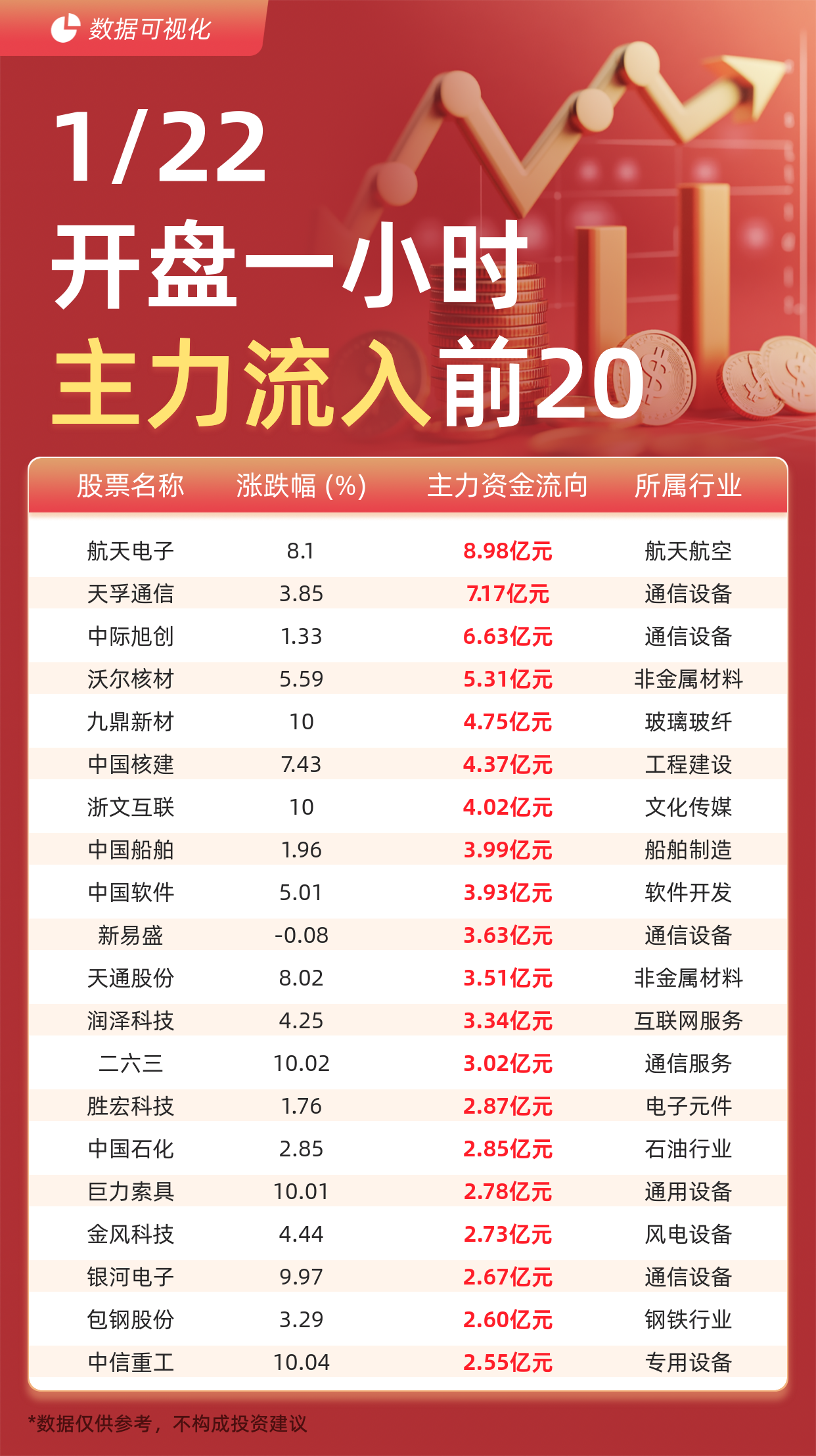
主力资金流入前20:航天电子流入8.98亿元、天孚通信流入7.17亿元
Jin Rong Jie· 2026-01-22 02:43
Group 1 - The top 20 stocks with significant capital inflow include Aerospace Electronics (8.98 billion), Tianfu Communication (7.17 billion), and Zhongji Xuchuang (6.63 billion) [1] - Aerospace Electronics experienced a price increase of 8.1%, while Tianfu Communication and Zhongji Xuchuang saw increases of 3.85% and 1.33% respectively [2] - Other notable stocks with substantial capital inflow include Woer Nuclear Materials (5.31 billion), Jiuding New Materials (4.75 billion), and China Nuclear Engineering (4.37 billion) [1][2] Group 2 - Jiuding New Materials had a significant price increase of 10%, while Zhejiang Wenlian and China Shipbuilding also saw increases of 10% and 1.96% respectively [2][3] - The energy sector is represented by China Petroleum with a capital inflow of 2.85 billion and a price increase of 2.85% [3] - Companies like Jushi Group and Goldwind Technology also showed strong performance with capital inflows of 2.78 billion and 2.73 billion, and price increases of 10.01% and 4.44% respectively [3]


关注国内铜资源增储带来的投资机会
East Money Securities· 2026-01-22 01:27
Investment Rating - The report maintains an "Outperform" rating for the non-ferrous metals industry, indicating expected performance above the market average [2][15]. Core Insights - The report highlights investment opportunities arising from the increase in domestic copper resource reserves, particularly noting the significant resource addition by Yulong Copper in Tibet, which adds 131.42 thousand tons of copper and 10.77 thousand tons of molybdenum [7][11]. - The aluminum sector is expected to maintain a strong performance due to optimistic macroeconomic expectations, despite a slight price correction [7][11]. - The precious metals market is experiencing mixed investor preferences, with gold demand increasing while silver demand shows a decline [7][11]. - The tungsten supply remains tight, with prices increasing, and there is a rising expectation for restocking post-holiday [7][11]. - The steel industry is poised for growth with new government policies aimed at stabilizing the sector, benefiting from infrastructure investments [8][11]. Summary by Sections Copper - LME copper and SHFE copper prices were reported at 13,000 and 100,770 USD/ton respectively, with a week-on-week decrease of 0.5% and 0.6% [7]. - The processing fee for imported copper concentrate is in negative territory, indicating tight supply [7]. - The operating rate of refined copper rod enterprises increased to 57.47%, up by 9.65 percentage points week-on-week [7]. Aluminum - LME aluminum and SHFE aluminum prices were reported at 3,147 and 23,925 USD/ton, with a week-on-week decrease of 1.0% and 1.7% [7]. - The operating rate of aluminum processing enterprises increased to 60.2% [7]. Precious Metals - SHFE gold and COMEX gold prices were reported at 1,032.3 CNY/gram and 4,601.1 USD/ounce, with week-on-week increases of 2.6% and 1.8% [7]. - SPDR gold ETF holdings increased by 21.1 tons week-on-week, indicating a preference for gold among overseas investors [7]. Tungsten and Rare Metals - Tungsten concentrate prices rose to 507,000 CNY/ton, with a week-on-week increase of 4.3% [7]. - The rare earth industry is experiencing tight supply, with prices for praseodymium-neodymium oxide and dysprosium oxide increasing [7]. Steel - SHFE rebar and hot-rolled coil prices were reported at 3,163 and 3,315 CNY/ton, with a week-on-week increase of 0.6% [8]. - The Ministry of Industry and Information Technology announced plans for a new round of growth stabilization policies for the steel industry [8].
近期工程机械用钢产销存分析
Xin Lang Cai Jing· 2026-01-21 10:25
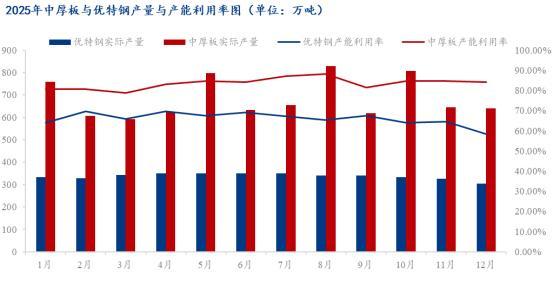
工程机械用钢作为钢铁行业与工程机械产业的重要一环,市场走势反映下游基建、制造业复苏及产业升 级的方向。近期国内市场以及海外市场同步驱动,工程机械用钢保持着稳步增加的运行态势。本文从产 销存的角度,对工程机械用钢近期市场运行状态进行解读。 一、生产品种差异化 高端产能供应不足 数据来源:钢联数据 从工程机械用钢品种来看,中厚板与优特圆钢在工程机械用钢当中最具有代表性。2025年中厚板整体实 际产量与优特钢呈现不同程度上的分化。其中中厚板保持着80%以上的利用率,而优特产能利用率却保 持着60%左右的波动,同时从相关产量上来看,优特钢月度产量较为平稳,中厚板产量变化相对较大。 同时从规模来看,2025年中厚板+优特钢实际产量在1.22亿吨,而工程机械用钢约占其中的40%左右, 2025年国内工程机械用钢产能达到5800万吨,显示行业生产节奏与市场需求基本匹配。头部钢企凭借技 术优势与客户绑定能力,产能释放更为充分,宝武集团、鞍钢、湖南华菱三家企业合计市场份额已提升 至63%,集中度持续走高。其中,宝武集团1500MPa级超高强钢产能实现增长,年供应量超80万吨,主 要配套三一重工、徐工集团等头部工程机械企业;南钢 ...
瑞达期货热轧卷板产业链日报-20260120
Rui Da Qi Huo· 2026-01-20 09:21
研究员: 蔡跃辉 期货从业资格号F0251444 期货投资咨询从业证书号Z0013101 免责声明 本报告中的信息均来源于公开可获得资料,瑞达期货股份有限公司力求准确可靠,但对这些信息的准确性及完整性不做任何保证,据此投资,责任 自负。本报告不构成个人投资建议,客户应考虑本报告中的任何意见或建议是否符合其特定状况。本报告版权仅为我公司所有,未经书面许可,任 何机构和个人不得以任何形式翻版、复制和发布。如引用、刊发,需注明出处为瑞达期货股份有限公司研究院,且不得对本报告进行有悖原意的引 用、删节和修改。 | 项目类别 | 数据指标 | 最新 | 环比 数据指标 | 最新 | 环比 | | --- | --- | --- | --- | --- | --- | | 期货市场 | HC 主力合约收盘价(元/吨) | 3,276 | -23↓ HC 主力合约持仓量(手) | 1486145 | -15864↓ | | | HC 合约前20名净持仓(手) | -13,902 | +5130↑ HC5-10合约价差(元/吨) | -19 | +1↑ | | | HC 上期所仓单日报(日,吨) | 216602 | -44 ...
【立方债市通】2025年PPN平均利率2.52%/胡明柱任南阳产投董事长/中国平煤神马集团发行10亿中票
Sou Hu Cai Jing· 2026-01-19 12:59
Group 1: Regulatory Actions - In 2025, the Trading Association imposed self-discipline penalties on 143 entities, focusing on five key areas including structured issuance and fundraising management [1] - The penalties included the first-time crackdown on issues such as low-price underwriting of financial bonds and violations related to rating agencies and fund misappropriation [1] - A total of 44 structured issuance institutions were penalized, and 32 institutions faced penalties for trading violations, including price manipulation and interest transfer [1] Group 2: Debt Financing Market - In 2025, the average issuance rate for PPN was 2.52%, down 43 basis points from 2024 [2] - The Trading Association facilitated the registration of 1.24 trillion yuan in targeted debt financing tools, with 1.1 trillion yuan issued, representing 14% of the overall market [2] Group 3: Monetary Policy - The People's Bank of China conducted a 7-day reverse repurchase operation of 158.3 billion yuan, with a net injection of 72.2 billion yuan [4] - The operation had a bidding amount and winning amount of 158.3 billion yuan, with an interest rate of 1.40% [4] Group 4: Bond Issuance Activities - China Pingmei Shenma Group issued 1 billion yuan in medium-term notes at an interest rate of 2.82%, with funds intended for debt repayment [8] - Anyang Steel plans to issue 400 million yuan in medium-term notes to supplement working capital, rated AA+ [9] - Zhengzhou Economic Development Capital Group completed the issuance of 650 million yuan in corporate bonds at a rate of 2.40%, aimed at repaying existing debts [10] Group 5: Market Developments - Shanghai Pudong Capital Investment Operation Co., Ltd. was established with a registered capital of 10 billion yuan, focusing on asset management and optimization of state-owned capital [14] - The Trading Association reduced the debt financing tool quota by 16.731 billion yuan across eight companies [16][17]



螺纹日报:震荡偏弱-20260119
Guan Tong Qi Huo· 2026-01-19 11:17
Report Industry Investment Rating - The short - term view of the steel industry is an oscillatory pattern with support at the bottom and pressure at the top, maintaining the idea of buying at support levels and participating flexibly [4] Core Viewpoints - The current rebar market is in an oscillatory and weak state. The demand is seasonally weak but winter storage demand is starting. The production is slightly decreasing and at a relatively low level compared to recent years. The inventory is slightly decreasing and at a relatively low position with little pressure. The cost support is decreasing, and the real - estate demand continues the downward cycle, limiting the upside space, while the infrastructure demand may have some resilience [4] Summary by Directory Market行情回顾 (Market Review) - Futures price: On Monday, the rebar main contract's open interest decreased by 27,384 lots, and the trading volume shrank compared to the previous trading day, with 1,056,242 lots. The price was oscillatory and weak throughout the day, breaking below the 5 - day and 10 - day moving averages in the short - term. It closed at 3,140 yuan/ton, down 33 yuan/ton or 1.04%, with a low of 3,134 and a high of 3,171 [1] - Spot price: The mainstream area's rebar HRB400E 20mm was quoted at 3,290 yuan/ton, down 10 yuan compared to the previous trading day [1] - Basis: The futures price was at a discount of 150 yuan/ton to the spot price. The large basis provided some support, and there was a certain cost - effectiveness for the winter storage on the futures market [1] Fundamental Data Supply - demand situation - Supply side: As of the week of January 15, the rebar production decreased by 0.74 million tons week - on - week to 1.903 billion tons, starting to decline slightly after four consecutive weeks of increase. It was 2.99 million tons lower year - on - year in the Gregorian calendar. The blast furnace operating rate of 247 steel mills was 78.84%, down 0.47 percentage points week - on - week and up 1.66 percentage points year - on - year; the blast furnace iron - making capacity utilization rate was 85.48%, down 0.56 percentage points week - on - week and up 1.20 percentage points year - on - year; the steel mill profitability rate was 39.83%, up 2.17 percentage points week - on - week and down 10.39 percentage points year - on - year; the daily average pig iron output was 2.2801 billion tons, down 1.49 million tons week - on - week. The current production was still relatively low compared to recent years, providing some support for the price [2] - Demand side: The apparent consumption rebounded, indicating that winter storage might have started. As of the week of January 15, the apparent consumption increased by 15.38 million tons week - on - week to 1.9034 billion tons, and was 5.19 million tons higher year - on - year. After three consecutive weeks of decline, the apparent consumption rebounded significantly, suggesting the start of winter storage demand [2] Inventory situation - The total inventory decreased slightly by 0.04 million tons week - on - week to 4.3807 billion tons as of the week of January 15. The social inventory was 2.9541 billion tons, up 5.23 million tons week - on - week but still at a low level in recent years, and the steel mill inventory was 1.4266 billion tons, down 5.27 million tons. The accumulation of social inventory indicated weak downstream demand, and the reduction of steel mill inventory indicated that traders had a certain amount of winter storage [3] Macroeconomic situation - The central economic meeting proposed to use various policy tools such as reserve requirement ratio cuts and interest rate cuts flexibly and efficiently to maintain sufficient liquidity and smooth the monetary policy transmission mechanism. It aimed to stabilize the real - estate market, control new supply, reduce inventory, and optimize supply according to local conditions, and encourage the acquisition of existing commercial housing for affordable housing. The Fed cut interest rates by 25 basis points in December as expected. The macro - economic expectation was moderately positive. The 15th Five - Year Plan provided a transformation path for the steel industry, focusing on "controlling production capacity, optimizing structure, promoting transformation, and improving quality". Macroscopically, the incremental demand was relatively limited, but the loose cycle provided some support, and the upper limit of demand determined the pressure [3] Driving Factor Analysis - Bullish factors: The inventory was at a three - year low, the supply side was cutting production to avoid excessive competition, production capacity was strictly controlled, policies supported demand, the demand would marginally improve after the Spring Festival, and the macro - economic expectation was loose [4] - Bearish factors: The inventory accumulation after the Spring Festival might exceed expectations, the de - stocking speed would slow down, the blast furnace restart would accelerate, the winter storage demand was cautious, the real - estate demand continued to decline, exports were restricted, and the economic recovery was weak [4] Short - term View Summary - After the accident at Baotou Steel over the weekend, the futures market rose slightly in the morning session, but the real - estate data released today continued to decline, and the market weakened again. Currently, the rebar demand was seasonally weak, but the data released last week showed an increase, indicating that winter storage demand was starting. The production decreased slightly and was at a relatively low level compared to recent years. The anti - excessive competition policy was expected to shrink production capacity, providing downward support. The inventory decreased slightly and was at a relatively low level with little pressure. In terms of cost, iron ore prices fell sharply today, port inventory was high, and coking coal and coke prices were weak, reducing cost support. The real - estate demand continued the downward cycle, with limited incremental demand, restricting the upside space. However, infrastructure demand might have some resilience. In the short - term, the price broke below the 5 - day and 10 - day moving averages, and in the medium - term, support should be watched at the 30 - day and 60 - day moving averages. Currently, the market was in an oscillatory pattern with support at the bottom and pressure at the top. It was advisable to maintain the idea of buying at support levels and participate flexibly [4]
智能制造标准密集出台,我国标准体系迈向应用深化新阶段
Xin Hua Wang· 2026-01-13 07:40
Core Insights - The rapid growth in the number of standards published in China's intelligent manufacturing industry in 2025, reaching a total of 21, indicates a comprehensive coverage across key sectors such as machinery, electronics, communications, steel, non-ferrous metals, and power [1][2][3] Group 1: Equipment Manufacturing - Three standards were introduced in the equipment manufacturing sector, including the "Technical Requirements for Digital Workshops of Small Circuit Breakers," which fills a gap in low-voltage electrical equipment standards and provides a replicable implementation path for SMEs' digital transformation [1] Group 2: Electronics Information - Six standards were released in the electronics information sector, including a series of standards for "Digital Design of Radar and Similar Electronic Information Equipment," which establishes a systematic digital design standard framework, enhancing R&D efficiency and product reliability [1] Group 3: Raw Materials Industry - Ten standards were published in the raw materials industry, characterized by "precise control and green orientation," with a focus on energy consumption in steel production and the establishment of a comprehensive smart factory standard system in the non-ferrous metals sector [2] Group 4: Consumer Goods - Two standards were introduced in the consumer goods sector, specifically addressing the tobacco industry, with guidelines for intelligent machinery and smart factory construction that aim to enhance the industry's overall intelligent upgrade [2] Group 5: Policy Coordination - The release of these standards aligns with national strategies for intelligent manufacturing, aiming to eliminate "data silos" and "standard barriers" across different industries and enterprises, thus supporting collaborative upgrades for businesses of all sizes [3]