工业企业利润

Search documents
东海证券晨会纪要-20260330
Donghai Securities· 2026-03-30 11:39
Group 1: Key Recommendations - The report highlights the expected divergence in oil price impacts, suggesting that while oil prices have been volatile, the overall market response has been muted due to strategic reserves and easing sanctions. However, this buffer is depleting, indicating potential future price increases [7]. - The report recommends focusing on domestic supply chain stability and re-evaluating asset values in advanced production capacities, particularly in the coal chemical industry, ethylene production from imported US ethane, and large refining sectors [7]. - It suggests a balanced asset allocation strategy across domestic bonds, commodities, and broad market indices, with a positive outlook on sectors such as AI applications, coal, non-ferrous metals, and innovative pharmaceuticals [7]. Group 2: Profit Trends in Domestic Industry - The report notes that in January-February 2026, the total profit of industrial enterprises above a designated size increased by 15.2% year-on-year, significantly up from the previous value of 0.6% [10]. - The increase in profits is attributed to three factors: revenue growth, profit margins, and a low base effect from the previous year, particularly due to the timing of the Spring Festival [11]. - The report indicates that while profits are expected to stabilize, geopolitical uncertainties and potential inflationary pressures could impact downstream profit margins, necessitating a review of domestic demand policies [10][11]. Group 3: Economic and Financial News - The State Council has called for expanding market access and opening up the service sector, emphasizing the importance of service industries in modern economic development [14]. - The People's Bank of China has reported that the financial sector remains stable, with ongoing efforts to mitigate financial risks and enhance the monitoring and assessment of financial stability [15]. - Russia plans to ban gasoline exports starting April 1, 2026, to stabilize domestic prices amid geopolitical tensions affecting energy markets [16]. Group 4: Market Performance - The A-share market showed mixed performance, with the Shanghai Composite Index closing at 3913 points, up 0.63%, while the Shenzhen Component and ChiNext indices also saw gains [17]. - The report notes that the energy metals sector led the market with a significant increase of 6.11%, while other sectors such as chemical pharmaceuticals and agricultural chemicals also performed well [22]. - The report highlights that the overall market sentiment has improved, with a notable increase in net inflows of large capital into various sectors [20].

1-2月工业企业利润数据点评:工业企业利润同比大幅增长,高技术制造业贡献增强
Zhong Cheng Xin Guo Ji· 2026-03-30 11:09
Group 1: Industrial Profit Growth - In January-February 2026, industrial enterprises' revenue increased by 5.3% year-on-year, up 2.5 percentage points from the same period last year[2] - Industrial profits grew by 15.2% year-on-year, marking the highest level since 2022, and up 15.5 percentage points from the previous year[3] - The profit margin for industrial enterprises was 4.92%, an increase of 0.39 percentage points compared to the same period last year[3] Group 2: Cost and Inventory Dynamics - The cost per 100 yuan of revenue for industrial enterprises was 84.83 yuan, a decrease of 0.28 yuan, the lowest since 2024[3] - Finished goods inventory increased by 6.6% year-on-year, indicating a proactive restocking behavior among enterprises[4] - Accounts receivable grew by 7.1% year-on-year, with the average collection period extending by 8.5 days to 76.4 days[4] Group 3: Sector Performance Disparities - Private enterprises saw a significant profit increase of 37.2%, the highest since August 2021, up 46.2 percentage points year-on-year[6] - State-owned enterprises' profits grew by 5.3%, while foreign and Hong Kong-Macau-Taiwan enterprises experienced a profit decline of 3.8%[6] - The mining sector's profits increased by 9.9%, while manufacturing profits rose by 18.9% year-on-year[9] Group 4: Future Outlook - Continued strong external demand, particularly in semiconductor-related industries, is expected to support industrial profit recovery[15] - Domestic demand is anticipated to improve, driven by government initiatives to build a large domestic market[15] - The ongoing "anti-involution" policies and rising commodity prices are likely to further alleviate price pressures on industrial profits[15]
2026年03月30日申万期货品种策略日报-国债-20260330
Shen Yin Wan Guo Qi Huo· 2026-03-30 03:25
1. Report Industry Investment Rating - No relevant information provided. 2. Core View of the Report - The short - term market interest rates generally declined, with the SHIBOR 7 - day rate down 1bp, the DR007 rate down 2.23bp, and the GC007 rate down 3.2bp. The yields of key - term Chinese treasury bonds fluctuated, with the 10Y treasury bond yield rising 0.02bp to 1.82%, and the long - short (10 - 2) treasury bond yield spread at 43.27bp. Overseas, the 10Y US, German, and Japanese treasury bond yields rose by 2bp, 9bp, and 9.4bp respectively. The central bank's open - market operations had net injections last week. The national industrial enterprise profits in the first two months of this year increased by 15.2% year - on - year. Looking ahead, there is still room for the central bank to cut reserve requirements and interest rates. The short - end treasury bond futures prices are supported, while the long - end treasury bond futures prices are expected to face pressure due to rising commodity prices and the Fed's hawkish stance [2][3]. 3. Summary by Relevant Catalogs 3.1 Futures Market - **Price and Volume**: The prices of treasury bond futures fluctuated. The T2606 contract fell 0.01%. The trading volume and open interest of each contract also changed. For example, the open interest of TS2606 decreased by 489, while that of TF2606 increased by 4461 [2]. - **Arbitrage**: The IRR of the CTD bonds corresponding to the main treasury bond futures contracts was at a low level, with no arbitrage opportunities [2]. 3.2 Spot Market - **Short - term Market Interest Rates**: The short - term market interest rates generally declined. SHIBOR 7 - day, DR007, and GC007 rates decreased by 1bp, 2.23bp, and 3.2bp respectively [2]. - **Chinese Key - term Treasury Bond Yields**: The yields of key - term Chinese treasury bonds fluctuated. The 10Y treasury bond yield rose 0.02bp to 1.82%, and the long - short (10 - 2) treasury bond yield spread was 43.27bp [2]. - **Overseas Key - term Treasury Bond Yields**: The 10Y US, German, and Japanese treasury bond yields rose by 2bp, 9bp, and 9.4bp respectively [2]. 3.3 Macro News - **Central Bank Operations**: On March 27, the central bank conducted 1462 billion yuan of 7 - day reverse repurchase operations, with a net injection of 1257 billion yuan on that day. Last week, the central bank had a net injection of 2319 billion yuan through reverse repurchase operations and carried out 5000 billion yuan of MLF operations to replace the 4500 billion yuan of matured MLF [3]. - **International Situation**: The US - Israel - Iran conflict continued to be intense. Iran increased its attacks on the US and Israel, and the US proposed a cease - fire plan which was rejected by Iran. The US vice - president said that the rise in US domestic oil prices was a short - term market reaction and would fall after the US withdrew from Iran [3]. - **Domestic Policy**: The State Council emphasized promoting the development of the service industry and improving the graded diagnosis and treatment system. The National Bureau of Statistics announced that the profits of industrial enterprises above designated size from January to February increased by 15.2% year - on - year. The central bank required to improve the financial risk prevention and resolution system [3]. 3.4 Industry Information - **Interest Rates**: The money market interest rates mostly declined, while the inter - bank lending rates showed mixed trends. The yields of US treasury bonds also fluctuated, with short - term yields falling and long - term yields rising [3]. - **Market Outlook**: The central bank's open - market operations maintained a relatively stable capital supply. The Middle East situation pushed up inflation expectations and increased financial market volatility. The industrial enterprise profits showed a recovery trend. The short - end treasury bond futures prices were supported, while the long - end prices were expected to face pressure [3].
宏观与大类资产周报:即将进入关键4月-20260329
CMS· 2026-03-29 13:02
Domestic Economic Indicators - March PPI is expected to be around 0.6% month-on-month, with a year-on-year PPI of approximately 0.1%, potentially ending a 41-month streak of negative PPI[5] - From January to February, industrial profits increased by 15.2% year-on-year, with significant contributions from high-tech manufacturing and related raw material industries[5] Global Economic Risks - Two of the four major global economic pressures have emerged: oil prices exceeding $100 could lead to an early recession in the U.S.; the dollar index breaking 100 may pressure non-U.S. liquidity[5] - The 10-year U.S. Treasury yield surpassing 5% could burden U.S. fiscal health, while the S&P 500 index may adjust by 20% if it reaches its peak, as indicated by historical patterns[5] Market Trends - Oil prices are fluctuating around $100 per barrel, prompting significant political responses, while the dollar index has reached 100, leading to gold sell-offs by central banks in Poland and Turkey[5] - If the U.S. maintains control over the situation, a critical point may be reached in mid to late April, potentially improving global risk appetite[5] Monetary Policy and Liquidity - The central bank has continued net liquidity injections, with a total net injection of 281.9 billion yuan during the week of March 23-27[21] - The average rates for R001, DR001, R007, and DR007 were 1.3871%, 1.3179%, 1.5069%, and 1.4398%, respectively, showing minor fluctuations compared to the previous week[22] Government Debt Financing - Local government debt net financing was 1305.97 billion yuan, and national debt net financing was 948.10 billion yuan, totaling approximately 2254.07 billion yuan for the week[23] - Upcoming local government debt issuance is planned at 1184.24 billion yuan, with net financing expected to be 399.68 billion yuan[23] Stock Market Performance - Major indices in the A-share market experienced declines, with the ChiNext index showing the largest drop of 1.68%[39] - The U.S. stock market also faced downward pressure, with the Nasdaq index leading the decline at 3.23%[39]
2026年1-2月工业企业利润数据点评:工业企业“补库存”
Ping An Securities· 2026-03-28 23:31
Group 1: Profit Growth - In January-February 2026, profits of large-scale industrial enterprises reached 10,245.6 billion yuan, a year-on-year increase of 15.2%[1] - The profit growth rate improved significantly from 5.3% in December 2025, an increase of 9.9 percentage points[2] - The cumulative revenue profit margin reached 4.92%, up 0.39 percentage points from the same period last year, contributing to profit growth[2] Group 2: Sector Performance - Mining and raw materials sectors saw a profit increase of 9.9% and 88.3% respectively, with the latter accelerating by 71.1 percentage points compared to the previous year[2] - Equipment manufacturing profits grew by 23.5%, while high-tech manufacturing profits surged by 58.7%, contributing 7.9 percentage points to overall industrial profit growth[2] - The computer and communication equipment sector experienced a staggering profit growth of 203.5%, significantly boosting overall industrial profit growth by 8.6 percentage points[2] Group 3: Inventory and Receivables - By the end of February, industrial enterprises' assets and liabilities grew by 5.5% and 5.8% respectively, with liabilities expanding faster than assets[2] - Finished goods inventory increased by 6.6%, marking the fastest growth since April 2023, while revenue grew by 5.3%[2] - Accounts receivable increased by 7.1%, with an average collection period of 76.4 days, up 1.5 days from the previous year[2] Group 4: Risks - Risks include the potential ineffectiveness of growth stabilization policies, overseas economic downturns, and escalating geopolitical conflicts[7]
中游制造毛利率之“浴火重生”——1-2月工业企业利润点评
一瑜中的· 2026-03-28 02:36
Core Viewpoint - The article highlights the significant improvement in industrial enterprise profits in early 2026, with a year-on-year profit growth of 15.2% for large-scale industrial enterprises, driven by both revenue and profit margin increases [2][25]. Group 1: Industrial Enterprise Profit Data - In January-February 2026, the profit growth for state-owned industrial enterprises was 5.3%, while private enterprises saw a remarkable growth of 37.2%, and foreign and Hong Kong-Macau-Taiwan enterprises experienced a decline of 3.8% [2][25]. - The inventory level as of February 2026 showed a year-on-year increase of 6.6%, up from 3.9% previously [2][25]. - The revenue growth rate for large-scale industrial enterprises in January-February 2026 was 5.3%, compared to a decline of 3.2% in December 2025 [3][25]. Group 2: Profit Margin Analysis - The overall profit margin for January-February 2026 was 4.92%, an increase from 4.49% in the same period last year [3][25]. - The gross profit margin for January-February 2026 was 15.2%, compared to 14.9% in the previous year, while the expense ratio was 8.66%, slightly up from 8.56% [3][25]. - The mining industry saw a year-on-year profit growth of 9.9%, while the manufacturing sector experienced a growth of 18.9% [26]. Group 3: Midstream Manufacturing Margin Challenges - The midstream manufacturing sector has faced three major challenges affecting its gross profit margin: tariff impacts, direct cost shocks from rising metal prices, and high oil prices [4][10]. - Tariff impacts began in April 2025, with tariff revenues increasing from $8.16 billion in March 2025 to $29.67 billion in September 2025, before decreasing to $26.59 billion by February 2026 [5][12]. - Despite significant increases in metal prices, the gross profit margin for midstream manufacturing rose to 15.2% from 14.8% year-on-year, indicating resilience in the face of rising costs [6][15]. Group 4: Sector-Specific Performance - Within the manufacturing sector, the midstream equipment manufacturing industry saw a year-on-year growth rate of 23.4%, with the computer, communication, and other electronic equipment manufacturing sector's profits increasing by 200% [26]. - The automotive manufacturing sector, however, faced a significant decline of 30.2% in profits [26]. - The upstream sectors, including non-ferrous metal smelting and rolling, reported a profit growth of 150%, while the chemical raw materials and products manufacturing sector grew by 35.9% [26].


2026年1-2月工业企业利润分析:利润增长开门红
Yin He Zheng Quan· 2026-03-27 07:55
Profit Growth Overview - Industrial enterprises' profits increased by 15.2% year-on-year in January-February 2026, reaching 10,245.6 billion yuan[1] - The profit margin improved to 4.92%, up by 0.39 percentage points compared to the previous year[1] Revenue and Production Factors - Revenue growth was driven by both volume and price increases, with production rising by 6.3% and export demand contributing significantly[1] - The Producer Price Index (PPI) showed signs of recovery, with a year-on-year increase of 0.4% in February 2026, compared to a decline of 1.4% in the previous year[1] Inventory and Cost Pressures - Inventory levels increased by 6.68% in January-February 2026, indicating a proactive restocking strategy in response to rising revenue[1] - Cost pressures have not fully materialized, with a cash turnover ratio of 84.83, reflecting ongoing financial strain[1] Sector Performance - The equipment manufacturing sector acted as a stabilizing force, with profits growing by 23.5%[1] - High-tech manufacturing profits surged by 58.7%, indicating a strong performance in this segment[1] Future Outlook - The current economic phase is characterized by strong external demand, moderate internal recovery, and gradual price increases[3] - Key risks include potential cost pressures from rising oil prices and the ability of enterprises to manage these costs effectively[3]
【数据发布】2026年1—2月份全国规模以上工业企业利润增长15.2%
中汽协会数据· 2026-03-27 07:04
Core Viewpoint - In the first two months of 2026, China's industrial enterprises above designated size achieved a total profit of 10,245.6 billion yuan, representing a year-on-year increase of 15.2% [1] Group 1: Profit and Revenue Overview - In January-February, state-owned enterprises achieved a total profit of 3,665.6 billion yuan, up 5.3% year-on-year; joint-stock enterprises reported a profit of 8,032.9 billion yuan, an increase of 22.1%; foreign and Hong Kong, Macao, and Taiwan-invested enterprises saw profits decline by 3.8% to 2,167.5 billion yuan; private enterprises experienced a profit increase of 37.2% to 2,844.5 billion yuan [1] - The mining industry reported a total profit of 1,556.1 billion yuan, a year-on-year increase of 9.9%; the manufacturing sector achieved a profit of 7,321.5 billion yuan, up 18.9%; the electricity, heat, gas, and water production and supply industry reported a profit of 1,368.0 billion yuan, an increase of 3.7% [1] Group 2: Industry-Specific Profit Growth - The computer, communication, and other electronic equipment manufacturing industry saw profits increase by 2.0 times; the non-ferrous metal smelting and rolling processing industry grew by 1.5 times; the chemical raw materials and chemical products manufacturing industry increased by 35.9%; the non-metallic mineral products industry grew by 16.2% [2] - The textile industry reported a profit increase of 12.6%; the agricultural and sideline food processing industry grew by 8.0%; the electrical machinery and equipment manufacturing industry increased by 6.2% [2] - The coal mining and washing industry grew by 4.5%; the specialized equipment manufacturing industry increased by 4.3%; the general equipment manufacturing industry grew by 3.6%; the electricity and heat production and supply industry increased by 3.4% [2] - The automotive manufacturing industry saw a profit decline of 30.2%; the black metal smelting and rolling processing industry reported increased losses [2] Group 3: Financial Indicators - In January-February, industrial enterprises above designated size achieved operating revenue of 20.84 trillion yuan, a year-on-year increase of 5.3%; operating costs amounted to 17.68 trillion yuan, up 5.0%; the operating revenue profit margin was 4.92%, an increase of 0.43 percentage points year-on-year [2] - By the end of February, total assets of industrial enterprises above designated size reached 188.40 trillion yuan, a year-on-year increase of 5.5%; total liabilities amounted to 108.59 trillion yuan, up 5.8%; total owners' equity was 79.82 trillion yuan, an increase of 5.1% [3] - The asset-liability ratio stood at 57.6%, up 0.1 percentage points year-on-year; accounts receivable reached 26.55 trillion yuan, a year-on-year increase of 7.1%; finished goods inventory was 6.68 trillion yuan, up 6.6% [3] Group 4: Efficiency Metrics - The cost per 100 yuan of operating revenue was 84.83 yuan, a decrease of 0.24 yuan year-on-year; expenses per 100 yuan of operating revenue were 8.66 yuan, an increase of 0.02 yuan year-on-year [3] - By the end of February, the average revenue per 100 yuan of assets was 66.4 yuan, a decrease of 0.1 yuan year-on-year; per capita revenue was 1.749 million yuan, an increase of 95,000 yuan year-on-year [3] - The turnover days for finished goods inventory were 22.7 days, an increase of 0.4 days year-on-year; the average collection period for accounts receivable was 76.4 days, an increase of 1.3 days year-on-year [3]
2026年1-2月工业企业利润点评:开年工业企业利润:超预期的含金量
Guolian Minsheng Securities· 2026-03-27 05:27
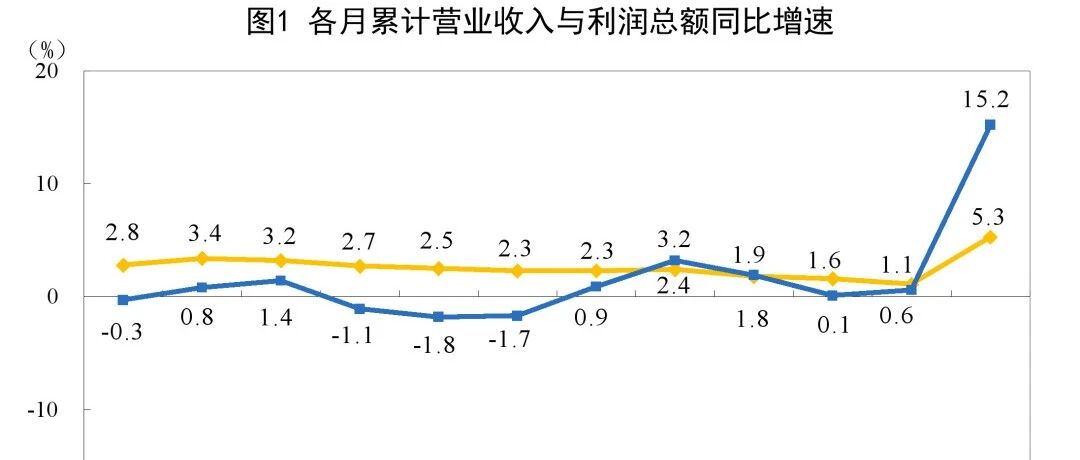
Profit Growth Overview - In January-February 2026, industrial enterprises achieved a total profit of 10,245.6 billion yuan, marking a year-on-year increase of 15.2%[6] - The profit growth rate surged from 5.3% in December 2025 to 15.2% in the first two months of 2026, indicating a significant improvement in industrial profitability[6] Industry Performance - Profit recovery showed clear industry differentiation: upstream industries saw a profit increase of 34.3%, midstream industries 26.4%, while downstream industries faced a decline of 11.4%[3] - Upstream profit improvements were primarily driven by price support, particularly in non-ferrous metal smelting and mining, which experienced nearly triple-digit growth[3][4] Midstream and Downstream Insights - Midstream profit growth was attributed to accelerated production, with the electronics manufacturing sector seeing a remarkable profit increase of 203.5% year-on-year[4] - Downstream industries, particularly furniture manufacturing (-40.0%) and automotive manufacturing (-30.2%), showed significant profit declines, reflecting consumer caution towards durable goods and large expenditures[4][7] Cost and Efficiency Factors - The revenue profit margin for enterprises improved significantly, with a notable decrease in the cost-to-revenue ratio, likely due to equipment upgrades and ongoing tax reductions[3] - The increase in finished goods inventory growth in January-February indicated early signs of proactive restocking, although sustainability depends on demand recovery[4][7] Risk Considerations - Future profit sustainability is contingent on the recovery pace of end-user demand, with current downstream profits indicating that demand has not fully stabilized[7] - Potential risks include policy outcomes not meeting expectations, unexpected changes in the domestic economic landscape, and fluctuations in export dynamics[7]
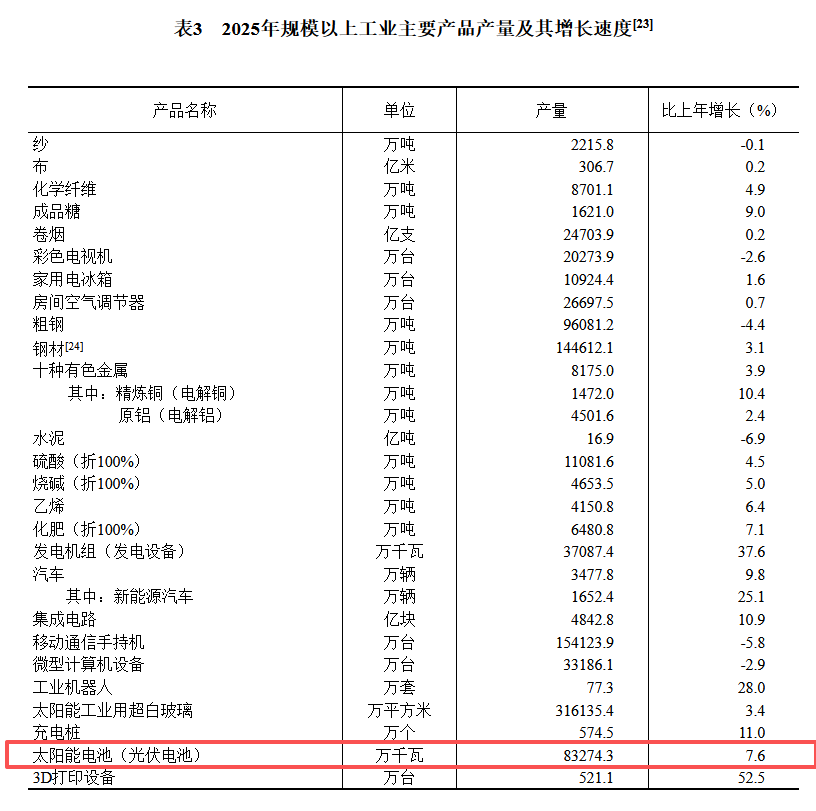
国家统计局:2025年中国太阳能电池(光伏电池)产量83274.3万千瓦
Guo Jia Tong Ji Ju· 2026-02-28 02:08
Core Insights - The National Bureau of Statistics of China released the "Statistical Bulletin on National Economic and Social Development for 2025," highlighting various industrial growth rates and production figures across sectors [1][2]. Industrial Growth - The value added of the agricultural and sideline food processing industry increased by 5.6% year-on-year, while the textile industry grew by 3.0% [1]. - The chemical raw materials and chemical products manufacturing industry saw a growth of 7.8%, and the general equipment manufacturing industry grew by 8.0% [1]. - The automotive manufacturing industry experienced significant growth at 11.5%, and the electrical machinery and equipment manufacturing industry grew by 9.2% [1]. - The production of solar cells (photovoltaic cells) reached 83,274.3 million kilowatts, marking a year-on-year increase of 7.6% [1][2]. Production Data - In 2025, the output of various products included: - Refined copper: 1,472,000 tons, up 10.4% - New energy vehicles: 1,652,400 units, up 25.1% - Industrial robots: 77,300 sets, up 28.0% - Solar photovoltaic panels: 83,274.3 million kilowatts, up 7.6% [2]. - The total profit of industrial enterprises above designated size was 739.82 billion yuan, a 0.6% increase from the previous year [2]. Energy Production - China's solar power generation reached 1,173.24 billion kilowatt-hours, reflecting a substantial year-on-year growth of 39.8% [3][5]. - The total electricity generation was 10,575.25 billion kilowatt-hours, with thermal power generation slightly declining by 0.7% [5].