
食品加工与肉类

Search documents
中粮科技:截至2026年1月9日股东人数合计100439户
Zheng Quan Ri Bao Wang· 2026-01-12 13:15
Group 1 - The core point of the article is that COFCO Technology (000930) reported a total of 100,439 shareholders as of January 9, 2026 [1]

龙大美食1月9日获融资买入471.88万元,融资余额3.02亿元
Xin Lang Cai Jing· 2026-01-12 01:41
Group 1 - The core viewpoint of the news is that Longda Food has experienced a decrease in revenue and profit, indicating potential challenges in its business performance [2] - As of January 9, Longda Food's stock price increased by 0.24%, with a trading volume of 64.31 million yuan, and a net financing purchase of 72,700 yuan [1] - The company's financing balance is 303 million yuan, accounting for 6.64% of its market capitalization, which is below the 10th percentile level over the past year, indicating a low financing level [1] Group 2 - Longda Food's revenue for the period from January to September 2025 was 7.625 billion yuan, a year-on-year decrease of 4.85%, while the net profit attributable to shareholders was -183 million yuan, a significant year-on-year decrease of 349.93% [2] - The number of shareholders for Longda Food as of December 31 was 44,200, a decrease of 2.58% from the previous period, while the average circulating shares per person increased by 2.76% to 24,401 shares [2] - Since its A-share listing, Longda Food has distributed a total of 443 million yuan in dividends, with no dividends paid in the last three years [2]

双汇发展:公司积极实施肉类多元化发展
Zheng Quan Ri Bao Wang· 2026-01-08 14:13
Core Viewpoint - The company is focusing on the poultry industry as a key area for growth, driven by increasing domestic chicken consumption and a diversified meat strategy [1] Group 1: Company Strategy - The company has implemented a diversified meat strategy, with the poultry sector covering chicken farming, slaughtering, and processing as a significant focus area [1] - The establishment of a Poultry Industry Operations Center has been approved by the board to enhance management across the poultry supply chain, aiming for improved operational quality [1] Group 2: Performance Outlook - The poultry sector is expected to show significant year-on-year improvement in operational performance by the third quarter of 2025 through enhanced standardization and refined management practices [1]

煌上煌:获高新技术企业认定,三年内享税收优惠
Xin Lang Cai Jing· 2026-01-04 07:39
Core Viewpoint - The company has received a "High-tech Enterprise Certificate" from relevant departments in Jiangxi Province, which allows it to benefit from a reduced corporate income tax rate of 15% for the years 2025 to 2027 [1] Group 1 - The certificate number is GR202536000751, issued on October 29, 2025, and is valid for three years [1] - The recognition as a high-tech enterprise is not expected to have a significant impact on the company's current operating performance [1]

周黑鸭(01458)12月31日斥资62.84万港元回购38.6万股
Zhi Tong Cai Jing· 2025-12-31 06:24
Group 1 - The company, Zhou Hei Ya (01458), announced a share buyback plan, intending to repurchase 386,000 shares at a total cost of HKD 628,400 [1] - The buyback price per share is set between HKD 1.61 and HKD 1.65 [1]
煌上煌:拟使用不超过2亿元闲置自有资金进行投资理财
Xin Lang Cai Jing· 2025-12-30 09:05
Core Viewpoint - The company has approved the use of up to 200 million yuan of idle self-owned funds for investment and wealth management, focusing on safe, liquid, and controllable risk financial products [1] Group 1 - The company held its 18th temporary meeting of the sixth board of directors on December 30 [1] - The board approved a proposal to continue using part of its idle funds for investment and wealth management [1] - The investment products will include structured deposits, reverse repos, income certificates, and fixed-income products, all from financial institutions with legal operating qualifications [1] Group 2 - The approved investment amount is capped at 200 million yuan and is valid for 12 months from the date of board approval [1] - The funds can be used in a rolling manner within the specified limit [1]
鹏程食品成为顺商猪肉生鲜品独家供应商,7家直营专柜开业
Bei Ke Cai Jing· 2025-12-29 05:21
Core Insights - Beijing Shunxin Holdings Group Co., Ltd. has signed a strategic framework cooperation agreement with Beijing Shunyi Commercial Group Co., Ltd. to supply pork products exclusively through its subsidiary, Pengcheng Food [1] - The collaboration aims to connect high-quality local agricultural products with consumer channels, enhancing the availability of safe and healthy pork products for residents in the capital [1] Group 1 - The partnership will allow all stores under Shunyi Commercial Group to exclusively offer pork products from Pengcheng Food, which has a 60-year history in the pork industry and a comprehensive supply chain management system [1] - The direct supply model reduces intermediaries, ensuring consumers receive high-quality pork at competitive prices [1] - The initiative is positioned as a significant step towards strengthening the capital's livelihood security and promoting high-quality regional industrial development [1] Group 2 - On the first day of operation, seven direct sales counters sold 40 whole pigs and 3.5 tons of pork cuts, with sales increasing to 60 whole pigs and 4 tons of cuts on the signing day, which coincided with a weekend [2] - The integration of agricultural industry leaders with local supermarket chains is expected to break down barriers in agricultural product sales, providing a model for regional agricultural and commercial integration [2] - Pengcheng Food plans to expand its direct sales network across Beijing, aiming for a grid-like coverage within 1.5 kilometers of urban areas, thereby enhancing its service to the community and contributing to the modernization of livelihood security in China [2]

“航母级”基金激起资本活水,年内近300家上市公司涉足投资基金
Sou Hu Cai Jing· 2025-12-26 06:42
Group 1 - The National Venture Capital Guidance Fund has officially launched, focusing on early-stage investments in sectors such as integrated circuits, artificial intelligence, aerospace, and low-altitude economy [1][3] - The fund aims to mobilize nearly 1 trillion yuan in local and social capital through its establishment [3] - Three regional sub-funds have been established in Beijing, Shanghai, and Shenzhen, with total scales of 296.46 billion yuan, 471 billion yuan, and 450.5 billion yuan respectively [3] Group 2 - The fund features a three-tier structure: national mother fund, regional mother funds, and sub-funds, with a 20-year duration to promote "patient capital" [4] - Sub-funds are required to invest 70% of their capital in seed and early-stage projects, without regional reinvestment obligations [4] - The private equity and venture capital market is expected to see a significant increase, with a 37.42% year-on-year growth in new registered funds by Q3 2025 [4] Group 3 - State-owned capital dominates the LP market with an investment of 123.12 billion yuan, accounting for 46.8% of total contributions [5] - Corporate investors contribute 44.15 billion yuan, representing 16.8% of the total, primarily from industrial groups and listed companies [5] - Nearly 300 listed companies have engaged in or are planning to establish investment funds this year [5] Group 4 - Companies like Meinian Health and Binhua Co. are actively participating in venture capital by establishing or investing in funds focused on AI, automation, and strategic emerging industries [6][7] - The investment strategies of these companies aim to enhance their competitive edge and align with their long-term strategic goals [6][7] - The establishment of investment funds by listed companies is seen as a way to expand business opportunities and leverage professional investment capabilities [9]





周黑鸭于12月24日斥资39.6万港元回购22.7万股
Xin Lang Cai Jing· 2025-12-25 03:45
Group 1 - Company announced a share buyback of 227,000 shares for a total cost of HKD 396,000 on December 24, 2025 [1]
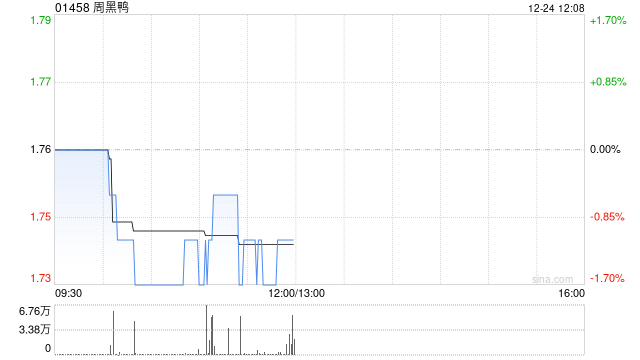
周黑鸭12月24日斥资39.6万港元回购22.7万股
Zhi Tong Cai Jing· 2025-12-24 06:53
Group 1 - The company, Zhou Hei Ya (01458), announced a share buyback plan, intending to repurchase 227,000 shares at a cost of HKD 396,000 [1]