
建筑设计

Search documents
财联社6月4日晚间新闻精选
news flash· 2025-06-04 13:45
Group 1 - The Ministry of Industry and Information Technology is promoting the development of the artificial intelligence industry and empowering new industrialization, focusing on the layout of general large models and industry-specific large models, emphasizing hardware and software adaptation, and accelerating the establishment of high-quality industry data sets to enhance the intelligence level of key product equipment [1] - The Hong Kong Securities and Futures Commission is considering introducing virtual asset derivatives trading for professional investors, encouraging local and international companies to explore innovations and applications of virtual asset technology [1] - The National Energy Administration is organizing the first batch of pilot work for the construction of a new power system, coordinating regional stock and incremental data center green electricity demand and new energy resource conditions, and collaboratively planning the layout of computing power and electricity projects [1] Group 2 - The Ministry of Finance and the Ministry of Housing and Urban-Rural Development are conducting the 2025 annual evaluation for central financial support for urban renewal actions, planning to support 20 cities including Beijing and Tianjin in implementing urban renewal actions [1] - Kingsoft Office continues to appoint Lei Jun as the honorary chairman of the company [1] - Sinovac Biotech's controlling shareholder, Koyi Medicine, plans to reduce its holdings by no more than 3% of the company's shares [1] - Zhongheng Design has reported that the revenue from its "low-altitude economy" and "commercial aerospace" related project designs is relatively small [1] - Lehui International has indicated that its fresh beer business accounts for a small proportion and is still in a loss stage [1] - A portion of the company's directors and supervisors at Aoheng Co., Ltd. reduced their holdings by 153,000 shares during the period of abnormal stock trading according to the reduction plan [1] - Wantai Biological's application for marketing authorization of its nine-valent HPV vaccine has been approved [1]


建研设计: 关于全资子公司完成工商登记并取得营业执照的公告
Zheng Quan Zhi Xing· 2025-06-04 11:31
Core Viewpoint - Anhui Provincial Architectural Design Research Institute Co., Ltd. has established a wholly-owned subsidiary with an investment of 2 million yuan, indicating strategic expansion in the engineering consulting sector [1]. Group 1: Company Announcement - The company held its 16th meeting of the 3rd board of directors on May 9, 2025, where it approved the investment to set up a wholly-owned subsidiary [1]. - The subsidiary, named Anhui Provincial Jianyuan Lushi Development Co., Ltd., has completed its business registration and obtained a business license from the Hefei Market Supervision Administration [1]. Group 2: Business License Information - The newly established subsidiary is officially named "Provincial Jianyuan (Feixi) Engineering Consulting Co., Ltd." with a registered capital of 2 million yuan [1]. - The company type is a limited liability company, and it was established on June 3, 2025, with Jiang Shen as the legal representative [1]. - The business scope includes general project engineering technical services, engineering management services, and engineering cost consulting services [1].
本周再添9家!中国化学等多股披露回购增持再贷款计划,相关A股名单一览
Xin Lang Cai Jing· 2025-05-31 10:48
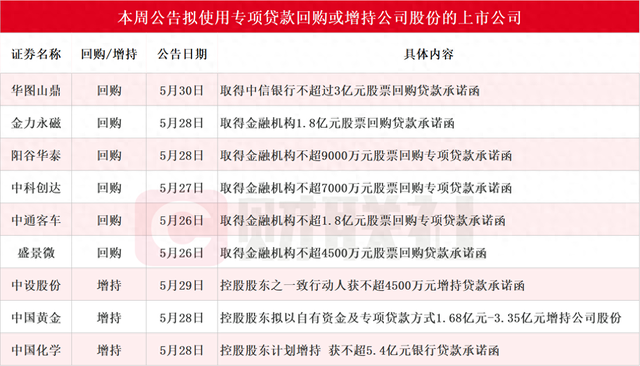
Core Viewpoint - The number of A-share listed companies announcing share repurchase and increase in loans is on the rise, with nine companies disclosing relevant information this week [1]. Group 1: Companies Announcing Repurchase or Increase - Huatu Shanding announced a stock repurchase plan with a loan commitment of up to 300 million yuan from CITIC Bank [1][2]. - Jinli Permanent Magnet received a loan commitment of 180 million yuan from a financial institution for stock repurchase [1][2]. - Yanggu Huatai obtained a special loan commitment of up to 90 million yuan for stock repurchase [1]. - Zhongke Chuangda secured a special loan commitment of up to 70 million yuan for stock repurchase [1]. - Zhongtong Bus received a loan commitment of up to 180 million yuan for stock repurchase [1][3]. - Shengjing Micro acquired a loan commitment of up to 45 million yuan for stock repurchase [1]. - Zhongshe Co. announced a loan commitment of up to 45 million yuan for share increase by a controlling shareholder [1]. - China National Gold plans to increase its shares using self-owned funds and special loans ranging from 168 million to 335 million yuan [1]. - China Chemical Engineering plans to increase its shares with a loan commitment of up to 540 million yuan [1][2]. Group 2: Loan Details and Conditions - The loan for Huatu Shanding is specifically for share repurchase and has a term of up to 36 months [2]. - Jinli Permanent Magnet's loan is also for stock repurchase and has a term of up to 3 years [2]. - Zhongtong Bus's loan is designated for stock repurchase with a term of up to 3 years [3].




华蓝集团(301027) - 301027华蓝集团投资者关系管理信息20250530
2025-05-30 11:18
Group 1: Financial Performance and Debt Management - Guangxi is one of the 12 key provinces for debt reduction, with significant government support for accounts receivable recovery [2] - In 2024, the company signed contracts worth approximately CNY 2,194.51 million for energy management, a year-on-year increase of 166% [5] - The company achieved a total contract amount of CNY 2,559 million for renewable energy design projects in 2024, representing a 145% increase compared to the previous year [5] Group 2: Urban Renewal and Construction Repair - The company's urban renewal business focuses on historical district renovations, providing technical consulting services for urban renewal and building modifications [3] - The collaboration with Keshun Waterproof Technology Co., Ltd. aims to enhance capabilities in building repair, covering areas such as structural reinforcement and mechanical renovation [3][4] - Urban renewal and building repair services currently account for a small proportion of the company's total revenue [3] Group 3: Strategic Partnerships and Business Expansion - The partnership with Keshun involves resource sharing, technical collaboration, and market expansion, enhancing competitiveness in the building repair sector [4] - The company has established a comprehensive business chain for energy management, including project evaluation, design planning, and implementation [6] - The company acquired Guangxi Hualan Hydropower Engineering Design Co., Ltd. in 2023 to expand into water conservancy-related construction and consulting services [6] Group 4: Future Outlook and Cash Flow Management - The company anticipates further improvement in cash flow in 2025, building on significant enhancements in 2024 [6] - Measures will be taken to strengthen accounts receivable recovery and reduce bad debt risks [6] - The company plans to pursue mergers and acquisitions in alignment with its strategic goals [6]

霍普股份: 关于股票交易异常波动的公告
Zheng Quan Zhi Xing· 2025-05-30 09:32
一、股票交易异常波动的具体情况 上海霍普建筑设计事务所股份有限公司(以下简称"公司")股票于2025 年5月29日、5月30日连续两个交易日收盘价格涨幅偏离值累计超过30%,根据 深圳证券交易所相关规定,属于股票交易异常波动的情况。 二、公司关注并核实相关情况 证券代码:301024 证券简称:霍普股份 公告编号:2025-040 上海霍普建筑设计事务所股份有限公司 本公司及董事会全体成员保证信息披露的内容真实、准确、完整,没有 虚假记载、误导性陈述或重大遗漏。 三、是否存在应披露而未披露信息的说明 公司董事会确认,除上述情况外,公司目前没有任何根据《深圳证券交易 所创业板股票上市规则》规定应予以披露而未披露的事项或与该事项有关的筹 划、商谈、意向、协议等;董事会也未获悉公司有根据《深圳证券交易所创业 板股票上市规则》的规定应予以披露而未披露的、对公司股票交易价格产生较 大影响的信息;公司前期披露的信息不存在需要更正、补充之处。 四、风险提示 国证券报》《上海证券报》《证券时报》《证券日报》《 》为公司 指定的信息披露媒体,公司所有信息均以在上述指定媒体刊登的信息为准。 务,及时做好信息披露工作。敬请广大投资 ...
华图山鼎首季赚1.2亿能否持续待观望 车璐累计套现8亿再抛3%减持计划
Chang Jiang Shang Bao· 2025-05-28 23:44
Core Viewpoint - The former actual controller of Huatu Shanding, Che Lu, plans to reduce his stake in the company by up to 3%, potentially cashing out approximately 386 million yuan, indicating a trend of significant share reductions by the former controller amid concerns about the company's performance [2][5][10]. Group 1: Shareholding and Reduction Plans - Che Lu currently holds 16.53% of Huatu Shanding's shares, making him the second-largest shareholder [4][6]. - This planned reduction marks Che Lu's fourth attempt to cash out, with the latest reduction scheduled between June 19 and September 18, 2025 [4][6]. - The shares Che Lu intends to sell are sourced from shares acquired before the company's IPO and from capital reserve conversions [4]. Group 2: Financial Performance and Market Context - Huatu Shanding's core business includes non-degree training and architectural design, with non-degree training being the primary focus [3][10]. - The company has faced poor performance since its change of ownership in 2019, with a notable decline in revenue and profits until a recent recovery in 2024, where revenue increased by 1046.34% year-on-year [10][11]. - In the first quarter of 2024, the company reported a revenue of 828 million yuan and a net profit of 121 million yuan, marking significant growth compared to previous years [11]. Group 3: Historical Context and Ownership Changes - Huatu Shanding was formerly known as Shanding Design and underwent a change in control in 2019, leading to a significant ownership transfer and a rebranding to Huatu Shanding [6][7]. - The ownership transition involved a complex arrangement where Huatu Education's assets were effectively injected into Huatu Shanding, aiming to pivot the company's focus towards education [10][11]. - Che Lu has previously cashed out significant amounts, totaling nearly 800 million yuan through various share reductions since the company's ownership change [9].
业界专家学者相聚江苏扬州共话“好房子”
Zhong Guo Xin Wen Wang· 2025-05-27 11:59
Core Viewpoint - The concept of "good housing" is emphasized as a crucial element in meeting the high-quality living needs of the population, with a focus on improving residential quality and sustainability [1][2] Group 1: Government Initiatives - The State Council's report highlights the need for safe, comfortable, green, and smart housing to meet the public's high-quality living requirements [1] - Yangzhou has introduced a notification to enhance the construction of improvement-type housing, aiming for a transformation from functional to quality-oriented residential projects [1] Group 2: Expert Opinions - Experts stress that building materials are fundamental to "good housing," advocating for material conservation and sustainability to ensure comfort and health [1] - The importance of residential design is highlighted, with a call to draw wisdom from daily life and adapt to changing living conditions [1] - Different eras have distinct definitions of "good housing," necessitating a focus on enhancing living quality and happiness across various demographics, including considerations for the elderly and children [1] Group 3: Industry Perspectives - The chairman of a construction group defines "good housing" as a community that resembles a park, where residents can safely enjoy outdoor activities and a healthy lifestyle [2]
矩阵股份: 关于作废2024年限制性股票激励计划部分已授予但尚未归属的限制性股票的公告
Zheng Quan Zhi Xing· 2025-05-27 09:25
根据矩阵纵横设计股份有限公司(以下简称"公司")2024 年第二次临时股 东大会的授权,公司于 2025 年 5 月 27 日召开第二届董事会第十三次会议、第二 届监事会第十三次会议,审议通过了《关于作废 2024 年限制性股票激励计划部 分已授予但尚未归属的限制性股票的议案》,同意作废 2024 年限制性股票激励计 划(以下简称"《激励计划》"或"本激励计划")部分已授予但尚未归属的第二 类限制性股票 116.406 万股。现将有关事项说明如下: 一、本激励计划已履行的审批程序 证券代码:301365 证券简称:矩阵股份 公告编号:2025-034 矩阵纵横设计股份有限公司 关于作废 2024 年限制性股票激励计划部分已授予 但尚未归属的限制性股票的公告 本公司及董事会全体成员保证信息披露的内容真实、准确、完整,没有虚假 记载、误导性陈述或重大遗漏。 次会议审议通过了《关于公司<2024 年限制性股票激励计划(草案)>及其摘要 的议案》等议案。公司 2024 年限制性股票激励计划拟向激励对象授予 360.3 万 股限制性股票,限制性股票授予价格为 5.82 元/股。公司监事会对 2024 年限制性 股票激励 ...

尤安设计: 第三届董事会第三十六次会议决议公告
Zheng Quan Zhi Xing· 2025-05-26 08:16
证券代码:300983 证券简称:尤安设计 公告编号:2025-033 上海尤安建筑设计股份有限公司 本公司及董事会全体成员保证信息披露的内容真实、准确、完整,没有虚假记载、误导 性陈述或重大遗漏。 经与会董事认真讨论,会议以记名投票方式审议了如下议案: 《关于注销部分分公司的议案》 为优化分支机构的布局,同意公司注销上海尤安建筑设计股份有限公司安徽 分公司、上海尤安建筑设计股份有限公司成都分公司、上海尤安建筑设计股份有 限公司武汉分公司、上海尤安建筑设计股份有限公司深圳分公司和上海尤安建筑 设计股份有限公司西安分公司。该事项不会对公司的财务及经营状况产生重大不 利影响,亦符合公司目前的战略规划和经营发展的需要,不存在损害公司和全体 股东,特别是中小股东利益的情况。董事会授权公司总经理及其授权人员负责向 市场监督管理部门办理注销登记手续。本次注销登记内容最终以市场监督管理部 门核准的内容为准。 具体内容详见公司同日披露于巨潮资讯网(www.cninfo.com.cn)的《上海 尤安建筑设计股份有限公司关于注销部分分公司的公告》。 表决结果:9 票同意,占全体董事人数的 100%;0 票反对;0 票弃权。 三、 ...
第十批中国20世纪建筑遗产项目推介名录出炉
Nan Jing Ri Bao· 2025-05-26 02:34
Core Insights - The event held on May 25 showcased 100 projects of 20th-century architectural heritage, emphasizing the importance of preserving and innovating historical architecture in urban renewal efforts [1][2] Group 1: Architectural Heritage Projects - The event highlighted significant projects such as the Nanjing Lishi Society site, Nanjing Confucius Temple architectural complex, Nanjing Science and Technology Museum, and Sun Ke's former residence [1] - The Lishi Society site, built in 1931, is a national key cultural relic and features a "品" shaped arrangement of buildings, showcasing a blend of traditional Chinese architecture with modern functionality [1] - The Nanjing Confucius Temple complex represents a large-scale historical architecture project that was restored starting in 1985, reflecting the urban fabric and architectural style of the Ming and Qing dynasties [1] Group 2: Notable Architectural Designs - The Nanjing Science and Technology Museum, designed by Academician Zhong Xunzheng, exemplifies successful modern Chinese architecture through its harmonious integration with the urban environment and innovative use of materials [2] - Sun Ke's former residence, designed by architect Yang Tingbao in 1944, features a two-story brick-concrete structure with an area of approximately 1,000 square meters, showcasing innovative design elements for ventilation and cooling without air conditioning [2] - Since September 2016, the China Cultural Relics Society has promoted a total of 1,000 projects in ten batches, with a significant representation of architectural heritage projects from Jiangsu Province and Nanjing [2]