信托

Search documents
“2025证券市场年会”在京举行群英汇聚 共话资本市场改革与创新
Zheng Quan Ri Bao Zhi Sheng· 2025-12-26 16:41
Core Viewpoint - The "2025 Securities Market Annual Conference" emphasized the need for reform and innovation in the capital market to enhance its ability to serve the real economy and protect investors, particularly in key areas like technology and green finance [1][2] Group 1: Development Direction - The upcoming "15th Five-Year Plan" aims to improve the inclusiveness and adaptability of the capital market, ensuring a coordinated investment and financing function [2] - The conference highlighted the importance of deepening reforms to enhance the capital market's attractiveness and competitiveness, aligning with national economic development goals [2] Group 2: Wealth Management - Wealth management is identified as a crucial bridge between residents' wealth and the real economy, essential for fostering long-term capital and stabilizing the capital market [3] - The focus on innovation in regulatory frameworks is necessary to empower institutions and give investment choices back to investors [3] Group 3: Practical Focus - The "Financial Sub-Forum" and "Listed Companies Sub-Forum" addressed specific practical issues, including asset allocation and risk management in a complex market environment [4][5] - Discussions included the role of technology in reshaping corporate ecosystems and the challenges and breakthroughs in technological innovation [5] Group 4: Awards and Recognition - The conference concluded with the "2025 Golden Horse Award Ceremony," recognizing outstanding contributions to the healthy development of the capital market across various sectors [5]
中粮信托获批变更股权
Bei Jing Shang Bao· 2025-12-26 14:14
北京商报讯(记者 岳品瑜 董晗萱)12月26日,据国家金融监督管理总局行政许可信息,北京金融监管 局同意中粮产业投资有限公司受让中粮财务有限责任公司持有的中粮信托有限责任公司3.2502%股权。 受让后,中粮产业投资有限公司合计持股比例为3.2502%。 ...
中油资本:拟收购英大期货100%股权
Mei Ri Jing Ji Xin Wen· 2025-12-26 14:09
Group 1 - The core point of the article is that China Petroleum Capital plans to acquire 100% equity of Yingda Futures from Yingda Securities for approximately RMB 1.129 billion [1] - The transaction will be evaluated by Walkson (Beijing) International Asset Appraisal Co., Ltd., which has completed the asset evaluation report and received confirmation from the State-owned Assets Supervision and Administration Commission [1] - The transaction price is determined based on the asset evaluation project record issued by the state asset regulatory authority on December 2, 2025 [1] Group 2 - For the first half of 2025, the revenue composition of China Petroleum Capital is as follows: commercial banks 47.04%, financial companies 38.53%, financial leasing 7.94%, others 5.72%, and trust business 0.76% [1] - As of the report date, the market capitalization of China Petroleum Capital is RMB 120.6 billion [1]

华鑫信托党委书记、董事长朱勇:耐心资本投资AI产业的指数法则
Zheng Quan Ri Bao Wang· 2025-12-26 11:18
感谢主办方证券日报的邀请,也感谢舒总刚才的介绍。结合主题——大资管时代,财富如何保值增值这 个主题,我想从金融投资的角度,谈一谈如何运用指数法则,培育耐心资本,践行长期主义,以金融活 水助力AI产业,我汇报的题目是耐心资本投资AI产业的指数法则。指数法则又称幂律分布,也叫二八 定律,有时候也叫马太效应,是风险投资领域普遍适用的规律性准则,它之所以叫指数法则,是因为少 数几个项目的成功所获得的回报,足以覆盖整个基金其他项目的亏损,并留有剩余。 正如彼得·蒂尔最先提出指数法则的时候,他在《从0到1》这本书中指出风险投资的最大幂律,是最佳 投资所带来的回报等于或者超过整个基金其他投资的总回报,指数法则作为一个法则非常重要,但是在 当前的金融投资领域并不为大家所熟悉,所以还有重申的必要。特别是在当今AI新时代,万物源自比 特,信息技术投资本身也遵循风险投资的总体规律,也就是遵循着指数法则的规律。在指数法则适用的 条件下,投资于AI领域的资本我认为对当前有以下五个方面的启示: 第一,在时间维度上,我们要做耐心资本,不耐心是人的天性,耐心是我们后天的努力和追求。具体在 AI投资领域,耐心还是一个理性的选择。根据指数法则, ...
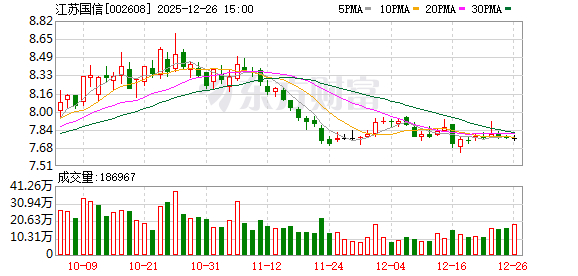
江苏国信:关于子公司诉讼事项的进展公告
Zheng Quan Ri Bao· 2025-12-26 11:12
Core Viewpoint - Jiangsu Guoxin announced that its subsidiary, Jiangsu Trust, has faced a legal dispute involving a trust loan of 2.5 billion yuan with Jiasui Real Estate and Huizhou Jiazhaoye, which was upheld by the Jiangsu Provincial High Court in the second instance, maintaining the original ruling [2] Summary by Categories Legal Proceedings - The Jiangsu Provincial High Court rejected the appeal and upheld the original judgment regarding the 2.5 billion yuan trust loan dispute [2] Financial Impact - The company stated that the trust assets carry their own risk and that this legal matter is not expected to affect the current or future profits [2]


中国外贸信托首单“双委托人”信托落地
Zheng Quan Ri Bao Wang· 2025-12-26 10:49
Core Viewpoint - The launch of China's first "dual trustee" trust product, "Fuyuhengan No. 2," addresses the core needs of family wealth management by integrating the advantages of the trust system with family warmth, providing a new path for family wealth management in China [1] Group 1: Key Features of the "Dual Trustee" Structure - The first core feature is the "long-term mechanism" that allows the trust to operate across life cycles, ensuring continuity even if one trustee passes away, thus solving the traditional wealth management issue of lifecycle limitations [1] - The second core feature is the "T+0" dual information disclosure mechanism that enhances trust among family members by ensuring that both trustees receive real-time information, eliminating potential conflicts arising from information asymmetry [2] - The third core feature is the ability to effectively manage risks associated with changes in family relationships, with pre-defined handling methods in the trust contract to maintain the independence and stability of trust assets, thereby avoiding disputes and ensuring ongoing support for family members [2]
家纺龙头1.2亿理财资金“爆雷” 中信证券判赔近3000万
Xin Lang Zheng Quan· 2025-12-26 09:44
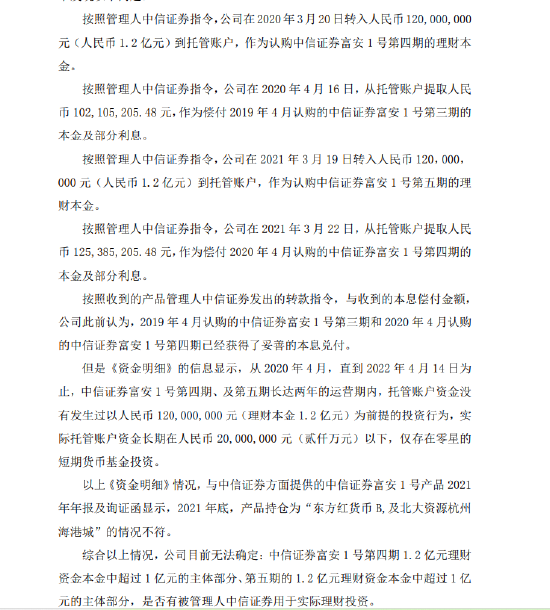
Core Viewpoint - The dispute involving a 120 million yuan investment by Fuanna in a financial product managed by CITIC Securities has revealed significant concerns regarding fund allocation and potential mismanagement, leading to a lawsuit and a recent court ruling favoring Fuanna [1][3]. Group 1: Background of the Dispute - The seeds of the dispute were sown in 2018 when Fuanna signed an asset management contract with CITIC Securities, investing a total of 540 million yuan in the "CITIC Securities Fuanna FOF Customized No. 1 Single Asset Management Plan" over five phases [1]. - The immediate trigger for the lawsuit was the fifth phase product, amounting to 120 million yuan, which failed to pay out upon maturity on March 19, 2022, resulting in a substantial default [1]. Group 2: Fund Allocation Concerns - Fuanna discovered significant doubts regarding the flow of its invested funds, noting that the 120 million yuan principal was transferred out just three days after being deposited, allegedly to pay off the principal and interest of a previous product [1]. - Similar operations were observed with the funds from the fourth phase, raising serious questions about whether the invested capital was used for the intended investments as per the contract or for "borrowing new to pay old" [1]. Group 3: Underlying Asset Issues - The underlying asset of the investment, the "Beida Resources Hangzhou Haigang City" project, was already in default, with its debtor, Zhejiang Lande Real Estate, having received qualified opinions in its 2019 and 2020 audit reports [2]. - The guarantor, Beida Fangzheng Group, is also undergoing restructuring, further complicating the situation [2]. Group 4: Legal Proceedings and Court Ruling - After months of unsuccessful negotiations with CITIC Securities, Fuanna filed a lawsuit on August 31, 2023, against CITIC Securities and the Guangzhou branch of China Merchants Bank [3]. - On December 25, the court ruled that CITIC Securities must compensate Fuanna for principal losses amounting to 29.2863 million yuan, with future recoveries from the asset management plan to be split 50/50 between Fuanna and CITIC Securities, capped at the compensation amount [4]. - The court also confirmed that there are still 35.8371 million yuan in investment returns from Western Trust Company that Fuanna has yet to withdraw, and the defendants are required to assist Fuanna in retrieving these funds and their interest [4].


江苏国信:子公司金融借款诉讼二审维持原判,涉案25亿
Xin Lang Cai Jing· 2025-12-26 08:45
江苏国信公告称,控股子公司江苏信托曾就金融借款合同纠纷起诉佳穗置业和惠东佳兆业,涉案信托贷 款本金25亿元及相应利息等。2025年2月,南京中院一审判决佳穗置业返还本金25亿,支付利息、逾期 利息及违约金等。其后,佳穗置业和惠东佳兆业上诉,请求撤销承担评估费判决。近日,江苏信托收到 省高院二审判决,驳回上诉,维持原判。该诉讼结果预计不会对公司本期及期后利润产生影响。 ...
王峥嵘:以“本源”链接“能源”
Zheng Quan Ri Bao Wang· 2025-12-26 07:45
Core Viewpoint - Kunlun Trust is focusing on the energy sector and enhancing its asset management capabilities to adapt to the current low-interest-rate environment and the evolving asset management landscape in China [2][7]. Group 1: Company Background - Kunlun Trust, originally founded as Jinguang Trust in 1986, was acquired by China National Petroleum Corporation (CNPC) in 2009 and rebranded as Kunlun Trust, which is a significant brand under CNPC [1]. - The company has a registered capital of 10.2 billion yuan and manages over 300 billion yuan in assets, with a strong presence in cities like Beijing, Ningbo, and Guangzhou [1]. Group 2: Industry Context - The trust industry is undergoing its sixth transformation, with regulatory improvements and a focus on returning to core functions, emphasizing active management and service to the real economy [2]. - The new "National Nine Articles" and the Central Economic Work Conference have set a policy framework that supports the trust industry, allowing it to play a unique role across various markets [2]. Group 3: Strategic Focus - Kunlun Trust aims to enhance its marketing and product operation capabilities to better serve the energy sector and differentiate itself from other trust companies [3][4]. - The company has successfully transitioned to a model that emphasizes asset management and has achieved a significant increase in its asset management scale, reaching 40.672 billion yuan in integrated finance [4]. Group 4: Product Development - The company has developed a diverse product range, including cash management, pure debt, and family trusts, with a focus on wealth preservation and growth [5][6]. - Kunlun Trust is the first company approved by the financial regulatory authority to pilot pension trusts, with over 200 contracts and a scale nearing 50 million yuan [6]. Group 5: Future Outlook - Despite the low-interest-rate environment, the trust industry is expected to have significant growth potential, leveraging its unique functionalities to support wealth preservation and social governance [7].
芦苇任中国邮政集团副总经理 或将接任邮储银行行长
Xi Niu Cai Jing· 2025-12-26 05:20
12月23日,"中国邮政"微信公众号发布公告称,中国邮政集团有限公司召开党组会议,宣布了中共中央组织部关于芦苇、刘建军的职务任免决定,芦苇任中 国邮政集团有限公司副总经理、党组成员,免去刘建军的中国邮政集团有限公司副总经理、党组成员职务。相关职务任免按有关法律规定办理。 据悉,刘建军已担任邮储银行党委书记、行长职位近4年半,目前已年满60岁。此前,有媒体报道称,芦苇或将接棒刘建军,赴邮储银行出任行长。 公开资料显示,2022年10月,因工作调整,芦苇辞任中信银行副行长,同时赴任中信信托,2023年3月起任中信信托总经理,2024年5月升任中信信托董事 长。2025年2月,芦苇回归中信银行,接任行长职位,中信银行原行长刘成则赴任中信建投证券出任董事长。 ...