
Funds

Search documents
GLQ: Attractive Valuation But Flawed Portfolio Strategy
Seeking Alpha· 2026-01-09 03:06
Core Insights - The current equity market is challenging for finding investment opportunities as market indices are near all-time highs [1] - Equity-income funds, such as the Clough Global Equity Fund (GLQ), are highlighted as potential investment options [1] - A hybrid investment strategy combining classic dividend growth stocks with Business Development Companies, REITs, and Closed End Funds can enhance investment income while achieving total returns comparable to traditional index funds [1] Investment Strategy - The strategy focuses on high-quality dividend stocks and assets that provide long-term growth potential [1] - The approach aims to create a balance between income generation and total return, aligning with the performance of the S&P index [1]


天风证券:市场正步入新一轮交易脉冲的启动窗口
Xin Lang Cai Jing· 2026-01-09 00:47
Market Overview - In December, the market experienced a rebound, with the Shanghai Composite Index achieving 11 consecutive gains, reaching the 4000-point mark, indicating a sustained upward trend [1][7] - The Federal Reserve implemented an interest rate cut in December, and with the potential new chair taking office in 2026, the monetary policy path may become clearer, improving global market liquidity [1][7] - The Central Economic Work Conference held in late December successfully outlined new growth stabilization policies, which are gradually being implemented, further enhancing market risk appetite [1][7] Fund Flows - In December, new issuance of equity public funds decreased to 590.14 million shares, down 126.29 million from the previous month, marking an 86.11% percentile over the past three years [2][9] - The net subscription of stock ETFs in December was 937.89 billion, a significant increase of 760.89 billion from the previous month, with broad-based ETFs being the main direction of fund inflow [2][9] - Private equity securities funds continued to grow, with a total scale of 7.04 trillion in November, reflecting a recovery trend in new issuances [2][9] Northbound Capital - In December, the average daily trading volume of northbound capital decreased to 1894.04 billion, down 14.39% from the previous month, with its share of total A-share trading falling to 10.07% [3][10] - The margin financing balance increased to 2.54 trillion by the end of December, up 2.71% month-on-month, indicating a slight recovery in trading activity [3][10] Insurance and Banking - In Q3 2025, the net increase in equity assets held by property and life insurance companies was 8639.94 billion, with their stock and fund holdings accounting for 15.49% of total asset utilization, a continuous increase over three quarters [4][11] - In December, the number of newly issued wealth management products rose to 7514, up 12.98% from the previous month, indicating a recovery in the issuance of financial products [4][12] Capital Market Indicators - The three main capital flow indicators showed a slight increase in trading pulse, with a value of -0.03 as of December 31, indicating a stabilization in market trading sentiment [5][12] - The overall net reduction in industrial capital in December was 507.84 billion, with a daily average net reduction of 22.08 billion, maintaining a trend of net reduction [4][12]


公募2025年自购超5600亿
2 1 Shi Ji Jing Ji Bao Dao· 2026-01-08 23:36
Core Insights - The public fund industry in 2025 demonstrated strong confidence in the market through a large-scale "self-investment" initiative, with total self-purchase transactions amounting to 562.66 billion yuan, a significant increase of 51.8% compared to 370.65 billion yuan in 2024 [1][3][9] - The structure of self-purchases underwent significant changes, with non-monetary funds seeing a net subscription of 9.34 billion yuan, a year-on-year surge of 130%, while monetary funds faced nearly 200 billion yuan in net redemptions [1][4][9] Self-Purchase Scale and Structure Changes - In 2025, the total self-purchase amount for public non-monetary products reached 9.34 billion yuan, up from 4.06 billion yuan in 2024, marking an increase of 5.28 billion yuan [4][12] - Among non-monetary funds, bond funds led with a net subscription of 4.21 billion yuan, while stock and mixed funds saw net subscriptions of 2.38 billion yuan and 2.15 billion yuan, respectively [4][12] - In stark contrast, monetary funds experienced a net redemption of 193.95 billion yuan, compared to a net subscription of 2.53 billion yuan in 2024, indicating a shift of institutional funds from traditional cash management tools to assets with higher return expectations [4][12] Focus on Index Funds - Index funds have become a key focus for public institutions in their self-purchase strategies, with passive index bond funds, passive index funds, and enhanced index funds collectively accounting for 49.55 billion yuan, representing over 53% of the total self-purchase amount for non-monetary funds [5][14] - Notably, the E Fund's index products received a total of 1.8 billion yuan in self-purchases, with eight index products exceeding 100 million yuan in net subscriptions [5][14] Market and Policy Drivers - The A-share market exhibited a "W-shaped" trend in 2025, with major indices showing impressive annual performances, including a rise of 18.41% for the Shanghai Composite Index and 49.57% for the ChiNext Index, creating a favorable environment for fund self-purchases [6][15] - Regulatory policies have played a crucial role, with the China Securities Regulatory Commission's action plan in May 2025 enhancing the evaluation criteria for self-purchases, thereby incentivizing long-term self-investment behavior among fund managers [6][15] Long-term Investment Trends - The self-purchase behavior in 2025 reflects a shift towards "increasing non-monetary investments, long-term orientation, and normalization," moving from a short-term market stabilization tool to a systematic arrangement for long-term value investment [7][16] - The industry is witnessing a growing emphasis on aligning self-purchases with long-term performance, which is expected to drive the public fund industry towards a high-quality development phase, moving away from a focus on scale expansion [8][17]
德邦基金: 深耕长期价值 书写公募高质量发展新篇章
Zhong Guo Zheng Quan Bao· 2026-01-08 22:16
Group 1: Core Insights - The 20th Central Committee's Fourth Plenary Session emphasizes the importance of building a strong financial nation and highlights the role of capital markets in China's economic development during the 14th Five-Year Plan [1] - The 2025 Central Economic Work Conference outlines a macro policy path for 2026, focusing on stabilizing the economy while promoting quality and efficiency [1] Group 2: Company Strategy - Debon Fund, as a state-controlled securities firm, aims to meet the higher demands of the public fund industry by aligning with national strategies and becoming a trusted partner for wealth preservation and growth [2] - The company focuses on three key areas: aligning with national strategic directions, enhancing core research and investment capabilities, and strengthening compliance and risk control [2] Group 3: Investment Focus - The Central Economic Work Conference calls for a more proactive fiscal policy and moderately loose monetary policy to create a favorable environment for structural opportunities [3] - Debon Fund integrates national strategy into its investment research, focusing on technology innovation and industrial upgrades, with products covering sectors like AI, semiconductors, and high-end manufacturing [3] Group 4: Fixed Income and Quantitative Investments - The "Debon Bond Family" series offers tailored investment tools through refined credit selection and duration management for various risk preferences [4] - The company is also expanding its quantitative product line to provide more index-based investment options, aiming for sustainable long-term returns [4] Group 5: Research and Development - The Central Economic Work Conference emphasizes the importance of serving the public and creating sustainable wealth for investors [5] - Debon Fund is building a modern research and investment system that integrates macro, industry, and micro-level analyses to enhance investment returns [5] Group 6: Digital Transformation - Debon Fund is responding to the digital finance strategy by increasing technology investments and developing a proprietary AI-driven research platform [6] - The company aims to enhance customer experience through precise research, efficient operations, and warm service [6] Group 7: Risk Management - The Central Economic Work Conference stresses the need for robust compliance and risk management in the public fund industry [7] - Debon Fund prioritizes risk control as a vital aspect of its development, implementing comprehensive compliance management and real-time risk monitoring systems [7] Group 8: Commitment to National Development - As the 14th Five-Year Plan begins, Debon Fund commits to integrating its development with national goals, focusing on financial contributions to China's modernization and the construction of a strong financial nation [8]
百亿基金经理施成与国投瑞银同被起诉,开年多家公募先后被诉
Nan Fang Du Shi Bao· 2026-01-08 11:32
Core Viewpoint - The recent court announcement from the Shanghai High People's Court regarding a lawsuit involving Guotou Ruijin Fund Management Co., Ltd. and its fund manager Shi Cheng has drawn significant attention in the public fund industry, marking a rare case of a fund company and fund manager being jointly sued [2][6] Group 1: Lawsuit Details - Investor Li has filed a lawsuit against Guotou Ruijin Fund and fund manager Shi Cheng for "financial entrusted management contract disputes," with the court date set for January 13 [2] - This case is part of a broader trend, as multiple public fund lawsuits have emerged since 2026, indicating a new wave of litigation in the industry [2][6] Group 2: Fund Manager Profile - Shi Cheng, a prominent fund manager at Guotou Ruijin, has 14 years of experience in the securities industry and has seen significant success, particularly during the structural bull market in the new energy sector from 2020 to 2021 [4] - Under Shi's management, the funds Guotou Ruijin Advanced Manufacturing and Guotou Ruijin New Energy A achieved net value growth rates exceeding 100% in 2020, leading to a surge in management scale to 21.287 billion yuan by the third quarter of 2021 [4] Group 3: Performance Metrics - As of January 7, Shi Cheng manages six products with a total scale of 10.736 billion yuan, showing a clear performance divergence among the funds [5] - Three of the funds managed by Shi Cheng have returns exceeding 100%, while others, such as Guotou Ruijin Industry Transformation A, have reported negative returns of -21.37% [5] Group 4: Industry Trends and Challenges - The public fund industry is experiencing a surge in lawsuits, with various types of disputes emerging, including financial entrusted management contract disputes and labor disputes [6] - The underlying issues leading to this litigation wave include rapid industry expansion, inadequate compliance and risk management, and a lack of a robust investor protection system [7] Group 5: Legal and Regulatory Perspectives - The involvement of fund managers as co-defendants in lawsuits raises questions about the delineation of responsibility between fund companies and individual managers [9] - Experts suggest that personal liability for fund managers should be limited to cases of significant negligence or violations of fiduciary duties, emphasizing the need for clear boundaries in legal accountability [9] Group 6: Reform Initiatives - In response to the challenges, regulatory bodies are pushing for reforms aimed at aligning industry practices with investor interests, including long-term assessments and floating management fees [10] - Successful implementation of these reforms will depend on comprehensive measures that enhance transparency, improve investor suitability management, and strengthen corporate governance [10]

【金融街发布】聚焦国家级、国际化、市场化方向,金融街加快打造优质基金聚集区
Xin Lang Cai Jing· 2026-01-08 09:40
Core Viewpoint - The Xicheng District is leveraging its status as a national financial management center to accelerate the establishment of an efficient regulatory framework, capital aggregation, talent gathering, high-quality services, and a fund ecosystem that integrates industry and finance [1] Group 1: Fund Ecosystem Development - The district has implemented a "one-stop service" model to significantly reduce fund registration time by collaborating with city and district-level administrative approval systems [1] - A total of 2,341 billion yuan in new registered fund scale is expected from four national-level corporate funds by 2025, including the National Venture Capital Guidance Fund and the National Military-Civilian Integration Investment Fund (Phase II) [1] - The financial street has attracted 205 private fund managers, with private equity (venture capital) funds managing a total scale of approximately 10.4 trillion yuan, creating a clustering effect [1] Group 2: Professional Services Enhancement - The focus will be on optimizing the processes for private fund managers and fund establishment, enhancing collaboration with regulatory bodies, industry associations, and professional service institutions to provide professional guidance for fund establishment [1] - Strengthening legal protections and conducting in-depth research on financial policies and regulations to better reflect the opinions and suggestions of financial institutions in national laws and policies [1] - Talent service support will be enhanced, with recommendations for outstanding talents to participate in the "Xirong Plan" [1] Group 3: Promoting Industry-Finance Integration - The district will organize high-quality roadshow activities for technology-based enterprises to present equity financing needs, providing project financing and policy consulting as part of post-investment services [2] - The aim is to improve the "technology-capital-industry" chain through these initiatives [2] Group 4: Building Communication Platforms - Establishing a private fund alliance through the Financial Street Cooperation Development Council's Asset Management Special Committee to create a platform for cross-sector governance and communication [3] - Regular exchange activities will be held to promote the development of the fund industry [3]

中金公司:预计2026年约2-4万亿元活化资金流向非存款投资领域
Xin Hua Cai Jing· 2026-01-08 01:24
Group 1 - The core viewpoint of the report is that in 2026, residents are expected to add approximately 2-4 trillion yuan of activated funds flowing into non-deposit investment areas, following the trend of deposit migration in 2025 [1] - In 2026, the maturity schedule of deposits will be more front-loaded, with 32 trillion yuan of long-term fixed deposits maturing, an increase of 4 trillion yuan year-on-year; 61% of these deposits are expected to mature in the first quarter, compared to 51%-58% in 2023-2025 [1] - The company is optimistic about the overall space for fund activation in the first quarter due to the expanding re-pricing of bank deposits [1] Group 2 - The company is optimistic about the incremental demand for insurance, particularly from the transformation of the bancassurance channel; the trend of increased premium income has already been confirmed since the beginning of the year [2] - The outlook for fixed income + products is promising, as the low interest rate environment and deepening capital market reforms are expected to enhance their cost-effectiveness [2] - The demand for money market funds is expected to continue due to the reduced liquidity compensation for fixed deposits [3]

ETF市场5年成长——总规模突破6万亿元大关
2 1 Shi Ji Jing Ji Bao Dao· 2026-01-08 01:06
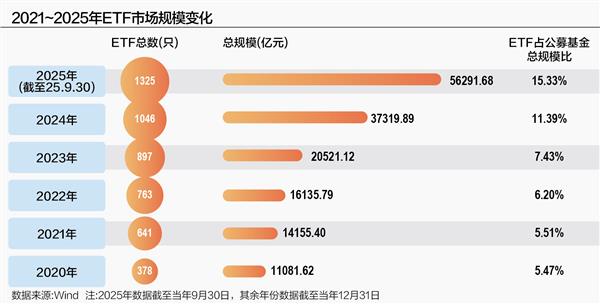
Core Insights - The ETF market in China has reached a significant milestone, surpassing 6 trillion yuan in total scale, reflecting a growth of 60% year-on-year [2] - Over the past five years, the total scale of ETFs has increased from 1.1 trillion yuan to 6.02 trillion yuan, marking a cumulative growth of 452.53% [4][5] - The market has seen a substantial increase in the number of products and trading volume, indicating a shift in investor preferences towards passive investment strategies [5] Market Overview - As of December 2025, the total scale of ETFs reached 6.03 trillion yuan, with an increase of 2.29 trillion yuan within the year [2] - The number of ETF products grew from 326 to 1402, with a total trading volume rising from 843.48 billion yuan to 3960.20 billion yuan, reflecting a growth of 369.51% [5] - The proportion of ETFs in the public fund market increased from 5.47% at the end of 2020 to 15.33% by the third quarter of 2025 [5] Competitive Landscape - The top ten ETF management firms have remained relatively stable, with seven firms consistently leading the market, including 华夏基金 (China Asset Management), 易方达基金 (E Fund), and 华泰柏瑞基金 (Huatai-PB) [6][8] - 华夏基金 has maintained its position as the largest ETF manager, with its scale growing from 1879 billion yuan in 2020 to 9570 billion yuan by the end of 2025 [8] - The entry threshold for the top ten ETF managers has significantly increased, with the required management scale rising from 300 billion yuan five years ago to 2000 billion yuan by the end of 2025 [9] Index Performance - The 沪深300 index remains the most popular, with ETF scale reaching 11855.57 billion yuan by the end of 2025, solidifying its status as a core asset allocation tool [12] - New indices like 中证A500 have gained traction, with its ETF scale surpassing 3000 billion yuan, indicating a shift towards high-quality asset representation [12] - The diversification of asset classes in the top ten indices reflects changing investor preferences, with technology and growth indices gaining prominence [13] Investor Composition - Institutional investors have solidified their dominance in the ETF market, with their share increasing from 69.07% at the end of 2020 to 76.84% by mid-2025 [16] - The absolute scale of institutional holdings grew from 743.8 billion yuan to 3.3 trillion yuan, highlighting a significant influx of long-term capital [16] - Individual investors have shown a consistent engagement with ETFs, maintaining a net value holding ratio close to that of institutional investors [17] Role of State-Owned Entities - The "national team" has increasingly utilized ETFs as a tool for market stabilization, with significant investments from 中央汇金 (Central Huijin) growing from 147 billion yuan in 2013 to over 12 trillion yuan by mid-2025 [18][19] - The diversification of the national team's ETF holdings has expanded to include various sectors, indicating a strategic approach to market support [19]
基金销售新规落地:理财“加权益”与公募“强适配”时代开启
Zhong Guo Zheng Quan Bao· 2026-01-08 00:16
Group 1 - The core viewpoint of the news is that the newly released regulations on the management of sales fees for publicly offered securities investment funds have relaxed the redemption fee constraints for bond funds, which is expected to enhance the role of bond ETFs in liquidity management and trading for financial institutions [1][2] - The adjustment in redemption fees allows fund managers to set different standards for institutional investors who hold bond fund shares for more than thirty days, which is a significant change from the previous draft [2] - The fine-tuning of subscription fees, particularly the significant reduction in fees for index equity funds, is anticipated to increase the allocation of financial resources to equity funds [3] Group 2 - Financial institutions are expected to increase their allocation to equity funds, particularly broad-based index funds and low-volatility "fixed income plus" products, as a response to the new fee structures [1][3] - The collaboration between public funds and financial institutions is deepening, with public funds optimizing their product lines to better meet the changing allocation needs of financial resources [4][5] - The introduction of refined fixed-income product lines, such as credit bond products categorized by duration, aims to provide financial institutions with effective asset allocation tools [4][5]
公募基金改革送“新年礼包”
Jing Ji Ri Bao· 2026-01-07 23:44
Core Viewpoint - The implementation of the "Regulations on the Management of Sales Expenses for Publicly Raised Securities Investment Funds" will take effect on January 1, 2026, marking a significant step in the reform of public fund fee structures, aimed at reducing investor costs and enhancing the quality of the public fund industry [1] Group 1: Fee Reduction Measures - The sales fee reform will lead to an overall reduction of 34% in sales expenses across the industry, saving investors approximately 30 billion yuan annually [2] - Specific examples include a reduction in sales service fees for money market funds from 25 yuan to 15 yuan for a 10,000 yuan investment, and a decrease in subscription fees for actively managed equity funds from 150 yuan to 80 yuan for the same investment amount [2] Group 2: Focus Areas for Resource Allocation - The regulations will guide industry resources towards two key areas: enhancing services for individual investors and promoting equity investments [2] - The cap on customer maintenance fees for individual investors will not exceed 50% of management fees, incentivizing sales institutions to improve service experiences for individual investors [2] Group 3: Mechanism Innovations - The design of the regulations includes innovative mechanisms such as waiving sales service fees for non-money market funds held for over one year, encouraging long-term holding by clients [2] - Differentiated arrangements for customer maintenance fees will guide institutions to focus on equity fund allocations, enhancing the competitiveness of equity funds [2] Group 4: Impact on the Industry - The fee reform is expected to drive profound changes within the industry, shifting the focus of fund managers towards investment management capabilities, product innovation, and customer service [4] - Fund companies will need to rely less on traditional channel-driven models and instead focus on long-term performance, robust risk control, and meeting customer needs to gain market share [4]