
锂电池

Search documents
零碳工厂迎来“顶层设计”
Xin Jing Bao· 2026-01-23 09:52
Core Viewpoint - The construction of zero-carbon factories in China is being guided by a new policy framework aimed at promoting green transformation in the manufacturing sector, with specific targets set for 2027 and 2030 [1][2]. Group 1: Policy and Guidelines - The "Guiding Opinions" issued by multiple government bodies aim to cultivate a number of zero-carbon factories in key industries by 2027, expanding to additional sectors by 2030 [1][2]. - The transition from energy-saving to green factories and then to zero-carbon factories reflects a progressive evolution in China's manufacturing green transformation [2][3]. Group 2: Importance of Zero-Carbon Factories - Zero-carbon factories are essential for reducing carbon emissions in the industrial sector, which accounts for nearly 70% of China's total carbon emissions [2]. - The construction of zero-carbon factories is recognized as a critical step towards deep decarbonization in the industrial field [2][3]. Group 3: Implementation Challenges - The construction of zero-carbon factories involves complex and systemic challenges, including energy structure, technology, funding, and management, with varying implementation paths across different regions and industries [3][4]. - There are existing issues such as inconsistent evaluation requirements and a lack of robust carbon emission accounting frameworks that need to be addressed [3][4]. Group 4: Regional Initiatives and Standards - Several regions in China, including Tianjin, Shanghai, and Jiangsu, have initiated pilot projects for near-zero carbon factories, establishing a foundation for broader zero-carbon factory construction [4]. - Industry associations have developed over 30 technical standards to guide the construction and evaluation of zero-carbon factories based on international benchmarks [4]. Group 5: Opportunities in Digitalization and Green Energy - The push for zero-carbon factories is expected to create significant opportunities in digital technologies, particularly in areas like digital twin modeling and simulation for manufacturing processes [7]. - The "Guiding Opinions" encourage the development of integrated projects for green hydrogen and ammonia, aiming to establish a sustainable supply chain for clean energy [7].
1月23日主题复盘 | 太空光伏掀涨停潮,航天连续反弹,锂电池也表现不俗
Xuan Gu Bao· 2026-01-23 08:51
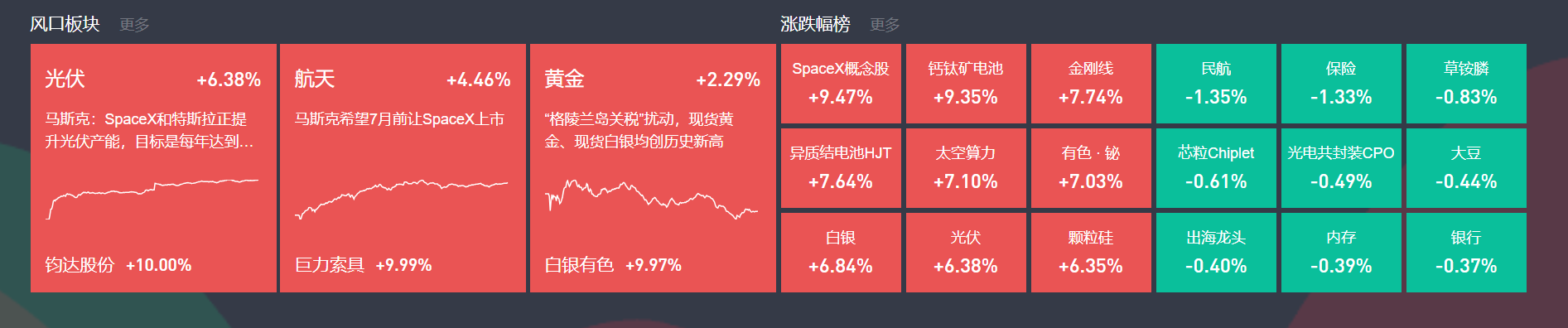
Market Overview - The market opened high and fluctuated throughout the day, with all three major indices rising collectively. The trading volume reached 3.12 trillion [1] - The photovoltaic sector saw a significant surge, with over 30 stocks including Longi Green Energy and Aiko Solar hitting the daily limit [1] - The commercial aerospace concept continued its strong performance, with nearly 20 stocks including Goldwind Technology and Aerospace Electronics also reaching the daily limit [1] - The precious metals sector remained strong, with stocks like China Gold and Silver Nonferrous hitting the daily limit [1] - In contrast, CPO concept stocks fell, with New Yisheng, Zhongji Xuchuang, and Tianfu Communication dropping over 5% [1] Photovoltaic Sector - The photovoltaic sector experienced a wave of limit-up stocks, with JunDa Co., Shuangliang Energy, Maiwei Co., and Saiwu Technology among those hitting the limit [4] - Elon Musk announced that SpaceX and Tesla are increasing solar energy production capacity, aiming for an annual target of 100GW [5] - JunDa Co. achieved a two-day limit-up, with a latest price of 99.44 and a 10% increase, while Shuangliang Energy rose by 9.94% to 7.85 [5] Aerospace Sector - The aerospace sector continued to rebound significantly, with stocks like Jieli Rigging and West Materials hitting the daily limit [7] - A press conference for the "Space Tourism Global Launch" was held, showcasing China's first commercial manned spacecraft, "Chuan Yue Zhe No. 1" [7] - Blue Arrow Aerospace's IPO status changed to "inquiry" on the Shanghai Stock Exchange [7] Lithium Battery Sector - The lithium battery sector saw a substantial increase, with stocks like Dazhong Mining and Weiling Co. hitting the daily limit [10] - Lithium carbonate futures surged by 5.47%, with a cumulative increase of over 20% in the past four trading days [10] - The market is experiencing a phase of supply-demand mismatch, with strong demand for lithium carbonate driven by battery exports and inventory shortages [11] Future Outlook - According to Citic Futures, the lithium market is expected to transition from slight oversupply to tight balance by 2026, with demand growth projected at 30% and supply growth at 25% [13] - The aerospace industry is anticipated to enter a low-cost era with the successful implementation of reusable rocket technology, benefiting upstream sectors such as high-temperature alloys and special materials [9]





光伏、贵金属、锂电池涨幅居前,高手看好这些主线!
Mei Ri Jing Ji Xin Wen· 2026-01-23 08:39
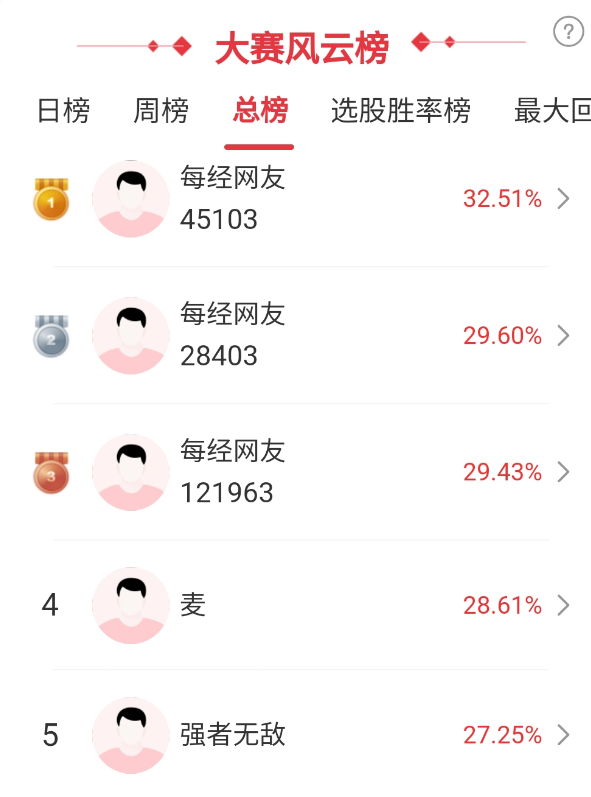
每经编辑|吴永久 周五,A股行情较好,121只个股涨停,光伏、商业航天、贵金属、锂电池等板块涨幅居前。截至收盘,沪指涨0.33%,收报4136.16点。上证50和沪深300 指数回调。沪深京三市成交额达到31184亿元,较周四放量4017亿元。 由每日经济新闻App举办的掘金大赛第82期比赛于1月19日开始,目前开赛5天,多位选手跑步入场。比赛报名时间为1月17日到1月30日,比赛时间为1月 19日到1月30日。大赛为模拟炒股,模拟资金50万元。每期比赛结束,正收益就获现金奖励!报名就拿福利!冲刺月度积分王大奖! 每期比赛的税前现金奖励为:第1名奖励688元,第2~4名奖励188元/人,第5~10名奖励88元/人,其余正收益选手均分500元正收益奖。月度积分王的税前 现金奖励为:第1名奖励888元,第2~4名奖励288元/人,第5~10名奖励188元/人,第11~30名奖励68元/人,第31~100名奖励18元/人。 报名方式: 首先下载每日经济新闻App,然后打开每日经济新闻App,点击页面最下方的"私人订制",点击主页上的"掘金大赛",点击"免费参赛",然后输入参赛昵 称,就能报名了。需要注意的是,只有在 ...
鑫椤锂电一周观察 |中汽协:2025中国汽车全年销售3440万辆
鑫椤锂电· 2026-01-23 08:11
Industry Overview - The lithium carbonate market price has returned to 170,000 yuan/ton, with a significant increase in market activity following a drop to 150,000 yuan/ton, indicating market acceptance of the new price level [7] - The domestic lithium battery market is expected to see stable prices in the first quarter, with a projected year-on-year production decline of only 10-15%, which is better than previous years [15] Market Insights - In 2025, China's automobile sales are projected to reach 34.4 million units, with a year-on-year growth of 9.4%, and new energy vehicles (NEVs) accounting for 50.8% of domestic sales [3] - The Congo government has submitted a shortlist of state-owned mineral assets to the U.S., aiming to attract investment and enhance its influence in the critical mineral supply chain [4] Company Developments - Wanrun New Energy plans to invest 1.079 billion yuan in a high-pressure dense lithium iron phosphate project, with a production capacity of 70,000 tons per year [5] - Putailai has forecasted a net profit of 230 to 240 million yuan for 2025, representing a year-on-year increase of over 90% [6] Price Trends - As of January 22, 2025, the price for battery-grade lithium carbonate is between 161,000 to 168,000 yuan/ton, while industrial-grade is between 147,000 to 153,000 yuan/ton [8] - The price for ternary materials is experiencing fluctuations, driven by the rise in lithium carbonate prices, with 5-series single crystal materials priced at 195,000 to 202,000 yuan/ton [9] Supply Chain Dynamics - The supply of phosphoric acid is expected to be tight this year, influencing the pricing and availability of lithium iron phosphate [10] - The electrode material market is stable, with some small and medium manufacturers increasing prices for mid- to low-end products by 1,000 to 2,000 yuan/ton [12] Future Outlook - The global lithium battery application market is anticipated to grow significantly from 2025 to 2029, with ongoing research and competitive strategy analysis being conducted [18]



我国已发布 “新三样”国家标准57项
Ke Ji Ri Bao· 2026-01-23 06:34
Core Insights - The rapid rise of the "new three items" industry, represented by new energy vehicles, lithium batteries, and photovoltaic products, is becoming a new engine for high-quality economic development in China [1] - The National Market Supervision Administration has published 57 national standards related to the "new three items" to support innovation and upgrade in these industries [1] Group 1: New Energy Vehicles - 13 national standards have been published in the new energy vehicle sector, covering areas such as remote service and management, battery swap safety requirements, and charging systems [1] - These standards effectively support the development of remote operation and vehicle-to-network interaction technologies [1] Group 2: Lithium Batteries - 2 national standards have been established for lithium batteries, enhancing product lifecycle traceability [1] - The focus is on improving safety, classification, quality management, and green low-carbon aspects to elevate energy efficiency and support industry upgrades [2] Group 3: Photovoltaic Products - 42 national standards have been issued for photovoltaic products, addressing green product evaluation and ground-mounted photovoltaic modules [1] - Future plans include the development of 80 new national standards focusing on product quality safety, energy consumption limits, and intelligent operation of photovoltaic systems [2] Group 4: Future Plans and Actions - The "Action Plan" aims to establish 167 national standard projects by 2025 for the "new three items" industry [1] - The National Market Supervision Administration will accelerate the development of relevant national standards and enhance dissemination through expert interpretations and on-site promotion meetings [2]
嘉实成长派姚志鹏的“投资抉择”:提示科技“交易拥挤”,组合转向均衡
Hua Er Jie Jian Wen· 2026-01-23 03:17
Core Viewpoint - The market is experiencing significant differentiation as of Q4 2025, with a focus on the balance between returns, cycles, and risks rather than just the correctness of investment directions [1] Group 1: Fund Manager Insights - Fund manager Yao Zhipeng has been with Harvest Fund since 2011, focusing on growth and industry directions, and has extensive experience managing various product types [1][2] - The total scale of products managed by Yao Zhipeng is approximately 20 billion yuan, with Harvest Power Pioneer being a representative product [2] Group 2: Portfolio Composition - The top ten holdings of Harvest Power Pioneer include Ningde Times, Xinda Bio, Hunan Youneng, WuXi AppTec, O-film Tech, Zhongkuang Resources, Putailai, Nongfu Spring, Tianqi Lithium, and Xiaopeng Motors, indicating a multi-line structure [2][3] - The portfolio is built on three clear lines: 1. New energy, lithium battery, and new energy vehicle industry chain [3] 2. Pharmaceutical and innovative assets, reflecting ongoing attention to the innovative drug industry chain [3] 3. Consumer goods, with Nongfu Spring being one of the few hundred billion-level products in the food and beverage sector [4] Group 3: Market Environment Analysis - The overall market in Q4 2025 is characterized by a steady rise, with good returns in commercial aerospace, copper and aluminum commodities, chemicals, communications, and insurance, while cyclical assets have adjusted [4][5] - Yao Zhipeng expresses a cautious and neutral stance on the technology sector, highlighting the crowded nature of tech investments and the reevaluation of risks associated with AI [5][6] Group 4: Economic Outlook and Investment Strategy - The primary task for the Chinese economy in 2026 is to expand domestic demand, which will likely influence investment directions [6][7] - Long-term favored directions include new energy, new technology, new consumption, and innovative drugs, focusing on lithium batteries, embodied intelligent applications, and consumer assets that align with improving consumption [7] - Attention is also drawn to the potential for foreign capital inflow due to the appreciation of the RMB and the attractiveness of leading companies in various industries [8][9] Group 5: Portfolio Adjustment Strategy - Yao Zhipeng plans to gradually increase allocations to domestic demand and cyclical leading assets, enhancing the balance of the portfolio while dynamically adjusting based on macro and mid-level environmental changes [8][9]
我国已发布“新三样”国家标准57项
Ke Ji Ri Bao· 2026-01-23 03:09
Group 1 - The core viewpoint of the articles highlights the rapid rise of the "new three items" industry, including new energy vehicles, lithium batteries, and photovoltaic products, as a new engine for China's high-quality economic development [1] - The National Market Supervision Administration has published a total of 57 national standards related to the "new three items" sector to support industrial safety, green, and sustainable development [1] - In the new energy vehicle sector, 13 national standards have been released, covering areas such as remote service and management, battery swap safety requirements, and charging systems, which support the development of remote operation and vehicle-network interaction technologies [1] Group 2 - The "Action Plan" for the enhancement of standards in the new energy vehicle, lithium battery, and photovoltaic industries aims to establish 167 national standard projects by 2025 [2] - The plan includes the revision and formulation of 57 national standards in the new energy vehicle sector, focusing on improving safety and product quality to support the intelligent, connected, and international development of new energy vehicles [2] - In the lithium battery sector, 30 new national standards will be developed, emphasizing product safety, classification, quality management, and green low-carbon initiatives to enhance energy efficiency and support industrial upgrades [2] Group 3 - The National Market Supervision Administration will accelerate the development of relevant national standards for the "new three items" and strengthen the dissemination of already published standards through expert interpretations and on-site promotion meetings [3] - The aim is to ensure that the industry accurately understands and timely implements the standards, thereby leading the high-quality development of the "new three items" industry [3]
SPIR:2026全球锂电池行业发展白皮书发布
起点锂电· 2026-01-23 02:44
Core Insights - The global lithium battery shipment in 2025 is projected to reach 2042.7 GWh, representing a year-on-year growth of 46.8%, with power batteries accounting for 62.2% of the demand structure [2] - By 2030, the global lithium battery shipment is expected to reach 5333.6 GWh, with a decreasing share of power batteries and an increasing trend in energy storage batteries [2] Group 1: EV Power Lithium Batteries - In 2025, global sales of new energy vehicles are expected to reach 24.04 million units, a year-on-year increase of 31.8%, driving the global EV power battery shipment to 1271 GWh, up 39.9% [3] - The market concentration for EV power batteries is increasing, with the top five companies accounting for 72% of the market share [10] Group 2: Energy Storage Lithium Batteries - The global energy storage battery shipment is projected to be 637 GWh in 2025, a year-on-year increase of 78.9%, primarily driven by markets in China, Europe, the Middle East, and Southeast Asia [3][14] - The market concentration for energy storage batteries is also rising, with the top five companies expected to hold 53.3% of the market share in 2025 [14] Group 3: Lightweight Power Lithium Batteries - The implementation of new national standards for electric bicycles in September 2025 is expected to stimulate demand, with global lightweight power battery shipments reaching 55.4 GWh, a year-on-year increase of 10.8% [4] Group 4: 3C Lithium Batteries - The global 3C lithium battery shipment is projected to be 70.8 GWh in 2025, with a year-on-year growth of 5.8%, driven by device replacements and hardware upgrades [4] - The 3C electronics sector is expected to maintain steady growth, with shipments projected to exceed 115.2 GWh by 2030, reflecting a compound annual growth rate of 10.2% over the next five years [4] Group 5: Battery Materials Market - In 2025, the global shipment of lithium battery cathode materials is expected to reach 479.8 million tons, a year-on-year increase of 48.5%, with lithium iron phosphate accounting for 78% of the total [21] - The global shipment of lithium battery anode materials is projected to be 272.3 million tons in 2025, with artificial graphite making up 89.3% of the total [27] Group 6: Electrolyte and Separator Markets - The global lithium battery electrolyte shipment is expected to reach 239.6 million tons in 2025, a year-on-year increase of 53% [29] - The global lithium battery separator shipment is projected to be 384.9 billion square meters in 2025, with a year-on-year growth of 48.6% [36] Group 7: Copper and Aluminum Foil Markets - The global lithium battery copper foil shipment is expected to reach 148.7 million tons in 2025, with a year-on-year growth of 49.1% [39] - The global lithium battery aluminum foil market is projected to reach 72.3 million tons in 2025, a year-on-year increase of 48.8% [43]

广西自贸试验区推出第七批制度创新成果 便利对东盟贸易往来
Zhong Guo Xin Wen Wang· 2026-01-23 02:18
Group 1 - The Guangxi Free Trade Zone has launched 40 innovative institutional achievements to enhance trade facilitation with ASEAN, focusing on cross-border recognition of driving licenses, cross-border medical cooperation, and the export of automobiles from inland areas [1] - A significant highlight is the establishment of a digital service for cross-border license recognition between China and Malaysia, reducing the driving license certification process from approximately 2 weeks to 10 minutes [1] - In cross-border medical cooperation, the Guangxi Free Trade Zone has collaborated with Cambodian medical institutions to create a standard for caregiver services, facilitating the introduction of Chinese medical service standards to ASEAN [1] Group 2 - The Guangxi Free Trade Zone is developing a "one-stop" aluminum product trading service system in collaboration with the Baise Coordinated Development Zone, utilizing the China-ASEAN bulk commodity trading platform [2] - A lithium battery export inspection mechanism has been established to eliminate the need for re-inspection at ports, helping companies save about 20% on logistics costs and increasing market share in ASEAN [2] - The implementation of a unified fee system at international ports has resulted in over 10 million RMB in fee reductions for enterprises by standardizing charges and services between China and Vietnam [2]
2026宏观展望:周期的力量
Guang Fa Qi Huo· 2026-01-23 02:17
Report Industry Investment Rating No relevant content provided. Core Viewpoints of the Report - In 2026, the world will be in a macro - background of deepening "de - globalization" and the resonance of loose fiscal policies of major economies. Supply - chain vulnerability and demand expansion will lead to a tightening of resource supply - demand relations, and intensify strategic competition for key minerals and energy [1]. - China's economy will be based on the principle of "internal stability and external control" in 2026. Exports will remain a mainstay, investment will play a supporting role, and consumption will focus on equipment updates and service - scenario innovation. The de - dollarization trend and the weakening of the US dollar credit will bring opportunities for international capital inflows into RMB assets, and Sino - US competition will focus on technology and supply - chain security [1]. - In 2026, a macro - hedging portfolio should be constructed under the premise of seeking certainty. Commodity assets will have prominent allocation value, with the order of commodity > equity > bond. Attention should be paid to potential uncertainties such as recessions in Europe and the US, domestic inflation repair, geopolitics, and real - estate risks [2]. Summary by Directory I. Cycle Changes: Resonance of "De - globalization" and Loose Fiscal Policies (1) The Wave of De - globalization: From Great - Power Games to the G2 Pattern - International events such as the COVID - 19 pandemic, the Russia - Ukraine war, and the Trump administration's high - tariff policies have led to the wave of de - globalization, which is essentially the reshaping of the world order [6]. - Traditional capitalist powers like the US and the UK are withdrawing from international alliances, while emerging - market countries led by China are exploring new international cooperation models. A G2 competition pattern between China and the US is gradually taking shape in key technologies and resources [7]. - The wave of de - globalization has increased the vulnerability of the global supply chain, deteriorated the global trade environment, and accelerated the rotation and increased the volatility of global major assets. The credit systems of the US dollar and US Treasury bonds have been shaken [9]. (2) Loose Fiscal Resonance: Upward Global Manufacturing and Inventory Cycles - In 2026, the fiscal policies of major overseas economies such as the US, Europe, and Japan are expected to expand further. The US "big and beautiful" bill may increase the fiscal deficit by $4.1 trillion in the next decade, and EU countries will increase their defense spending to 5% of GDP by 2035. Japan will implement a trillion - level economic stimulus plan. This will lead to an increase in economic activity demand and drive up the global manufacturing and inventory cycles [15]. (3) Resource Shortage: Tightening Supply - Demand Balance - De - globalization has increased supply - chain vulnerability, and loose fiscal policies will stimulate demand, leading to a tightening of the global industrial supply - demand relationship. Countries will pay more attention to resource competition for national security. The US is seizing resources through trade control and military actions. Core resources such as minerals and energy will see price increases in 2026 [16]. II. The Game between Endogenous Momentum and External Changes (1) Endogenous Economic Transformation: Long - Term Policy Guidance of the 15th Five - Year Plan - In 2026, as the starting year of the 15th Five - Year Plan, China aims to achieve a reasonable GDP growth rate while gradually realizing structural transformation. New - quality productivity sectors such as AI, biomedicine, and new energy will become new pillar industries [17]. - Investment will be the supporting force for achieving economic growth goals, while consumption will be the main growth driver. Exports will remain a mainstay due to factors such as reduced Sino - US trade - dispute volatility, fiscal expansion in developed economies, and the rise of emerging markets. Investment in infrastructure, manufacturing, and new areas will support economic growth, and real - estate's negative impact on the economy is expected to turn neutral [18][19][23]. - In the consumption area, policies will focus on releasing existing demand through subsidies and exploring incremental demand by expanding service - consumption scenarios [27]. (2) External Changes and Game: Coexistence of Challenges and Opportunities - The weakening of the US dollar credit due to the expiration of the "petro - dollar" agreement and the establishment of a new cross - border settlement mechanism provides an opportunity for RMB assets. International capital will flow back to the Asia - Pacific market and drive up the prices of RMB - denominated assets. China can promote RMB internationalization [30]. - Sino - US relations will remain a key variable in 2026. The two countries have long - term competition and phased balance in technology and resource issues. The competition pattern will not change significantly, and extreme decoupling is unlikely [31]. III. Guidance on Major Asset Allocation: Constructing a Macro - Hedging Portfolio (1) Between "Change and Constancy": Unchanging Competition Relations and Changing Cycle Rotations - The long - term competition exists among all global economies due to limited resources and growing economic demand. China's economic recovery has three main lines: technological independence, price repair, and expansion of domestic demand. The US will try to avoid recession and stagflation, and continue to rely on the stock market and AI to support the economy [33]. (2) 2026: Seeking Certainty and Constructing a Major Asset Portfolio: Commodity > Equity > Bond - In 2026, asset allocation should pursue certainty and balance risks. Attention should be paid to risks such as recessions in Europe and the US, slow domestic inflation repair, intensified de - globalization, and a downward real - estate market [36]. (3) Grasping the Rhythm and Main Lines in the Short, Medium, and Long Terms - Based on economic - cycle theory, in the high - inflation and high - growth stage (2026 - 2027 expected), commodities will be dominant. Different commodity sectors will rotate in the order of risk pricing, expected trading, and real - situation regression [37]. - In 2026, the four quarters will be dominated by different factors: Q1 is dominated by short - term liquidity, driving up the prices of precious metals and non - ferrous metals; Q2 focuses on correcting the mid - term narrative; Q3 verifies the long - term logic; Q4 is for brewing cross - year expectations [39].