
Artificial Intelligence

Search documents
HSBC Holdings plc (HSBC) Cuts 10% of its U.S.-Based Debt Capital Markets Team as Part of Ongoing Cost Reductions
Insider Monkey· 2026-02-25 05:13
When Jeff Bezos said that one breakthrough technology would shape Amazon’s destiny, even Wall Street’s biggest analysts were caught off guard. Fast forward a year and Amazon’s new CEO Andy Jassy described generative AI as a “once-in-a-lifetime” technology that is already being used across Amazon to reinvent customer experiences. At the 8th Future Investment Initiative conference, Elon Musk predicted that by 2040 there would be at least 10 billion humanoid robots, with each priced between $20,000 and $25,000 ...





美法官驳回xAI对OpenAI商业机密诉讼:指控缺乏证据支撑
Huan Qiu Wang Zi Xun· 2026-02-25 04:46
Core Viewpoint - A U.S. federal judge dismissed xAI's lawsuit against OpenAI and its CEO Sam Altman, ruling that the claims did not prove any wrongdoing by OpenAI [1][4] Group 1: Lawsuit Background - The lawsuit originated from xAI's allegations in September of the previous year, claiming that several former employees illegally took source code and trade secrets related to xAI's chatbot Grok when they joined OpenAI [4] - xAI argued that OpenAI indirectly acquired its core competitive technology through the hiring of these employees, constituting unfair competition [4] Group 2: Court Ruling - Judge Rita Lin stated that xAI's complaint "did not allege any inducement or participation in the theft of trade secrets by OpenAI itself" and failed to provide evidence that "the former employees used the stolen technology during their employment at OpenAI" [4] - The ruling emphasized that the law requires the plaintiff to prove direct involvement of the defendant in wrongful conduct, rather than just actions by individual associates [4] - This ruling aligns with the judge's previous stance, as she indicated in January that xAI's claims "lacked factual basis" and granted a deadline until March 17 for xAI to submit an amended complaint [4]
AI行业主线开年布局展望:智谱&MiniMax
2026-02-25 04:12
中金公司闭门会议仅限受邀嘉宾参会本次会议交流内容仅供参考不构成对买卖任何证券或其他金融工具的出价或增价或提供任何投资决策建议的服务嘉宾交流观点仅代表其本人的判断中金公司对其信息及观点的完整性准确性不做任何形式的确认或保证对依据或者使用本会议内容所造成的一切后果 This conference is a closed-door meeting of CICC.Only invited guests are allowed to attend the conference.The information and opinions presented in this conference are for reference only,and do not constitute an offer to buy or sell or a solicitation of an offer to buy or sell any securities or financial products,or any investment advice or service. The invited guest's speech on ...
美国AI公司指控中国偷技术?马斯克:你偷数据赔15亿时怎么不吭声
Sou Hu Cai Jing· 2026-02-25 03:55
Group 1 - The core issue revolves around accusations of "model distillation" theft by Anthropic against three Chinese companies, highlighting a double standard in the AI industry regarding technology ethics and commercial interests [3][5] - Anthropic claims that these Chinese companies used 24,000 fake accounts to interact with their Claude model 16 million times, alleging that this constitutes theft of core capabilities [3] - Elon Musk's response points out Anthropic's own history of data theft, having paid $1.5 billion in a copyright settlement, thus questioning the legitimacy of their accusations against others [3][5] Group 2 - Model distillation is described as a neutral technical method where a "teacher model" teaches a "student model" through interactions, raising questions about the legitimacy of labeling such practices as theft [5] - The controversy reflects a broader issue in the AI industry, where the lack of clear technical boundaries and ethical guidelines leads to accusations and counter-accusations among companies [9] - The timing of Anthropic's accusations suggests a political motive, as it aligns with U.S. efforts to impose export controls on AI chips, indicating a potential use of technology disputes as a justification for political actions [7] Group 3 - The AI industry is characterized by a significant lag in rules and ethics, with companies often operating in a "gray area" regarding data usage and technology imitation [9] - The need for clearer regulations is emphasized, suggesting that the industry should focus on establishing boundaries for data use and model distillation rather than engaging in mutual accusations [11] - The future of AI should prioritize collaborative rule-making over competitive blame, as the technology itself is neutral and its ethical implications depend on its users [11]
首轮融资拿下1亿美元押注“AI社会模拟器” 斯坦福小镇团队创立的Simile能否预知未来?
Xin Lang Cai Jing· 2026-02-25 03:17
2026年2月,人工智能智能体赛道的战火已烧至每一个角落。就在近日,曾因"斯坦福AI小镇"而轰动学 术圈的创始团队核心成员正式官宣创业,新公司Simile完成1亿美元A轮融资,试图打造能够规模化模拟 人类行为的"AI社会模拟器"。 这笔融资不仅吸引了顶级风投的领投,更获得了斯坦福大学知名人工智能学者李飞飞、OpenAI联合创 始人Andrej Karpathy等一众硅谷科技大佬的背书。 Simile的技术根基源于2023年那篇震撼业界的论文《生成式智能体》。当时,由Joon Sung Park及其导 师、现任Simile首席科学家Percy Liang等人构建的虚拟小镇"Smallville",仅凭25个基于GPT的AI智能体 和简单的身份设定,就让这些电子小人自主地上演了社交八卦、信息传播甚至策划情人节派对的戏码。 这一研究被视为生成式智能体领域的开创性成果,首次证明了大模型能在虚拟世界中模拟出接近真人的 类人行为。 如今,Simile的野心远不止于像素游戏。团队将原本只能承载25个智能体的架构升级为可容纳千级智能 体的大规模模拟平台,旨在构建一个"基础世界模型",用以预测任何规模、任何情况下的人类行为。 ...
Kimi最新估值超百亿美元:估值增速已超字节、拼多多,春节期间收入大涨
3 6 Ke· 2026-02-25 02:53
据IPO早知道消息,在完成上一轮5亿美金融资仅一个多月后,Kimi母公司月之暗面(Moonshot AI)新一轮超7亿美元融资即将完成全部交割并实现超 募。本轮融资由阿里、腾讯、五源、九安等联合领投,高榕创投等老股东继续加码,投后估值超100亿美元。 值得一提的是,Kimi连续两轮超12亿美金的融资,创下了近一年来大模型行业的最高融资纪录。事实上,在这一轮融资即将完成之际,Kimi已经以100 亿-120亿美元的估值开启了新一轮融资,并已获得多家机构的意向,不乏早前鲜少布局中国科技企业的欧洲背景机构。 更值得关注的是,K2.5大模型发布不到一个月后,Kimi近20天的累计收入已超过2025年全年总收入,增长主要受全球付费用户及API调用量大涨共同驱 动;且Kimi的收入在K2.5发布之后出现结构性反转,海外收入已超过国内收入。 短期不着急上市、将主动权掌握自己手中,更希望在一级市探索技术与资本新型关系 不可否认的是,当下Kimi在一级市场的热度之高在一定程度上的确得益于智谱和MiniMax在二级市场屡创新高,曾一度双双市值突破3000亿港元,投资人 的FOMO(Fear of Missing Out,错失恐惧 ...
港股AI应用股走弱 MINIMAX-WP跌超16%
Mei Ri Jing Ji Xin Wen· 2026-02-25 02:16
(文章来源:每日经济新闻) 每经AI快讯,2月25日,港股AI应用股走弱,截至发稿,MINIMAX-WP(00100.HK)跌16.19%、智谱 (02513.HK)跌7.88%、海致科技集团(02706.HK)跌6.22%。 ...
千问3.5登顶Hugging Face,AI人工智能ETF(512930)近4日“吸金”1.25亿
Xin Lang Cai Jing· 2026-02-25 01:49
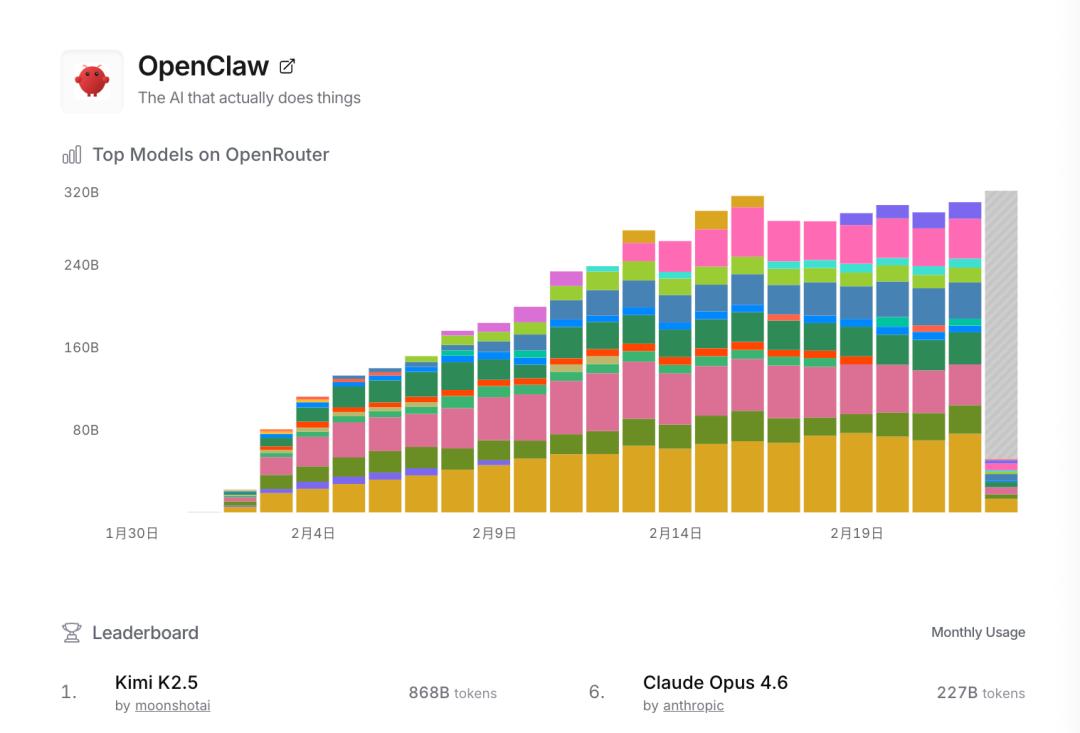
截至2026年2月25日 09:32,中证人工智能主题指数(930713)下跌0.30%。成分股方面涨跌互现,星宸科 技领涨4.17%,协创数据上涨1.23%,拓维信息上涨1.21%;芯原股份领跌4.09%,昆仑万维(维权)下 跌2.75%,北京君正下跌2.47%。AI人工智能ETF(512930)下跌0.40%,最新报价2.27元。 资金流入方面,AI人工智能ETF最新资金净流入3194.73万元。拉长时间看,近4个交易日内有3日资金 净流入,合计"吸金"1.25亿元,日均净流入达3118.97万元。(数据来源:Wind) 上个马年沪指涨近60%!新年新福利来了,炒股排面要拉满,新号启幸运>> 消息面上,全球最大AI开源社区Hugging Face公布新一期开源大模型榜单,阿里最新开源的原生多模态 模型千问3.5登顶全球榜首。在最新一期Hugging Face模型榜单前十中,有8款来自中国团队,涵盖阿里 巴巴、智谱、MiniMax、月之暗面等多家机构。 中信证券研报指出,2026春节期间,国产大模型token调用量井喷,截至2月22日此前一周的全球大模型 token用量中,前三甲均为国产大模型。token的 ...
港股公告掘金 | 海致科技集团与智谱订立战略合作框架协议,将在模型训练、应用场景落地等领域开展战略合作
Zhi Tong Cai Jing· 2026-02-25 01:44
Core Viewpoint - The article discusses the strategic cooperation framework agreement between Haizhi Technology Group and Zhipu, focusing on collaboration in model training and application scenarios [1] Group 1 - Haizhi Technology Group and Zhipu have entered into a strategic cooperation framework agreement [1] - The collaboration will focus on areas such as model training and the implementation of application scenarios [1]
港股异动 | 海致科技集团(02706)早盘涨超6% 携手智谱(02513)在模型训练、应用场景落地等领域开展战略合作
智通财经网· 2026-02-25 01:40
Core Viewpoint - Haizhi Technology Group (02706) has seen a stock price increase of over 6% in early trading, currently up 5.57% at HKD 128.9, with a trading volume of HKD 36.15 million, following the announcement of a strategic cooperation framework agreement with Zhipu (02513) [1] Group 1 - The strategic cooperation will focus on deep collaboration in model training and application scenarios, leveraging Haizhi's graph-model fusion technology (such as Atlas graph) and Zhipu's large model capabilities [1] - Haizhi Technology is dedicated to developing Atlas graph solutions and industry-level intelligent agents through graph-model fusion technology, providing industry-grade AI solutions [1] - Zhipu is recognized as a leading AI company in China, committed to pursuing innovations in Artificial General Intelligence (AGI) [1] Group 2 - The board of Haizhi Technology believes that the strategic cooperation will achieve resource complementarity and collaborative development, leveraging both companies' technological advantages, industry experience, and market resources [1]