文物保护

Search documents
现场教学提升文物消防安全水平
He Nan Ri Bao· 2025-10-18 23:29
Core Points - The provincial fire rescue team and the provincial cultural relics bureau conducted a fire safety training in Luoyang, focusing on the risks associated with cultural heritage sites and the importance of responsibility and emergency response [1][2] Group 1: Training and Safety Measures - The training included theoretical lectures analyzing fire risks in cultural buildings, emphasizing the "four checks" related to responsibility, disaster factors, evacuation conditions, and emergency response [1] - Participants engaged in practical training at Luoyang Museum and Guanyin Temple, observing the "four checks" process and emergency response simulations [1] - The Guanyin Temple, a key national cultural heritage site, has implemented measures to manage fire risks, including strict supervision of fire sources and electrical management [1] Group 2: Fire Safety Protocols - The museum has established fire safety agreements with external vendors, ensuring clear responsibility and regular checks on fire safety equipment [2] - All fire-related activities are prohibited within the museum, with outdoor cutting or welding required to have proper approvals and monitoring [2] - Participants expressed that the training enhanced their ability to apply knowledge practically, aiming to improve fire safety standards in the cultural relics sector [2]
文博日历丨战国帛书入藏湖南省博!一文了解战国“百科全书”
Yang Shi Xin Wen· 2025-10-13 13:11
Core Points - The return of the Changsha Bullet Warehouse Warring States silk manuscripts, specifically the second volume "Five Elements Order" and the third volume "Attack and Defense Divination," marks a significant cultural heritage event, ending a 79-year period of displacement [2][4][17] Group 1: Importance of the Manuscripts - The Changsha Bullet Warehouse Warring States silk manuscripts are the earliest known silk texts in China, dating back to around 300 BC, and are crucial for studying ancient Chinese astronomy, military science, philology, literature, and intellectual history [6][9] - The manuscripts serve as a transition from bamboo slips to paper books, highlighting the evolution of Chinese writing materials [7] - The manuscripts are considered an "encyclopedia" of Warring States life, with over 1,600 characters focused on divination and related subjects [10][12] Group 2: Content Overview - The first volume "Four Seasons Order" contains a creation myth detailing the cosmic origins and seasonal changes, featuring illustrations of twelve month deities and their associated auspicious and inauspicious days [12][14] - The second volume "Five Elements Order" categorizes the year into five segments based on the five elements, detailing seasonal and monthly auspiciousness [14] - The third volume "Attack and Defense Divination" provides guidelines for military strategies regarding siege and defense, organized by cardinal directions [16] Group 3: Cultural Significance and Future Prospects - The successful return of these manuscripts exemplifies China's commitment to cultural heritage protection and international cooperation in repatriating lost artifacts [17][19] - The manuscripts' return is seen as a significant achievement in enhancing national cultural confidence and soft power, reinforcing China's determination to safeguard its cultural roots [19] - The National Cultural Heritage Administration aims to expedite the return of the first volume "Four Seasons Order" and hopes for more lost Chinese artifacts to return home [19]

技术突破!文物医生成功“加固”三星堆象牙,国宝终可直面公众
Xin Hua She· 2025-09-29 09:48
Core Insights - The Chengdu Institute of Cultural Relics and Archaeology has made significant breakthroughs in the preservation technology of ivory artifacts from the Sanxingdui site, allowing for public display in museums soon [1][2] Group 1: Preservation Challenges - The preservation of ivory artifacts is particularly challenging due to their fragile nature and susceptibility to decay after being buried for over 3,000 years [1] - Despite the discovery of over 700 ivory pieces from six sacrificial pits at Sanxingdui, very few have been displayed in museums due to their deteriorated condition [1] Group 2: Technological Advancements - A collaborative effort involving nine research institutions has led to the development of key preservation techniques, including on-site protection and dehydration reinforcement [2] - The newly developed techniques have successfully extracted and reinforced ivory artifacts, enhancing their strength to meet museum display standards [2] Group 3: Future Prospects - The application of these preservation techniques is currently being demonstrated with the ivory artifacts from both Sanxingdui and the Jinsha site, with one reinforced piece already on display at the Chengdu Archaeological Center [2] - There is optimism that visitors will soon be able to see the newly unearthed ivory artifacts at the Sanxingdui Museum [2]
我国首部文物数字化智能移动平台发布
Ren Min Ri Bao· 2025-09-23 22:51
Core Insights - The first comprehensive digital mobile platform for cultural relics in China has been successfully developed, integrating data collection, processing, and storage equipment [1] - This platform marks a significant technological breakthrough in the field of cultural relics digital protection, enabling efficient data collection from remote areas [1] Group 1: Technological Advancements - The platform overcomes traditional spatial limitations in cultural relics digitization, allowing for real-time inspection and secure storage of data [1] - The research team has successfully addressed challenges in extreme environments, such as small spaces and large caves, enhancing the coverage, precision, and completeness of data collection [1] Group 2: Strategic Vision - The Dunhuang Academy adheres to the philosophy of "permanent preservation and sustainable utilization," promoting the iterative upgrade of digital technologies [1] - A modular and intelligent set of digital collection equipment has been established, along with the development of high-resolution image stitching software and multi-source data fusion software for 3D reconstruction [1] Group 3: Integration and Development - The initiative aims to automate and enhance the efficiency of cultural relics data collection and processing, establishing a preliminary digital standard system [1] - The project emphasizes the integration of production, education, research, and application in the field of cultural relics digitization [1]
文化中国行丨湖北荆州:技术创新为有机质文物全生命周期“护航”
Xin Hua Wang· 2025-09-17 02:04
Core Viewpoint - The article highlights the innovative techniques employed by the Jingzhou Cultural Relics Protection Center to ensure the preservation of organic cultural relics throughout their entire lifecycle, showcasing successful restoration projects and the center's collaborative efforts with archaeological units [1][4][7]. Group 1: Technological Innovation in Preservation - The Jingzhou Cultural Relics Protection Center has provided technical support for cultural relic preservation to over 130 cultural heritage units across 27 provinces, successfully extending the lifespan of more than 10,000 wooden lacquerware items and over 110,000 bamboo and wooden slips [1][4]. - The center employs a combination of new technologies and traditional methods to restore organic relics, allowing for the revival of historical artifacts that span thousands of years [4][7]. Group 2: Notable Restoration Projects - A significant restoration project involved the recovery of over 3,900 bamboo slips from the Qin family tomb, which became the largest collection of Warring States bamboo slips discovered in China, with approximately 30,000 characters revealed [4][5]. - The restoration of the bamboo slips is ongoing, with 40% of the work completed and an expected completion date set for 2027 [5]. Group 3: Collaborative Efforts and Outreach - The center has established eight workstations in various cities to promote restoration techniques and support grassroots cultural heritage units, enhancing the overall capacity of the cultural relics protection industry [7]. - The center emphasizes a comprehensive protection approach, from immediate on-site preservation to laboratory rescue and preventive measures for stored and exhibited relics [7]. Group 4: Team Composition and Expertise - The restoration team at the center consists of professionals with an average age of 38, combining expertise from various disciplines to advance the preservation of organic cultural relics [9].
世界遗产达60项 博物馆年接待观众近15亿人次 文物事业高质量发展迈出坚实步伐
Ren Min Ri Bao· 2025-09-11 01:31
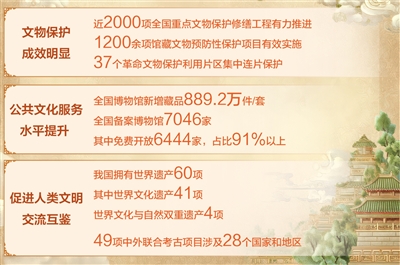
Core Viewpoint - The "14th Five-Year Plan" period has seen significant advancements in the high-quality development of cultural relics and heritage protection in China, with historical achievements being made in various aspects of cultural preservation and public engagement [2][3]. Group 1: Cultural Relics Protection - The protection of cultural relics has improved significantly, with nearly 2,000 key national relic protection and restoration projects underway and over 1,200 preventive protection projects implemented [3]. - The new revised "Cultural Relics Protection Law" will take effect on March 1, 2025, marking a new phase of legal governance in cultural relics protection [3]. - A comprehensive legal framework for cultural relics protection has been established, consisting of the Cultural Relics Protection Law, six administrative regulations, ten departmental rules, and over 400 local regulations [3][4]. Group 2: Return of Lost Cultural Relics - The revised law includes provisions for the retrieval of lost cultural relics, enhancing inter-departmental collaboration in this area [4]. - A total of 537 pieces of lost cultural relics have been returned to China, including significant artifacts that had been lost for decades [4]. Group 3: Technological Advancements - Technology plays an increasingly important role in cultural relics work, with advancements in satellite remote sensing, drones, IoT, and AI enhancing risk monitoring and prevention capabilities [4]. - Significant progress has been made in the scientific diagnosis and dynamic monitoring of relic diseases, as well as in the development of anti-weathering technologies [4]. Group 4: Museum Development - During the "14th Five-Year Plan" period, 8.892 million new museum collections were added, with 91% of the 7,046 registered museums being free to the public [5]. - Museums received nearly 1.5 billion visitors annually, contributing to a robust development of the museum sector in China [5]. Group 5: Cultural Education and Public Engagement - Over 40,000 exhibitions and 500,000 educational activities are held annually, promoting the transmission of traditional and revolutionary cultures [6]. - The popularity of museums has led to challenges in visitor access, prompting efforts to enhance service quality and visitor experience [6]. Group 6: International Cultural Exchange - China has successfully added several cultural heritage sites to the World Heritage List, with ongoing efforts to promote international cooperation in cultural heritage protection [7]. - The establishment of the "Asian Cultural Heritage Protection Alliance" reflects China's commitment to global cultural heritage governance [7]. Group 7: Archaeological Contributions - The "Chinese Civilization Exploration Project" has made significant contributions to the understanding of civilization origins, with advanced archaeological equipment achieving breakthroughs in underwater archaeology [8]. - International collaborations in cultural relic technology have garnered widespread participation from the global academic community, highlighting the role of relics in promoting cultural exchange [8].
坚持保护第一做好活化文章赓续城市文脉 加快打造彰显中华文明的世界人文之都
Xi An Ri Bao· 2025-09-02 02:41
Core Viewpoint - The emphasis is on the integration of cultural heritage protection and cultural industry development, aiming to enhance the historical and cultural identity of the city while promoting the "cultural + technology" development path [1][2]. Group 1: Cultural Heritage Protection - The city aims to implement Xi Jinping's cultural thoughts and directives to promote cultural prosperity and heritage protection [1]. - The principle of "protection first" is highlighted, focusing on the comprehensive management and utilization of cultural relics [1]. - The importance of maintaining the historical authenticity and cultural continuity of heritage is stressed [1]. Group 2: Cultural Industry Development - The immersive cultural tourism project "Exploring the Sleeping Emperor's Tomb" is introduced, which combines technology with cultural experiences [1]. - The need for innovative exhibition methods and increased promotion of cultural relics to enhance public engagement and cultural confidence is emphasized [2]. - The city is committed to strengthening the integration of culture and technology to enhance the cultural connotation of products [1].
招标!河北发布1434.52万科技考古与文物保护设备采购大单
仪器信息网· 2025-08-28 06:16
Core Viewpoint - The Hebei Provincial Institute of Cultural Relics and Archaeology has announced a procurement tender for scientific archaeological and cultural relics protection laboratory equipment, with a total budget of 143.452 million yuan, aimed at enhancing the laboratory's research capabilities [1][2]. Summary by Sections Tender Announcement - The procurement project is divided into six lots, focusing on high-end scientific instruments and software systems to improve archaeological analysis and cultural relics protection capabilities [2]. Lot Details - **Lot 1**: Budget of 2.3162 million yuan, focusing on basic laboratory equipment and sample processing, including items like laboratory tables, sample cabinets, and high-precision 3D laser scanners. Contract duration is 45 calendar days [3]. - **Lot 2**: Budget of 3.29 million yuan, aimed at precision analysis of organic and inorganic components, including instruments like gas chromatography-mass spectrometry and scanning electron microscopes. Contract duration is 90 calendar days [3]. - **Lot 3**: Budget of 4.224 million yuan, focusing on elemental and molecular structure analysis equipment, such as X-ray fluorescence spectrometers and Raman spectrometers. Suppliers must provide a valid radiation safety license. Contract duration is 100 calendar days [3]. - **Lot 4**: Budget of 1.79 million yuan, covering environmental simulation and microscopic observation equipment, including constant temperature drying ovens and handheld electronic microscopes. Suppliers must have medical device operating or manufacturing qualifications [4]. - **Lot 5**: Budget of 2.36 million yuan, for high-end imported equipment for phase and microstructure analysis, including X-ray diffractometers and super-depth microscopes. Suppliers must provide a radiation safety license and authorization from the original manufacturer [4]. - **Lot 6**: Budget of 365,000 yuan, focusing on data processing and visualization software systems, including graphic workstations and GIS software [5]. Key Information - Project number: ZBYZB-2025085. Tender documents can be obtained for free from the Hebei Public Resource Trading Service Platform from August 26 to September 1, 2025 [6]. - Bid submission deadlines are September 16, 2025, for lots 1-3 and September 17, 2025, for lots 4-6, with the opening of bids taking place at the Hebei Public Resource Trading Center [7]. - The evaluation method will be a "double-blind" review, ensuring fairness and impartiality in the assessment process [8].

“超三分之二村民同意”不是重修文保单位合法程序
Xin Jing Bao· 2025-08-12 09:55
Core Viewpoint - The article discusses the illegal plans by local villagers to privately demolish and rebuild the Qing Dynasty building, Jingchan Temple, which is a provincial cultural heritage site in Haikou City, despite over two-thirds of villagers agreeing to the reconstruction [1][2]. Group 1: Legal Framework - The villagers' collective agreement does not equate to legality, as the Cultural Relics Protection Law in China requires approval from relevant cultural relics administrative departments for any repairs to cultural heritage sites [2][3]. - The law mandates that repairs, maintenance, or relocation of immovable cultural relics must adhere to principles of minimal intervention and preservation of authenticity, necessitating professional oversight [2][3]. Group 2: Community Awareness and Responsibilities - The situation highlights a gap in the villagers' understanding of cultural heritage protection, indicating a need for better education and awareness from relevant authorities [3]. - The article emphasizes the importance of ongoing maintenance and legal compliance for cultural heritage sites, suggesting that proactive measures by authorities could prevent unauthorized actions by local residents [3].
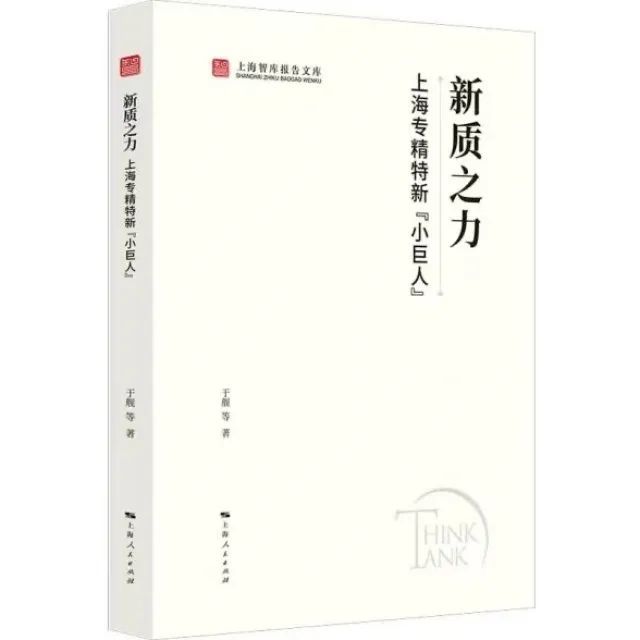
入选上海智库报告文库,第一财经研究院“小巨人”调研专著出版
Di Yi Cai Jing Zi Xun· 2025-07-30 08:53
Core Insights - The publication "New Quality Power: Shanghai Specialized, Refined, and Innovative 'Little Giants'" has been officially released and included in the "Shanghai Think Tank Report Library" [1][3] - The book focuses on Shanghai's specialized, refined, and innovative "Little Giants" enterprises, showcasing their entrepreneurial stories and contributions to new quality productivity [3][6] Industry Overview - The concept of "specialized, refined, and innovative" enterprises was proposed over a decade ago in Shanghai, and these "Little Giants" have become leaders in various economic sectors, demonstrating strong innovation capabilities and high market shares [6][7] - As of early April 2025, Shanghai has 857 specialized, refined, and innovative "Little Giants," ranking among the top cities in China [6] Research Methodology - The book employs both quantitative and qualitative analysis to assess the contributions of the "3+6" industries and related "Little Giants" to economic development, examining the structure, industrial chain, and technological innovations within these sectors [7] - A distinctive feature of the book is the random sampling survey of "Little Giants," capturing the experiences and insights of entrepreneurs to summarize successful practices and development models [7][8] Case Studies - The research team visited numerous specialized, refined, and innovative "Little Giants" in Shanghai, highlighting companies such as Tianchen Group, which provides anti-counterfeiting materials for Moutai liquor, and Rikon, a medical device company addressing prostate health issues [8] - The founder of Leyan Electric, Jin Haiyong, encapsulated the spirit of these "Little Giants" with the phrase "one life, one thing," emphasizing their dedication to specialization and innovation [8]