
酒

Search documents
贵州民营企业“一哥”易主:年营收超过400亿元,取代通源集团
Sou Hu Cai Jing· 2025-12-25 12:49
Group 1 - The "Top 100 Private Enterprises in Guizhou 2025" was officially announced, with an entry threshold of 693 million yuan, an increase of 7.94% from 2024 [1] - The total operating revenue of the top 100 enterprises reached 294.69 billion yuan, total assets amounted to 411.60 billion yuan, and total profits were 14.29 billion yuan, representing year-on-year growth of 2.78%, 21.47%, and 16.12% respectively [1] - The top 100 enterprises created 173,800 jobs, with 51 companies participating in rural revitalization and 55 in the "Ten Thousand Enterprises Prosperity in Ten Thousand Villages" initiative [1] Group 2 - The industrial distribution remains dominated by the secondary sector, with an increasing proportion, adding 9 new companies; manufacturing leads with 62 companies, while the service sector has 21 companies [3] - In terms of specific industries, 14 companies are in non-ferrous metal smelting and rolling processing, followed by 11 in coal mining and washing, 9 in chemical raw materials and products manufacturing, 7 in non-metallic mineral products, and 6 in retail [3] Group 3 - The top positions in the list include Guizhou Jili, Fuzhiyuan, Huaxia Airlines (6.696 billion yuan), and others, with Guizhou Zhenjiu being the largest private liquor company in Guizhou [5] - Guizhou Zhenjiu, established in 1975, has a production capacity exceeding 41,000 tons and a base liquor inventory of 90,000 tons, ranking third among Guizhou liquor companies [5] - Tongyuan Group, with a revenue of 28.923 billion yuan, is the largest automotive dealer group in Western China, serving over 1.4 million customers [7] Group 4 - Zhongwei Co., Ltd. ranked first with a revenue of 40.223 billion yuan, focusing on new energy materials and having established a global supply chain [9] - The company has invested over 15 billion yuan in fixed assets to develop two major industrial bases, with a comprehensive global resource and recycling system [9] Group 5 - The list includes various companies across different sectors, such as food manufacturing, retail, and coal mining, indicating a diverse industrial landscape in Guizhou [11][12][13][14][15][16][17][18][19][20][21][22]


一年收入超1200亿,湖南民营企业之冠,是全省唯一破千亿的民企
Sou Hu Cai Jing· 2025-12-22 17:10
Core Insights - The 2025 Hunan Private Enterprises Top 100 list has been officially released, marking the fifth edition of this ranking, showcasing the stable development and growth of the listed companies over the past year [2] - The overall scale of the top 100 private enterprises has reached new heights, with significant increases in total revenue and total assets compared to the previous year [2] - Manufacturing companies dominate the list, with 50 out of 100 firms, highlighting new materials, new energy, and high-end equipment manufacturing as key growth areas [2] Company Rankings - The top three companies are SANY Group, BYD Auto, and Lens Technology, with SANY Group leading the list with an annual revenue of approximately 124.23 billion yuan [7][8] - BYD Auto ranks second, recognized for its comprehensive layout in the new energy vehicle sector, serving as a model for the transformation of Hunan's automotive industry [7] - Lens Technology, ranked third, has achieved vertical integration capabilities from raw material production to final assembly, establishing long-term strategic partnerships with leading global consumer electronics and smart automotive brands [7] Industry Characteristics - The listed companies are primarily headquartered in cities such as Changsha, Loudi, Zhuzhou, and Hengyang, forming a collaborative development pattern centered around provincial capitals [2] - The manufacturing sector is characterized by high R&D investment, high added value, and high growth potential, representing the future direction of industrial development in Hunan [2] - The top 10 companies include diverse sectors such as high-tech materials, digital smart devices, and supply chain management, indicating a broad spectrum of industry representation [4][6]



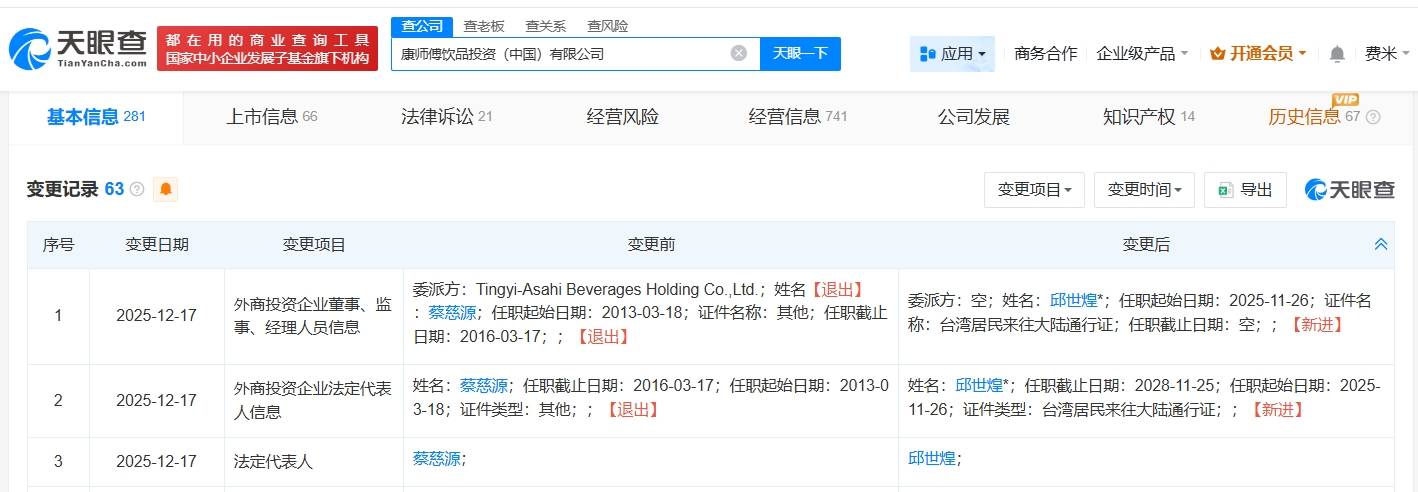
康师傅饮品投资公司董事长变更
Sou Hu Cai Jing· 2025-12-19 02:29
雷达财经讯,天眼查App显示,近日,康师傅饮品投资(中国)有限公司发生工商变更,蔡慈源卸任法定代表人、董事长,由邱世煌接任。 宣 工商自主公示股东 该公司成立于2011年5月,注册资本约5.5亿人民币,经营范围包括在国家允许外商投资的领域依法进行投资,为其母公司、关联公司、所投资企业提供品牌 推广、市场营销服务等,由KSF Beverage Holding Co.,Ltd.全资持股。 | | | 草公司 首老板 音关系 音风险 | | | | | --- | --- | --- | --- | --- | --- | | | 都在用的商业查询工具 家中小企业发展子基金旗下机构 | 康师傅饮品投资 (中国) 有限公司 | | × 天眼一下 | ● 应用 ▼ 商务合作 | | 基本信息 281 | 上市信息 66 法律诉讼 21 | | 经营风险 | 经营信息 741 | 公司发展 | | 变更记录 63 0 ● | | | | | 变更项目。 | | 序号 变电日期 | 变更项目 | 变更前 | | | | | 1 2025-12-17 | 外商投资企业董事、监 | 委派方:Tingyi-Asahi Bever ...
鸿利智汇:大股东泸州老窖集团力求成为全球影响力的世界一流产融控股集团
Sou Hu Cai Jing· 2025-12-15 03:58
Group 1 - The core viewpoint of the article is that Hongli Zhihui's major shareholder, Luzhou Laojiao Group, aims to become a globally influential first-class financial holding group, focusing on building an ecosystem-driven industrial chain [1] - The company plans to develop six key industries: liquor, finance, trade, technology, food, and construction, with a goal of achieving revenue exceeding 100 billion yuan [1] - The strategy emphasizes a dual-driven approach combining both real economy and finance to create a modern industrial ecosystem and world-class industrial clusters [1]


2025年1-10月酒、饮料和精制茶制造业企业有5920个,同比下降1.37%
Chan Ye Xin Xi Wang· 2025-12-15 03:29
2016-2025年1-10月酒、饮料和精制茶制造业企业数统计图 数据来源:国家统计局,智研咨询整理 知前沿,问智研。智研咨询是中国一流产业咨询机构,十数年持续深耕产业研究领域,提供深度产业研 究报告、商业计划书、可行性研究报告及定制服务等一站式产业咨询服务。专业的角度、品质化的服 务、敏锐的市场洞察力,专注于提供完善的产业解决方案,为您的投资决策赋能。 相关报告:智研咨询发布的《2026-2032年中国饮料行业市场运营格局及未来前景分析报告》 2025年1-10月,酒、饮料和精制茶制造业企业数(以下数据涉及的企业,均为规模以上工业企业,从 2011年起,规模以上工业企业起点标准由原来的年主营业务收入500万元提高到年主营业务收入2000万 元)为5920个,和上年同期相比,减少了82个,同比下降1.37%,占工业总企业的比重为1.13%。 上市公司:承德露露(000848),阳光乳业(001318),皇氏集团(002329),贝因美(002570),西 部牧业(300106),品渥食品(300892),熊猫乳品(300898),三元股份(600429),光明乳业 (600597),妙可蓝多(600882), ...

四川11月物价数据出炉,核心CPI连续9个月上涨
Sou Hu Cai Jing· 2025-12-12 16:34
Group 1: Consumer Price Index (CPI) Trends - In November, the Consumer Price Index (CPI) in Sichuan increased by 0.1% year-on-year, marking the highest increase since February, with a month-on-month decrease of 0.1% [2] - The decline in pork prices, which fell by 2.2% month-on-month, significantly impacted the CPI, as pork prices are typically higher during this season due to increased demand [2] - The core CPI, excluding food and energy prices, rose by 0.9% year-on-year, maintaining an upward trend for nine consecutive months, driven by rising service prices and improved industrial consumer goods prices [3] Group 2: Producer Price Index (PPI) Trends - The Producer Price Index (PPI) in Sichuan decreased by 2.8% year-on-year in November, with a month-on-month decline of 0.2%, influenced by falling energy prices and weak demand [4] - Despite the overall decline in PPI, the non-ferrous metal industry showed positive performance, with prices increasing by 1.8% month-on-month and 6.0% year-on-year, attributed to strong demand from the new energy and electronics sectors [5] - The beverage manufacturing sector also experienced a slight increase, with prices rising by 0.1% month-on-month and 0.7% year-on-year, indicating strong consumer support [5]
重庆上市公司并购重组交易额劲增 2025年前三季度同比增长637%
Jing Ji Guan Cha Wang· 2025-12-12 06:04
Core Insights - The fifth Chongqing Capital Market High-Quality Development Conference emphasized the importance of listed companies in driving the capital market's high-quality development, urging them to take on responsibilities in governance, innovation, and investor relations [1] Group 1: Listed Companies in Chongqing - As of now, Chongqing has 78 A-share listed companies with a market capitalization of approximately 1.3 trillion yuan [2] - In the first three quarters of 2025, these companies achieved operating revenue of 572.13 billion yuan and net profit of 32.96 billion yuan, with over 40% of firms experiencing growth in both metrics [2] - Chongqing's listed companies exhibit a "124+N" characteristic, with a national leading R&D investment of 14.768 billion yuan in the first half of 2025, a year-on-year increase of 42.1% [2][3] Group 2: Key Performance Indicators - Chongqing's listed companies have the largest asset scale in Central and Western China, reaching 40.173 billion yuan by the end of the third quarter of 2025, a 7% year-on-year increase [3] - The refinancing scale of these companies reached 13 billion yuan in the first three quarters of 2025, marking a 125.9% increase year-on-year, ranking second in Western China [3] - The number of companies with over 50% of revenue from overseas is second in Western China, with 7 companies achieving this in the first half of 2025 [3] Group 3: Unique Industry Characteristics - Several companies in Chongqing have made significant achievements in their respective industries, such as Sanfeng Environment issuing the first "Belt and Road" technology innovation green corporate bond in the country [4] - Chongqing Rural Commercial Bank has the largest asset scale among rural commercial banks nationwide, while companies like Giant Network and Chongqing Beer lead in their respective sectors [4] Group 4: Two Rivers New Area Development - The Two Rivers New Area has 37 listed companies, contributing approximately 55.15% of the city's operating revenue and 49.35% of net profit, despite representing only 37% of the total number of listed companies [6] - Since the implementation of the "merger and acquisition six guidelines," Chongqing has seen active mergers and acquisitions, with 12 companies completing 14 transactions worth 35.276 billion yuan in the first three quarters of 2025, a 637% increase year-on-year [6][7] Group 5: Recommendations for Future Development - The report suggests optimizing policy supply and reducing transaction costs for successful mergers, including offering preferential policies for projects that land in Chongqing and exploring the establishment of a "merger loan risk compensation fund" [7]





2025年第49周:酒行业周度市场观察
艾瑞咨询· 2025-12-11 00:05
Industry Environment - The domestic liquor industry is experiencing a "winter," with declining production and revenue, and weak consumer demand leading to price drops. The production of white liquor has decreased from 13.58 million tons in 2016 to 6.29 million tons, while beer production has fallen from 50.8 million tons in 2013 to 33.12 million tons. Major companies like Kweichow Moutai and Wuliangye are seeing significant slowdowns in performance [2][3] - Companies are shifting towards low-alcohol and light bottle liquor to attract younger consumers, while beer manufacturers are introducing non-alcoholic and low-sugar beverages. Despite the overall industry downturn, there remains long-term growth potential, with innovation and niche markets being key to breaking through [3] White Liquor Price Surge - During the Double Eleven shopping festival, white liquor was used as a low-price draw on e-commerce platforms, but a collective price increase followed shortly after, with brands like Moutai and Yanghe raising prices. This price surge began with mid-range products and expanded to all categories, as companies implemented quota controls and measures against low pricing to address high inventory and price inversion issues. Short-term demand during New Year and Spring Festival may drive prices higher, but long-term risks persist due to high inventory levels of mid-range brands and economic uncertainties [4] Marketing Strategies for New Year and Spring Festival - The New Year and Spring Festival are peak sales periods for white liquor, prompting brands to prepare marketing strategies in advance. Zodiac-themed liquor products were launched early to capture the gift market. Companies are employing detailed strategies, emphasizing digitalization and regional penetration, while enhancing consumer engagement through immersive experiences and value promotions. This year's marketing is characterized by preemptive, refined, and standardized approaches aimed at rebuilding channel confidence and enhancing brand resilience [5] Reflections on Double Eleven - The liquor industry observed three major trends during this year's Double Eleven: collaboration between platforms and brands to regulate channels and combat low-price tactics, a clear polarization in consumer preferences between high-end gift liquor and affordable self-consumption options, and accelerated online-offline integration through immersive experiences and instant delivery [6] Industry Transformation from 2021 to 2025 - The period from 2021 to 2025 is critical for the transformation and development of the Chinese liquor industry, marked by capital mergers, regulatory upgrades, product innovations, and market adjustments. The industry is expected to face inventory reduction and strategic shifts, with a notable rise in domestic whiskey. By 2025, the industry is anticipated to embrace low-alcohol and health-oriented trends, with ESG becoming a consensus [7] Light Bottle Liquor Market Dynamics - The light bottle liquor market is becoming a popular segment within the white liquor industry, with intense competition and a reshaping of market dynamics. The 50 yuan price range is a focal point for companies, with products like Guojiao 1573 performing well. The market is projected to exceed 150 billion yuan in 2024, growing at a rate of 17%, although profit margins are generally lower than the industry average. The shift from "low price for volume" to "quality competition" is evident, necessitating an upgrade in marketing strategies [8] Fourth Quarter Performance Outlook - The third quarter of this year has been challenging for the white liquor industry, making the fourth quarter crucial for annual performance. The industry is transitioning from scale expansion to value reconstruction, focusing on deepening consumer engagement and cultural empowerment. Major brands are enhancing consumer experiences through events, while regional companies are concentrating on localized strategies [9] Emerging Trends in the Loose Liquor Market - Loose liquor, once a staple for older generations, is now gaining popularity among younger consumers. New brands are rapidly expanding, with the market expected to surpass 80 billion yuan in 2024. The market is divided into traditional community stores and new "loose liquor shops" catering to younger consumers' social needs. Despite significant market potential, competition is fierce, and profitability remains challenging [11] Banquet Market as a Potential Lifeline - The Chinese white liquor industry is facing severe challenges, with a declining consumer base and reduced sales in banquet settings. Younger consumers show low acceptance of white liquor, while older consumers are drinking less for health reasons. The industry is exploring low-alcohol and light bottle liquor to attract younger buyers and is focusing on banquet scenarios for growth. However, competition in the banquet market is intense, and brand appeal and cost-effectiveness will be critical [12] Brand Highlights - Jingyu Qingjiu has been recognized for its role in the revival of Chinese sake, winning the "Category Champion" award at a national conference. The brand emphasizes cultural revival and technological innovation, with an annual production capacity of 15,000 tons and a strong online sales presence [13][14] - Five Star Liquor is navigating the transformation in the sauce liquor sector by focusing on quality and talent development, achieving significant recognition in international competitions and maintaining a robust growth strategy [15] - Diaoyutai Liquor is leveraging sports marketing to enhance brand experience and connect with high-net-worth individuals, showcasing a commitment to quality and craftsmanship [16] - Fenjiu is demonstrating resilience in the face of market adjustments, with a focus on optimizing product structure and expanding its national strategy, achieving a revenue of 32.92 billion yuan in the first three quarters of 2025 [17][18]

每天三分钟公告很轻松 | 星宇股份拟斥资2亿元至3亿元回购公司股份
Shang Hai Zheng Quan Bao· 2025-12-10 16:16
Group 1 - Xingyu Co., Ltd. plans to repurchase company shares with an investment of 200 million to 300 million yuan, using its own funds at a maximum price of 180 yuan per share [1] - The repurchased shares will be used for an employee stock ownership plan [1] Group 2 - Kweichow Moutai announced a mid-term profit distribution plan, distributing a cash dividend of 23.957 yuan per share, totaling approximately 30 billion yuan [2] - Wuliangye also announced a mid-term profit distribution plan, distributing 25.78 yuan in cash for every 10 shares, with a total of 38.82 billion shares [2] Group 3 - Century Huatong's subsidiary, Guosheng Capital, holds 19.5887 million shares of Moer Thread, accounting for 4.8968% of the total shares before the IPO and 4.1676% after [3] - The estimated impact on Century Huatong's net profit for Q4 2025 from this holding is approximately 640 million yuan, representing 53% of the audited net profit for 2024 [3] Group 4 - CATL plans to issue bonds not exceeding 10 billion yuan to optimize its debt structure and reduce financing costs [4] - Daon Co. will acquire 80% of Ningbo Aisikai Synthetic Rubber Co., Ltd. for 516 million yuan, enhancing its position in the elastomer sector [4][5] Group 5 - Wanxun New Materials intends to acquire 100% of Eurofoil Luxembourg S.A. for approximately 12.39 million euros, aiming to strengthen its position in the aluminum foil and sheet market [7] - Sanmu Group plans to sell 75 office properties valued at 24.11 million yuan to Fuzhou Bonded Port Guoli Group [7] Group 6 - The company received government subsidies totaling 12.49 million yuan, with 8.64 million yuan related to income, impacting the net profit for 2024 [12] - Xue Long Group plans to establish a wholly-owned subsidiary with a registered capital of 100 million yuan to enhance its vertical integration in the industry [12] Group 7 - Nanjing Medical plans to invest in a modern pharmaceutical logistics expansion project with a total investment of up to 397.53 million yuan [13] - Zhongchuan Special Gas plans to invest approximately 86.99 million yuan in a new electronic gas production project [14] Group 8 - Meidike plans to introduce strategic investors for its optical semiconductor subsidiary, with an investment of 200 million yuan [15] - Yuntianhua is acquiring a 100% stake in Tianyao Chemical for 36.89 million yuan, making it a wholly-owned subsidiary [16] Group 9 - Huasheng Co. intends to acquire 97.40% of Easy Technology for 662.34 million yuan, entering the AIDC field [17][18] - The acquisition will enhance the company's capabilities in high-performance computing and green energy technology [18] Group 10 - Zaiseng Technology reported that its revenue from aerospace-related products is less than 0.5% of total revenue, indicating limited impact on overall performance [19]

劲酒断货背后:流量出圈与百亿酒企的转型突围
Xin Lang Cai Jing· 2025-12-10 03:47
Core Insights - The unexpected popularity of Jin Jiu has led to supply shortages in regions like Henan and Guangdong since the second half of 2025, indicating a significant surge in demand for the health wine market [1][7] - The brand is attempting to leverage this surge in interest to achieve both customer base expansion and performance improvement [1][7] Group 1: Market Dynamics - Jin Jiu's rise in popularity is attributed to organic social media sharing, transforming its image from a "male health wine" to a "female internet celebrity wine" [2][8] - The product has been associated with various trendy cocktails and has gained the nickname "menstrual miracle water," with over 100,000 related posts on platforms like Xiaohongshu [2][8] - The company has responded to this trend by launching a pink packaging version of Jin Jiu aimed at the female market and engaging in social media interactions to promote a "light health" and "micro-drunk" image [2][8] Group 2: Consumer Behavior and Company Strategy - The younger demographic's demand for affordable products has facilitated Jin Jiu's popularity, with a 125ml bottle priced at around 10 yuan, appealing to the "cheap and large" value proposition [10] - The alcohol content of 35 degrees is lower than traditional spirits, making it more acceptable to female consumers [10] - The company has proactively built a content marketing team since 2022 to target Gen Z and female consumers, responding quickly to user-generated content that positions Jin Jiu as a "women's drink" and "domestic whiskey" [10] Group 3: Financial Performance and Growth Challenges - The brand has seen significant growth, with approximately 900,000 new young users in the past two years, including 400,000 women, and an overall performance increase of about 10% this year [12] - Jin Jiu's sales for the first half of the year surged by 50%, marking a critical turning point for the company after years of stagnation around the 10 billion yuan revenue mark [12] - Despite this growth, the health wine market is projected to be limited, with an estimated size of 587 billion yuan in 2025, and Jin Jiu already holding a market share of 35% to 43.7% [12] Group 4: Risks and Future Outlook - The company faces challenges such as medical controversies that could undermine consumer trust and affect sales sustainability [13] - The monthly nature of menstrual cycles may limit repeat purchases, even if users acknowledge the product's benefits [13] - Long-term, the brand must overcome the perception of being a "health product" and convert short-term interest into stable demand for herbal alcoholic beverages [13]