
酒店业

Search documents
11.26日报
Ge Long Hui· 2025-11-26 20:20
Group 1 - The U.S. retail sales fell by 0.2% in September, primarily due to the expiration of electric vehicle tax incentives and a decline in auto sales, which may support a rate cut in December [1] - Nvidia's stock plummeted due to the rise of Google's TPU, breaking its uniqueness in the market. AMD also saw a decline, losing its position as a viable alternative to Nvidia. Nvidia reassured the market of its lead over TPU, but the loss of monopoly status could significantly reduce its premium [1] - Atour's Q3 revenue reached 2.63 billion, a year-on-year increase of 38.4%, with a net profit of 490 million, up 27%. The average room revenue was 371.3 yuan, recovering to 97.8% of the same period last year, and the company raised its full-year revenue guidance. Compared to peers, Atour's performance stands out as Jinjiang's revenue declined, while Junting and Huazhu grew by 4% and 8%, respectively [1] Group 2 - NIO reported a Q3 loss of 2.74 billion, with CEO Li Bin stating that the company would achieve profitability in the next quarter, although the market remains skeptical, leading to a continued decline in stock price [2]


华天酒店:11月26日召开董事会会议
Mei Ri Jing Ji Xin Wen· 2025-11-26 11:43
每经头条(nbdtoutiao)——国开行辟谣的"人民资产"是什么?记者实探:号称投资600元80天赚8万 元!一位投资人的女儿:劝不住她,警察都拦不住 (记者 张明双) 2025年1至6月份,华天酒店的营业收入构成为:酒店业占比83.16%,其他行业占比15.88%,房地产业 占比0.96%。 截至发稿,华天酒店市值为35亿元。 每经AI快讯,华天酒店(SZ 000428,收盘价:3.39元)11月26日晚间发布公告称,公司第九届2025年 第二次董事会临时会议于2025年11月26日以通讯表决方式召开。会议审议了《关于修订 <独立董事专门 会议工作细则> 的议案》等文件。 ...

提前大涨!81岁A股创始人拟出让控制权
中国基金报· 2025-11-26 08:17
Core Viewpoint - The controlling shareholder of Junting Hotel, Wu Qiyuan, is planning a change in the company's control, which may lead to a change in the controlling shareholder and actual controller [2][6]. Group 1: Company Control Change - Junting Hotel announced that Wu Qiyuan is planning a change in the company's control, which may result in a change of the controlling shareholder and actual controller [2][6]. - The stock of Junting Hotel will be suspended from trading starting November 26, 2025, for a period not exceeding two trading days to ensure fair information disclosure and avoid abnormal stock price fluctuations [6]. Group 2: Financial Performance - From 2022 to 2024, Junting Hotel's operating revenue is projected to be 342 million, 534 million, and 676 million respectively, while the net profit attributable to the parent company is expected to be 29.75 million, 30.52 million, and 25.20 million, showing an overall downward trend [8]. - In the first three quarters of 2025, the company achieved operating revenue of 506 million, a year-on-year increase of 0.58%, but the net profit was only 9.90 million, a significant decrease of 45.92% year-on-year, indicating a persistent "increasing revenue without increasing profit" situation [11]. Group 3: Operational Challenges - Junting Hotel has been facing challenges in profitability, attributed to increased investment in direct-operated hotels, which leads to a longer ramp-up period and higher initial losses due to significant upfront costs [10]. - The company has opened up its franchise business to alleviate the long ramp-up period of direct-operated stores, with a total of 25 signed franchise stores, of which 8 are officially operating as of the end of the third quarter [11]. Group 4: Project Adjustments - The completion time for new direct-operated hotel investment development projects and existing hotel renovation upgrade projects has been postponed from January 2026 to December 2027 due to ongoing structural adjustments in the domestic mid-to-high-end hotel market and intensified competition [12]. - The company claims that the adjustments are made based on prudent management and investment principles, considering the recovery pace of various markets and property conditions [12].


君亭酒店筹划易主,停牌前股价大涨
Shen Zhen Shang Bao· 2025-11-26 02:46
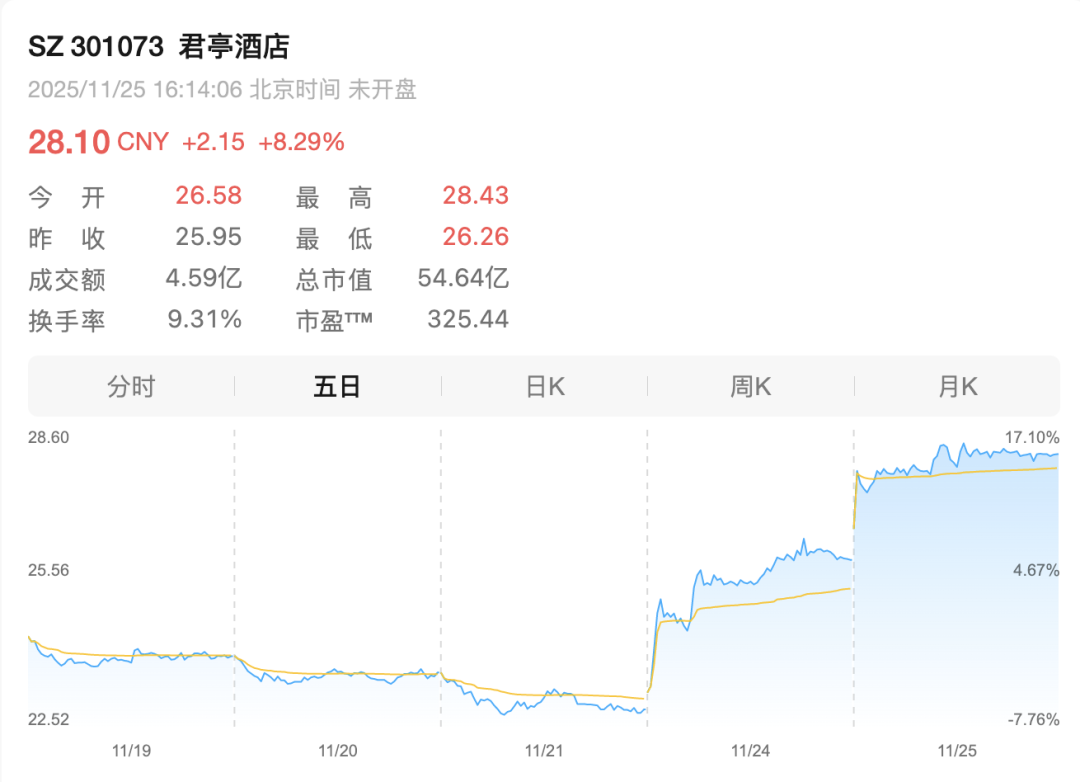
11月25日晚间,君亭酒店(301073)公告,公司控股股东筹划控制权变更。 | 今 开 26.58 最 高 28.43 | | --- | | 昨 收 25.95 最 低 26.26 | | 成交额 4.59亿 | | 换手率 9.31% | 公开资料显示,君亭酒店集团股份有限公司是深交所创业板上市公司,专注住宿业务27年,是中国领先的高端商务酒店和度假酒店运营商及中高端清选酒 店和生活方式酒店的开拓者。主营业务包含酒店的投资、运营和管理。 此前,君亭酒店刚刚宣布,拟控股浙江君澜酒店管理有限公司(简称"君澜管理")。 根据公告,公司拟收购君澜管理剩余的21%股权,收购价格为7980万元,交易完成后,公司将持有君澜管理100%股权,标的公司将成为公司全资子公 司。 君亭酒店称,本次收购剩余21%股权,标志着公司对"君澜"品牌体系的整合进入深化阶段,进一步巩固了在中高端酒店管理服务领域的战略主导地位。 连续大动作背后,君亭酒店盈利持续承压。2022年至2024年,归母净利润分别为2974.59万元、3051.99万元、2519.97万元,同比变动幅度分别 为-19.43%、2.60%、-17.43%,整体呈下跌 ...

报价16亿元!广州珠江新城知名五星级酒店对外出售
Sou Hu Cai Jing· 2025-11-25 21:44
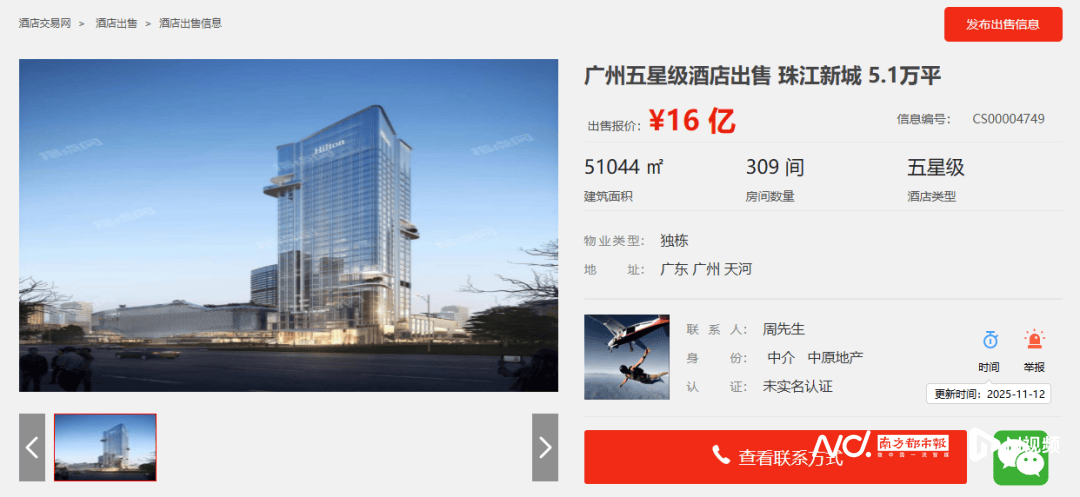
近日,网传广州天河CBD五星级酒店康莱德酒店对外出售。网传信息显示,该酒店位于珠江新城,建筑面积共5.1万平方米、客房数量为309间,属于五星 级酒店,出售报价为16亿元。南都记者多方核实得知,该对外出售的酒店为广州康莱德酒店。 网传广州五星级酒店出售信息。 富力集团官方网站显示,广州康莱德酒店坐落在珠江新城商务圈,设有309间智能化的时尚客房。从公开的照片看,酒店客房可看见广州塔与珠江江景。 这与网传信息中"309间客房""项目酒店坐落于城市CBD核心位置,拥揽广州地标小蛮腰之景"一致。 广州康莱德酒店一工作人员告诉南都记者,广州康莱德酒店确实正在对外出售,但对酒店运营不会产生太大影响,只是预计会有新的业主加入。 公开资料显示,康莱德酒店为希尔顿集团旗下高奢酒店品牌。广州康莱德酒店由富力、合景泰富、新鸿基2017年联合开发并交由富力酒店板块运营。 南都广州新闻部出品 采写:南都N视频记者 王美苏 官网公布的广州康莱德酒店客房图。 ...
Atour Lifestyle (ATAT) - 2025 Q3 - Earnings Call Transcript
2025-11-25 13:02
Financial Data and Key Metrics Changes - The company's net revenues for Q3 2025 grew by 38.4% year-over-year and 6.5% quarter-over-quarter to RMB 2,628 million [31] - Adjusted net income for Q3 2025 was RMB 488 million, representing a 27.0% increase year-over-year, with an adjusted net profit margin of 18.6% [35] - Adjusted EBITDA for Q3 2025 was RMB 685 million, up by 28.7% year-over-year, with an adjusted EBITDA margin of 26.1% [35] Business Line Data and Key Metrics Changes - In the hotel business, ROPA was RMB 371.3 million, representing 97.8% of its level in the same period of 2024, with OCC at 99.9% and ADR at 98.1% of the prior year [8] - The retail business achieved GMV of RMB 994 million, reflecting a 75.5% year-over-year increase, with online channels contributing over 90% of total GMV [20] Market Data and Key Metrics Changes - The hotel sector showed moderate recovery with robust travel and leisure demand, while the retail market increasingly focused on experiential offerings and quality-of-life upgrades [5][6] - The company opened 152 new hotels in Q3 2025, a record high for a single quarter, bringing the total to 1,948 hotels, a 27.1% year-over-year increase [10] Company Strategy and Development Direction - The company emphasizes quality-first principles in its expansion strategy, focusing on premier hotels in core locations while maintaining operational quality [47] - Atour Planet aims to lead the sleep industry with innovative product standards based on sensory science, differentiating itself from competitors [54] Management's Comments on Operating Environment and Future Outlook - Management noted a shift in consumer behavior towards value and rational purchasing decisions amid macroeconomic volatility [5] - The company expects continued divergence in market performance but remains optimistic about long-term growth through quality offerings and user engagement [42] Other Important Information - The company declared a second cash dividend for 2025 totaling approximately USD 50 million, representing about 29% of last year's net income [61] - The company maintains a healthy cash position with cash and cash equivalents totaling RMB 2,670 million as of September 30, 2025 [35] Q&A Session Summary Question: Could the management share the REFPA trend since October? - Management indicated that REFPA has shown progressive improvement year-over-year, with expectations for easing pressure in Q4 due to strong demand in core cities [40][41] Question: Could you share more about the recent new hotel signing trends? - Management confirmed that new hotel signings are in line with last year, maintaining a steady development pace, with a target of 500 new openings for the year [49] Question: Could the management share your perspective on the competition in the retail business? - Management acknowledged increasing competition but emphasized a focus on evolving user needs and the introduction of innovative product standards to maintain a competitive edge [53][54] Question: Could management provide an update on the planning and progress regarding shareholder returns? - Management stated that the cumulative dividend for the year reaches about USD 108 million, exceeding their commitment of at least 50% of net income [61][62] Question: Could you share your plan for the Atour Lite brand in the next steps? - Management expressed optimism about Atour Lite's long-term development, focusing on solidifying operational foundations and aiming for 1,000 hotels in the future [69]

Atour Lifestyle (ATAT) - 2025 Q3 - Earnings Call Transcript
2025-11-25 13:00
Financial Data and Key Metrics Changes - The company's net revenues for Q3 2025 grew by 38.4% year-over-year and 6.5% quarter-over-quarter to RMB 2,628 million [38] - Adjusted net income for Q3 2025 was RMB 488 million, representing a 27.0% increase year-over-year, with an adjusted net profit margin of 18.6% [43] - Adjusted EBITDA for Q3 2025 was RMB 685 million, up by 28.7% year-over-year, with an adjusted EBITDA margin of 26.1% [43] Business Line Data and Key Metrics Changes - In the hotel business, ROPA was RMB 371.3 million, representing 97.8% of its level in the same period of 2024, with OCC at 99.9% and ADR at 98.1% of the prior year [9] - The retail business sustained strong growth, with GMV reaching RMB 994 million, reflecting a 75.5% year-over-year increase [24] - Revenues from miniaturized hotels were RMB 1,560 million, up 32.3% year-over-year, while revenues from leased hotels decreased by 13.4% year-over-year to RMB 164 million [38][39] Market Data and Key Metrics Changes - The hotel sector showed moderate recovery, with travel and leisure demand remaining robust, although recovery was uneven across regions [5] - Online channels contributed over 90% of total GMV in the retail business, indicating a strong shift towards digital sales [24] Company Strategy and Development Direction - The company focuses on quality-first principles in its rapid expansion, emphasizing rigorous project selection and high-quality growth [12][19] - Atour aims to solidify its competitive moat in the upper-mid-scale market by leveraging its product offerings and expanding into core business districts [17] - The company plans to achieve a total of 2,000 premier hotels by year-end 2025, with a pipeline of 754 hotels under development [11][12] Management's Comments on Operating Environment and Future Outlook - Management noted ongoing volatility in the macro environment, with consumers prioritizing value and rational purchasing decisions [5] - The company expects continued divergence in market performance, with challenges remaining, but is confident in its ability to attract users with high-quality products [50] Other Important Information - The company declared a second cash dividend for 2025 totaling approximately USD 50 million, representing about 29% of last year's net income [44][68] - The company raised its full-year retail revenue growth outlook to at least 65% year-on-year, adjusting the group's full-year revenue guidance to a growth of 35% year-on-year [64] Q&A Session Summary Question: Could the management share the REFPA trend since October? - Management indicated that REFPA has shown a trend of progressive improvement year-over-year, with expectations for easing pressure in Q4 due to strong demand in core cities [46][49] Question: Could you please share more about the recent new hotel signing trends? - Management confirmed that new hotel signings are in line with last year, maintaining a steady development pace, with a focus on quality over scale [53][55] Question: Could the management share your perspective on the competition in the retail business? - Management acknowledged increasing competition but emphasized a focus on evolving user needs and the establishment of a new standard for product quality [59][61] Question: Could management provide an update on the planning and progress regarding shareholder returns? - Management confirmed a cumulative dividend total for the year of approximately USD 108 million, exceeding their commitment of no less than 50% of net income [67][69] Question: Could you share your plan for Atour Lite in the next steps? - Management expressed optimism about Atour Lite's long-term development, focusing on solidifying operational foundations and systematic capabilities [71][75]
国信证券:维持华住集团-S(01179)“优于大市”评级 看好龙头优势扩张
智通财经网· 2025-11-25 02:40
Core Viewpoint - Guosen Securities maintains an "outperform" rating for Huazhu Group-S (01179), highlighting the company's solid industry leadership and accelerated performance growth in Q3, with revenue and net profit exceeding expectations, particularly in the China region [1] Group 1: Q3 Performance - Huazhu's hotel revenue reached approximately 30.6 billion yuan, a year-on-year increase of 17.5%, with Huazhu China growing by 18.4% [1] - Q3 revenue was 6.96 billion yuan, up 8.1% year-on-year, surpassing the previous guidance of 2-6% [1] - Net profit attributable to shareholders was 1.47 billion yuan, a year-on-year increase of 15.4%, with adjusted net profit at 1.52 billion yuan, up 10.8% [1] - Huazhu China's revenue was 5.72 billion yuan, a year-on-year increase of 10.8%, exceeding the previous guidance of 4-8% [1] Group 2: Membership and Revenue Management - Q3 mixed RevPAR for Huazhu China was 256 yuan, with positive growth in average daily rate (ADR) of 0.9% [2] - Membership numbers surpassed 300 million, a year-on-year increase of 17.3%, with member booking nights rising by 19.7% to over 66 million, accounting for 74% of total nights [2] - Q3 DH mixed RevPAR grew by 6.4% year-on-year [2] Group 3: Store Expansion and Profitability - In the first three quarters, the company opened 2,038 new stores and closed 483, resulting in a net increase of 1,555 stores [3] - The company expects to exceed the initial target of opening 2,300 stores for the year, with 12,600 operating hotels and a market share estimated at 11% [3] - Q3 group franchise revenue and gross operating profit (GOP) increased by 27.4% and 28.6% year-on-year, respectively [3] Group 4: Q4 Outlook - The company anticipates Q4 revenue growth of 2-6%, with domestic growth of 3-7% and franchise revenue growth of 17-21% [4] - Q4 domestic RevPAR is expected to remain stable or see slight increases, indicating a generally healthy development trend [4] - The company believes that despite uncertainties in business travel demand, industry data has stabilized, suggesting that business travel has not weakened further [4]
当酒店招聘开始强调能挨骂
3 6 Ke· 2025-11-25 02:08
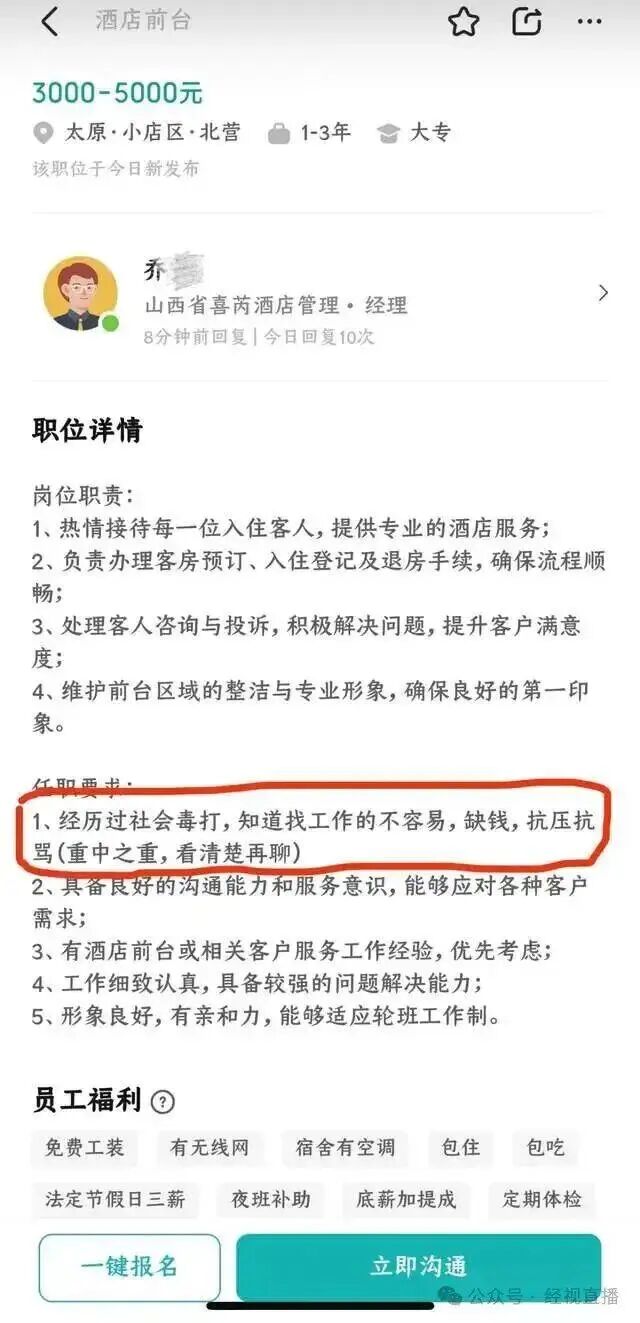
01 前段时间,一则招聘启事在酒店业炸开了锅。 山西一家名叫喜芮的酒店管理公司,发布了一则酒店前台招聘信息,岗位是酒店前台,而让它刷屏的是一条任职要求: 经历过社会毒打,知道找工作不容易,缺钱,抗压抗骂。末尾还特别标注,这一点是重中之重,看清楚再聊。 岗位薪资写着3000到5000元。 新闻很快铺满社交媒体,不少网友看到后表示,这样的招聘描述容易对求职者造成精神压力。 这件事,在旅界搭建的行业交流社群也引起了热烈讨论。 评论却并未一边倒地批评酒店,反而有不少从业者表达认同,称写在明面上挺好,反而省了后面彼此的尴尬。 一个华中地区从业十余年的前台经理A总和我小窗时则说得更直接,意思是现在酒店一线运营岗位,谁都知道挨骂是日常,很多时候不是老板骂你,是客 人骂你,你不仅得学会接住骂,还得拼命赔笑脸。 前台则正是重灾区。 A总和我讲了一个发生在他们店里的真实经历。 他们是一家中高端商务型酒店,过去一直愿意帮住客叫车,哪怕深夜也尽力安排。 结果有一次凌晨四点,一位客人要去机场,前台提前二十分钟开始叫车。 平台一直没有司机接单,等到客人下楼时,车还没到,客人立刻恼火,质问、摔手机、威胁投诉,现场一度混乱。 第二天,A总的 ...
广州CBD知名五星级酒店,要卖了
券商中国· 2025-11-24 23:34
网传广州五星级酒店出售信息 富力集团官方网站显示,广州康莱德酒店坐落在珠江新城商务圈,设有309间智能化的时尚客房。从公开的照片看,酒店客房可看见广州塔与珠江江景。这与网传 信息中"309间客房""项目酒店坐落于城市CBD核心位置,拥揽广州地标小蛮腰之景"一致。 广州康莱德酒店一工作人员告诉南都记者,广州康莱德酒店确实正在对外出售,但对酒店运营不会产生太大影响,只是预计会有新的业主加入。 公开资料显示,康莱德酒店为希尔顿集团旗下高奢酒店品牌。广州康莱德酒店由富力、合景泰富、新鸿基2017年联合开发并交由富力酒店板块运营。 来源:南方都市报 责编: 汪云鹏 校 对:高源 百万用户都在看 2分钟,20%涨停!四大利好,集体驱动! 存储芯片,重磅突发! 凌晨,直线猛拉!英伟达,重大发布! 深夜!全线大跌!美股,利空来袭! 近日,网传广州天河CBD五星级酒店康莱德酒店对外出售。 网传信息显示,该酒店位于珠江新城,建筑面积共5.1万平方米、客房数量为309间,属于五星级酒店,出售报价为16亿元。 南都记者多方核实得知,该对外出售的酒店为广州康莱德酒店。 违法和不良信息举报电话:0755-83514034 邮箱:bwb@ ...
