教育培训

Search documents
内部信风波后俞敏洪再致歉,为何员工不能共情?
第一财经· 2025-11-24 09:10
Core Viewpoint - The controversy surrounding New Oriental's founder Yu Minhong's internal letter from Antarctica reflects deeper concerns about the company's management strategy and its alignment with current business challenges, particularly regarding the sustainability and independence of the Oriental Selection business [3][4]. Group 1: Management and Leadership Changes - Yu Minhong's internal letter sparked criticism, with employees feeling disconnected from management's priorities, especially following the departure of key executives like Sun Dongxu [3][4]. - The company has faced significant leadership instability, with the exits of core personnel leading to a decline in operational performance and market confidence [6][7]. Group 2: Financial Performance - New Oriental's Q1 FY2026 report showed a 6.1% year-on-year revenue increase, but net profit attributable to shareholders fell by 1.9% [6]. - Oriental Selection's FY2025 financials revealed a 30.9% year-on-year revenue decline in core operations, with net profit dropping from 249.1 million to 6.2 million [6][7]. Group 3: Market Concerns - The company's gross merchandise volume (GMV) for the fiscal year decreased by 39.2%, from 14.3 billion to 8.7 billion [7]. - Investors are increasingly focused on Yu Minhong's prioritization of business segments and the need for talent resource allocation rather than personal endeavors [8].



华图山鼎:公司高度重视AI领域的布局
Zheng Quan Ri Bao Wang· 2025-11-24 07:44
Core Viewpoint - The company emphasizes its strategic focus on the AI sector, developing a range of AI products to enhance educational training and operational efficiency [1] Group 1: AI Product Development - The company has identified key areas in AI, including AI interview evaluation, AI essay grading, AI personalized tutoring, AI simplified question banks, and AI photo-based question searching [1] - These AI products cover the entire learning scenario of student training, including learning, practice, assessment, and evaluation [1] Group 2: Operational Efficiency - The AI interview evaluation has been scaled for use in teaching, research, and teacher training, significantly improving product delivery efficiency [1] - The implementation of these AI solutions is aimed at reducing costs and increasing operational efficiency [1] Group 3: Market Reach - By the first half of 2025, the company's AI interview evaluation will have reached over 10,000 students across more than 30 provinces and cities nationwide [1]

内部信风波后俞敏洪再致歉,为何员工不能共情?
Di Yi Cai Jing· 2025-11-24 06:17
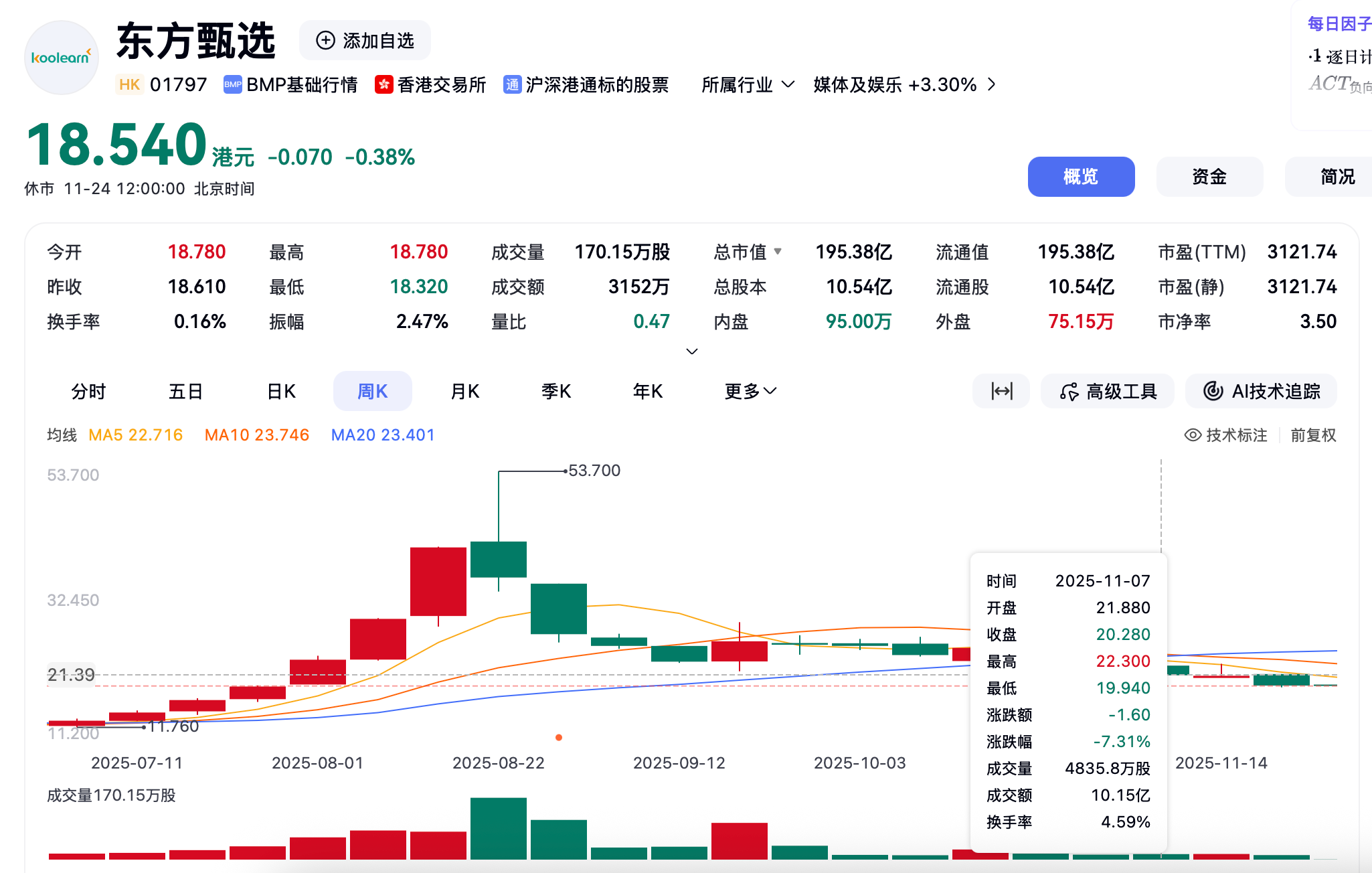
Core Viewpoint - The controversy surrounding the internal letter from New Oriental's founder Yu Minhong reflects market concerns about the independence and profitability sustainability of Dongfang Zhenxuan's business [1][2]. Group 1: Internal Controversy - Yu Minhong's internal letter, celebrating the company's 32nd anniversary, was perceived by some employees as boastful, leading to public backlash on social media [1]. - Yu Minhong apologized twice, clarifying that the letter was intended to share views rather than show off, and he acknowledged the negative connotations of the color red used in the letter [1]. - Following the letter, Dongfang Zhenxuan's stock price has been declining, particularly after the confirmation of the departure of former CEO Sun Dongxu [1]. Group 2: Business Performance and Management Concerns - Dongfang Zhenxuan has faced significant challenges, including the departure of key personnel and declining financial performance, with a 30.9% year-over-year decrease in revenue from ongoing operations [4]. - The company's GMV dropped by 39.2% from 143 billion to 87 billion, and net profit fell from 249.1 million to 6.2 million [4]. - Yu Minhong emphasized the need for prioritization and resource allocation within the company, particularly in the context of its educational and e-commerce ventures [5]. Group 3: Market Reactions - The market's reaction to the internal letter and management changes indicates a lack of confidence in Dongfang Zhenxuan's future growth and operational stability [2][4]. - As of November 24, New Oriental's stock rose by 2.09%, while Dongfang Zhenxuan's stock fell by 0.64%, reflecting investor sentiment [6].
马光远称俞敏洪内部信是解释非道歉
3 6 Ke· 2025-11-24 05:46
Core Viewpoint - The internal letter from Yu Minhong, chairman of New Oriental Education Group, is characterized as an explanation rather than an apology, addressing employee dissatisfaction regarding his previous comments and the use of red font in the letter [1] Group 1 - Yu Minhong expressed regret for triggering employee dissatisfaction with his previous letter, clarifying that his references to Antarctica were not intended to boast [1] - The use of red font in the letter was explained as a cultural reference, with Yu stating that it symbolizes celebration for his generation [1] - Economist Ma Guangyuan supported Yu Minhong's stance, emphasizing that the letter was more about clarification than an apology and criticized the narrative of creating a divide between management and employees [1]

昂立教育:立足于教培主业,收购旅游公司,将银发经济业务作为公司业务增长的第二曲线
Cai Jing Wang· 2025-11-24 04:18
Group 1 - The core viewpoint of the articles is that Angli Education is acquiring Shanghai Leyou International Travel Agency to achieve strategic and business synergies, focusing on the aging population and the silver economy as a growth avenue [1][2] - Angli Education's main business is in education and training, and the acquisition aims to provide personalized travel services for the elderly, enhancing the company's silver economy business [1] - Shanghai Leyou is one of the top three local travel agencies in Shanghai, with a strong market reputation and a customer base that is over 70% elderly, which aligns with Angli Education's target demographic for its "Happy Community" initiative [1] Group 2 - As of June 2025, Shanghai Leyou reported a negative net asset value of 9.1295 million yuan, indicating insolvency, with revenues of 65.9225 million yuan and 38.6414 million yuan for 2024 and the first half of 2025, respectively, both showing net losses [2] - Despite the losses, the equity value of Shanghai Leyou is assessed at 38.5 million yuan, reflecting an appreciation of 47.6295 million yuan, with a growth rate of 521.71% [2] - For the first three quarters of 2025, Angli Education achieved a revenue of 1.081 billion yuan, a year-on-year increase of 12.03%, and a net profit of 46 million yuan, up 141.11% year-on-year, attributed to improved operational efficiency [2]

俞敏洪再发全员信致歉,将选取10名优秀基层员工感受南极
Sou Hu Cai Jing· 2025-11-24 01:45
Core Points - The core message of the letter is an apology from the founder of New Oriental, Yu Minhong, addressing employee concerns regarding his recent trip to Antarctica and emphasizing the importance of mutual support between the company and its employees [1][3][5] Group 1: Apology and Employee Relations - Yu Minhong expressed regret for any misunderstanding caused by his letter sent from Antarctica, clarifying that it was not intended to boast but to share his experiences and insights with employees [1][3] - He acknowledged that the trip had personal leisure aspects but also served a professional purpose related to youth natural exploration education [1][4] - The founder encouraged employees to maintain the company's image and resolve any unfair treatment through internal channels, highlighting the importance of a stable work environment for all [1][5] Group 2: Future Plans and Employee Engagement - Yu Minhong stated that he would be actively involved in various aspects of New Oriental and its subsidiary, Dongfang Zhenxuan, in the coming months, inviting employees to share their opinions and suggestions [1][7] - As a motivational initiative, the company plans to select ten outstanding grassroots employees to visit Antarctica next winter, allowing them to experience its beauty [1][7] - The letter emphasized the reciprocal relationship between the company and its employees, where both parties contribute to each other's success [1][6][7]
俞敏洪致信员工解释南极行争议,称老板也在拼命努力
Xin Lang Ke Ji· 2025-11-23 16:53
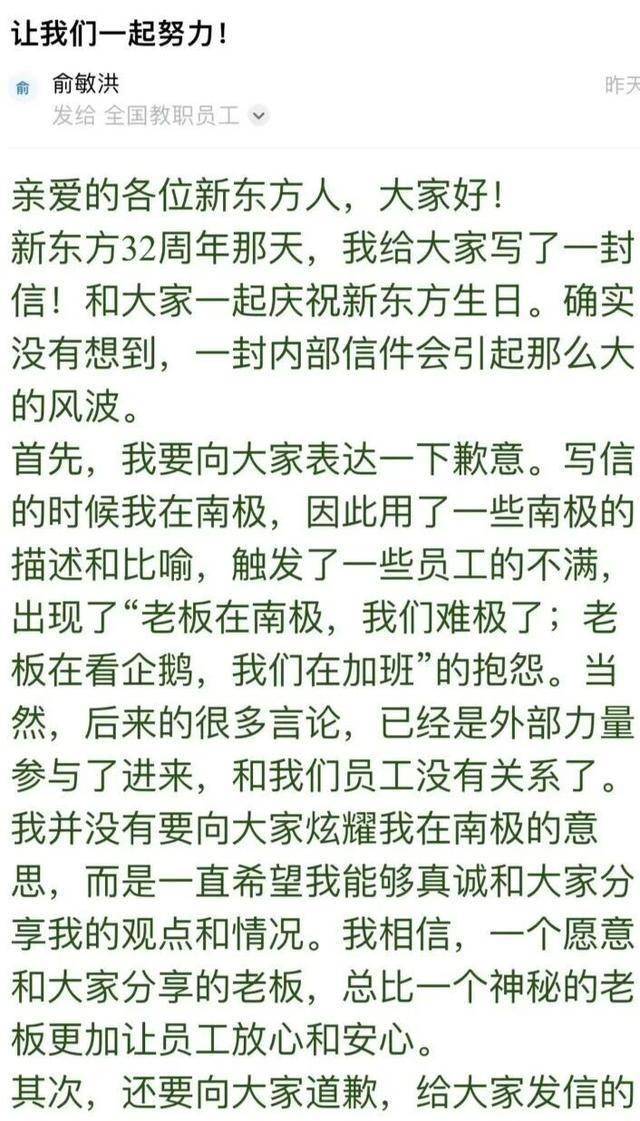
Core Viewpoint - The letter from the founder emphasizes the importance of mutual effort and understanding between the company and its employees, addressing recent employee dissatisfaction regarding his trip to Antarctica and the use of red font in communications. Group 1: Apology and Communication - The founder expressed apologies to employees for any misunderstanding caused by his letter written from Antarctica, clarifying that the intention was to share thoughts and not to boast about the trip [1][3] - The use of red font in the communication was explained as a cultural reference, with the founder acknowledging that it may have been perceived negatively by some employees [1][6] Group 2: Work and Personal Development - The trip to Antarctica had both personal and professional elements, aimed at discussing youth natural exploration education and meeting potential talent for the company [2][7] - The founder encouraged employees to address any unfair treatment through internal channels and welcomed open communication, emphasizing the importance of maintaining the company's image [2][11] Group 3: Company Culture and Values - The founder highlighted the collaborative nature of the company, stating that both employees and management are working towards mutual success and that the company is a place for personal growth and freedom [13][15] - Acknowledgment was made of the hard work of teachers and staff, with a commitment to ensuring a supportive work environment where everyone can thrive [11][15]
“没有要炫耀在南极的意思”,俞敏洪道歉:“用员工血汗钱旅游”说法不妥,老板也在拼命努力!
凤凰网财经· 2025-11-23 12:39
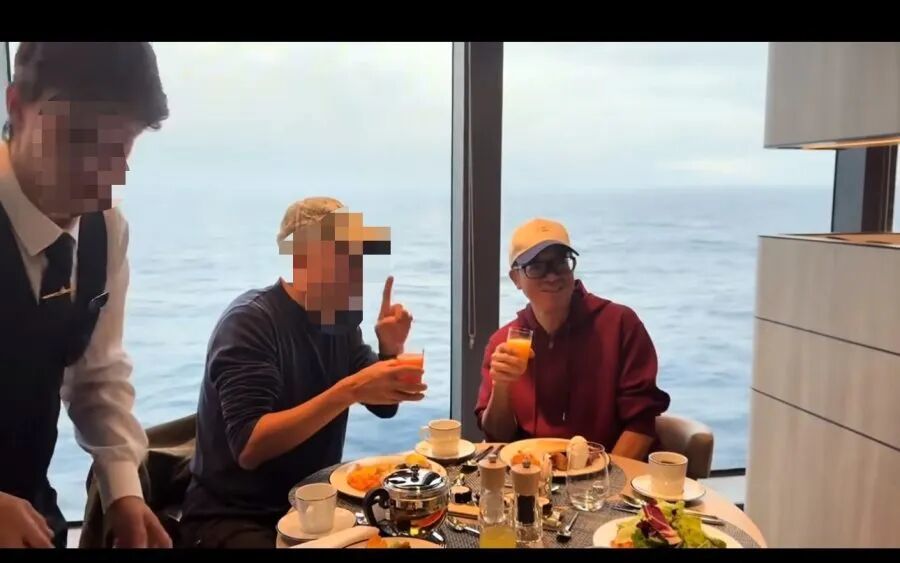
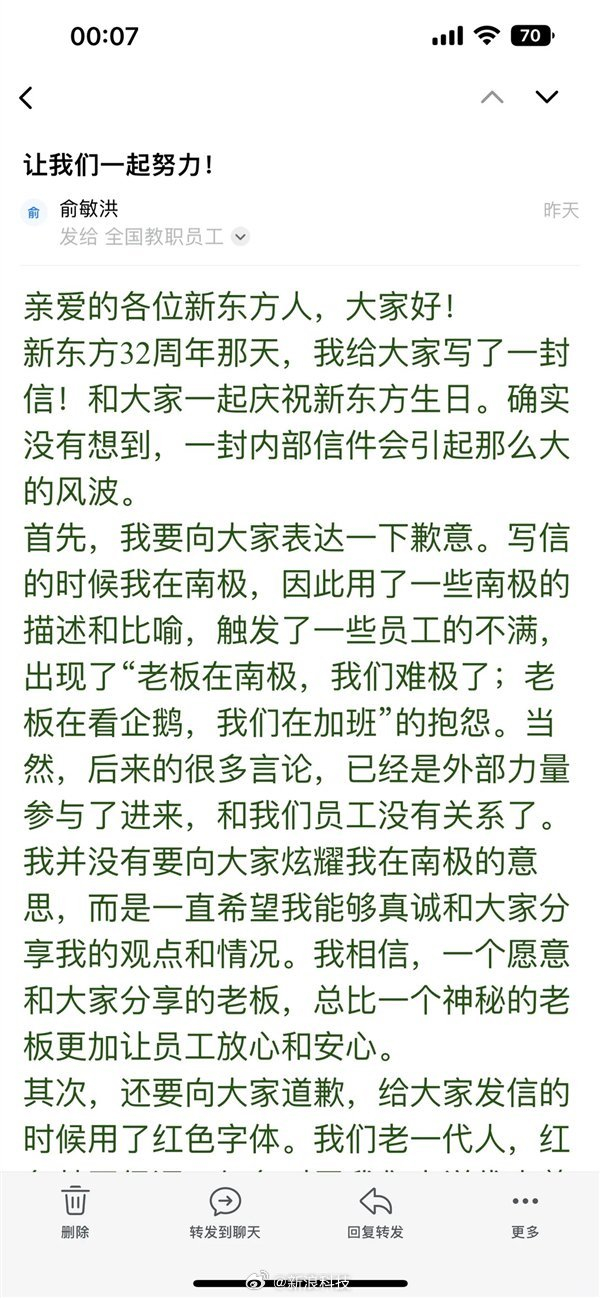
俞敏洪首先向员工表达了歉意,写信时在南极,因此用了一些南极的描述和比喻,触发了一些员工的不满,并没有要向大家炫耀在南极的意思,而是 一直希望能够真诚和大家分享我的观点和情况。"一个愿意和大家分享的老板,总比一个神秘的老板更加让员工放心和安心。" 对于用红色字体,俞敏洪也道歉。老一代人,红色基因很深。红色对于老一代人来说代表着喜庆和欢庆,所以并没有别的意思。 11月23日,据红星新闻援引媒体报道,俞敏洪又写了一封主题为"让我们一起努力"的全员信,再次向员工道歉,并详细解释了自己写信的缘由和初 衷。 俞敏洪在南极旅游。 图/视频截图 对于"用员工的血汗钱旅游"的说法,俞敏洪认为这样的表达不妥,你在努力工作的同时,老板们也在拼命努力,并承担更大的风险,确保公司的正常 发展,为你提供工作保障,是互相成就、互相合作、双向选择的过程。 俞敏洪承认,这次到南极来,确实有一定的个人旅游的味道,但同时也是为了工作。奚志农老师邀请他过来,是为了就青少年自然探索教育的问题进 行深入探讨。这次在南极,还碰到了几位优秀的人才,都是做自然教育和探索的专家,未来有可能进入新东方工作。 俞敏洪表示,如果在新东方工作,并且没有放弃这份工作,就 ...

蒋晖:每周只去公司0.5天,我怎么管好一家500人的公司?
创业家· 2025-11-23 09:43
Core Insights - The article emphasizes the importance of effective management strategies that allow business leaders to minimize their time spent in the office while maximizing productivity and efficiency through delegation and proper team selection [5][21]. Group 1: Management Strategies - The company focuses on hiring project leaders with a strong sense of responsibility and teamwork, offering salaries that are 20% to 50% higher than competitors to ensure high performance and autonomy [8][12]. - A key management approach involves setting clear core goals and strategies in collaboration with operational leaders, rather than leaving them to determine their own targets, which enhances efficiency [22][24]. - The company implements a dual-leadership model for key projects to mitigate risks associated with employee turnover, ensuring continuity and collaborative problem-solving [27][28]. Group 2: Time Valuation - The article discusses the importance of valuing the leader's time, suggesting that if a leader's daily value is estimated at 10,000 yuan, hiring employees to handle tasks that would take the leader a month is a cost-effective strategy [14][17]. - By assigning tasks to capable employees, the company can achieve significant productivity gains while allowing the leader to focus on strategic oversight rather than daily operations [19][20]. Group 3: Training and Development - The article promotes a three-day management training course that aims to equip business leaders with practical management skills, emphasizing real-world applications rather than theoretical knowledge [30][33]. - The course covers various aspects of management, including incentive systems, goal management, and organizational structure, designed to help leaders streamline operations and enhance team performance [39][47][50]. Group 4: Employee Performance and Retention - The company addresses common performance issues through structured performance assessments and incentive systems, aiming to create a self-driven team environment [41][44]. - Strategies are implemented to ensure that employees are engaged and motivated, reducing turnover and fostering a culture of continuous improvement [46][56]. Group 5: Organizational Structure - The article highlights the need for an advanced organizational structure that allows for self-management among employees, reducing the dependency on the leader for daily operations [51]. - This structure aims to clarify roles and responsibilities, enabling the company to operate efficiently without the constant presence of the leader [51]. Group 6: Recruitment and Talent Management - The company emphasizes the importance of effective recruitment strategies to attract high-quality talent, ensuring that the right people are in place to drive the business forward [53][57]. - Training is provided to enhance the recruitment process, focusing on selecting candidates who are proactive, creative, and aligned with the company's values [56][58].

俞敏洪道歉:“用员工血汗钱旅游”说法不妥,老板也在拼命努力
Mei Ri Jing Ji Xin Wen· 2025-11-23 06:04
Core Viewpoint - The letter from Yu Minhong, titled "Let's Work Hard Together," expresses apologies to employees and clarifies his intentions behind the letter, which was written during his trip to Antarctica [1][4]. Group 1: Apology and Intentions - Yu Minhong apologized to employees for any misunderstandings caused by his letter, emphasizing that he did not intend to boast about his trip to Antarctica but rather to share his thoughts sincerely [4]. - He acknowledged that his use of red font in the letter was a cultural reference, not meant to convey any other meaning [4]. - Yu Minhong addressed the criticism regarding the perception of using employees' hard-earned money for travel, stating that both employees and management are working hard and taking risks for the company's success [4]. Group 2: Context of the Trip - The trip to Antarctica had both personal and professional elements, as he was invited to discuss youth natural exploration education [4]. - During the trip, he met several experts in natural education, who may potentially join New Oriental in the future [4]. Group 3: Employee Reactions - The letter did not resonate as intended with some employees, who expressed dissatisfaction on social media, highlighting the contrast between Yu Minhong's experience and their own [6]. - Some employees found the descriptions of the Antarctic scenery in the letter to be ironic given their circumstances [6]. Group 4: Company Background and Financial Performance - New Oriental, founded in 1993, has undergone significant transformations, including a shift to live streaming and diversification into various educational services [10]. - The company is currently facing operational pressures, with a reported 73.7% drop in net profit to $7.1 million for the fourth quarter of fiscal year 2025, largely due to challenges in its core education business [10]. - The first quarter of fiscal year 2026 showed a net revenue of $1.523 billion, a 6.1% year-over-year increase, driven by new educational business growth [11]. Group 5: Market Performance - As of November 21, 2023, New Oriental's stock in the Hong Kong market has seen a decline of 4.39%, with a market capitalization of 619 billion HKD [11]. - In the U.S. market, New Oriental's stock rose by 0.92% to $51.65, with a market capitalization of $8.2 billion [12].