
电商平台

Search documents
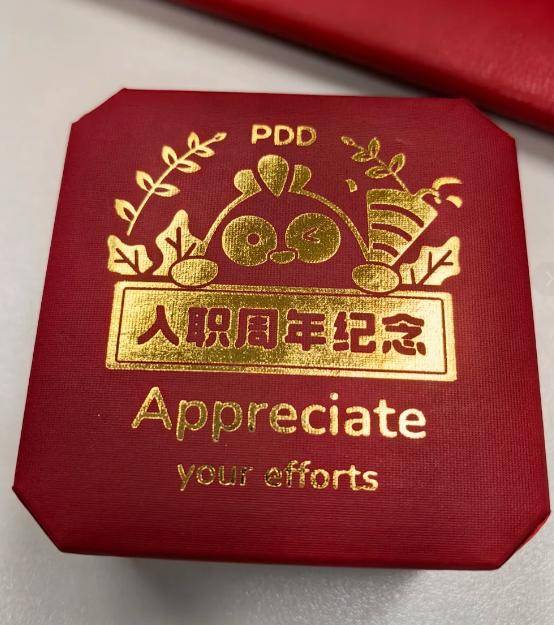
拼多多给员工发黄金,10年老员工直接领100克金子
Sou Hu Cai Jing· 2025-10-23 23:19
Core Points - Pinduoduo is celebrating its 10th anniversary in 2025 and has initiated a new tradition of gifting gold to employees [1][5] - The weight of the gold rings given to employees varies based on their years of service, with those who have been with the company for over 10 years receiving a significant gift of 100 grams of gold [5] Summary by Category Employee Recognition - Pinduoduo has established a tradition of giving gold gifts to employees starting in 2024, with the weight of the gifts increasing based on tenure [5] - Employees with over 3 years of service receive a gold ring weighing approximately 4 grams, while those with over 5 years receive an 11-gram ring [5] - For employees who have been with the company for 10 years, the gift has increased from 60 grams in the previous year to 100 grams this year [5]


亚马逊卖家如何定价?
Sou Hu Cai Jing· 2025-10-23 16:25
Core Insights - Pricing strategy is crucial for Amazon sellers, as it significantly impacts sales volume and profitability. Setting prices too high can deter buyers, while setting them too low can lead to insufficient profits and potential accusations of unfair competition. Group 1: Factors Influencing Pricing - Understanding the cost structure is essential, including procurement costs, logistics, storage, packaging, platform commissions (typically 8%-15%), and promotional expenses [3] - Market conditions must be analyzed, as sellers need to be aware of the price range of similar products offered by competitors on the platform [4] - Seller positioning is important; sellers must decide whether to focus on volume sales or brand quality, which will influence their pricing strategy [5] Group 2: Competitive Analysis - Sellers should conduct competitor analysis by searching for keywords on Amazon to observe the price range of top products. Pricing should be set within a reasonable range, slightly below leading competitors or in line with the majority, while using promotions to attract customers [6] Group 3: Strategies for New Sellers - New sellers may consider setting initial prices slightly lower to attract early orders and feedback, for example, pricing at $17.9 or $18.5 when the market price is $19.9 [7] - Once a seller has gained sufficient reviews and rankings, they can gradually increase prices to align with market averages [8] - Combining lower prices with advertising can enhance sales volume, allowing for smoother price adjustments later [9]

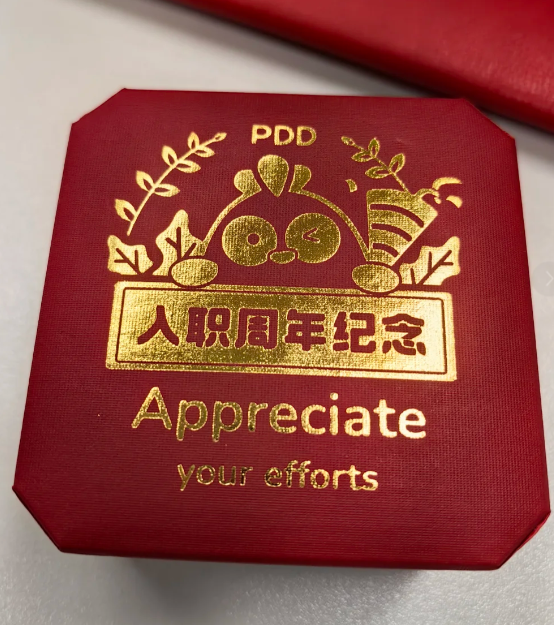
拼多多给员工发黄金,10年老员工直接领100克金子? 网友:还得是真金白银实在!
Qi Lu Wan Bao· 2025-10-23 08:59
Core Points - Pinduoduo is celebrating its 10th anniversary in 2025 and has initiated a new tradition of giving gold gifts to employees [1][7] - The weight of the gold rings given to employees varies based on their tenure, with those employed for over 10 years receiving a significant gift of 100 grams of gold [7] Summary by Category Employee Recognition - Pinduoduo has established a tradition of awarding gold gifts to employees, starting in 2024, with the weight of the gifts increasing based on years of service [7] - Employees with over 3 years of service receive a gold ring weighing approximately 4 grams, while those with over 5 years receive an 11-gram ring [7] - For employees with over 10 years of service, the gift has increased from 60 grams in 2024 to 100 grams in the current year [7] Company Milestones - The year 2025 marks the 10th anniversary of Pinduoduo, which was founded in 2015 [1][7] - The company is focused on creating value for consumers and adapting to changes in the e-commerce landscape [5]
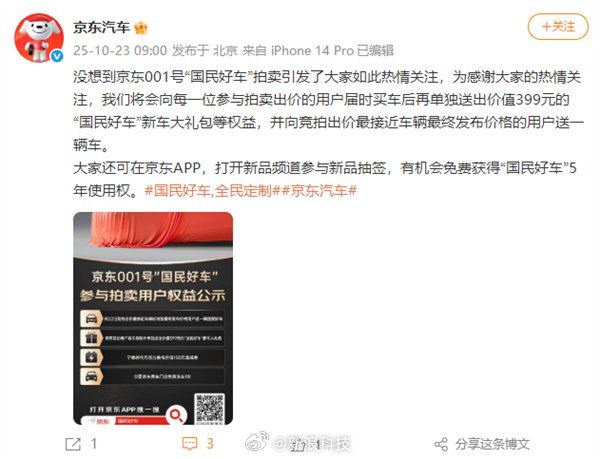
京东001号国民好车拍出7819万天价,竞拍者将获赠车
Xin Lang Ke Ji· 2025-10-23 06:00
Core Insights - JD.com's auction of the "National Good Car" No. 001 attracted significant attention, culminating in a final bid of 78.1934 million yuan, far exceeding the initial price range of 100,000 to 120,000 yuan [1][2] Group 1: Auction Details - The starting bid for the "National Good Car" was set at 1 yuan, with a final sale price of 78.1934 million yuan [1] - Participants were required to pay a deposit of 100 yuan, which could be deducted from the final payment if they won the auction [1][2] - If a participant decided to forfeit the purchase after winning, the 100 yuan deposit would be retained by JD.com [2] Group 2: Customer Engagement - JD.com expressed surprise at the high level of interest in the auction and announced plans to reward all participants with a 399 yuan "National Good Car" gift package upon purchasing a vehicle [2] - Additionally, JD.com will offer a car to the user whose bid was closest to the final auction price [2]

双11进入AI赛点!抖音电商的进取与隐忧
Sou Hu Cai Jing· 2025-10-23 01:13
Core Insights - The "Double 11" shopping festival is evolving, with major e-commerce platforms like Tmall, Kuaishou, Douyin, JD, and Xiaohongshu launching pre-sales to create a competitive atmosphere [2] - The focus for "Double 11" in 2025 will revolve around "extended cycles" and "low prices," with each platform adopting different strategies despite similar trends [2] Group 1: Douyin's Strategy and Performance - Douyin e-commerce launched the "Douyin Mall Double 11 Goodies Festival" on October 9, offering significant discounts and consumer coupons to stimulate sales [3] - Douyin reported impressive growth, with the number of merchants achieving over 10 million in sales increasing by 102% year-on-year, and the number of products exceeding 100 million in sales rising by 240% [3][4] - The platform's strategy combines affordable pricing with experiential shopping, targeting consumers' desire for value [3] Group 2: Competitive Landscape - The competition for "Double 11" has shifted from merely comparing GMV to a comprehensive battle focusing on efficiency, quality, and ecosystem development [6] - Douyin faces challenges in logistics and after-sales service, which could hinder its growth compared to established players like JD and Alibaba [6] - Traditional platforms like Tmall and JD have shown strong sales growth, with Tmall reporting significant brand performance during the pre-sale period [7] Group 3: AI Integration - This year's "Double 11" features a significant emphasis on AI technology across major platforms, moving from marketing gimmicks to practical applications [9] - Douyin is leveraging AI to enhance user experience, with initiatives like AI-assisted shopping recommendations to improve conversion rates [10] - However, Douyin must overcome challenges in integrating AI effectively into its e-commerce ecosystem, particularly in quality control and logistics [11]

折扣越多、信任越少?双11正在透支“低价”神话
Sou Hu Cai Jing· 2025-10-22 13:42
10月20日晚8点,双11首轮尾款支付通道开启。不到两天,社交平台上已是吐槽声一片:消费者抱怨"各种 优惠太复杂","算来算去还是买贵了";商家则搬出店铺销量流量数据,指责"活动成本高、没效果"。 从17年前的"半价狂欢"到现在的"数字游戏",作为最经典的电商大促活动,双11正站在信任的岔路口,迎 接买卖双方的重新审视。 "烧脑"的双11,消费者买单吗? 今年双11,一笔订单的优惠明细能拉多长? | 金额明细 | × | | --- | --- | | 实际优惠金额以活动当天下单页为准 | | | 商品息价 | ¥7379.60 | | 共减 | 减¥3692.11 | | 单品直降及店铺优惠 | 减¥1166.00 V | | 官方立减 | 减¥911.70 | | 购物券 | 减¥200.00 V | | 88VIP专享9.5折 | 減¥20.70 V | | 平台及达人优惠 | 减¥40.00 V | | 淘金币 | 减¥1.96 | | 家电消费券 | 减¥0.00 V | | 红句 9折券已抵¥ 497.02,可再抵¥ 2.98 | 减 ¥541 75 V | 单品直降、店铺满减、官方立减、购物券、 ...

京东001号汽车拍出4200万高价,1600人竞拍
Xin Lang Ke Ji· 2025-10-22 10:55
【#京东001汽车拍卖价超4200万#】今日,京东001号"国民好车"在京东启动拍卖仪式,起拍价1元。该 活动吸引了超21万人围观,超1600人参与竞拍,最高出价超4200万。据了解,此次竞拍,用户只需要交 100元保证金,如果放弃支付或支付后取消订单,将扣除保证金100元。由于毁约成本较低,该溢价最终 成交概率较小。 ...

多家平台发布涉税信息报送规则,电商税务合规已关乎生存
Sou Hu Cai Jing· 2025-10-22 09:46
Core Points - The implementation of the new tax reporting regulations for internet platform enterprises marks a significant transformation in the tax administration of e-commerce in China, addressing long-standing issues of information asymmetry and increasing compliance requirements for various e-commerce operators [2][4] Group 1: New Regulations Overview - The new regulations expand the regulatory scope to include all types of online sales platforms, including traditional B2C, social e-commerce, live streaming sales, and community group buying, thereby ensuring comprehensive coverage [2] - Platforms are required to report two main categories of tax-related information: basic platform information and detailed identity and income information of operators and employees, with specific requirements for income reporting [3] - Platforms are now held accountable for the authenticity, accuracy, and completeness of the reported information, facing penalties ranging from 20,000 to 500,000 yuan for non-compliance [4] Group 2: Tax Risks for E-commerce Operators - E-commerce operators face significant risks related to concealing sales income, as the new regulations require platforms to report all taxable income, making it easier for tax authorities to identify discrepancies [5][7] - The risk of inflating sales through fake transactions (刷单) is heightened, as such activities will now be included in the data reported to regulators, potentially triggering tax audits if discrepancies arise [8] - There is a risk of abusing tax incentives by artificially segmenting businesses to exploit lower tax rates, which could lead to tax adjustments by authorities if deemed to lack economic substance [9] Group 3: Compliance Recommendations - E-commerce operators should restructure their business processes and internal controls to ensure consistency across all transaction flows, including business, contracts, invoices, and funds [10] - It is essential to optimize accounting practices and tax reporting to align with accounting standards and tax laws, including maintaining auxiliary records for special transactions [11] - A robust documentation management system should be established to retain all relevant transaction records, including contracts, logistics, and payment proofs [12] - Operators are encouraged to leverage tax incentives appropriately while seeking professional tax advisory support to navigate the complexities of the new regulations [13] Conclusion - The new tax regulations signify a new phase in e-commerce tax administration, reflecting the principles of tax legality and innovation in regulatory models within the digital economy [14] - While the regulations may increase compliance costs and expose historical issues in the short term, they are expected to foster a fair competitive environment and promote healthy industry development in the long run [15]

“霸总男团”发红包,短剧预热双11
3 6 Ke· 2025-10-22 09:07
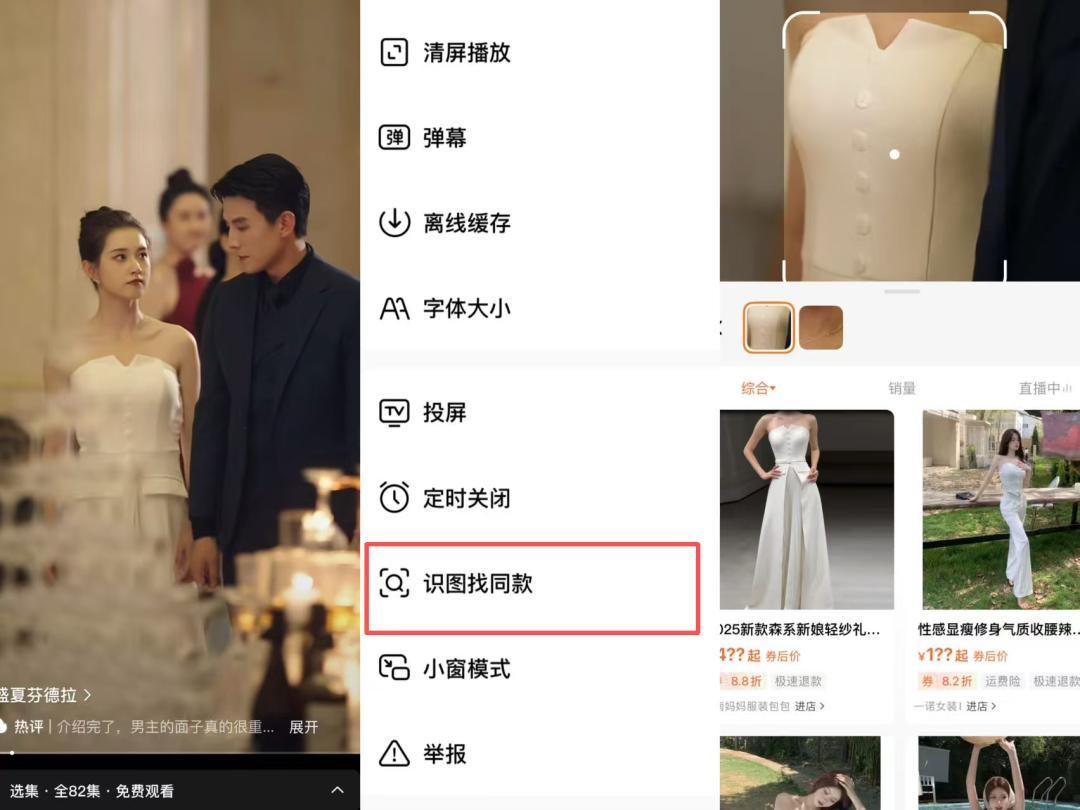
Core Insights - This year's Double Eleven (双11) shopping festival is witnessing a shift from traditional live-streaming sales to short dramas as a new marketing force, potentially opening a second growth curve for e-commerce [1] - ByteDance's Hongguo short dramas have introduced a "search for similar items" feature, indicating a monetization model for short dramas, which could significantly contribute to the upcoming Double Eleven sales [1][3] - Major e-commerce platforms like Taobao, JD.com, and Pinduoduo have already entered the short drama space, using it as a new method for brand marketing and customer acquisition [1][3] E-commerce Platforms' Strategies - JD.com has made significant investments in short drama operations, including hiring for multiple related positions, indicating a strong commitment to this new avenue [10][15] - Taobao has been developing its short drama strategy since 2024, launching initiatives like the "100 Billion Taobao Drama Plan" to enhance brand engagement through customized content [12][13] - Pinduoduo has also initiated a "Duoduo Has Good Dramas" plan, providing substantial traffic support and financial incentives to attract creators, aiming to engage lower-tier market users [15] Consumer Behavior and Marketing Dynamics - Short dramas are influencing consumer habits, with users like Li Jing purchasing items featured in the dramas, showcasing the emotional connection and trust built through storytelling [2][18] - The transition from brand marketing to direct sales in short dramas is expected to increase the scale of participation from both short drama creators and small businesses [3][16] - The emotional engagement created by short dramas is seen as a key advantage over traditional live-streaming, as it fosters a deeper connection with consumers, leading to higher conversion rates [9][16] Competitive Landscape - The competition among e-commerce platforms is intensifying, with each platform striving to capture user attention and increase engagement through short dramas [9][10] - The integration of short dramas with e-commerce functionalities, such as direct links to purchase items, is becoming a common strategy to enhance user experience and drive sales [3][10] - As the market for live-streaming becomes saturated, short dramas are emerging as a potential catalyst for e-commerce growth, providing a fresh approach to attract and retain users [9][18]

李佳琦回应“一夜之间赔了20亿”:都是假的,不用为我难过
Qi Lu Wan Bao· 2025-10-22 09:04
近日,社交平台上出现很多网友发布"双十一李佳琦赔了20亿"的帖子,相关传言引发热议。 0:00 / 1:09 随着各大电商平台陆续拉开"双十一"购物节大幕,不少消费者提前进入"选货"模式。今年"双十一",各大平台依然延续"战线拉长"策略,促销周期多从10 月下旬持续至11月中旬。 在优惠规则设计上,今年各大平台拿出各自"打法":京东与抖音于10月9日晚同步开跑,其中京东主打"现货开卖",推出官方直降及跨店满减等玩法,抖 音推出"一件直降"、消费券和专项补贴等;淘宝/天猫采用"预售+现货"组合,10月15日晚启动预售,10月20日晚开始支付第一波尾款并同步开启现货销 售,主打官方立减叠加消费券、品类券等多重优惠;拼多多则于10月16日晚开启大促,主打整点抢券、跨店满减等玩法。 10月20日晚,随着消费者开始支付第一波尾款,"双十一 没便宜"话题冲上热搜。不少消费者在经历一番计算比价后发现,部分商品即便预付定金,最终 到手价跟现货直买差不多甚至更高。一时间,"双十一 算不明白"等话题在社交平台上引发广泛共鸣。规则复杂、计算心累、实惠难寻,让不少人直呼"心 累"。 (齐鲁晚报·齐鲁壹点客户端编辑 张宝帆综合浙江在线 ...
