
软件和信息技术服务

Search documents
2025年9月起,增值税期末留抵退税政策有新变化
蓝色柳林财税室· 2025-11-08 14:12
Core Viewpoint - The article discusses the new changes to the VAT end-of-period credit refund policy effective from September 2025, allowing eligible taxpayers to apply for refunds of their end-of-period VAT credits under specific conditions [3]. Group 1: Eligible Industries - Taxpayers in the manufacturing, scientific research and technical services, software and information technology services, and ecological protection and environmental governance sectors can apply for monthly refunds of their end-of-period VAT credits [5]. - The refund calculation formula for these industries is: Refundable VAT credit = End-of-period VAT credit × Input composition ratio × 100% [6]. Group 2: Real Estate Sector - Real estate developers can apply for a refund of 60% of the newly increased end-of-period VAT credits if the new credits are greater than zero for six consecutive months, with the sixth month’s new credits not less than 500,000 yuan [8]. - The refund calculation formula for real estate developers is: Refundable VAT credit = Newly increased end-of-period VAT credit compared to March 31, 2019, × Input composition ratio × 60% [9]. Group 3: Other Taxpayers - Other taxpayers can apply for a refund if they have positive end-of-period VAT credits for six consecutive months, and the newly increased credits in the sixth month compared to the previous year’s end-of-period credits are not less than 500,000 yuan [11]. - The refund calculation formula for these taxpayers is: Refundable VAT credit = Newly increased end-of-period VAT credit (up to 100 million yuan) × Input composition ratio × 60% + (amount exceeding 100 million yuan) × Input composition ratio × 30% [11]. Group 4: Eligibility Conditions - To qualify for the policy, taxpayers must have an A or B tax credit rating [12]. - Taxpayers must not have committed fraud related to VAT refunds or have been penalized for tax evasion in the past 36 months [13][14]. - Taxpayers must not have enjoyed VAT immediate refund policies since April 1, 2019, unless otherwise specified [15].


核心条款未能达成共识,德固特终止“蛇吞象”式收购
Shen Zhen Shang Bao· 2025-11-08 10:30
Core Viewpoint - The company intends to terminate the major asset restructuring transaction to acquire 100% equity of Haowei Technology due to the inability to reach an agreement on key terms with the transaction parties [1][2]. Group 1: Transaction Details - The company planned to acquire Haowei Technology through a combination of issuing shares and cash payments, along with raising supporting funds [1][2]. - Despite multiple negotiations, the company could not agree on the transaction price and other core terms with the transaction parties [1][2]. - The termination of the transaction will not adversely affect the company's normal business operations or harm the interests of shareholders, particularly minority shareholders [2]. Group 2: Financial Comparison - In 2024, the company's revenue was just over 500 million, while Haowei Technology's revenue exceeded 3.6 billion [3]. - As of March 31 of this year, the company's total assets were 1.156 billion, with equity of 765 million, compared to Haowei Technology's total assets of 5.617 billion and equity of 2.954 billion, indicating a significant disparity between the two companies [3]. Group 3: Company Profiles - The company is a high-tech energy-saving and environmental protection equipment manufacturer, providing solutions in clean combustion and heat energy saving across various sectors [3]. - Haowei Technology is an international software and information technology service provider, offering digital and intelligent solutions to global telecom operators and enterprise clients [3].

光庭信息取得集成汽车驾驶用例仿真场景生成相关专利
Jin Rong Jie· 2025-11-08 09:25
Group 1 - The core point of the article is that Wuhan Guangting Information Technology Co., Ltd. has obtained a patent for a method and system for generating simulated scenarios for integrated automotive driving use cases, with the patent granted on CN 115080385 B and the application date being May 2022 [1] Group 2 - Wuhan Guangting Information Technology Co., Ltd. was established in 2011 and is located in Wuhan, primarily engaged in software and information technology services [1] - The company has a registered capital of 92.6223 million RMB [1] - According to data analysis, the company has invested in 14 enterprises, participated in 531 bidding projects, holds 41 trademark registrations, and has 656 patent registrations, along with 31 administrative licenses [1]
300950,终止重大资产重组!
Zhong Guo Ji Jin Bao· 2025-11-08 02:17
Core Viewpoint - The company Deguot plans to terminate the acquisition of 100% equity in Haowei Technology due to the inability to reach an agreement on key terms of the transaction with the counterparties [1][2]. Group 1: Transaction Details - Deguot intended to acquire Haowei Technology through a combination of share issuance and cash payment, aiming to create a second growth curve for the company [1][4]. - The negotiation process has been ongoing, but Deguot and the counterparties have failed to agree on the transaction price and other core terms [2]. - The major shareholders of Haowei Technology include Nanjing Xiruan Enterprise Management Partnership, ZTE Corporation, and Nanjing Jiayuteng Enterprise Management Partnership, holding 27.83%, 27.62%, and 13.85% respectively [3]. Group 2: Financial Performance - Deguot's net profit for the years 2022 to 2024 is projected to be 65.58 million, 38.66 million, and 96.71 million respectively, with non-recurring net profit figures of 57.76 million, 33.63 million, and 93.44 million [4]. - In the first three quarters of 2025, Deguot's net profit decreased by 26.39% to 72.26 million, while the non-recurring net profit fell by 31.86% to 65.24 million [4]. Group 3: Haowei Technology Overview - Haowei Technology is an international software and information technology service provider, focusing on digital transformation solutions based on cloud computing, big data, and artificial intelligence for telecom operators, government, and enterprise clients [5]. - The company has three main business lines: telecom software development and services, cloud and AI software development and services, and industry digital solutions, with significant advantages in overseas business [5]. - Haowei Technology's net profit for 2023, 2024, and the first quarter of 2025 is projected to be 202 million, 205 million, and -13.3 million respectively [6].
赛力斯申请混动汽车驱动模式控制相关专利,避免低电量且驾驶员加速时出现的动力不足及行车不平稳问题
Jin Rong Jie· 2025-11-08 01:05
Group 1 - Chengdu Silis Technology Co., Ltd. has applied for a patent titled "Hybrid Vehicle Drive Mode Control Method, System, and Hybrid Vehicle," with publication number CN120902710A and application date set for October 2025 [1] - The patent describes a method for controlling the drive mode of hybrid vehicles, which includes obtaining current driving conditions such as speed, road conditions, battery level, and drive mode [1] - The method involves generating commands to switch between series and parallel drive modes based on the vehicle's power requirements and the driver's acceleration intent, particularly when the battery level is below a preset threshold [1] Group 2 - Chengdu Silis Technology Co., Ltd. was established in 2021 and is located in Chengdu, primarily engaged in software and information technology services [1] - The company has a registered capital of 5 million RMB and has made investments in one other enterprise, holding a total of 402 patents and one administrative license [1]

国能日新服务电站净增千余家 拟携手东方园林4亿布局储能
Chang Jiang Shang Bao· 2025-11-07 00:01
Core Viewpoint - Guoneng Rixin plans to establish a joint venture with Dongfang Yuanglin's subsidiary to develop a storage-related company, aiming to expand market opportunities and create new profit growth points [1][2][3]. Joint Venture Details - Guoneng Rixin and Dongfang Xinneng will jointly invest in establishing Dongfang Xinneng (Beijing) Energy Storage Industry Development Co., Ltd. with a registered capital of 400 million yuan, where Guoneng Rixin will contribute 160 million yuan, accounting for 40% [2]. - Dongfang Xinneng will manage the financing and operations of the joint venture and its project companies, while Guoneng Rixin will provide feasibility and economic assessments for renewable energy projects [2][3]. Strategic Focus - The investment aligns with Guoneng Rixin's strategic development plans, leveraging Dongfang Xinneng's advantages in renewable asset development and Guoneng Rixin's expertise in asset operation services to explore new business models [3]. Performance Growth - In the first half of 2025, Guoneng Rixin's service scale increased significantly, with a net addition of 1,116 power stations, surpassing historical levels [1][4]. - The company reported a revenue of 205 million yuan from its renewable energy power forecasting products, accounting for 63.96% of total revenue, indicating strong downstream demand [4]. Financial Results - For the first three quarters of 2025, Guoneng Rixin achieved a revenue of 500 million yuan, a year-on-year increase of 36.97%, and a net profit of approximately 75.43 million yuan, up 41.75% [5]. - The company improved cost management, with reductions in sales, management, and R&D expense ratios compared to the previous year [5].


能源数字化领先企业、光刻材料龙头今日申购,2只新股上市
2 1 Shi Ji Jing Ji Bao Dao· 2025-11-06 23:29
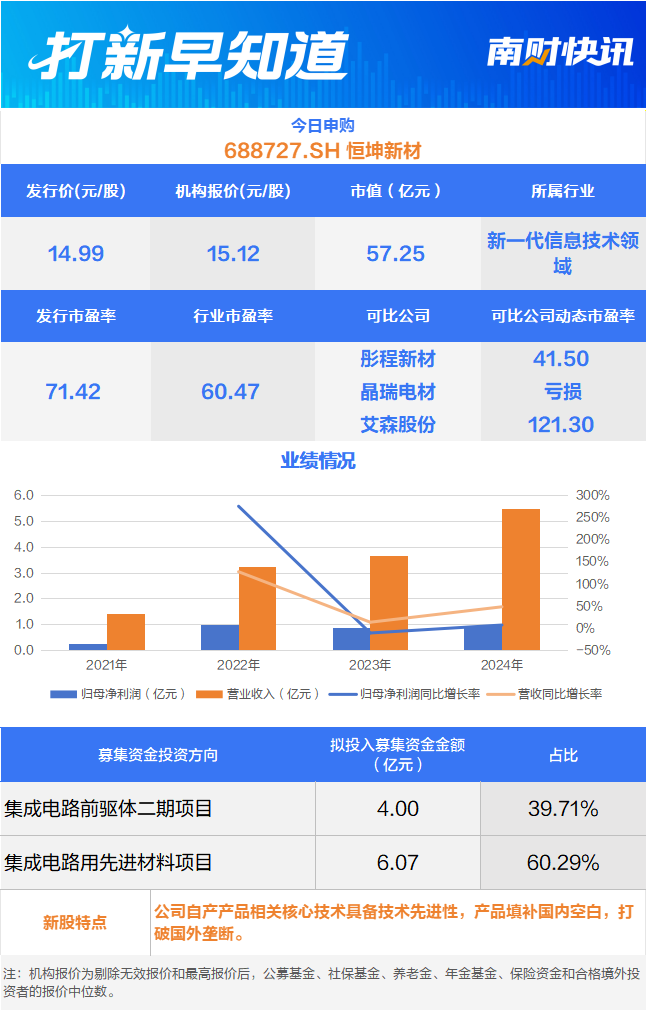
New IPOs - Two new stocks are available for subscription: Hengkun New Materials (688727.SH) on the Sci-Tech Innovation Board and Nanfang Digital (301638.SZ) on the ChiNext Board [1] - Hengkun New Materials focuses on the research and industrial application of key materials in the integrated circuit field, being one of the few domestic companies capable of developing and mass-producing 12-inch integrated circuit wafer manufacturing materials [2][4] - Nanfang Digital provides comprehensive digital construction solutions for clients in the power and energy sectors, aiming to drive digital transformation in the electricity industry [7][8] Hengkun New Materials - The offering price is 14.99 CNY per share, with a market capitalization of 57.25 billion CNY and an issuance P/E ratio of 71.42, compared to the industry average of 60.47 [4] - The company’s main products include SOC, BARC, KrF photoresist, i-Line photoresist, and TEOS precursor materials, with sales revenue projected to grow from 123.58 million CNY in 2022 to 344.19 million CNY in 2024 [5][6] - Hengkun New Materials has a high customer concentration, primarily serving top domestic wafer manufacturers, and has achieved a market share exceeding 10% in the domestic market for photoresist materials [5][6] Nanfang Digital - The offering price is 5.69 CNY per share, with a market capitalization of 153.80 billion CNY and an issuance P/E ratio of 32.22, significantly lower than the industry average of 71.22 [8][10] - The company’s revenue from digital grid construction reached 75.51 million CNY in the first half of 2025, accounting for 48.64% of total revenue, with significant contributions from enterprise digitalization and digital infrastructure [11][12] - Nanfang Digital has developed key technologies for the power industry, including an IoT operating system and a dedicated AI model, and has participated in multiple national key R&D projects [11] DeLijia - DeLijia, listed on the main board, specializes in the research, production, and sales of high-speed heavy-load precision gear transmission products, primarily for wind power generation [13][16] - The offering price is 46.68 CNY per share, with a market capitalization of 186.70 billion CNY and an issuance P/E ratio of 34.98 [16] - The company has established strong partnerships with leading wind turbine manufacturers and is projected to hold a 16.22% market share in China’s wind power transmission equipment sector by 2024 [19] Zhongcheng Consulting - Zhongcheng Consulting, listed on the Beijing Stock Exchange, focuses on engineering consulting services and has ranked among the top in Jiangsu province for several years [20][23] - The offering price is 14.27 CNY per share, with a market capitalization of 1300.18 billion CNY and an issuance P/E ratio of 9.69, significantly lower than the industry average of 40.16 [23] - The company’s revenue from engineering cost consulting accounted for 53.39% of total revenue in the first half of the year, with a notable increase in accounts receivable posing a potential risk [25]
延趣网络科技以3.31亿元竞得泉州富力万达文华酒店
Ge Long Hui A P P· 2025-11-05 03:57
Core Insights - Quanzhou Yanqu Network Technology Co., Ltd. acquired the R&F Wanda Hotel in Quanzhou for 331 million yuan, below its market reference price of 473 million yuan [1] Company Overview - Quanzhou Yanqu Network Technology Co., Ltd. is a subsidiary of Xiamen Yanqu Network Technology Co., Ltd., primarily engaged in software and information technology services [1] - The company focuses on developing innovative products in the ancient costume management and nurturing game sector [1] Property Details - The acquired property is a 24-story building with a total construction area of 47,767 square meters, designated for hotel use but currently utilized for commercial, office, and guest room purposes [1] - The property is located on the southern side of the mid-section of Baozhou Road in Fengze District, Quanzhou [1]
运达科技:控股股东运达创新解除质押2410万股
Mei Ri Jing Ji Xin Wen· 2025-11-04 10:41
Group 1 - Company Yunda Technology (运达科技) announced the release of 24.1 million shares from pledge by its controlling shareholder Yunda Innovation (运达创新) [1] - As of the announcement date, Yunda Innovation has a total of 37.88 million shares pledged, accounting for 36.99% of its total holdings [1] - For the first half of 2025, Yunda Technology's revenue composition is 99.65% from software and information technology services, with other businesses contributing 0.35% [1] Group 2 - Yunda Technology has a market capitalization of 5.7 billion yuan [2] - The industry is experiencing a surge in overseas orders, increasing by 246%, covering over 50 countries and regions [2] - Entrepreneurs have warned of potential malicious competition as some are selling at a loss [2]

郑州、洛阳、南阳,稳居全省前三!
Sou Hu Cai Jing· 2025-11-01 12:19
Core Insights - The economic performance of 18 cities in Henan province for the first three quarters has been released, showing a GDP growth of 5.6%, surpassing the national average by 0.4 percentage points [2][4]. Group 1: Economic Growth - Henan's GDP for the first three quarters reached 48,867.57 billion yuan, with a year-on-year growth of 5.6% [2]. - 15 cities in Henan outperformed the national GDP growth rate, with notable performances from cities like Luohe and Xuchang, which recorded growth rates of 7% and 6.6% respectively [2][3]. - 16 cities in Henan achieved GDP growth rates of 5.4% or higher, indicating strong economic momentum [3]. Group 2: Key Cities Performance - Zhengzhou, Luoyang, and Nanyang maintained the top three GDP positions in the province, with Zhengzhou's GDP exceeding 1.1 trillion yuan and a growth rate of 5.4% [4][6]. - Luoyang's GDP growth rate was 5.8%, while Nanyang's growth rate was higher than both Zhengzhou and Luoyang, with all three cities contributing significantly to the provincial economy [5][6]. - Zhengzhou's industrial output increased by 8.8%, with 27 out of 37 industrial sectors showing growth [4][6]. Group 3: Industrial and Consumer Contributions - The industrial sector showed resilience, with 70% of cities in Henan achieving industrial output growth rates above 8% [7]. - Consumer spending also contributed positively, with several cities reporting retail sales growth rates of 7% or higher [7]. - The province's investment growth rates remained robust, with all reported cities showing investment growth rates above 4.4% [7]. Group 4: Future Outlook - The fourth quarter is critical for achieving annual economic targets, with a focus on maintaining stability in employment, enterprises, and market expectations [9]. - Continued efforts in industrial upgrading and service sector development are expected to enhance economic growth structures in key cities like Zhengzhou and Luoyang [9].