
脑机接口

Search documents
股市暴涨13.7%!脑机接口凭什么成为2026开年顶流?
机器人圈· 2026-01-12 09:29
Core Viewpoint - The recent surge in the brain-computer interface (BCI) sector in the A-share market reflects a significant shift from laboratory research to clinical application, marking a milestone in the integration of life sciences and engineering technology [1] Group 1: Domestic Breakthroughs - The domestic BCI field has seen a rapid increase in clinical achievements, highlighted by Brain Tiger Technology's launch of the first fully implanted, wireless, and fully functional BCI product, which successfully enabled a high-level paraplegic patient to control web browsing through thought [2] - This "three-in-one" product addresses critical issues such as infection risks associated with external systems and allows patients to connect with various devices, creating an "extended body" ecosystem [2] - Clinical data shows that patients achieved thought control within five days post-surgery, with a decoding rate of 5.2 BPS, comparable to international standards [2] Group 2: Technological Advancements - The second-generation high-throughput wireless invasive BCI system developed by the Chinese Academy of Sciences allows high-level paraplegic patients to control wheelchairs and other devices using only their thoughts, with a fourfold increase in data reading speed [3] - The establishment of China's first comprehensive clinical trial area for BCIs signifies the standardization and scaling of clinical research in this field, providing ample clinical data support for technological iterations [3] Group 3: Industry Acceleration - The rapid advancements in domestic technology are fueled by a competitive global environment, exemplified by Neuralink's plans for large-scale production of BCI devices and significant reductions in surgical time and costs [4] - The shift from niche research to essential medical applications is driven by the need for effective treatments for patients with spinal cord injuries and other neurological conditions, marking a revolutionary breakthrough in life sciences [4] Group 4: Caution Amidst Enthusiasm - Despite the excitement in the capital markets, the BCI field is still in a critical phase of clinical validation, with significant challenges remaining before large-scale commercialization can be achieved [5] - The complexity of the human brain presents a major challenge for accurately capturing and interpreting neural signals, with projections indicating that recording from one million neurons may not be feasible until 2100 [5] Group 5: Long-term Value of Technological Progress - The stock market surge in the BCI sector represents a forward-looking vote of confidence in breakthroughs in life sciences technology, which has the potential to transform the lives of millions suffering from neurological diseases [6] - As China transitions from a follower to a competitor in the BCI field, ongoing clinical breakthroughs and technological innovations are paving the way for new possibilities in human health [6]

一财主播说|脑机接口“独角兽”强脑科技或提交香港IPO申请
Di Yi Cai Jing· 2026-01-12 09:29
据报道,脑机接口公司强脑科技将以保密形式提交香港IPO申请。今天,脑机接口概念股集体上涨,南 京熊猫6天5板,道氏技术封涨停。另据此前报道,强脑科技已完成约20亿元人民币融资,为脑机接口领 域除马斯克旗下Neuralink以外的世界第二大规模融资。值得一提的是,其投资人阵容强大,包括IDG、 由英特尔CEO陈立武创立的华登国际,"果链"巨头蓝思科技、领益智造,战略投资方韦尔股份、润泽科 技、华住集团、好未来集团等。强脑科技与DeepSeek,宇树科技等科技企业并称为"杭州六小龙",是全 球极其少数实现脑机接口产品规模性量产的企业。另外,脑机交互与人机共融海河实验室主任明东表 示,脑机接口在医疗健康、消费电子、军事航天等多个领域展现出巨大的应用前景和市场潜力。 ...
传强脑科技秘密交香港IPO申请,或成“杭州六小龙”首家上市公司
Feng Huang Wang· 2026-01-12 09:05
1月12日,据彭博社消息,浙江强脑科技有限公司(BrainCo)已秘密提交香港IPO申请,有望成为中 国"杭州六巨头"(杭州六大新兴科技公司)中首家上市的企业。 此次发行由中金公司与瑞银集团合作推进,预计募集资金规模为数亿美元,具体细节仍在讨论中。 据了解,强脑科技是一家专注于脑机接口技术的科技公司,属于杭州新兴科技企业群体"杭州六小龙"之 一,该群体还包括人工智能公司深度求索(DeepSeek)。此外,杭州作为阿里巴巴集团总部所在地, 近年来已培育出多家科技创新企业。 强脑科技由韩璧丞于2015年创立,专注于非侵入式脑机接口技术,产品包括仿生肢体等,其技术路线区 别于需植入设备的美国脑机接口"领头羊"公司——Neuralink。 脑机接口技术近年被视为中美科技竞争的前沿领域之一,中国亦在政策与资本层面加大对相关本土企业 的支持。强脑科技若成功上市,将成为国内脑机接口赛道走向公开资本市场的重要节点。 公开信息显示,强脑科技近期完成了一轮约20亿元人民币的融资,由IDG资本与华登国际领投。目前, 脑机接口领域已成为科技发展的前沿赛道之一,除强脑科技外,中国国内亦有神玑医疗、脑陆科技等公 司在该领域进行探索。 另 ...
脑机接口板块,利好
Zhong Guo Zheng Quan Bao· 2026-01-12 08:40
Group 1: AI Applications and Brain-Computer Interface (BCI) Sector - The AI application sector is leading the market, with significant gains observed in stocks such as Zhiyu, Weimeng Group, and Kingsoft Cloud [2] - The brain-computer interface sector is experiencing a strong performance, driven by positive news from the Tianjin University BCI laboratory focusing on non-invasive BCI technology [2][3] - The Tianjin University BCI laboratory has developed a comprehensive chain from high-performance devices to clinical applications, including products for stroke rehabilitation and emotional state detection in astronauts [6] Group 2: Commercial Aerospace Sector - The commercial aerospace sector continues to show strong activity, with related stocks performing well [7] - Recent government initiatives in Zhejiang and Shanghai are aimed at promoting low-orbit satellite internet and advanced manufacturing in the aerospace sector [10] Group 3: Stock Performance Highlights - Notable stock performances in the BCI sector include: - Yinkang Life: +12.16% [5] - Beiyikang: +11.89% [5] - Aipeng Medical: +10.94% [5] - Hai Ge Communication: +10.00% [5] - The commercial aerospace sector also saw significant gains, with stocks like Tianli Composite up by 24.96% and Zhongtai Co. up by 20.02% [8]

沸腾了!今天,见证A股历史!
天天基金网· 2026-01-12 08:30
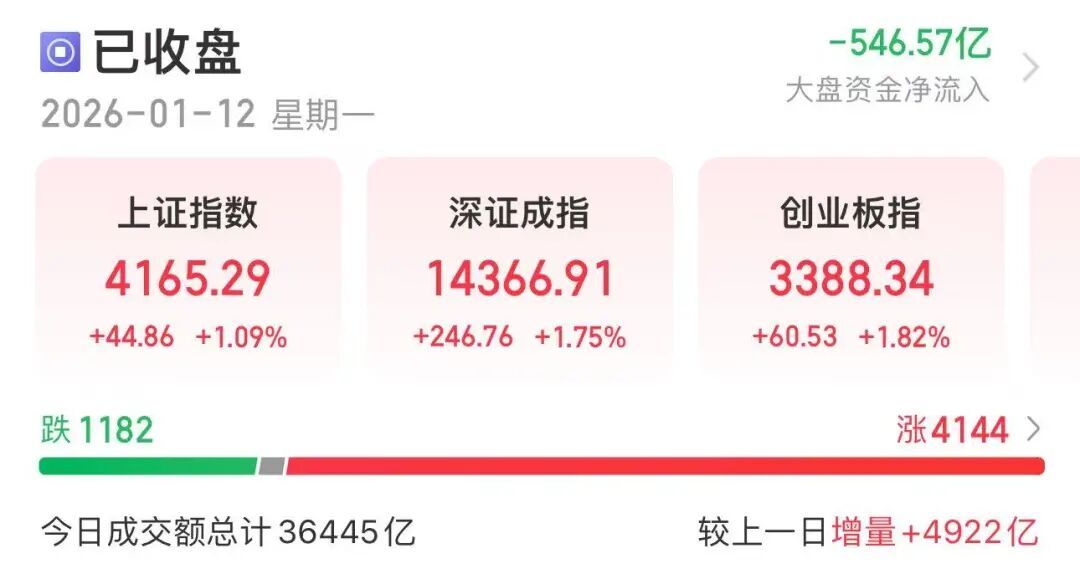
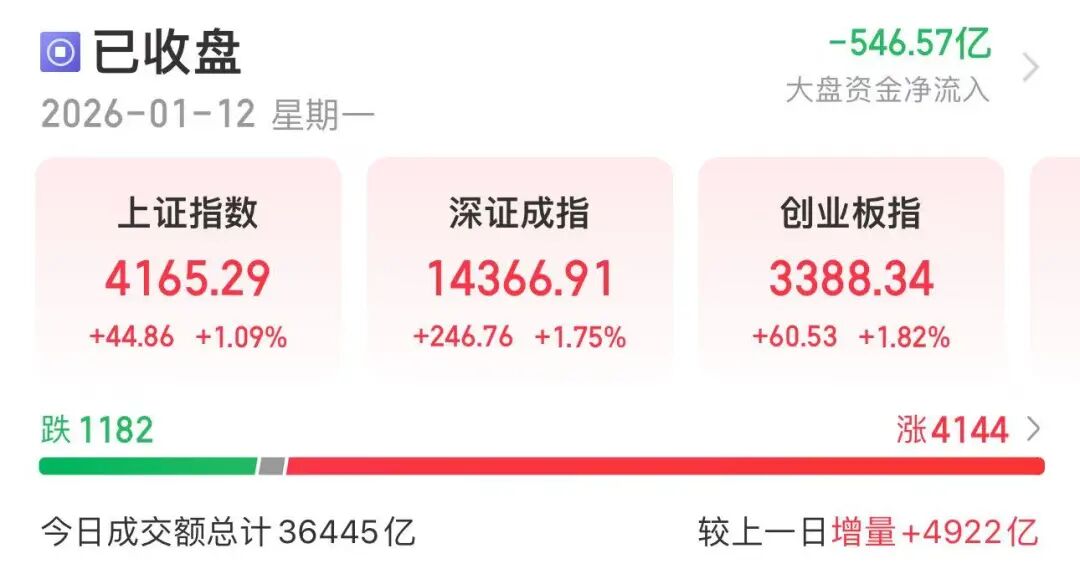
Market Overview - The A-share market experienced a significant rally, with all three major indices rising over 1%. The Shanghai Composite Index increased by 1.09%, the Shenzhen Component Index by 1.75%, and the ChiNext Index by 1.82% [2] - Over 4,000 stocks rose, with 201 stocks hitting the daily limit up, while 1,182 stocks declined [3] - The total trading volume reached 36.446 trillion yuan, marking the second consecutive day of exceeding 30 trillion yuan, an increase of 4.787 trillion yuan from the previous trading day, setting a new historical record for trading volume [2][4] Sector Performance - The surge in the market is linked to the recent popularity of the Generative Engine Optimization (GEO) concept, which focuses on enhancing the visibility of content in AI search results [5] - AI application and marketing sectors saw significant gains, with stocks like BlueFocus Communication Group and Hand Information Technology hitting the daily limit up [4] - The commercial aerospace sector continued its strong performance, with China Satellite and China Satcom both reaching new highs [7] Notable Stocks - Several stocks recorded substantial gains, including: - Parallel Technology: +21.07% [7] - BlueFocus Communication Group: +20.02% [7] - Hand Information Technology: +20.01% [7] - The satellite ETF also saw a limit up, reflecting the overall bullish sentiment in the market [10] Brain-Computer Interface Sector - The brain-computer interface sector remained active, with stocks like Dao Technology and Rock Mountain Technology hitting the daily limit up. This activity is supported by recent developments in brain-computer interaction technology [12] - Strong Brain Technology has reportedly submitted a confidential IPO application in Hong Kong [13]

电子行业跟踪报告:2026年Neuralink将对脑机接口设备进行大规模生产
Shanghai Aijian Securities· 2026-01-12 08:30
Investment Rating - The report rates the electronic industry as "Outperform" compared to the market [1]. Core Insights - Neuralink is set to begin large-scale production of brain-computer interface (BCI) devices in 2026, transitioning to a more streamlined and nearly fully automated surgical process [2][5]. - The global BCI market is projected to reach $3.3 billion by 2026, with a compound annual growth rate (CAGR) of 12.7% from 2024 to 2026 [15][16]. - Non-invasive BCI technology is expected to dominate the market, accounting for over 80% of the BCI products by 2024 [16]. Summary by Sections Neuralink Development History - Neuralink was founded in 2016 by Elon Musk, focusing on invasive brain-computer interfaces and AI integration into the human cortex [6]. - The first product was launched in 2019, featuring ultra-thin flexible electrodes and a custom microchip [9]. Overview of Brain-Computer Interfaces - BCIs establish a direct communication pathway between the brain and external devices, aiming to interpret brain activity and convert it into commands for controlling devices [10]. Market Analysis - The global BCI market is expected to reach $2.6 billion in 2024, with a year-on-year growth of 8.3% [15]. - In China, the BCI market is projected to reach $460 million in 2024, growing by 18.5% [15]. Non-Invasive BCI Manufacturers - Companies like Kernel, Neurable, and MindMaze are actively developing non-invasive BCI technologies [20]. - Domestic companies such as Strong Brain Technology and Xiangyu Medical are also making significant advancements in this field [20].
脑机接口板块,利好!
Zhong Guo Zheng Quan Bao· 2026-01-12 08:23
Group 1: AI Applications and Brain-Computer Interface (BCI) - The AI application sector is leading the market, with stocks like Zhiyu, Weimeng Group, and Kingsoft Cloud showing significant gains [2] - The brain-computer interface sector is experiencing a boost, driven by positive news from the Tianjin University team focusing on non-invasive BCI technology [2][3] - The Tianjin University BCI lab has developed a comprehensive chain from high-performance devices to clinical applications, including products for stroke rehabilitation and emotional state monitoring in astronauts [6] Group 2: Commercial Aerospace - The commercial aerospace sector remains active, with related stocks continuing to rise [7] - Recent government initiatives in Zhejiang and Shanghai are promoting investment in low-altitude economy and commercial aerospace, indicating a supportive regulatory environment for these industries [10] Group 3: Company-Specific Developments - Tianpu Co. (605255) faced a trading halt and subsequently a limit down, closing at 196.22 CNY per share, following a significant price increase of 1663.2% in 2025 [11] - The company issued a clarification regarding rumors about its actual controller, stating that the claims were unfounded and did not involve any official statements [12][13]
脑机接口IPO浪潮起!强脑科技赴港上市,行业商业化拐点已至?
Jin Rong Jie· 2026-01-12 08:20
Group 1: Industry Overview - Brain-computer interface (BCI) technology is at a critical juncture of "technological breakthrough to commercialization," supported by policies, technology, and application scenarios [2] - The global market for BCI is expected to change due to policy benefits, external production expectations, and domestic clinical breakthroughs [2] - Invasive BCI products are still in clinical trials, while non-invasive products, such as rehabilitation systems and sleep aids, have been partially launched [2] Group 2: Technological Advancements - Advancements in chips, electrodes, and algorithms, along with improved regulatory standards, are expected to lead to intensive commercialization of BCI products in the coming years [2] - Companies like Neuralink plan to start large-scale production of BCI devices by 2026, with significant innovations in surgical procedures [2] Group 3: Competitive Landscape - The BCI industry in China is still in its early stages, with most companies being small in scale [2] - There is a notable advantage in the signal quality of invasive BCIs, while non-invasive BCIs offer high safety and ease of operation, serving as a complement to invasive types [2] Group 4: Industry Chain and Key Players - Upstream: Innovative Medical has strategically invested in Hangzhou Boling Medical Technology to enter the BCI field [3] - Midstream: Nanjing Panda is developing key technologies for multimodal human-computer interaction systems based on BCI technology [6] - Downstream: Sanbo Neuroscience has achieved breakthroughs in precise tumor removal technology and is exploring clinical applications related to brain science [8]
沪指17连阳,A股成交额超3.6万亿元创新高!多只卫星ETF涨停
Sou Hu Cai Jing· 2026-01-12 08:18
红星资本局根据Wind统计发现,A股成交额自2025年12月26日突破2万亿元以来,已经连续10个交易日稳定在2万亿元以上,并在1月9日突破3万亿元大关。 | | | A股成交额超2.6万亿交易日一览 | | | --- | --- | --- | --- | | | 日期 | 成交量(亿股) 成交額(亿元) | | | | 2026-01-12 | 2,008. 741 | 36, 446. 14 | | | 2024-10-08 | 2, 890. 60 | 34, 697. 61 | | 3 | 2025-08-27 | 2, 012. 58 | 31, 973. 38 | | 4 | 2025-08-25 | 1, 968. 26 | 31, 768. 40 | | 5 | 2025-09-18 | 1, 961. 73 | 31, 665. 28 | | 6 | 2026-01-09 | 1, 754. 62 | 31, 523. 68 | | 7 | 2025-08-28 | 1, 859. 43 | 30, 007. 19 | | 8 | 2024-10-09 | 2, 260. 77 | 29 ...
今天,沸腾了!
Zhong Guo Ji Jin Bao· 2026-01-12 08:16
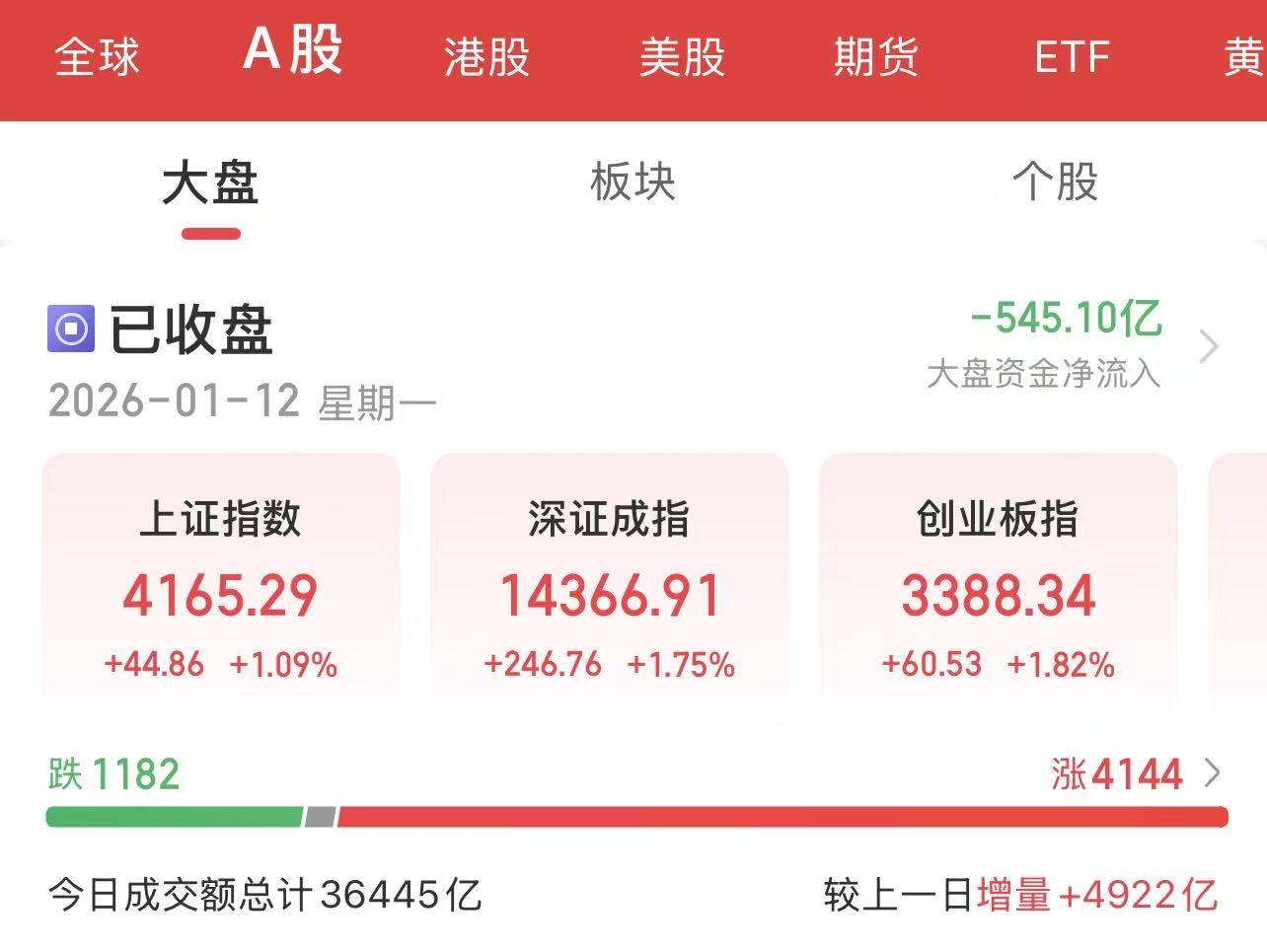
Market Overview - The A-share market experienced a significant rally, with all three major indices opening lower but closing higher, resulting in over 4,000 stocks rising. The Shanghai and Shenzhen stock exchanges recorded a trading volume of 3.6 trillion yuan, marking the second consecutive day of surpassing 3 trillion yuan, an increase of 478.7 billion yuan from the previous trading day, setting a new historical record for trading volume in 2024 [1][2]. Stock Performance - By the end of the trading session, the Shanghai Composite Index rose by 1.09%, the Shenzhen Component Index increased by 1.75%, and the ChiNext Index gained 1.82% [2]. - A total of 4,144 stocks saw an increase, with 201 stocks hitting the daily limit up, while 1,182 stocks declined [3][4]. Sector Highlights - The AI application and marketing sectors saw a strong performance, with stocks such as BlueFocus Communication Group (300058) and Hand Information (300170) hitting the daily limit up. The surge in these sectors is linked to the recent popularity of the Generative Engine Optimization (GEO) concept, which enhances visibility in AI search results [5]. - The commercial aerospace sector continued its strong momentum, with China Satellite (600118) and China Satcom (601698) reaching their daily limit up. This follows the announcement that China submitted an application for an additional 203,000 satellites, covering 14 satellite constellations [7]. Notable Stocks - Stocks such as Yidian Tianxia (301171), Zhongwen Online (300364), and Tianlong Group (300063) all increased by 20% [6]. - In the brain-computer interface sector, companies like Daoshi Technology (300409) and Yanshan Technology (002195) also saw significant gains, with the former rising by 19.99% [11][12].
