
油气开采

Search documents
长庆油田连续6年保持高产规模
Zhong Guo Hua Gong Bao· 2025-12-03 02:52
Core Insights - Changqing Oilfield has achieved an annual oil and gas equivalent production of over 60 million tons, maintaining this high production level for six consecutive years since becoming China's first large-scale oil and gas field of this size in 2020 [1] Group 1: Production Achievements - The exploration and development area of Changqing Oilfield is primarily located in the Ordos Basin, characterized by low pressure, low permeability, and low abundance, making development challenging [2] - In 2024, Changqing Oilfield's annual oil and gas equivalent production is expected to reach a historical high, accounting for one-sixth of the total domestic oil and gas production for that year [2] Group 2: Technological Advancements - Changqing Oilfield has increased its efforts in exploration, development, and technological innovation to overcome the challenges of "three lows" in oil and gas reservoirs [2] - The oilfield has established China's first 3 million-ton shale oil production base and a 50 billion cubic meter gas area [2] - A hydraulic fracturing test site has been built at the Qingcheng shale oil platform to enhance single well production and promote the effective development of shale oil [2] - The first "zero-support agent" fracturing operation for coalbed methane was implemented at the Shaanxi Mizhi coalbed gas production site, marking a significant transition in fracturing methods [2] - In the Longdong Yuan 284 block, a demonstration area for the transformation of ultra-low permeability oil reservoirs to water injection development has been established, increasing oil extraction speed by four times and annual production from 48,000 tons to 196,000 tons [2]

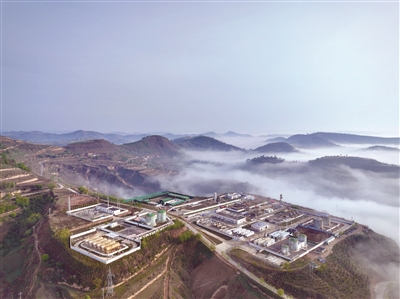
西南油气田公司,天然气年产量有望突破500亿立方米
Si Chuan Ri Bao· 2025-12-03 01:32
Core Insights - China National Petroleum Corporation's Southwest Oil and Gas Field Company has achieved a natural gas production of over 45.7 billion cubic meters this year, surpassing last year's output by over 1 billion cubic meters, setting a historical record for the same period, and is on track to meet the annual target of over 50 billion cubic meters [1][2] Group 1: Production Achievements - The company has successfully implemented precise exploration and drilling, achieving a drilling footage of 270,000 meters with an exploration success rate of 80%, resulting in over 10 high-yield gas wells with daily production exceeding 1 million cubic meters [1] - By 2025, the company plans to put into production 470 new wells, marking a historical high and a nearly 40% increase from last year [1] Group 2: Technological Advancements - The company has optimized drilling and completion techniques, significantly reducing the average drilling cycle for wells in the central Sichuan region from 310 days to 95.71 days, and has established a world record for reservoir reconstruction pressure at 175 MPa [2] - Key technological breakthroughs have directly contributed to an 80% exploration success rate and a 34% reduction in costs, serving as core drivers for high-quality production [2] Group 3: Operational Efficiency - To achieve a production target of over 50 billion cubic meters, the company needs to reach a peak daily production of over 15 million cubic meters, necessitating high operational organization [2] - The company has focused on integrated real-time dynamic management of production, storage, and sales, optimizing operational plans in response to deviations during production and sales processes [2] - In the central Sichuan region, the company has maximized operational load through surface collection optimization and new pipelines, achieving a maximum winter processing capacity of over 49 million cubic meters per day, contributing an additional 100 million cubic meters to production [2]
3项温室气体自愿减排项目方法学发布全国温室气体自愿减排交易市场首次将支持范围扩充到油气开采领域
Zhong Guo Neng Yuan Wang· 2025-12-03 01:08
Core Viewpoint - The Ministry of Ecology and Environment and the National Energy Administration have jointly released three methodologies for voluntary greenhouse gas emission reduction projects in offshore and onshore oil and gas fields, marking the first expansion of the national voluntary greenhouse gas emission reduction trading market to the oil and gas extraction sector [1] Group 1: Methane Emission Management - Methane is the second-largest greenhouse gas globally and is a key focus for the international community in addressing climate change [1] - The oil and gas extraction process often generates significant amounts of methane, which are typically either directly emitted or burned due to technical and cost constraints, leading to greenhouse gas emissions and energy waste [1] Group 2: Methodology Objectives - The newly released methodologies aim to guide companies in improving their handling of methane, converting it into usable clean energy [1] - The methodologies are designed to enhance environmental and economic benefits by promoting the synergy of carbon reduction, pollution reduction, and resource recovery [1] Group 3: Implementation and Future Steps - The design of the methodologies draws on mature experiences from international voluntary emission reduction mechanisms while considering the realities of China's oil and gas industry, enhancing the operability of project development and subsequent regulation [1] - The Ministry of Ecology and Environment will accelerate the establishment of a voluntary emission reduction methodology system to achieve comprehensive coverage in key areas and promote the development of emission reduction projects [1]
3项温室气体自愿减排项目方法学发布 全国温室气体自愿减排交易市场首次将支持范围扩充到油气开采领域
Ren Min Ri Bao· 2025-12-03 00:07
甲烷是全球第二大温室气体,是当前国际社会应对气候变化亟须管控的重点温室气体。在油气开采过程 中,常会产生大量甲烷气体。受技术、成本等因素限制,油气田通常会选择将这些气体直接排放或燃烧 处理,造成温室气体排放和能源浪费。 (文章来源:人民日报) 此次发布的方法学,旨在引导企业改进处理方式,将甲烷转化为可利用的清洁能源。在实现甲烷有效管 控的同时,推动降碳、减污与资源回收利用的协同增效,切实提升项目的环境效益与经济效益。本次方 法学设计过程中,充分借鉴了国际自愿减排机制的成熟经验,并结合我国油气行业实际,提升项目开发 和后续监管的可操作性,形成对标国际通行规则的高质量碳信用。 本报北京12月2日电 (记者寇江泽)生态环境部与国家能源局近日联合发布3项针对海陆油气田的温室 气体自愿减排项目方法学,这是全国温室气体自愿减排交易市场首次将支持范围扩充到油气开采领域, 通过市场机制破解油气甲烷回收利用难题。 下一步,生态环境部将加快推进自愿减排方法学体系建设,尽早实现重点领域全覆盖。同时,积极推动 减排项目开发落地,激励引导社会资本精准流向减排潜力大、综合效益突出的领域,为实现国家自主贡 献目标贡献力量。 ...
3项温室气体自愿减排项目方法学发布
Ren Min Ri Bao· 2025-12-02 22:33
Core Viewpoint - The Ministry of Ecology and Environment and the National Energy Administration of China have jointly released three methodologies for voluntary greenhouse gas emission reduction projects targeting offshore and onshore oil and gas fields, marking the first expansion of the national voluntary greenhouse gas emission reduction trading market to the oil and gas extraction sector [1] Group 1: Methane Emission Management - Methane is the second-largest greenhouse gas globally and is a key focus for the international community in addressing climate change [1] - The oil and gas extraction process generates significant amounts of methane, which are often directly emitted or burned due to technical and cost constraints, leading to greenhouse gas emissions and energy waste [1] Group 2: Methodology Objectives - The newly released methodologies aim to guide companies in improving their handling of methane by converting it into usable clean energy [1] - The methodologies are designed to enhance environmental and economic benefits by promoting the synergy of carbon reduction, pollution reduction, and resource recovery [1] Group 3: Implementation and Future Steps - The design of the methodologies draws on mature experiences from international voluntary emission reduction mechanisms while considering the realities of China's oil and gas industry, enhancing the operability of project development and subsequent regulation [1] - The Ministry of Ecology and Environment will accelerate the establishment of a voluntary emission reduction methodology system to achieve comprehensive coverage in key areas and promote the development of reduction projects, guiding social capital towards areas with significant reduction potential and comprehensive benefits [1]
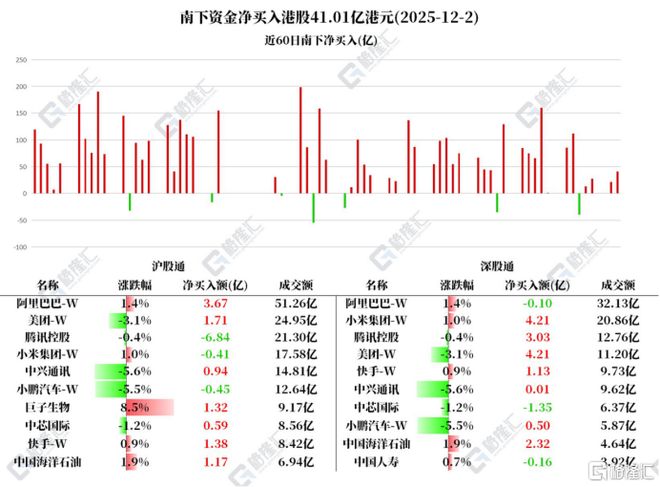
资金动向 | 北水火力加码!连续14日买入阿里,减仓腾讯、中海油
Ge Long Hui· 2025-12-02 11:21
Group 1: Market Activity - Southbound funds net bought HKD 4.1 billion in Hong Kong stocks on December 2, with notable purchases including Meituan-W (HKD 592 million), Xiaomi Group-W (HKD 380 million), Alibaba-W (HKD 357 million), Kuaishou-W (HKD 250 million), and GigaBio (HKD 131 million) [1] - Continuous net buying trends were observed, with Alibaba receiving a total of HKD 28.22244 billion over 14 days, Meituan accumulating HKD 1.98249 billion over 4 days, and Xiaomi gaining HKD 0.95066 billion over 3 days [4] Group 2: Company Updates - Alibaba-W announced a significant update to its image generation and editing model Qwen-Image, achieving breakthroughs in image editing consistency and multi-angle transformation, applicable in industrial design and creative concepts [5] - Xiaomi Group-W reported that its automotive division has delivered over 500,000 vehicles since April 3, 2024, with November deliveries exceeding 40,000 units, surpassing the annual target of 350,000 units set at the beginning of the year [5] - Kuaishou-W launched a new multi-modal creation engine "Keling O1," addressing challenges in AI video generation, and reported that its Keling AI business revenue exceeded RMB 300 million in Q3 2025, with expectations for annual revenue to double [5] - GigaBio announced plans to repurchase up to 103.6 million shares, representing 10% of its issued shares (excluding treasury shares) [5] Group 3: Industry Insights - China National Offshore Oil Corporation (CNOOC) faced damage to oil pipeline equipment connecting Kazakhstan and Russia, with institutions like ANZ predicting a short-term upward trend in oil prices, benefiting oil and gas companies' performance [6]
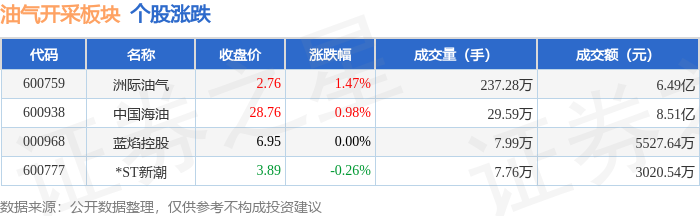
油气开采板块12月2日涨0.73%,洲际油气领涨,主力资金净流入1278.85万元
Zheng Xing Xing Ye Ri Bao· 2025-12-02 09:09
Core Viewpoint - The oil and gas extraction sector experienced a 0.73% increase on December 2, with Intercontinental Oil leading the gains, while the Shanghai Composite Index fell by 0.42% and the Shenzhen Component Index decreased by 0.68% [1] Group 1: Market Performance - The closing price of Intercontinental Oil was 2.76, reflecting a 1.47% increase, with a trading volume of 2.3728 million shares and a transaction value of 649 million yuan [1] - China National Offshore Oil Corporation (CNOOC) closed at 28.76, up by 0.98%, with a trading volume of 295,900 shares and a transaction value of 851 million yuan [1] - Blue Flame Holdings remained unchanged at 6.95, with a trading volume of 79,900 shares and a transaction value of 55.2764 million yuan [1] - ST Xinchao closed at 3.89, down by 0.26%, with a trading volume of 77,600 shares and a transaction value of 30.2054 million yuan [1] Group 2: Capital Flow - The oil and gas extraction sector saw a net inflow of 12.7885 million yuan from main funds, while retail investors experienced a net outflow of 26.7944 million yuan [1] - Intercontinental Oil had a net inflow of 20.6339 million yuan from main funds, but a net outflow of 12.0512 million yuan from retail investors [2] - CNOOC experienced a net outflow of 471,800 yuan from main funds, with a net inflow of 18.5347 million yuan from speculative funds [2] - Blue Flame Holdings had a net outflow of 3.4649 million yuan from main funds, with a net inflow of 154,580 yuan from speculative funds [2] - ST Xinchao faced a net outflow of 3.9087 million yuan from main funds, while speculative funds saw a net inflow of 250,810 yuan [2]




轮南油田成“零碳工厂”试点
Zhong Guo Hua Gong Bao· 2025-12-02 04:26
作为塔里木油田首个低碳示范区,轮南油田充分发挥区位优势、挖掘潜力及丰富太阳能资源,推动多技 术、多系统协同创新,通过光伏清洁替代、余热利用节能降耗、烟道气回注、辅助碳汇林和碳捕集利用 与封存(CCUS)等多能互补模式,实现油气生产"负碳运营"。"目前非化石能源消费占比已达 29.79%。"塔里木油田轮南采油气管理区执行董事、党委书记崔小虎介绍,"我们甚至直接用光伏电力为 井场电加热炉加热,替代传统燃气加热。" 在沙漠腹地,150亩"沙戈荒"空地上建有6兆瓦集中式光伏电站,15口单井场站铺设了1.45兆瓦分布式光 伏板,年发电量达1080万千瓦时,不仅满足轮南油田全年用电,余电还可返输电网。余热利用也成为节 能降碳的关键举措。油田利用压缩机出口130摄氏度的高温气体与供暖回水换热,实现年节约天然气97 万立方米,减排二氧化碳2097吨。此外,轮南油田租赁的8辆新能源电动车及2座光伏车棚,替代了老旧 燃油车,年节约汽油100余吨,实现减排304吨。 目前,轮南油田"零碳工厂"年碳排放量已由建设前的1.7万吨降为"负碳运营",实现每生产1吨原油减排 二氧化碳8.11千克。 中化新网讯 近日,2025年"零碳中国"标 ...
焕新能源“心脏”赋能绿色油田
Qi Lu Wan Bao· 2025-12-02 00:10
此次改造并非推倒重建,而是在保障区域持续供电的前提下,进行的一场高难度的"心脏不停跳搭桥手 术"。电力分公司明确了"安全可靠、清洁高效、智能可控"三大目标,推动变电站实现系统性跨越。 改造中,户外敞开式开关场升级为全室内200千伏GIS设备,结构更紧凑,抗恶劣环境能力全面提升; 倒闸操作实现计算机远程一键执行,大幅降低人为风险。同时,变电站增强了系统调度灵活性,为"火 电+绿电+储能"多元协同运行提供关键支撑,初步建成区域清洁电力汇集与调节枢纽。此外,通过部署 在线监测设备,构建起实时感知与诊断体系,运维模式由"被动检修"转向"主动防控"。 胜利油田滨海区域蕴藏着丰富的陆海油气资源,这里年产原油达807万吨,占油田总产量的34%,接近 全国年产量的4%。区域内电网结构完善、风光热资源富集,用能场景多元,已成为传统能源与清洁能 源融合创新、高效利用的"决胜主战场"。 肩负为滨海区域输送不竭动力重任的,正是220千伏新孤变电站——这座油田电压等级最高、规模最大 的枢纽变电站,堪称区域电网的"心脏"。 据了解,新孤变电站已持续运行超过30年,承担着海洋、孤东等六家开发单位的供电任务,年转供电量 达16亿千瓦时,占全 ...
这是12月1日在天津市滨海新区拍摄的渤海油田渤西油气处理厂(无人机照片)。截至12月1日,渤海油田渤西油气处理厂今年累计向天津市供应天然气超4亿立方米,为当地提供清洁能源保障。
Zhong Guo Zheng Quan Bao· 2025-12-01 20:25
这是12月1日在天津市滨海新区拍摄的渤海油田渤西油气处理厂(无人机照片)。截至12月1日,渤海油 田渤西油气处理厂今年累计向天津市供应天然气超4亿立方米,为当地提供清洁能源保障。 新华社图文 制图/韩景丰 ...