Telecommunications Equipment

Search documents
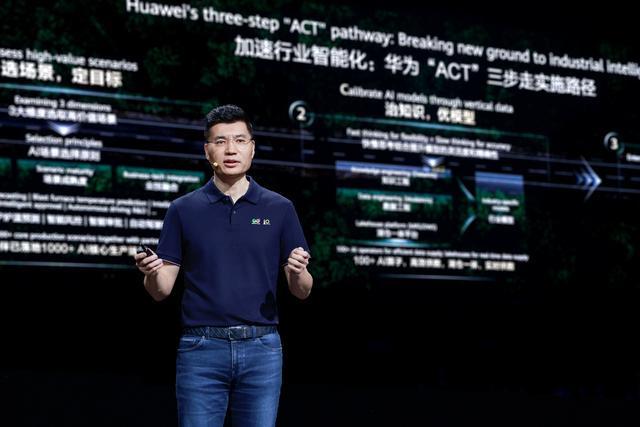
数据转价值、应用规模化,华为提出“ACT三步走”路径为企业智能化转型解题
Huan Qiu Wang Zi Xun· 2025-09-22 02:35
Core Viewpoint - AI technology has transitioned from the laboratory to the industry, becoming a core driver of transformation across various sectors, yet companies face challenges in realizing returns on investment, converting data into value, and scaling applications [1][3] Summary by Sections Industry Pain Points - Companies are grappling with three main challenges in their intelligent transformation: ensuring measurable returns on AI investments, converting proprietary data into competitive advantages, and scaling AI applications from experimental stages to core business support [3][4] Practical Examples - In the electricity sector, the Southern Power Grid utilized Huawei's Ascend computing platform and MindSpore AI framework to develop the "Big Watt" industry model, enhancing defect identification efficiency by five times and achieving over 90% accuracy in image recognition [4] - In healthcare, Huawei supported a partner in developing an AI medical record integration machine that generates records in as little as one second, significantly reducing consultation time and improving record quality [5] Key Discoveries for Industry Intelligence - Five key findings were identified for promoting industry intelligence: the importance of selecting relevant scenarios, the necessity of high-quality vertical data, the rapid scaling of AI agents, the emergence of human-machine collaboration as a new organizational paradigm, and the need for systematic governance and risk management [6] ACT Three-Step Pathway - The "ACT three-step" implementation methodology proposed by Huawei includes assessing high-value scenarios, calibrating AI models using vertical data, and scaling AI agents to transform business operations [7][8] - The assessment framework evaluates scenarios based on commercial value, maturity, and integration of business and technology, having successfully implemented over 1,000 AI core production scenarios [7] Infrastructure Support - Huawei emphasizes that AI-oriented ICT infrastructure is essential for supporting the ACT pathway, providing integrated products across data storage, computing, and networking [9] Ecosystem and Solutions - Huawei advocates for an open and cooperative approach to industry intelligence, recognizing that no single company can cover all areas, thus forming a robust ecosystem with over 6,300 partners [10][11] - The release of nine industry-specific intelligent solutions addresses core pain points across various sectors, such as steel temperature prediction and oil and gas exploration, providing replicable and customizable templates for enterprises [11] Shift from Technology-Driven to Value-Driven - The information conveyed by Huawei reflects a deep consideration of the logic behind industry intelligence, emphasizing a shift from technology-driven to value-driven approaches, focusing on high-value scenarios and vertical data [13]

场景化方案+伙伴:破解中小企业智能化转型难题的两大关键招
Huan Qiu Wang Zi Xun· 2025-09-22 02:29
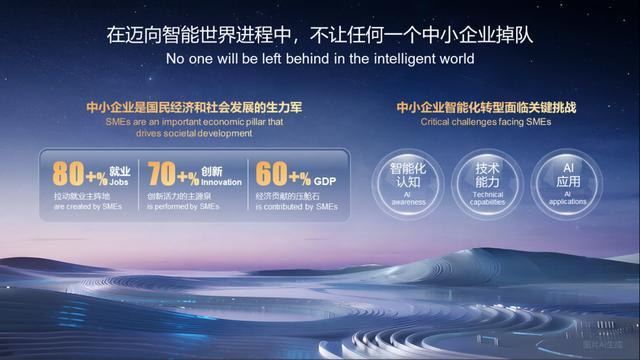
Core Insights - The article discusses the challenges faced by small and medium-sized enterprises (SMEs) in their digital transformation journey and highlights Huawei's new "4+10+N" intelligent solutions aimed at addressing these challenges [1][3] Group 1: Huawei's Intelligent Solutions - Huawei launched the "4+10+N" intelligent solution for SMEs, which focuses on four core scenarios: intelligent office, intelligent business, intelligent education, and intelligent healthcare [5][6] - The "10" refers to ten one-stop scenario-based solutions, including smart office spaces, intelligent hotels, and digital healthcare platforms [6] - The "N" represents a series of 26 star products designed to support the four core scenarios, ensuring efficient implementation and integration [6][8] Group 2: Partnership and Market Strategy - Huawei is enhancing its distribution strategy by transitioning from simple product distribution to a one-stop scenario-based solution distribution model [5][7] - The "百&万计划" (Hundred & Thousand Plan) aims to develop 100 diamond partners and collaborate with them to establish 10,000 elite engineering firms, enhancing service capabilities and market reach [7][8] - Huawei will provide comprehensive support to its diamond partners, including priority product supply, joint marketing activities, and technical training to improve service quality [7][8]
华为全联接大会总结
2025-09-22 00:59
Summary of Huawei's Full Connection Conference Industry and Company Overview - The conference focused on Huawei's advancements in AI infrastructure, particularly through the launch of the Lingxi Interactive Interconnection Protocol and three major super node products: Atlas 950, Atlas 960, and TaiShan 950 [1][2][3] Key Points and Arguments AI Infrastructure Developments - Huawei aims to build a comprehensive computing foundation to meet market demands for super nodes and consulting computing solutions, indicating a significant leap in AI computing capabilities [1][2] - The Atlas 950 and 960 super nodes are set to launch in Q4 2026 and Q4 2027, respectively, with a notable increase in computing power and interconnect bandwidth reaching up to 34PB per second [1][4] AI Chip Roadmap - The Ascend 950PR/G7 chip is scheduled for release in 2026, with plans for the Ascend 970 chip in 2028, showcasing Huawei's commitment to technological independence in AI chip development [1][5][8] - The Ascend 950PR chip will focus on pre-training tasks, while the Ascend 950G7 will support more complex operations, indicating a strategic shift in chip capabilities [5][8] Ecosystem Expansion - Huawei is opening its super node technology, including the Lingxi protocol and reference architecture, to foster collaboration with ecosystem partners, aiming to reshape the AI infrastructure market [1][7] - The launch of the HarmonyOS 5 and the investment of 1 billion in the Tian Gong plan to support the Harmony AI ecosystem are expected to attract more developers and enhance AI application innovation [3][11][13] Cybersecurity Solutions - The introduction of the Xinghe AI cybersecurity solution aims to unify network and security management, addressing new threats faced by branches, campuses, and data centers [1][10] Additional Important Content - The Atlas 950 super node will consist of 160 cabinets, achieving 800 million FLOPS (FB8) and 1.6 billion FLOPS (FB4), while the Atlas 960 will have 220 cabinets with 3.4 billion FLOPS (LLP8) and 6 billion FLOPS (LLB4) [4] - HarmonyOS 5 has been integrated into over 17 million devices, with 33,000 applications and services available, indicating a growing ecosystem [12] - The AI capabilities of the HarmonyOS, particularly through the voice assistant Xiaoyi, are being positioned as a central feature in various applications, enhancing user interaction and device connectivity [11][12]
华为启动“天工计划”,计划投入10亿元加速AI生态建设
Bei Jing Shang Bao· 2025-09-21 07:42
Group 1 - Huawei announced the launch of the "Tian Gong Plan" at the 2025 Global Connectivity Conference, committing to invest 1 billion yuan in resources to accelerate the HarmonyOS AI ecosystem development [1] - The number of HarmonyOS 5 terminal devices has surpassed 17 million, indicating that the HarmonyOS is rapidly advancing in the AI intelligent agent sector [1]
Jim Cramer on Lumentum: “We’ll Play With the House’s Money”
Yahoo Finance· 2025-09-19 03:25
Group 1 - Lumentum Holdings Inc. (NASDAQ:LITE) has recently experienced a surge in stock price after years of stagnation, prompting discussions on whether to hold or sell the stock [1] - The company produces optical and photonic products, including chips, components, and lasers, which are essential for cloud data centers, AI infrastructure, and various manufacturing sectors such as semiconductors, solar cells, and electric vehicle batteries [2] - Invesco Small Cap Value Fund highlighted that Lumentum reported better-than-expected revenue and earnings for its recent quarter, along with record orders for its data communications laser chips used in data center applications [2] Group 2 - Despite the positive outlook for Lumentum, some analysts believe that certain AI stocks present greater upside potential and carry less downside risk [2]

6G概念持续走强,世嘉科技、意华股份双双涨停
Xin Lang Cai Jing· 2025-09-19 02:38
Group 1 - The 6G concept continues to gain momentum, leading to significant stock price increases for companies such as Sega Technology and Yihua Shares, both of which reached their daily price limit [1] - Other companies in the sector, including Hengtong Optic-Electric, Daheng Technology, Jin Xin Nuo, Aoshikang, Haige Communications, and ZTE, also experienced stock price increases [1]




Akanda (AKAN) - Prospectus
2025-09-18 21:30
As filed with the Securities and Exchange Commission on September 18, 2025 Registration No. 333- UNITED STATES SECURITIES AND EXCHANGE COMMISSION Washington, D.C. 20549 Akanda Corp. (Exact name of Registrant as specified in its charter) Ontario, Canada 2833 Not Applicable FORM F-1 REGISTRATION STATEMENT UNDER THE SECURITIES ACT OF 1933 (State or other jurisdiction of incorporation or organization) (Primary Standard Industrial Classification Code Number) Akanda Corp. c/o Gowling WLG (Canada) LLP 100 King St. ...

详解OCS交换机当前产业化进展
2025-09-18 14:41
Summary of OCS Switch Industry Conference Call Industry Overview - The OCS (Optical Circuit Switching) switch market is currently valued at approximately $600 million and is expected to exceed $2 billion by 2030, with demand projected to grow to at least 50,000 units [1][5][11]. Key Companies and Their Strategies - **Google**: Leads the OCS switch application in AI scale-up networks, utilizing a unique 3D Torus architecture to interconnect 4,096 TPUs with 48 OCS switches, and supports 9,216 TPUs in the TPU V7 product. Google began exploring OCS in 2017-2018 and started scaling applications in 2023, indicating strong technical accumulation and market leadership [2][3][11]. - **NVIDIA**: Focuses on enhancing data center fault recovery capabilities through OCS switches, using coherent silicon-based liquid crystal solutions for redundancy and continuous operation [1][3]. - **Microsoft**: Evaluates Momentum MEMs and coherent silicon-based liquid crystal solutions for potential use in DCI (Data Center Interconnect) networks, showing rapid progress in hollow fiber layout and DCI interconnect device construction [1][3]. - **Domestic Manufacturers**: Significant players in the OCS supply chain, with companies like Wuxi Dekoli involved in custom development for Google’s next-generation OCS optical modules and MEMs chip manufacturing [2][8]. Market Dynamics and Trends - The demand for Google’s TPUs is expected to drive rapid growth in OCS orders, with conservative estimates suggesting a need for 25,000 units by 2026, potentially generating $1 billion in orders, and increasing to $1.6 to $1.8 billion by 2027 [2][11]. - The OCS technology has gained attention due to advancements that mitigate previous limitations such as long switching delays and limited port numbers, making it suitable for stable traffic scenarios [4][5]. Technical Insights - Current mainstream OCS technologies include MEMs, coherent silicon-based liquid crystal, and piezoelectric ceramic solutions, each with distinct advantages and drawbacks [6][9]. - Google’s next-generation OCS switch is in early development, showing promise in switching delay but not yet meeting industrial production standards [10]. Future Outlook - The OCS market is projected to grow significantly, with potential market share reaching 30% of the current electrical switch market as switching delays improve from milliseconds to microseconds and eventually nanoseconds [5][14]. - The integration of OCS in AI scale-up networks is expected to increase, with AI networks currently accounting for 50% of OCS applications, potentially rising to over 80% in the next three years [15][16]. Conclusion - The OCS switch technology is poised for substantial growth driven by major players like Google, NVIDIA, and Microsoft, alongside domestic manufacturers contributing to the supply chain. The anticipated advancements in technology and increasing demand for high-performance data center solutions will likely accelerate the adoption of OCS in various applications.

CommScope: Better Days To Come Post CCS Divestiture (NASDAQ:COMM)
Seeking Alpha· 2025-09-18 13:31
Core Viewpoint - CommScope Holding Company (NASDAQ: COMM) is identified as a Strong Buy Pick, with expectations of hidden value in its core business becoming apparent [1] Company Analysis - The analysis is rooted in Financial Engineering, focusing on companies with a rare financial profile [1] - The investment approach combines top-down screening with bottom-up company-specific analysis, utilizing metrics such as PEG ratios [1] - The goal is to make compelling research accessible to both retail and professional investors while maintaining analytical depth and a clear investment thesis [1] Analyst's Position - The analyst has a beneficial long position in CommScope shares through stock ownership, options, or other derivatives [1] - The article expresses the analyst's own opinions and is not compensated for it, aside from Seeking Alpha [1]


华为发布《智能世界2035》报告:展望十大技术趋势将如何塑造我们的未来
Sou Hu Cai Jing· 2025-09-18 12:00
Core Insights - Huawei released two reports, "Intelligent World 2035" and "Global Digital Intelligence Index 2025," outlining the technological evolution path for the next decade [3] - The reports predict a 100,000-fold increase in global computing power by 2035, transforming computing from a specialized tool to a universal social infrastructure [3][25] - The vision emphasizes a human-centered intelligent world, reshaping production methods, lifestyles, and the progress of civilization [3] Group 1: Ten Key Technological Trends - Trend 1: General Artificial Intelligence (AGI) will transition from laboratory to industrial application, with AI expected to handle complex decision-making tasks by 2035 [5][6] - Trend 2: A disruptive change in computing architecture will occur, with a projected 100,000-fold increase in total computing power [7][8] - Trend 3: A fundamental shift in data storage paradigms will take place, with AI storage capacity demand expected to grow 500 times by 2035 [9][10] - Trend 4: The scale of communication networks will increase dramatically, expanding from 9 billion people to 900 billion intelligent entities [11][12] - Trend 5: Energy systems will achieve intelligent management, with renewable energy generation surpassing 50% [13][14] - Trend 6: Interaction methods will evolve to multi-modal experiences, enhancing immersive engagement [15][16] - Trend 7: Health management will shift from treatment to prevention, with chronic disease prevention rates projected to exceed 80% [17][18] - Trend 8: Home robots will become standard, with over 90% of households expected to own smart robots [19][20] - Trend 9: Autonomous driving will redefine travel experiences, with L4+ level autonomous driving becoming widespread [21][22] - Trend 10: Software development will enter a human-machine collaboration era, significantly improving development efficiency [23] Group 2: Computing Revolution - By 2035, total computing power is expected to increase by 100,000 times, necessitating breakthroughs in multiple technology layers [25] - Innovations in computing architecture, such as integrated storage and optical computing, will overcome traditional limitations [25][26] - New computing paradigms, including neuromorphic and quantum computing, will provide superior solutions for specific scenarios [27][28] Group 3: Storage Upgrade - Data will become the "new fuel" driving AI development, with AI storage capacity demand projected to grow 500 times by 2035 [29] - Storage architecture will shift from "data storage" to "data service," enabling intelligent storage systems to understand data content [29] - Data management will transition from manual to intelligent management based on metadata [30] Group 4: Energy Transition - Energy will become a core element limiting AI's rapid development, with renewable energy generation expected to exceed 50% by 2035 [32] - AI will act as the "smart brain" of energy systems, optimizing energy distribution and usage [32] - Infrastructure will evolve towards distributed energy systems, enabling flexible scheduling and sharing of energy resources [32] Group 5: Health Transformation - AI will drive a paradigm shift in healthcare from "passive treatment" to "active prevention," with chronic disease prevention rates projected to exceed 80% [33] - Health prediction models based on multi-modal data will provide personalized prevention recommendations [33] - AI-assisted diagnostics will enhance healthcare efficiency and resource allocation [33] Group 6: Home Life and Enterprise Transformation - The penetration rate of smart home robots is expected to exceed 90%, transforming household tasks and experiences [36] - AI-driven autonomous decision-making will reshape production paradigms, with AI application rates reaching 85% by 2035, potentially increasing labor productivity by 60% [36] - Supply chain management will become more intelligent, with real-time demand forecasting and automated production adjustments [36] Group 7: Challenges and Considerations - The report highlights several core challenges in technological development, including the need for breakthroughs in physical world interaction and energy constraints [38] - Data security and privacy protection will face new challenges, necessitating a balance between data utilization and protection [38] - Ethical considerations in technology will require the establishment of new norms and standards for human-machine collaboration [38] Group 8: Insights and Outlook - The report envisions a future of human-machine collaboration and intelligent inclusivity, where technology evolves from a tool to a decision-making partner [39] - The transformation will require a reevaluation of the relationship between humans and technology, focusing on innovation and top-level design [39] - The competition in the future will extend beyond technology to include vision and hypothesis, with forward-thinking entities likely to lead in the intelligent civilization era [39]