算力革命

Search documents
机械行业太空光伏深度报告:双轨驱动:商业航天+算力革命,太空光伏迎新纪元
Guolian Minsheng Securities· 2026-03-26 08:18
Investment Rating - The report maintains a "Buy" rating for key companies in the space photovoltaic sector, including Maiwei Technology, Dier Laser, Jiejia Weichuang, and Aotwei [2][3]. Core Insights - The space photovoltaic sector is driven by the dual forces of commercial aerospace and the computing revolution, with space photovoltaic technology recognized as the primary energy source for space activities [6][7]. - The report highlights the rapid growth of commercial space launches, with global commercial launches expected to exceed 70% by 2025, and the increasing demand for AI-driven data centers, which necessitate innovative energy solutions [6][9]. - The report emphasizes the technological evolution in space photovoltaic systems, identifying triple-junction gallium arsenide as the current leader, while P-HJT and silicon/perovskite tandem technologies are anticipated to dominate in the near to mid-term [6][10]. Summary by Sections 1. Space Photovoltaics: The Sole Main Energy Source in Commercial Aerospace and Computing Revolution - The global aerospace industry is set to accelerate, with 323 launches and 4508 satellites expected in 2025, primarily driven by the US and China [13]. - The low Earth orbit (LEO) satellites are becoming a focal point, with over 1.3 million satellites currently proposed globally [16][18]. 2. Technological Iteration in Space Photovoltaics - Triple-junction gallium arsenide batteries dominate due to their high efficiency and radiation resistance, but their high cost limits large-scale production [42][47]. - P-HJT batteries are identified as the most cost-effective solution in current mass production technologies, with costs significantly lower than triple-junction gallium arsenide [48][50]. 3. Investment Recommendations - Focus on the SpaceX supply chain, with recommendations for leading companies such as Maiwei Technology (HJT battery equipment), Aotwei (module equipment), Dier Laser (battery laser processing), and Jiejia Weichuang (core battery processing equipment) [10][6]. - Additional companies to watch include Jing Sheng Mechanical and Electrical (silicon wafer growth equipment) and Liancheng CNC (silicon wafer processing equipment) [10].




芯片大消息!马斯克,重磅宣布!
是说芯语· 2026-03-22 06:47
Core Viewpoint - The Terafab project, a collaboration between Tesla, SpaceX, and xAI, aims to establish the largest chip manufacturing facility in history, targeting an annual production capacity of over 1 terawatt of computing power, which will significantly reshape the global semiconductor industry [1][2]. Group 1: Terafab Project Overview - The Terafab project aims to produce over 1 terawatt of computing power annually, covering the entire semiconductor supply chain, including logic chips, memory chips, and advanced packaging [2]. - Approximately 80% of the computing power will be allocated to space applications, while the remaining 20% will focus on ground applications, reflecting Musk's strategic vision for future technological competition [2]. - The project plans to utilize 2nm advanced process technology, integrating chip design, manufacturing, and testing within a single facility, which is expected to accelerate chip iteration speed significantly [2]. Group 2: Collaborative Efforts - The project involves deep collaboration among three major companies: SpaceX, Tesla, and xAI, each playing a crucial role in the initiative [3]. - SpaceX will handle 80% of the space computing capacity, providing specialized chips for projects like Starlink and deep space exploration, addressing challenges posed by extreme conditions in space [3]. - Tesla will focus on the 20% of ground computing power for its core businesses, including fully autonomous driving and robotics, ensuring self-sufficiency in chip supply [3]. Group 3: AI Integration - xAI will provide AI algorithms and optimization support for the Terafab chips, enhancing the training and inference capabilities of large AI models [4]. - The integration of space and ground computing will facilitate efficient deployment of AI models in space scenarios, creating a unified AI ecosystem [4]. Group 4: Industry Impact and Challenges - The announcement of the Terafab project is expected to disrupt the traditional semiconductor industry, promoting a shift from specialized manufacturing to vertical integration [8]. - The project aims to resolve computing power shortages in AI, aerospace, and smart automotive sectors, potentially leading to a new era in the space economy [8]. - However, the project faces significant challenges, including a required investment of $25 billion to $40 billion, a lengthy construction period of 3-5 years, and difficulties in acquiring advanced manufacturing equipment and skilled personnel [8][9].



春晚含“AI”量拉满 绩优科基前瞻布局拥抱新周期
Jiang Nan Shi Bao· 2026-02-26 03:28
Group 1 - The annual Spring Festival Gala has become a showcase for China's technological advancements, featuring elements like robots, drones, and AI, marking it as the gala with the highest "AI" content [1] - The A-share market experienced a strong start in the Year of the Horse, with notable performances in semiconductor and PCB sectors, driven by the momentum of technological innovation [1] - The core drivers of the post-Spring Festival A-share technology market are twofold: the acceleration of policy and industry catalysts, and the significant mapping effect from strong performances in overseas markets [1] Group 2 - Despite the ongoing potential in the technology sector, the rapid rotation of sectors and hotspots makes it challenging for ordinary investors to keep up with the market [2] - Public fund companies possess professional research teams and extensive industry knowledge, enabling them to identify quality stocks and mitigate information asymmetry risks for investors [2] - In 2025, several technology-focused funds achieved significant returns, with the Hui'an Growth Preferred Mixed Fund ranking 4th among 2272 comparable flexible allocation funds, boasting an annual return of 139.91% against a benchmark of 10.98% [2] Group 3 - The manager of Hui'an Growth Preferred Mixed Fund emphasizes that the industry wave is still strong, and the computing power revolution brought by AI reasoning is just beginning [3] - In Q4 2025, the fund underwent structural adjustments based on the principle that the focus of computing power will shift from connectivity to storage in the AI reasoning era [3] - The fund's strategy involved tactical profit-taking on high-performing overseas computing power assets while positioning for new growth areas, such as storage chips and humanoid robots, to optimize portfolio structure and reduce net value volatility [3]
算力“电力化”革命来袭,AI时代新基建暗战升级
Sou Hu Cai Jing· 2026-02-23 09:03
Group 1 - The core viewpoint of the articles highlights the emergence of a "computing power power station" construction battle in China, as AI computing power transitions into a fundamental resource akin to water, electricity, and coal [1][3] - ByteDance has launched the Seedance 2.0 video generation model, capable of producing multi-angle videos with native audio in just 60 seconds, pushing the application of multimodal AI to new heights [1] - The current computing power consumption of multimodal models exceeds that of the pure text era by more than ten times, prompting major domestic tech companies to accelerate their investments in computing infrastructure [3] Group 2 - Companies like Alibaba and Tencent are enhancing their liquid-cooled servers and intelligent computing centers, while Huawei is focusing on green data center technology to address the contradiction between computing power growth and energy constraints [3] - The AI models are transitioning from "black box" to "white box," with Alibaba's security department proposing the "endogenous security" concept, reducing trust barriers for AI applications in finance and healthcare [3] - The capital market is witnessing a revaluation of the computing power industry chain, with companies like SMIC and Zhongke Feimeng gaining investor interest due to technological breakthroughs, making sectors like optical modules and chip manufacturing investment hotspots [3]

英伟达统治AI时代:下游产业的算力革命与万亿机会
QYResearch· 2026-02-19 02:03
Core Viewpoint - NVIDIA has become a core driver of the global technology industry over the past three years, with projected revenue exceeding $130 billion for fiscal year 2025, and nearly 90% of this revenue coming from the data center business, maintaining a gross margin of 70%-75% [1][4]. Group 1: NVIDIA's Revenue and Downstream Demand Mechanism - The explosive growth of NVIDIA's data center business is central to its expansion, with data center revenue reaching approximately $11.52 billion in fiscal year 2025, a year-on-year increase of 142% [4]. - The Blackwell architecture contributed about $11 billion in revenue in a single quarter, marking the fastest product sales growth in the company's history [4]. - Data center revenue has consistently accounted for over 88%-90% of total revenue in multiple quarters, with Blackwell GPUs contributing approximately 70% of the computing revenue in this segment [4]. Group 2: Trends Behind Downstream Demand Explosion - Computing power has become a foundational infrastructure for productivity, with enterprises treating AI as a core business system rather than a pilot project [5]. - The developer ecosystem is experiencing a lock-in effect, with tools like CUDA and TensorRT becoming standards for millions of developers, making it costly to migrate to other platforms [5]. - Traditional enterprises are transitioning their IT architecture from CPU to GPU, necessitating a complete overhaul of storage, networking, cooling, power, and scheduling systems [5]. Group 3: NVIDIA's Impact on Downstream Industry Expansion - NVIDIA's growth is reshaping the entire industry ecosystem, with cloud service providers accelerating investments in dedicated AI data centers, deploying tens of thousands of Blackwell GPUs weekly [6]. - These investments are driving significant upgrades in power, cooling, and networking, creating a substantial boost for the downstream data center infrastructure market [6]. - Global capital expenditure on AI computing in data centers is expected to grow at a compound annual growth rate of approximately 40% from 2025 to 2030, potentially reaching $3-4 trillion by 2030 [6]. Group 4: Growth Opportunities in the Downstream Market - The growth in the downstream market is not only reflected in computing power demand but also in associated technologies and services [9]. - The developer community has reached millions, and enterprise-level AI development platform services are accelerating in growth [9]. - By 2030, global capital expenditure on AI data centers is projected to approach $4 trillion, presenting long-term business opportunities [9]. Group 5: Long-term Restructuring and Future Definition - NVIDIA's influence extends beyond technology, fundamentally reshaping downstream industries by establishing long-term architectural investments as the standard [11]. - The trend towards industry standardization is forming, with software ecosystems centered around CUDA and the promotion of AI factory concepts leading to market concentration [11]. - Business models in downstream industries are transitioning from product sales to "AI online services" and "intelligent automation platforms," enhancing customer retention and revenue sustainability [11]. Group 6: Sustained Long-term Growth - NVIDIA's success is not just about revenue growth; it is creating a technology-driven long-term industrial growth engine [12]. - For downstream enterprises, computing power procurement is evolving from a one-time capital expenditure to a continuous strategic investment [12]. - The core competitiveness of downstream enterprises is shifting from product manufacturing to participation in technology and architecture [12]. Group 7: Future Growth Drivers - Over the next decade, growth opportunities surrounding data centers, AI software and platforms, industry AI applications, and operational services will become significant drivers of economic growth [13].


电力设备行业2026年投资策略:国内电改与海外需求共振,风电电网迎来高质量发展
Hua Yuan Zheng Quan· 2026-02-08 13:35
Group 1 - The power industry is expected to achieve high-quality development as it enters a year of comprehensive marketization, driven by the "dual carbon" strategy and accelerated reforms in the electricity system [3][7][8] - The electricity market reform is set to fully unfold in the 15th Five-Year Plan, with significant policies introduced in the final year of the 14th Five-Year Plan that will have far-reaching impacts [3][11][12] - The core idea of the electricity reform is to reflect the different values of power sources (energy value, capacity value, adjustment value, and clean value) in market pricing, which has been historically dominated by energy value due to the predominance of coal power [8][10] Group 2 - The reform is expected to accelerate the construction of ultra-high voltage (UHV) and distribution networks, with UHV construction likely to speed up again as green electricity demand rises [3][16][24] - The investment in distribution networks has been low, with a continuous decline in the investment ratio, but this is expected to change as the demand for reliable power supply increases [28][34][41] - The introduction of capacity pricing for UHV and distribution networks is anticipated to stabilize project returns and promote the development of related projects [26][41] Group 3 - The surge in AI investments is projected to significantly increase electricity demand in the U.S., with OpenAI planning to deploy over 250GW of computing power by 2033, which could lead to a substantial electricity shortfall [45][49] - The U.S. electricity demand has been stagnant, but projections indicate that by 2030, peak load could approach 1000GW, driven largely by data centers [49][51] - The anticipated increase in electricity demand from AI investments presents a significant opportunity for companies involved in power generation and distribution [45][49] Group 4 - The profitability of wind turbine manufacturers is expected to improve, with domestic companies accelerating their international expansion as domestic bidding volumes remain high and prices trend upward [3][4] - Companies such as Goldwind Technology, Yunda Co., Mingyang Smart Energy, and Sany Heavy Industry are recommended for investment due to their competitive advantages in cost and market position [3][4]



百年康宁华丽转身:光纤终结二十年亏损,抱上Meta大腿成AI新贵!
Hua Er Jie Jian Wen· 2026-02-07 09:53
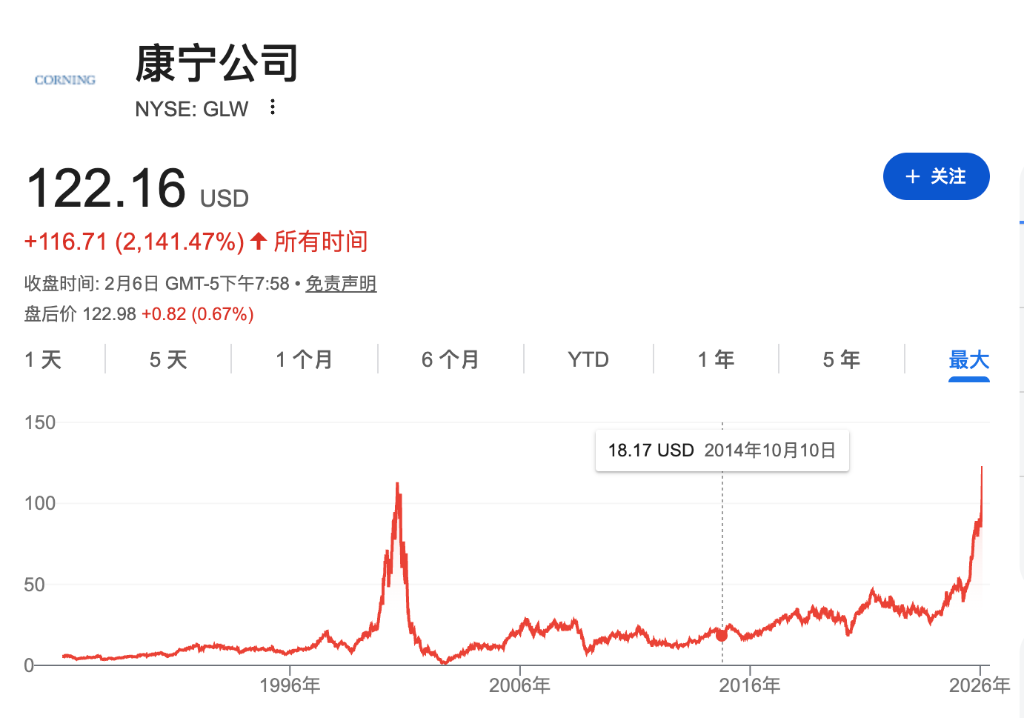
Core Insights - Corning's fiber optics business is emerging as a key beneficiary of the AI data center construction wave after nearly two decades of losses, highlighted by a recent $6 billion supply agreement with Meta [1] - The efficiency of photonic data transmission is three times that of electronic transmission over short distances and up to twenty times over long distances, making fiber optics the preferred choice as global computing infrastructure accelerates [1] - Corning's technology has expanded into Co-Packaged Optics (CPO), which enhances data transmission efficiency by embedding directly into servers, further solidifying its strategic position in AI infrastructure [1] Historical Context - Founded in 1851, Corning initially produced glass for incandescent bulbs and has since innovated in various materials technologies, including low-loss fiber optics developed in 1970, which became foundational for modern communication networks [4] - Despite achieving a technological breakthrough in low-loss fiber optics in 1970, the business struggled for nearly two decades, facing continuous losses and pressure from investors to divest [4] Strategic Turning Point - A pivotal insight in 2018 during a visit to Meta's data center led to the development of a new, thinner, and more flexible fiber optic cable to address significant interconnection challenges within data centers [5] - This strategic bet on technology has proven valuable following the surge in AI-driven demand for data centers, positioning Corning as a key supplier to major players like Meta [5] Long-term Investment Philosophy - Corning's core competitiveness stems from its unique vertical integration model and long-term talent strategy, maintaining control over critical industry chain segments and avoiding outsourcing of core operations [6] - During challenging periods, such as the pandemic, Corning prioritized retaining capacity and workforce, allowing for the accumulation of unique cross-domain experience among its engineers [7] Supply and Demand Dynamics - As North America's largest fiber optic manufacturer, Corning's data center fiber business has become its fastest-growing revenue engine, but future success is contingent on the actual investment pace of large tech companies in data center construction [8] - Current stock prices reflect optimistic expectations, yet the industry faces two major bottlenecks: maximum capacity and a shortage of skilled installation labor [8] - Corning is exploring technologies like Co-Packaged Optics (CPO) to support the next growth phase, with the cumulative delivery of fiber optics accelerating significantly [8]

重塑全球计算格局 马斯克筹划整合资产推进太空算力
Sou Hu Cai Jing· 2026-02-02 00:54
Core Viewpoint - SpaceX is seeking to launch and operate up to one million satellites to serve as orbital data centers, providing computational power for large-scale artificial intelligence reasoning and training [1] Group 1: Satellite Operations - The satellites will operate at altitudes ranging from 500 kilometers to 2000 kilometers in multiple orbital layers to meet global demand [1] - The system will rely on solar energy, which is expected to lower operational costs and reduce environmental impact compared to ground data centers [1] Group 2: Strategic Considerations - Elon Musk is considering integrating assets to advance the space computing layout, indicating a strategic choice to expand computational capabilities beyond Earth [1] - The ongoing development of projects like China's "Trinity Computing Constellation" and "Star Computing Plan," along with breakthroughs in reusable rockets and radiation-resistant materials, suggests a significant shift in the global computing landscape [1] - This space computing revolution is anticipated to provide critical support for the future digital and intelligent processes of society [1]
指数微红,个股普跌,近4600家绿盘!现在的A股到底该怎么玩?
Sou Hu Cai Jing· 2026-01-27 05:35
Market Overview - The market is characterized by a "split" where indices appear stable but individual stocks are predominantly declining, with over 4600 stocks experiencing losses [1] - The Shanghai Composite Index slightly increased by 0.03% to 4134.03 points, while the ChiNext Index and the STAR Market Index rose by 0.44% and 0.57% respectively [1] - In contrast, the Hong Kong market showed stronger performance, with the Hang Seng Index rising by 1.08%, supported by a policy boost from the central bank [1] Sector Performance - The technology sector, particularly the communication and electronics segments, saw significant gains, with the communication sector up by 2.13% and electronics by 1.50% [1] - The banking sector also rose by 1.03%, contributing to market stability [1] Drivers of Technology Sector - The strong performance in communication and electronics is driven by major advancements in the AI industry, including Alibaba's release of the Qwen3-Max-Thinking model and significant funding for another AI company [2] - Investment is flowing into the entire industry chain, from upstream hardware to related software applications, indicating a long-term trend towards technology and self-sufficiency [2] Market Sentiment and Trends - The current market sentiment reflects a preference for technology growth sectors over traditional cyclical industries, with a structural market trend likely to continue [3] - A-shares may continue to experience volatility, with funds likely to seek balance between technology and undervalued financial blue chips [3] Investment Strategy - Investors are advised to focus on understanding industry trends rather than chasing hot stocks, particularly in areas like AI and domestic substitution [3] - Attention should also be given to sectors with high growth forecasts, such as biopharmaceuticals, while maintaining a rational approach amidst market fluctuations [3]
【研报行业】无光不AI!硅光产业投资全梳理:从Fab厂到光模块,这些公司卡位算力新基建
第一财经· 2026-01-05 11:27
Group 1 - The article emphasizes the significance of AI and the new computing power revolution, highlighting a potential 10x market expansion with profits concentrating in specific segments of the supply chain [1] - A forecast suggests that 2026 may mark the year for China's commercial rocket reusable launch, urging attention to core "shovel stocks" and new 3D printing technology routes in commercial aerospace investments [1] - The low-altitude economy in Shanghai is undergoing an upgrade, indicating that the eVTOL (electric Vertical Take-Off and Landing) industry chain is at a critical juncture [1] - Elon Musk has accelerated production in the brain-computer interface industry, signaling a pivotal turning point for this sector [1]