城市轨道交通

Search documents
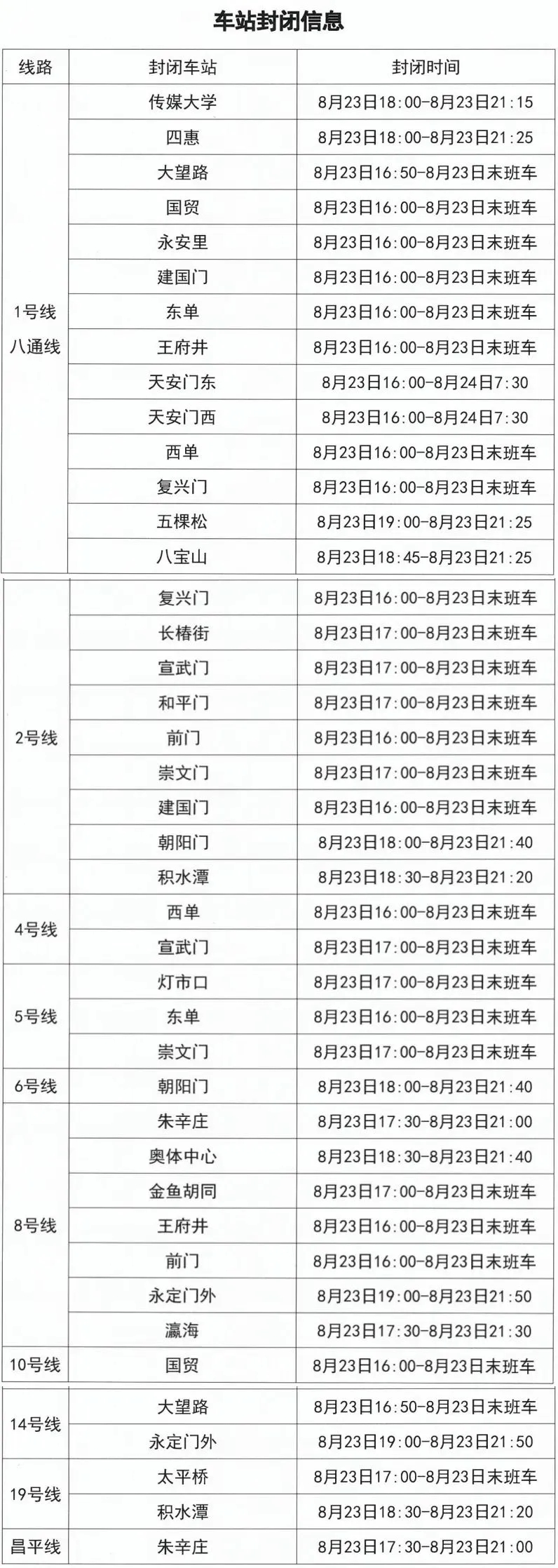
出行注意!今日14时起,北京这些地铁站、出入口封闭
Yang Shi Wang· 2025-08-23 02:51
Core Points - Beijing's Public Security Bureau announced temporary traffic management measures for certain subway lines to ensure the safety of a special event from August 23, 2025, 14:00 to August 24, 07:30 [1] - Multiple subway lines including Line 1, 2, 4, 5, 6, 8, 10, 14, 19, and Changping Line will have station closures and entry/exit restrictions during this period [1] Summary by Line - **Line 1**: Stations affected include Media University, Si Hui, Dawang Road, Dianmao, Yong'anli, Jianguomen, and Dongdan with varying closure times [2] - **Line 8**: Stations affected include Wangfujing and Qianmen with closures from 16:00 to the last train [4] - **Line 2**: Stations affected include Qianmen, Chongwenmen, Jianguomen, Chaoyangmen, and Jishuitan with specific closure times [4] - **Line 4**: Stations affected include Xidong and Xuanwumen with closures from 16:00 to the last train [4] - **Line 5**: Stations affected include Dongdan and Chongwenmen with closures from 16:00 to the last train [4] - **Line 6**: Stations affected include Chaoyangmen and Zhu Xinzhuang with closures from 18:00 to 21:40 [4] - **Line 10**: Station affected is Guomao with closure from 16:00 to the last train [4] - **Line 14**: Stations affected include Dawang Road and Yongdingmenwai with closures from 16:50 to the last train [4] - **Line 19**: Stations affected include Taipingqiao and Heshuiqiao with closures from 17:00 to the last train [4] - **Changping Line**: Station affected is Zhuxinzhuang with closure from 17:30 to 21:00 [5] Exit Closure Information - **Qianmen Station**: Exit A and D will be closed from August 23, 14:00 to August 24, 07:30 [7] - **Beijing Station**: Exits A and B will be closed from August 23, 17:00 to the last train [7]

福州地铁集团4亿元“24福州地铁GN002(碳中和债)”将付息1028万元
Sou Hu Cai Jing· 2025-08-22 04:02
来源:金融界 2025年8月22日,上海清算所网站披露公告,福州地铁集团有限公司2024年度第二期绿色中期票据(碳中 和债)发布2025年付息公告。该债券简称"24福州地铁GN002(碳中和债)",债券代码为132480078,发行 总额4亿元人民币,债项余额4亿元人民币,本计息期债券利率2.57%,本计息期付息日为2025年8月30 日(如遇法定节假日或休息日,则顺延至其后的第1个工作日),本期应偿还本息金额1028万元人民币 。 ...
被网友吐槽“滂臭”,深圳地铁官方回应_焦点要闻
Huan Qiu Wang· 2025-08-22 00:08
本文转自【广州日报】; (资料图片) 据南方日报报道 近日,多位深圳网友 在社交平台吐槽地铁车厢异味问题, 形容车厢内有 "汗臭、馊味、狐臭混杂的异味" "夏天坐地铁像被'腌入味'"。 网友反映 深圳地铁异味重 影响乘车体验 网友称,深圳地铁的臭味在1、3、5、10、11号等线路较为突出。有乘客表示在高温天气下异味更明 显,乘车体验不佳。更有人戏称"坐地铁全靠肺活量,看能屏住呼吸几个站"。 列车在隧道内行驶时,开关门过程可能带入外部异味 此外,工作人员表示,深圳地铁已针对异味问题采取应对措施: 其中一位发帖者告诉记者,深圳有多条地铁线路常常人挤人,部分乘客个人卫生欠佳,影响他人乘车体 验。他表示,以前深圳地铁的异味并不明显,空调风力也更强劲。 深圳地铁回应 近期多雨潮湿 已采取应对措施 近日,针对地铁异味问题,深圳地铁工作人员称: 部分列车风机积尘,加上近期多雨潮湿,易产生霉味 弱冷车厢因温度设置较高(约27℃),与室外温差小,可能让乘客更易感知异味 早晚高峰时段车厢拥挤,高温天气下乘客易出汗,多种气味混杂 雨天乘客携带的湿雨伞也可能带入霉味 增加列车回厂清洁维护频次,重点清洗空调系统内部,减少积尘霉味 适当 ...

北京“新标准”:轨道交通设计时速提升至每小时120公里
Xin Jing Bao· 2025-08-21 10:38
Core Viewpoint - The Beijing Municipal Planning and Natural Resources Commission and the Beijing Market Supervision Administration have revised the local standard for urban rail transit engineering design, resulting in the new "Urban Rail Transit Engineering Design Standard," which will be implemented on January 1, 2026 [1] Group 1: Enhancements in Design Standards - The new standard increases the total chapters from 26 to 31 and raises the maximum operating speed from 100 km/h to 120 km/h [2] - New provisions for fast and slow train operations are introduced, with fast train speed efficiency not lower than 60% and slow train speed efficiency not lower than 40% [2] Group 2: Operational Efficiency - The standard specifies that during peak hours, the interval for regular lines should not exceed 4 minutes, and for fast lines, it should not exceed 6 minutes [3] - For peak hours, the maximum interval for regular lines outside the main service area should not exceed 6 minutes, while for fast lines, it should not exceed 10 minutes [3] Group 3: Passenger Experience Improvements - The standard emphasizes improving passenger transfer experiences, suggesting the installation of automatic walkways in long transfer corridors [4] - It encourages the inclusion of diverse convenience facilities at stations, such as retail shops, food and beverage areas, and self-service zones [4] Group 4: Safety and Environmental Standards - The standard details safety requirements for underground structures, enhancing anti-floating design and waterproofing measures [5] - It sets energy-saving requirements for lighting, ventilation, and air conditioning systems, promoting the use of energy-efficient equipment [5] - The standard supports prefabricated intelligent green construction technologies, including design requirements for prefabricated stations and tracks [5]
广州轨道交通迎来通车“大年”
Nan Fang Du Shi Bao· 2025-08-20 06:39
Group 1: Metro and Intercity Rail Developments - Guangzhou Metro has opened the 10th line (Yangji East to Xilang section) and the 12th line (Xunfenggang to Guangzhou Sports Center, and Ersha Island to South University Town) on June 29, enhancing connectivity with multiple lines including the Guangfo Line and Line 22 [1] - The Guangzhou Metro plans to open a total of 10 lines (sections) this year, covering a total length of 173 kilometers, which includes 6 metro lines and 4 intercity lines, forming a three-dimensional transportation network of "metro + intercity" [1] - Three intercity railways have passed preliminary acceptance, including the Guangfo East Ring, the Pazhou Branch of the Suiguan-Shenzhen Intercity Railway, and the New Baiyun-Guangzhou Airport T2 section, marking significant progress towards operational readiness [3] Group 2: High-Speed Rail Progress - The construction of the Guangzhan High-Speed Railway has completed the full track laying, with a total length of approximately 401 kilometers and over 897 kilometers of track laid, aiming for completion by the end of the year [2] - Guangzhan High-Speed Railway is a key component of the national high-speed rail network and is expected to significantly reduce travel time between the western Guangdong region and the Guangdong-Hong Kong-Macao Greater Bay Area [2] Group 3: Baiyun Airport Developments - Baiyun Airport has served over 50.2 million passengers from January 1 to August 13, 2025, marking an 8.3% increase compared to the same period last year [4] - The T3 terminal of Baiyun Airport is set to be operational this year, contributing to a large hub structure of "three terminals + five runways" [6] - Baiyun Airport is positioned as a crucial air bridge connecting the Greater Bay Area to the world, with over 240 domestic and international destinations and more than 1,700 international flights weekly [5]
地铁19号线计划2028年建成
Shen Zhen Shang Bao· 2025-08-19 06:41
Core Viewpoint - The Shenzhen Metro Line 19 is progressing towards its planned operation in 2028, enhancing connectivity with other metro lines and improving public transport efficiency in the region [1] Group 1: Project Overview - The total length of Metro Line 19 is approximately 14.487 kilometers, with 12 stations and one new parking lot and one new main substation [1] - The line connects key areas such as Pingshan Central District, High-tech Park, and Bilin, facilitating a comprehensive transportation network [1] Group 2: Construction Progress - The Jinlong Station has successfully completed its enclosure structure, marking it as the second station to achieve this milestone on the line [1] - The project commenced in September 2024 and completed the diaphragm wall enclosure in just 127 days, utilizing integrated construction noise reduction equipment and intelligent spraying systems [1] Group 3: Technical Features - Line 19 will feature a fully automated operation system, with trains equipped for unattended operation (UTO) [1] - Jinlong Station is designed as a three-level underground station with a total length of 114.8 meters and a standard width of 21.5 meters [1]
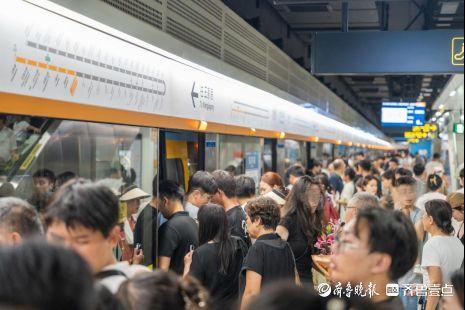
啤酒节30天“嗨啤”相伴,青岛地铁公共交通分担率突破50%
Qi Lu Wan Bao Wang· 2025-08-19 06:05
Core Insights - The Qingdao Metro has successfully enhanced consumer activity during the 35th Qingdao International Beer Festival through its "Rail + " model, achieving record operational data over a 30-day period [1] Group 1: Operational Performance - During the beer festival, the public transport share of Qingdao Metro exceeded 50%, with network passenger volume reaching historical highs of 2.1078 million and 2.1371 million for non-holiday and peak tourist periods respectively [3] - The daily passenger volume on lines 1, 2, and 3 set new records for working days, while lines 4, 8, and 24 stations also saw significant increases in foot traffic [3] - To accommodate nighttime travel, the metro extended service hours on 7 lines, with the latest train departing at 01:22, achieving a maximum capacity increase of over 21% and the largest deployment scale in history [3] Group 2: Service Enhancements - The metro implemented 20 convenience measures for visitors, including over 60,000 luggage storage services and a designated area for over 2,000 people to sober up [5] - Convenience service stations were equipped with packing boxes, translation devices, and POS machines, showcasing the city's commitment to customer service [5] - A representative from Qingdao Metro indicated plans to further enhance the "Rail +" service capabilities, positioning the metro as a vital artery for promoting consumption upgrades and improving public welfare [5]
深圳地铁暂不支持岭南通?官方回应:建议换用“交通联合”卡
Xin Lang Cai Jing· 2025-08-18 03:25
Core Viewpoint - The Shenzhen government has responded to a public suggestion for the integration of Lingnan Tong with the Shenzhen Metro, indicating that technical compatibility issues exist and recommending the use of the "Transportation Union" card instead [1] Group 1: Government Response - The Shenzhen Municipal Government's State-owned Assets Supervision and Administration Commission stated that achieving compatibility with Lingnan Tong is technically challenging [1] - The government suggests using the "Transportation Union" card, which has been promoted since 2019 to facilitate intercity travel across China [1] - The "Transportation Union" card has been successfully integrated with over 300 cities nationwide, enhancing convenience for cross-regional travel [1] Group 2: Technical Challenges - Local transportation cards exhibit significant differences in technical standards and weak system compatibility [1] - Implementing compatibility with the existing Shenzhen Metro system would require extensive hardware additions and software upgrades [1] - The modification would involve substantial resources and equipment across the entire network, making optimal configuration difficult to achieve [1]
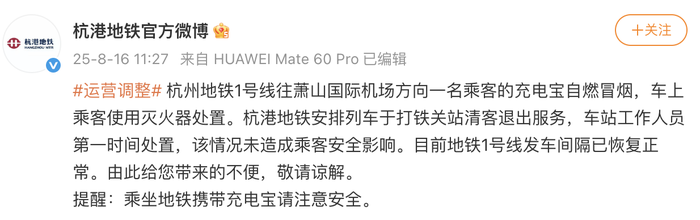
杭州地铁一乘客充电宝突然自燃,车厢传出浓烟!官方通报
Mei Ri Jing Ji Xin Wen· 2025-08-16 11:18
Incident Overview - A passenger's power bank caught fire on the Hangzhou Metro Line 1, causing smoke in the last carriage, but no safety issues were reported for other passengers [1][5] - The incident occurred around 10:30 AM on August 16, with the train being evacuated at Datieguan Station [1] Company Response - Hangzhou Metro officially responded at 11:27 AM, confirming the fire was due to a passenger's power bank and that the situation was handled with a fire extinguisher [4][5] - The train service interval was restored to normal shortly after the incident [4][5] Industry Context - There has been a rise in incidents involving power banks catching fire, prompting the Ministry of Industry and Information Technology to seek public input on revising safety standards for mobile power sources [7] - New mandatory national standards are being developed to enhance safety requirements for mobile power banks, including protections against overcharging, short circuits, and other hazards [7] - The updated regulations are set to take effect on August 15, 2025, and will require compliance from designated certification bodies [8]
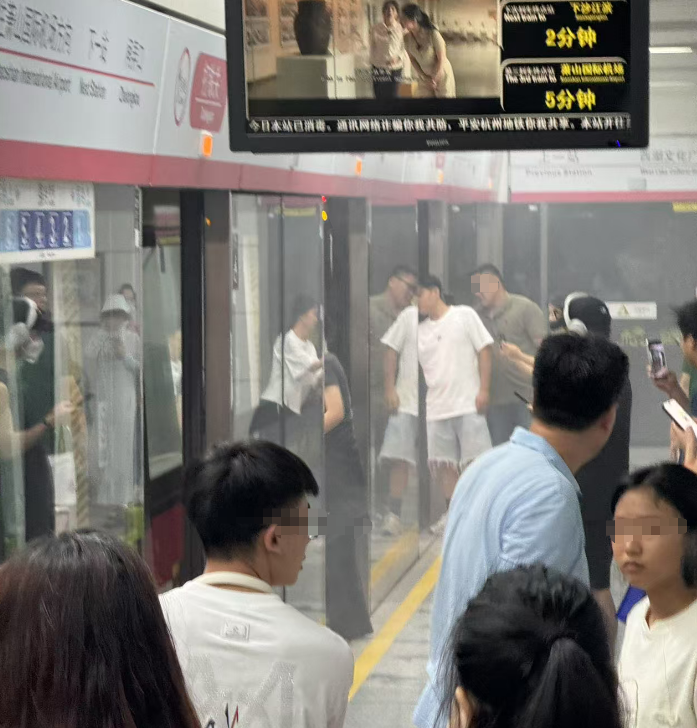
杭州地铁通报1号线一车厢冒烟:有充电宝自燃,未造成乘客安全影响
Yang Shi Wang· 2025-08-16 06:47
Core Viewpoint - A passenger's power bank caught fire on Hangzhou Metro Line 1, but the situation was promptly managed without affecting passenger safety [1] Group 1 - The incident occurred on August 16, when a passenger discovered smoke coming from the last carriage of the train heading towards Xiaoshan International Airport [1] - Passengers used a fire extinguisher to handle the situation, and the train was stopped at Datieguan Station to evacuate passengers [1] - The metro service resumed normal intervals shortly after the incident, and the company apologized for any inconvenience caused [1]