
城市轨道交通

Search documents
广州地铁十三号线二期年内开通4个站 已启动与一期“贯通跑图”试运行
Nan Fang Ri Bao Wang Luo Ban· 2025-08-08 07:41
Core Points - Guangzhou Metro Line 13 Phase II will open the segment from Yuzhu to Tianhe Park this year, with a total length of 8.3 kilometers and 98% of construction completed [1] - The line connects five major administrative districts and will enhance the east-west transportation backbone of the city, alleviating pressure on Line 5 and improving accessibility to the city center [1] - During the trial operation, the peak train interval will be reduced to approximately 6 minutes, significantly improving service frequency [1]
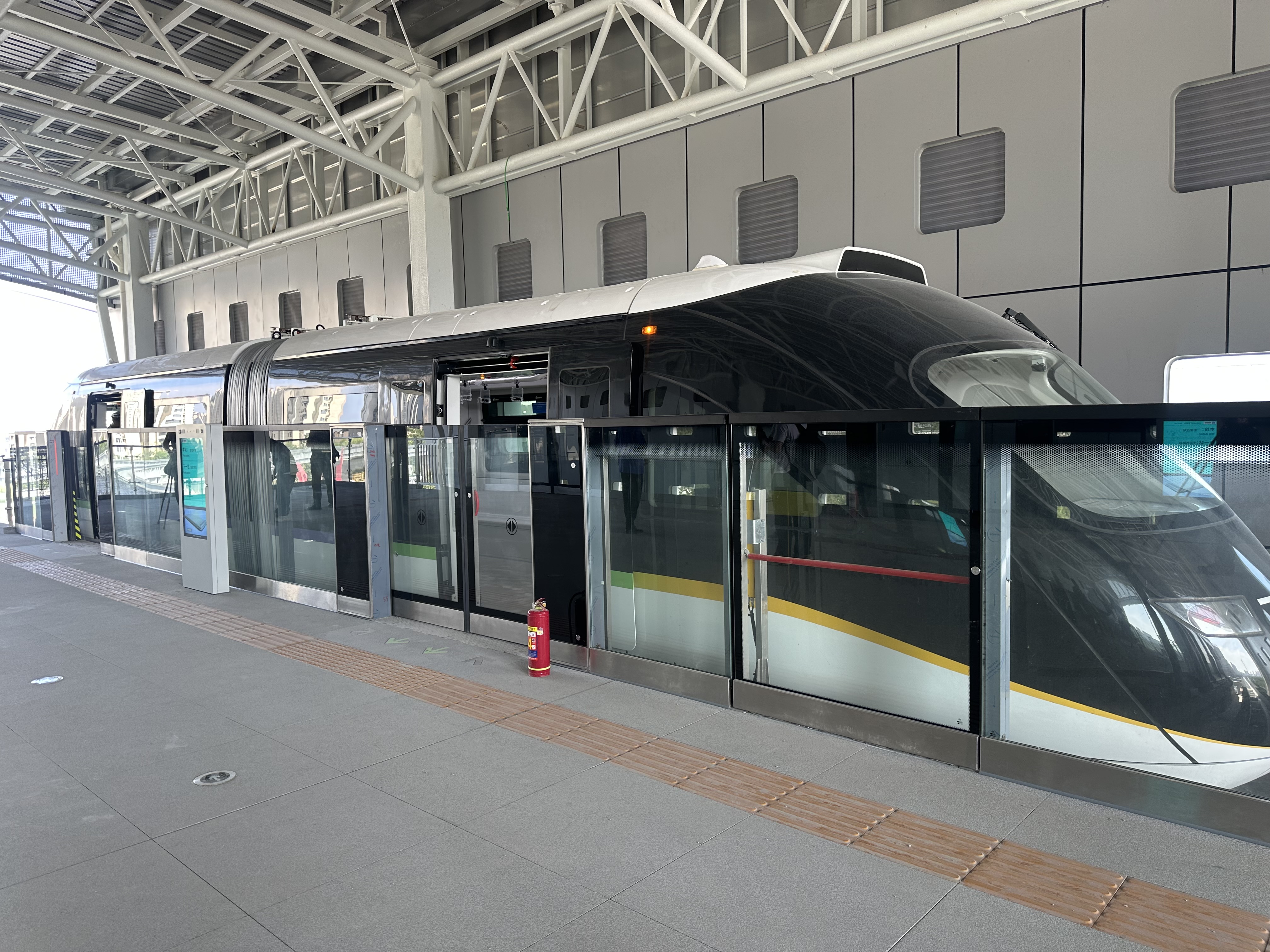
济南高新东区云巴开始试运行 预计将于12月初开通
Qi Lu Wan Bao Wang· 2025-08-07 03:14
Core Viewpoint - The launch of the cloud bus in Jinan's High-tech East District aims to enhance urban transportation, addressing the existing gaps in rail transit and providing a new travel option for citizens [1][2]. Group 1: Project Overview - The cloud bus will undergo a three-month trial run starting August 7, with full operation expected by early December [1]. - The total length of the cloud bus line is 30.55 kilometers, featuring 32 stations, designed to connect key industrial areas and improve transportation efficiency [1]. - The cloud bus operates on an automated driverless system, utilizing a unique U-shaped track beam and lateral guiding rubber wheels, which enhances safety and adaptability to complex terrains [1]. Group 2: Construction and Implementation - The Jinan Rail Transit Group is focused on accelerating the cloud bus project through standardized construction practices and innovative techniques, achieving a record of 11,500 tons of track beam erected in a month [2]. - The construction timeline from the first pile drilling on December 23, 2023, to the completion of civil works by May 19, 2025, is set to be completed in just 17 months [2]. - Environmental considerations were prioritized, with a reduction of approximately 23,000 square meters in construction barriers and minimal disruption to over 600 mature trees [2]. Group 3: Connectivity and Impact - Once operational, the cloud bus will integrate seamlessly with the upcoming metro lines 4 and 8, significantly enhancing regional connectivity [3]. - Initial operations will utilize two-car trains, each capable of carrying about 140 passengers, with a maximum speed of 80 kilometers per hour, addressing congestion issues in public transport [3]. - The project is expected to facilitate better commuting for residents and employees across industrial parks, promoting deeper integration of urban and industrial development in the High-tech East District [3].
壹探轨道|济南高新东区云巴开始试运行 预计将于12月初开通
Qi Lu Wan Bao· 2025-08-07 02:43
Core Viewpoint - The launch of the cloud bus in Jinan's High-tech East District aims to enhance urban transportation, filling the gap in rail transit and providing new travel options for citizens [1][4]. Group 1: Project Overview - The cloud bus project features a total length of 30.55 kilometers with 32 stations, addressing the transportation needs between key industrial areas and parks [4]. - The system is designed for low capacity, with a single-direction capacity of less than 10,000 passengers per hour, making it an optimal solution for the "last mile" connectivity issue [5]. Group 2: Technology and Safety Features - The cloud bus operates on an all-automatic driverless system, utilizing a unique U-shaped track beam and lateral guiding rubber wheels to enhance safety and adaptability to complex terrains [5]. - Energy efficiency is improved through the use of permanent magnet synchronous motors and energy recovery systems, while noise levels are minimized with active noise reduction technology [5]. Group 3: Construction and Implementation - The construction of the cloud bus has been expedited through standardized procedures and innovative techniques, achieving a record of approximately 11,500 tons of track beam erected in a single month [8]. - Environmental considerations were prioritized, with measures taken to minimize the impact on urban ecology, including the preservation of over 600 trees aged 20 years or more [8]. Group 4: Integration with Existing Transport - Once operational, the cloud bus will connect seamlessly with the upcoming metro lines 4 and 8, significantly enhancing regional connectivity [9]. - Initial operations will utilize two-car trains, each capable of carrying approximately 140 passengers, with a maximum speed of 80 kilometers per hour, addressing congestion issues and improving commuting efficiency [9].

北京地铁55年“进化史”:已开通29条线路,第30条将至
Xin Jing Bao· 2025-08-06 13:49
Core Points - By the end of 2024, Beijing will have 29 operational subway lines, totaling 879 kilometers in length and featuring 522 stations, including 98 transfer stations [1] - The first subway line, Line 1, was opened on October 1, 1969, and the network has expanded significantly over the past 55 years [1][2] - The 3rd and 12th subway lines are set to open on December 15, 2024, marking the addition of the 28th and 29th lines to the network [1][30][31] - The 18th line, a result of the expansion of Line 13, is expected to open by the end of this year, bringing the total to 30 lines [1] Summary by Line - **Line 1**: Opened on October 1, 1969, initially not open to the public until January 15, 1971, and officially operational on September 15, 1981 [2] - **Line 2**: Opened on September 20, 1984, as the first circular subway line in China [3] - **Line 13**: Opened its western section on September 28, 2002, and the eastern section on January 28, 2003 [4] - **Line 5**: Fully operational since October 7, 2007, serving as a major north-south transit line [6] - **Line 10**: Opened on July 19, 2008, and is currently the busiest line in the system [7] - **Capital Airport Line**: Opened on July 19, 2008, connecting the city to the international airport [9] - **Line 8**: Opened to the public on October 9, 2008, after initially serving the Olympics [10] - **Line 4**: Opened on September 28, 2009, and is operated by the MTR Corporation [11] - **Daxing Line**: Opened on December 30, 2010, and connects with Line 4 [12] - **Yizhuang Line**: Opened on December 30, 2010, with further extensions in subsequent years [13] - **Fangshan Line**: Opened its first section on December 30, 2010, with additional sections opened in later years [14] - **Changping Line**: Opened on December 30, 2010, and has seen multiple extensions since [15] - **Line 15**: Opened its first section on December 30, 2010, with further expansions in 2011 and 2014 [16] - **Line 9**: Opened its southern section on December 31, 2011, with further extensions in subsequent years [17] - **Line 6**: Opened on December 30, 2012, with additional sections opened in 2014 and 2018 [18] - **Line 14**: Opened its western section on May 5, 2013, with further expansions in the following years [19] - **Line 7**: Opened on December 28, 2014, and has been extended to serve new areas [20] - **Line 16**: Opened its northern section on December 31, 2016, with ongoing expansions planned [21] - **Xijiao Line**: Opened on December 30, 2017, connecting various parks and attractions [22] - **S1 Line**: Opened its first section on December 30, 2017, and completed the remaining section in 2021 [23] - **Yanqing Line**: Opened on December 30, 2017, as the first fully automated subway line in China [24] - **Daxing Airport Line**: Opened on September 26, 2019, serving the new airport [25] - **Yizhuang T1 Line**: Opened on December 31, 2020, with separate ticketing [26] - **Line 17**: Opened its southern section on December 31, 2021, with plans for full connectivity by 2025 [27] - **Line 19**: Opened its first section on December 31, 2021, with additional stations opened in July 2022 [28] - **Line 11**: Opened its western section on December 31, 2021, with further sections planned for December 2023 [29] - **Line 3**: Scheduled to open on December 15, 2024, completing its first phase [30] - **Line 12**: Also set to open on December 15, 2024, primarily running along the North Third Ring Road [31]
锐评|从1到19,这张网跳动着北京发展的脉搏
Bei Jing Ri Bao Ke Hu Duan· 2025-08-06 11:42
Core Insights - The official renaming of the 13A line to the 18 line marks the completion of Beijing's subway network, which now includes lines 1 to 19, enhancing urban connectivity and transportation efficiency [2][3] Group 1: Historical Development - The Beijing subway began construction on July 1, 1965, with the first line opening for trial operation in January 1971, initially serving a daily passenger flow of only tens of thousands [2] - Over the years, the subway network has expanded significantly, with key milestones including the opening of the 2nd line in 2002, the 5th line in 2007, and the operational mileage surpassing 600 kilometers by the end of 2017 [2] - As of now, the total operational mileage exceeds 800 kilometers, with over 400 stations and a daily passenger volume exceeding 11 million, placing it among the world's leading subway systems [2] Group 2: Institutional Support and Planning - The success of the Beijing subway is attributed to strong institutional execution, which is crucial for overcoming the complexities of construction in a megacity [3] - The city has maintained a consistent and forward-looking approach to subway planning and construction, exemplified by the foresight in station designs that facilitate future expansions [3] - The integration of various payment methods, including paper tickets, transit cards, and QR codes, enhances user convenience and accessibility for both residents and tourists [3] Group 3: Economic and Social Impact - A well-developed transportation network is fundamental to the economic and social development of a city, significantly impacting residents' quality of life and the city's image [3] - The Beijing subway has become the preferred commuting method for residents and a popular choice for tourists visiting the city, reflecting its importance in urban mobility [3][4]
申通地铁: 申通地铁关于诉讼执行进展的公告
Zheng Quan Zhi Xing· 2025-08-06 08:14
Core Viewpoint - The company is currently involved in a legal execution process regarding a lawsuit initiated to protect its rights, with a recent court ruling supporting the company's claims [1][2]. Group 1: Legal Proceedings - On March 13, 2024, the company filed a lawsuit with the Shanghai Pudong New District People's Court to safeguard its interests [1]. - The company received a favorable first-instance judgment on December 31, 2024, which supported all of its claims [1]. - The opposing party, Shanghai Shishi Leasing, appealed the first-instance judgment, leading to a second-instance case being accepted by the Shanghai Financial Court [1]. Group 2: Execution Progress - The case is currently in the execution phase, with the company's 27.5% stake in Shanghai Shishi Commercial Factoring Co., Ltd. being transferred to Shanghai Shishi Leasing [2][3]. - The company is entitled to receive a remaining equity repurchase payment of 7,127,397.26 yuan and has already exercised its right to a security transfer amounting to 137.5 million yuan [3]. - The execution results remain uncertain, and the potential impact on the company's current and future profits is not yet determined [2][3]. Group 3: Disclosure and Transparency - As of the announcement date, the company has no other undisclosed litigation or arbitration matters [2].

北京地铁将迎来18号线 计划年底与17号线贯通运营
Bei Jing Shang Bao· 2025-08-06 07:52
Group 1 - The 13A line of the Beijing subway has been officially renamed as Line 18, with the 17th line connecting through Tiantongyuan East Station, which is set to be operational by December 2025 [1] - The expansion project of Line 13 is the first large-scale "new construction + renovation" subway project in China, involving the largest scale of existing line renovation [1] - The construction plan includes splitting the existing "U" shaped line of Line 13 and building an "X" shaped east-west line between Line 16 and Line 17, resulting in two lines totaling 63.6 kilometers and 33 stations [1] Group 2 - The Beijing Subway Operations Company has conducted effective cold and hot sliding tests at the Xiaoxin Zhuang parking lot, validating the equipment compatibility and operational stability for the upcoming line operations [2] - The 13-18 northern section connection line is progressing towards smooth operation, with plans for vehicle debugging and project acceptance [2] - As of July, the construction of the Line 13 expansion project from Malianwa to Tiantongyuan East has reached 80% completion in equipment installation and decoration [2]
18号线来了!北京地铁1至19号线将全面补齐
Yang Shi Xin Wen· 2025-08-06 03:42
Core Points - The Beijing Subway Line 13 expansion project has officially named the 13A line as Line 18 [1] - Line 17 will connect with Line 18 at Tiantongyuan East Station, which is scheduled to open in December 2025 [1] - The completion of the cold and hot sliding tests at the Xiaoxin Zhuang parking lot indicates that Lines 13 and 18 will form an "X" shaped route, enhancing travel convenience for residents in Haidian, Changping, and Chaoyang districts [1] - The integration of Lines 1 to 19 will be fully completed with this development [1]
南京地铁5号线今起全线贯通运营
Xin Hua Ri Bao· 2025-08-05 21:23
Core Points - Nanjing Metro Line 5 North Section officially opens for operation on August 6 at 6 AM, completing the full line operation of Line 5 [1] - The total length of Line 5 is 37.4 kilometers, all of which is underground, with 30 underground stations [1] - Line 5 connects with existing lines at 8 stations, enhancing connectivity within the Nanjing metro network [1] Infrastructure Impact - The opening of Line 5 strengthens the "井字放射" (grid-like) metro network in Nanjing, serving as a major passenger artery alongside Lines 1, 2, 3, and 4 [1] - The line runs in a northwest-southeast direction, linking key areas such as Xinjiekou, Fuzimiao, and Nanjing New City, which is significant for boosting the status of core commercial districts [1] - With the full operation of Line 5, the total number of operational metro lines in Nanjing increases to 13, and the total operational mileage rises from 484 kilometers to 508 kilometers, with the total number of stations increasing from 234 to 255 [1]
5号线西延段完成热滑试验 起自黄贝岭站,终至大剧院站
Shen Zhen Shang Bao· 2025-08-04 16:57
Core Points - The successful completion of the hot sliding test for the west extension of Metro Line 5 marks a significant milestone in the project [1] - The west extension is expected to open within this year, connecting with the existing Line 5 to form a major transportation artery totaling 50.526 kilometers in length [1] - The extension runs along Shennan East Road, starting from Huangbeiling Station and ending at Grand Theatre Station, covering a total length of 2.88 kilometers with three stations: Dongmen Station, Lake Bei Station, and Grand Theatre Station [1] Project Details - The hot sliding test included low-speed, medium-speed, and high-speed assessments, with all indicators meeting design and acceptance standards [1] - The Grand Theatre Station will allow transfers to Lines 1 and 2, enhancing connectivity [1] - The successful hot sliding test indicates that the line has entered the signal and vehicle debugging phase, with comprehensive preparations conducted by Shenzhen Metro and related units [1] Impact on Transportation - The opening of the west extension will significantly improve transportation convenience in the central and southern regions, allowing direct access to commercial areas without needing to transfer to Line 2 [1] - The peak hour conditions at Huangbeiling Station are expected to improve further with the new extension [1]