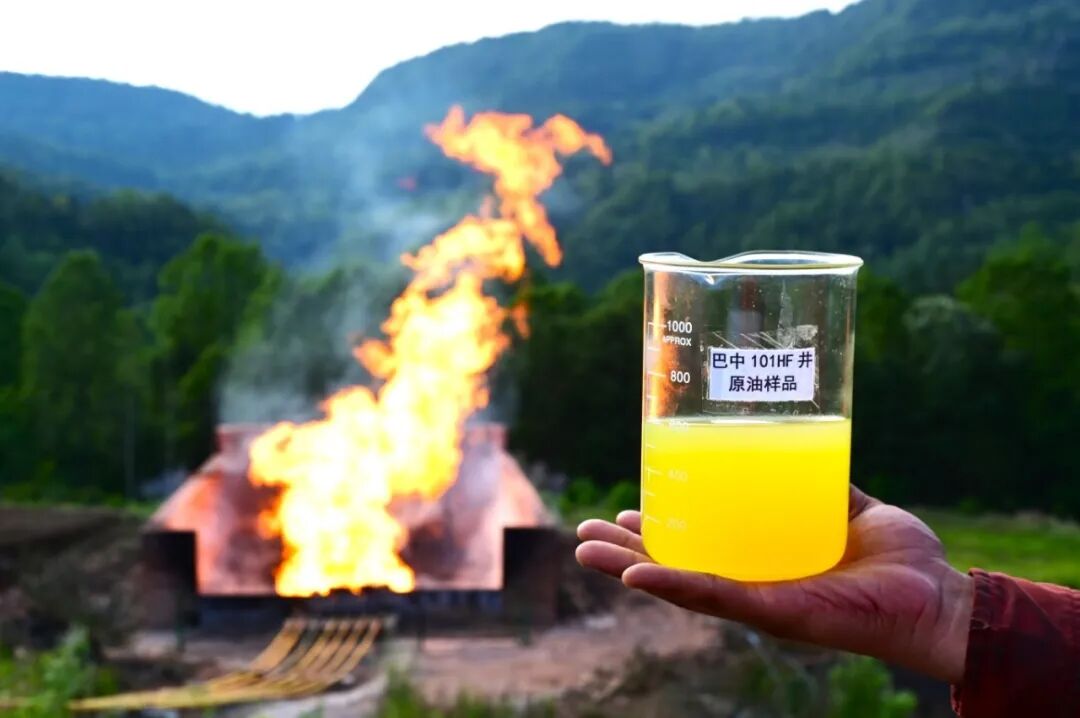
油气开采

Search documents
全国温室气体自愿减排交易市场扩容 纳入油田气领域
Ke Ji Ri Bao· 2025-11-23 10:49
Core Insights - The Ministry of Ecology and Environment has released three new methodologies for voluntary greenhouse gas emission reduction (CCER mechanism), expanding the total to nine methodologies since the mechanism's launch [1][2][3] - The new methodologies focus on the recovery and utilization of associated gas from onshore and offshore oil fields, promoting technological upgrades in the oil and gas industry for greenhouse gas reduction and resource recovery [1][2] Group 1: Onshore Gas Recovery - The "Onshore Gas Field Testing Gas Recovery Methodology" is noted for its unique "Chinese innovation" characteristics, as there is currently no market-based emission reduction incentive mechanism for such projects globally [1] - This methodology encourages the recovery of gas during testing phases for use in liquefied natural gas (LNG) and compressed natural gas (CNG), aiming to enhance recovery technology in the oil and gas sector [1] Group 2: Low-Volume Associated Gas - The "Onshore Oil Field Low-Volume Associated Gas Recovery Methodology" allows projects with associated gas production of less than 30,000 cubic meters per day to apply for CCER [2] - This methodology provides an incentive mechanism for small-scale, decentralized projects that currently lack economic feasibility, such as those in remote areas [2] - An example project in Heilongjiang with a gas source of 15,000 cubic meters per day could see its return on investment increase from 5% to approximately 8.5% with CCER benefits [2] Group 3: Offshore Gas Recovery - The "Offshore Oil Field Associated Gas Recovery Methodology" has identified four projects that collectively recover about 150 million cubic meters of gas per year, producing 32,000 tons of liquefied petroleum gas (LPG) annually [3] - A new project is expected to recover 100 million cubic meters of natural gas annually, resulting in a reduction of approximately 160,000 tons of emissions [3] - Estimated CCER revenue at 80 yuan per ton could generate an additional income of 12.8 million yuan for the project [3]
共同描绘中国式现代化万千气象下的老区图景
Ren Min Ri Bao· 2025-11-22 22:19
Core Viewpoint - The news highlights the efforts of Bazhong City in Sichuan Province to implement systematic reforms in mainstream media, emphasizing the importance of media integration in the digital age and the city's commitment to strengthening its ideological front and promoting its unique cultural and industrial characteristics [1][2]. Group 1: Media and Cultural Development - Bazhong City is actively implementing important reforms in mainstream media to adapt to the trends of the digital age, aiming to consolidate its ideological position and enhance the overall narrative [1]. - The city has a rich historical background, being a significant site for the Red Army during the revolutionary period, which continues to influence its cultural identity [1]. Group 2: Educational and Scientific Advancements - Bazhong has a strong emphasis on education and has produced numerous talents, including notable figures like Wu Weiren, the chief designer of the lunar exploration program [2]. - The city has established a national-level science popularization and innovation application industrial base, featuring advanced facilities such as the largest 16K immersive ultra-high-definition dome cinema in the country [2]. Group 3: Energy Resources and Industrial Strategy - Bazhong is rich in energy resources, with oil and gas mineral rights covering 82.5% of the city's area, and shale gas reserves amounting to 1.4 trillion cubic meters, alongside approximately 2.5 billion tons of shale oil resources [2]. - The city is focusing on developing characteristic advantageous industries and strategic emerging industries, implementing a development strategy centered on "ecological industrialization" and "advanced manufacturing" to build a modern industrial system unique to Bazhong [2].
洲际油气:累计回购5000万股
Mei Ri Jing Ji Xin Wen· 2025-11-21 12:02
Group 1 - The company, Intercontinental Oil and Gas, announced the completion of a share buyback on November 20, 2025, having repurchased 50 million shares, which accounts for 1.21% of its total share capital [1] - The highest buyback price was 2.78 CNY per share, the lowest was 2.32 CNY per share, and the average buyback price was 2.42 CNY per share, with a total expenditure of approximately 121 million CNY [1] - As of the report, the company's market capitalization stands at 10.7 billion CNY [1] Group 2 - For the fiscal year 2024, the company's revenue composition is heavily weighted towards oil and gas, which constitutes 99.89% of total revenue, while leasing and services account for only 0.11% [1]

洲际油气:首次回购1.21%公司股份,已使用资金总额为人民币1.21亿元
Xin Lang Cai Jing· 2025-11-21 11:33
Core Viewpoint - The company has announced its first share buyback, acquiring 1.21% of its total shares, with a total expenditure of RMB 121 million [1] Group 1 - The company has initiated a share repurchase program, indicating confidence in its own stock value [1] - The total amount spent on the buyback is RMB 121 million, reflecting a significant investment in its own shares [1] - The percentage of shares repurchased stands at 1.21%, which may influence market perception and investor sentiment [1]
加州州长:特朗普推出白痴计划
中国能源报· 2025-11-21 09:22
Core Viewpoint - The Trump administration announced a new offshore oil and gas development plan, significantly expanding the U.S. offshore oil and gas exploration area, which has faced strong opposition from local governments and environmental organizations [1][2]. Group 1: New Offshore Oil and Gas Development Plan - The new plan involves leasing several areas off the coasts of Alaska, California, and Florida, with plans to auction six offshore oil and gas development areas in California between 2027 and 2030 [4]. - The plan opens the door for oil and gas extraction in the eastern Gulf of Mexico, a region previously protected due to military training and weapon testing [5]. - According to the U.S. Energy Information Administration, oil extracted from federal waters accounts for 14% of the total U.S. oil production, while natural gas accounts for 2%, with most production coming from the Gulf of Mexico [5]. Group 2: Opposition to the Plan - The plan has faced strong opposition from state governments, bipartisan lawmakers, and environmental organizations, with California Governor Gavin Newsom criticizing it as harmful to coastal economies and communities [6][8]. - California has strict regulations on offshore oil and gas extraction, largely due to past environmental disasters, such as the 1969 oil spill near Santa Barbara [8]. - Florida's government and lawmakers have also expressed their opposition, emphasizing that the state's coastline should not be used for oil drilling [8][9].


特朗普政府宣布油气开发新动作 多州强烈反对
Xin Hua She· 2025-11-21 08:12
Core Viewpoint - The Trump administration announced a new offshore oil and gas development plan, significantly expanding the U.S. offshore oil and gas exploration area, which has faced strong opposition from local governments and environmental organizations [1][2]. Group 1: Policy Changes - The new oil and gas leasing plan aims to maintain U.S. energy dominance for decades to come, as stated by U.S. Interior Secretary Doug Burgum [2]. - The plan involves auctioning six offshore oil and gas development areas off the coast of California between 2027 and 2030, marking the first such auctions since the 1980s [2][3]. - The plan opens the eastern Gulf of Mexico for oil and gas exploration, an area previously protected due to military training and weapon testing [2]. Group 2: Opposition and Concerns - The plan has faced strong opposition from state governments, bipartisan lawmakers, and environmental organizations, with California Governor Gavin Newsom criticizing it as harmful to coastal economies and health [4]. - California has strict regulations on offshore oil and gas exploration, largely due to historical oil spills, such as the 1969 Santa Barbara oil spill [4]. - Environmental groups have raised concerns about the ecological risks posed to endangered species in the Santa Barbara Channel due to the new leasing plan [4].
油气开采板块11月20日跌0.88%,蓝焰控股领跌,主力资金净流出6940.67万元
Zheng Xing Xing Ye Ri Bao· 2025-11-20 09:16
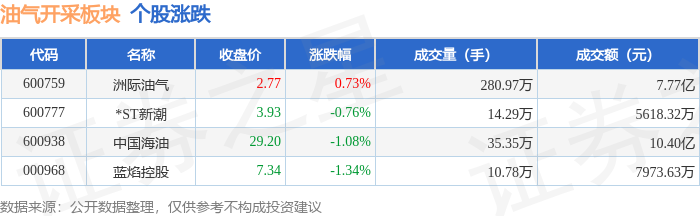
Core Points - The oil and gas extraction sector experienced a decline of 0.88% on November 20, with Blue Flame Holdings leading the drop [1] - The Shanghai Composite Index closed at 3931.05, down 0.4%, while the Shenzhen Component Index closed at 12980.82, down 0.76% [1] Sector Performance - The closing prices and performance of key stocks in the oil and gas extraction sector are as follows: - Intercontinental Oil & Gas (600759) closed at 2.77, up 0.73% with a trading volume of 2.8097 million shares [1] - ST Xinchao (600777) closed at 3.93, down 0.76% with a trading volume of 142,900 shares [1] - China National Offshore Oil Corporation (600938) closed at 29.20, down 1.08% with a trading volume of 353,500 shares [1] - Blue Flame Holdings (000968) closed at 7.34, down 1.34% with a trading volume of 107,800 shares [1] Capital Flow - The oil and gas extraction sector saw a net outflow of 69.4067 million yuan from institutional investors, while retail investors contributed a net inflow of 15.6092 million yuan [1] - The detailed capital flow for key stocks is as follows: - Blue Flame Holdings (000968) had a net outflow of 5.0863 million yuan from institutional investors, with a net inflow of 2.8235 million yuan from retail investors [2] - ST Xinchao (600777) experienced a net outflow of 8.9827 million yuan from institutional investors, with a net inflow of 7.0945 million yuan from retail investors [2] - Intercontinental Oil & Gas (600759) had a net outflow of 18.6567 million yuan from institutional investors, with a net inflow of 18.2155 million yuan from retail investors [2] - China National Offshore Oil Corporation (600938) saw a net outflow of 36.6811 million yuan from institutional investors, with a net outflow of 12.5243 million yuan from retail investors [2]



东海局首次开展海域油气矿业权实地核查
Zhong Guo Zi Ran Zi Yuan Bao· 2025-11-20 08:51
Core Viewpoint - The Ministry of Natural Resources has initiated an independent on-site verification of oil and gas mining rights in offshore areas, emphasizing the importance of legal compliance in exploration and extraction activities for national security and ecological protection [1] Group 1: Regulatory Framework - The verification process is based on laws such as the Mineral Resources Law of the People's Republic of China and the Management Measures for the Public Disclosure of Exploration and Mining Information by Mining Right Holders [1] - The East China Sea Bureau is responsible for ensuring the proper management and supervision of marine natural resources [1] Group 2: Importance of Offshore Oil and Gas Resources - Offshore oil and gas resources are a crucial component of China's energy reserves, directly impacting national strategic security and the overall development of the industry [1] Group 3: Verification Process - The East China Sea Bureau employs strict behavioral norms and procedures, utilizing methods such as on-site inspections, report reviews, document comparisons, inquiries, and verification to identify and mitigate risks [1] - The verification will be conducted with a minimum of 5% of the offshore oil and gas mining rights in the jurisdiction being inspected, adhering to the "double random, one public" principle [1]
“地智先锋”,燃动科技攻关一线的红色引擎
Zhong Guo Zi Ran Zi Yuan Bao· 2025-11-20 02:23
Core Viewpoint - Jiangsu Provincial Geological Survey Institute emphasizes the integration of party leadership with geological technology development, focusing on national strategic needs and industry advancements to drive innovation and digital transformation in geological science [1][11]. Group 1: Political and Technological Integration - The institute addresses key technological challenges in digital platform construction, such as data integration of commercial software and low efficiency of AI models, by forming task forces led by party members to develop AI replacement models [3][12]. - Collaborative mechanisms are strengthened through a "Party Building + Collaboration" model, leading to the creation of a three-dimensional database for underground space resources in Taixing City, in partnership with local natural resource departments and research institutions [3][12]. - The institute promotes deep integration of industry, academia, and research by collaborating with universities on national deep-earth technology projects and establishing strategic partnerships with local governments [3][12]. Group 2: Responsibility and Innovation Mechanisms - A comprehensive mechanism is established that integrates party leadership into the entire process of technology planning, project initiation, resource allocation, and result transformation, ensuring that innovation outcomes serve industrial development [5][13]. - The institute optimizes its innovation system by implementing a structured approach to talent development, funding, and technology transfer, ensuring that innovative practices are effectively rooted in scientific work [5][13]. - The cultivation of research talent is emphasized through activities that instill a sense of mission and responsibility, aligning with the broader goals of national development [5][13]. Group 3: Accelerating Technology Application - The institute accelerates the transformation of technological achievements into productive forces by organizing party members to engage directly with industry needs, particularly in green and low-carbon technologies [6][13]. - Focus areas include the innovation and application of geothermal exploration technologies in the Yangtze River Delta, contributing to the establishment of efficient utilization models for regional geothermal resources [6][13]. - Research on carbon dioxide geological storage potential and key technologies for deep geological storage is being conducted, showcasing the institute's commitment to integrating scientific innovation with industrial application [6][13]. Group 4: Digital Transformation Initiatives - The institute identifies digital transformation as a critical breakthrough, leading initiatives to enhance geological work through digital upgrades and smart technology applications [8][7]. - A detailed plan for the digital transformation of geological work is developed, with responsibilities assigned to various departments to ensure effective implementation [8][7]. - The institute leverages advanced technologies such as digital twins and big data to create a digital foundation for urban geology, enhancing applications in urban planning and geological assessments [8][7]. Group 5: Future Outlook - Looking ahead, the institute aims to continuously enrich the integration of party leadership with technological innovation, accelerating digital transformation and the conversion of scientific achievements into sustainable development contributions [9].
深地经济:万亿新赛道的巴中实践
Xin Lang Cai Jing· 2025-11-20 02:22
Core Concept - The concept of "deep earth economy" has gained significant attention in the capital market as of October 2025, indicating a strategic shift towards resource extraction from deep within the Earth, impacting various sectors such as oil and gas, mining, and infrastructure [1] Group 1: Market Response and Strategic Initiatives - The capital market has reacted positively to the emergence of the deep earth economy, with multiple sectors showing strength, suggesting a multi-trillion yuan new growth avenue [1] - The Ministry of Natural Resources has outlined plans for the 14th Five-Year Plan, emphasizing the need for standardization in emerging industries such as deep-sea and deep-earth exploration [1][2] - A special fund has been established at the central level to guide social capital and accelerate the formulation of national standards in deep earth drilling and equipment manufacturing [1] Group 2: Resource Potential and Development Opportunities - China possesses significant deep and ultra-deep oil and gas resources, totaling 671 million tons of oil equivalent, which accounts for approximately 34% of the nation's total oil and gas resources [2] - The Sichuan Basin, particularly the city of Bazhong, is identified as a key area for deep oil and gas exploration, benefiting from favorable geological conditions and substantial resource reserves [3][5] - Bazhong's natural gas geological reserves are estimated at 1.4 trillion cubic meters, with shale oil resources around 25 million tons, indicating high economic value and development potential [5] Group 3: Investment and Development Metrics - From January to October this year, Bazhong completed investments of 1.692 billion yuan, a year-on-year increase of 63.5%, with a notable rise in the number of oil and gas wells [7] - The city has seen a significant increase in natural gas production, reaching 360 million cubic meters, a 71.4% year-on-year growth, and oil production of 14,000 tons, a 600% increase [7] Group 4: Industrial Layout and Future Plans - Bazhong aims to establish a "billion-level energy and chemical industry cluster," focusing on natural gas and oil chemical projects, with a total investment of approximately 13.15 billion yuan [11] - The city is targeting advanced materials and clean energy sectors, with investments planned for high-end products such as electronic-grade epoxy resin and carbon nanotubes [11] - The strategic deployment in Bazhong aligns with the anticipated growth of the deep earth economy, which is projected to exceed 5 trillion yuan during the 14th Five-Year Plan period [9] Group 5: Collaborative Efforts and Governance - The 2025 Bazhong Oil and Gas Development Conference highlighted the collaboration between state-owned enterprises and local government, forming a comprehensive support system for resource exploration and development [12][15] - A series of agreements were signed during the conference, showcasing the government's commitment to rapid project initiation and efficient service delivery [13][15] - Bazhong is positioning itself as a replicable model for the deep earth economy, integrating government organization, enterprise collaboration, and research support to achieve resource exploration breakthroughs [16]